Advertisement
)

The push to electrify the global economy faces a brutal, multi-trillion-dollar roadblock: the subterranean natural gas grid. For a century, we have buried millions of miles of high-pressure steel beneath our cities to deliver methane. Abandoning this infrastructure to build a purely electric future from scratch is financially impossible, and the timeline required would guarantee catastrophic climate failure. We are chained to our existing pipes, but we can no longer afford the carbon they deliver.
Why should you care right now? Because utility executives and energy traders are executing a massive, invisible infrastructure hack to buy the world time. Instead of replacing the pipes, they are altering the molecular chemistry of the fuel inside them. By quietly injecting pure, zero-carbon hydrogen directly into the flowing natural gas supply, the industry has created Hydrogen-Enriched Natural Gas (HENG). This allows power companies to instantly slash millions of tons of carbon emissions across entire continents without a single homeowner having to buy a new stove or upgrade a furnace. HENG is the ultimate transitional lifeline, rewriting the economics of global decarbonization by recycling the fossil fuel grid.
What is Hydrogen-Enriched Natural Gas (HENG)?
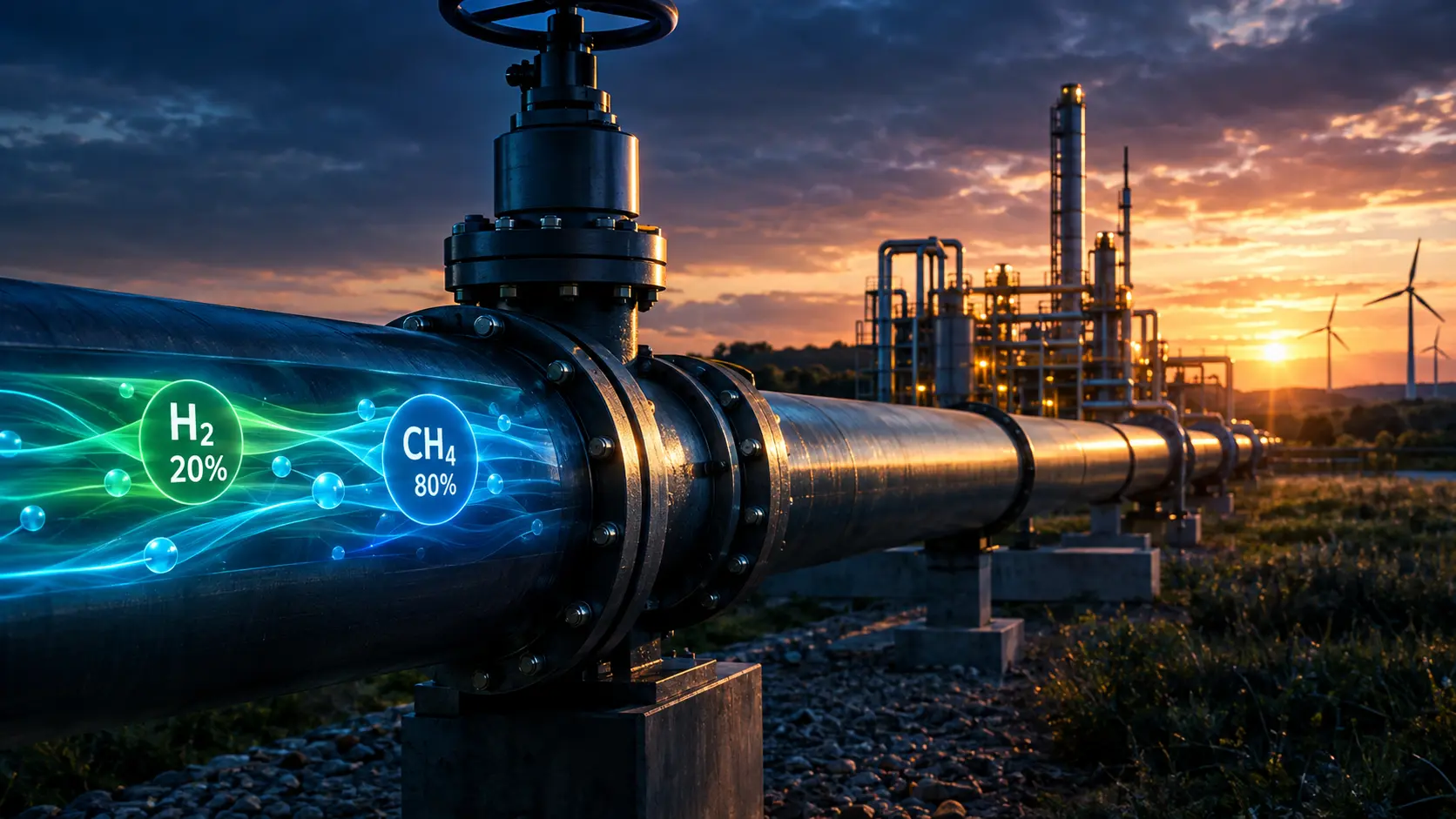
Hydrogen-Enriched Natural Gas (HENG) is a transitional climate fuel created by injecting pure hydrogen directly into existing methane pipelines. By maintaining hydrogen concentrations below 20% by volume, utilities can seamlessly deliver a lower-carbon energy source that burns safely in unmodified residential stoves, boilers, and industrial furnaces.
At a Glance
- Concept: Watering down fossil fuels with clean hydrogen inside the pipes we already have.
- Why it matters: It prevents trillions of dollars of existing gas pipelines from becoming instantly obsolete, buying the world time to transition to pure green energy.
- Who uses it: Major gas utility operators (e.g., Snam in Italy, National Grid in the UK, SoCalGas in the US) and industrial commodity traders.
- Biggest takeaway: Mixing 20% hydrogen into the pipe does not cut carbon emissions by 20%. Because hydrogen carries less energy by volume than methane, a 20% blend only reduces emissions by roughly 7%.
In Simple Words
Imagine you drink a large cup of dark roast coffee every morning. Your doctor tells you to cut back on caffeine immediately, but you refuse to buy a smaller mug or change your morning routine.
To solve this, you start filling your mug with 80% regular dark roast and 20% decaf. You are still drinking the exact same large mug of coffee, it tastes practically identical, and you didn’t have to change your routine at all—but you successfully lowered your caffeine intake.
HENG is the decaf. Utility companies want to lower the carbon (caffeine) going into your home, but they know you don’t want to rip out your gas stove or buy a new boiler. So, they inject 20% clean hydrogen into the natural gas supply before it ever reaches your house. The gas still burns perfectly in your stove, but it releases less carbon into the atmosphere.
Why This Matters
For Energy Policy Makers, Commodity Traders, and Utility Execs, HENG solves the Infrastructure Sunk-Cost Dilemma.
The push for “electrify everything” terrifies gas utility companies. If every home switches to electric heat pumps and induction stoves, the natural gas grid goes bankrupt. Millions of miles of transmission pipelines become worthless, buried liabilities.
HENG offers the natural gas industry a vital lifeline. By proving that legacy gas pipelines can be used to deliver clean hydrogen, utilities immediately re-value their infrastructure. They transition from being “fossil fuel distributors” to “clean molecule distributors.” For investors and policymakers, this is a massive win: it preserves existing capital investments, prevents the mass bankruptcy of utility providers, and initiates immediate, megaton-scale decarbonization without waiting for a 20-year electrical grid overhaul.
Micro-Insight: The transition to Net Zero is not just about inventing new green technology; it is about finding profitable ways to recycle the dirty infrastructure we already built.
Molecular Blending as Energy Policy
We are witnessing the era of Molecular Blending as Policy.
For the last decade, the clean energy transition was characterized by binary choices: wind vs. coal, electric vs. gas. HENG introduces the era of the continuum. By treating the gas grid as a massive mixing bowl, we are decarbonizing the demand side of the economy invisibly. Consumers turn on their stoves and unknowingly participate in a global climate initiative, proving that the most effective green policies are the ones that require zero behavioral change from the end user.
How Hydrogen-Enriched Natural Gas (HENG) Bypasses Embrittlement
Pumping the lightest, smallest molecule in the universe into a century-old steel pipe network requires a flawless grasp of metallurgy and thermodynamics. Here is the first-principles breakdown of the architecture.
1. The Fundamental Problem: Methane Combustion
Standard natural gas is almost entirely methane (CH₄). When you burn it, the carbon atom bonds with oxygen to create carbon dioxide (CO₂). If you want to use the pipeline but stop the CO₂, you need a gas that burns but has no carbon. Pure hydrogen (H₂,) is the perfect candidate—when it burns, it only produces water vapor (H₂O). But pumping 100% pure hydrogen into legacy grids instantly destroys them.
2. The Core Mechanism: The 20% Threshold
To use hydrogen safely, engineers construct massive “Power-to-Gas” injection stations along main pipeline routes. Electrolyzers split water into hydrogen using excess solar or wind power, and high-pressure valves inject this green hydrogen directly into the flowing methane stream. Extensive testing has proven that if the hydrogen concentration is kept at or below 20% by volume, the blended gas acts almost exactly like standard methane.
3. Technical Depth: Hydrogen Embrittlement
Why stop at 20%? Because of Hydrogen Embrittlement. Hydrogen molecules are incredibly small. Under high pressure, they diffuse straight into the microscopic crystal lattice of high-strength steel transmission pipelines. Once inside the steel, the hydrogen atoms disrupt the metal’s bonds, making the steel brittle. If a micro-fracture forms, the brittle steel shatters instead of bending, causing a catastrophic explosion. Keeping the blend at 20% ensures the partial pressure of the hydrogen remains too low to effectively penetrate and damage the steel structure.
Plain-English Takeaway: Hydrogen is so tiny it actually wiggles inside solid steel and weakens it from the inside out. Keeping the hydrogen blend low prevents the metal from cracking under pressure.
4. Technical Depth: Lower Heating Value (LHV)
While 20% hydrogen is safe for the pipes, it changes the thermodynamics of the fuel. Methane is incredibly energy-dense. Hydrogen has a massive energy density by weight, but a terrible energy density by volume (its Lower Heating Value). One cubic foot of hydrogen contains roughly one-third the thermal energy of one cubic foot of methane.
5. Real-World Consequences: The 7% Carbon Ceiling
If you replace 20% of the methane with hydrogen, the total energy inside the pipe drops. To ensure a homeowner’s stove still boils water at the same speed, the utility company must increase the total volume and flow rate of the gas to compensate for the “weaker” fuel. Because you have to pump more total gas to get the same heat, a 20% hydrogen blend only results in roughly a 7% actual reduction in CO₂ emissions.
HENG Pipeline Infrastructure Simulator
Thermodynamic Lower Heating Value (LHV) Penalty vs. Sub-Surface Hydrogen Embrittlement
Hydrogen Blend Ratio
20% H₂ (HENG Baseline)
Pipeline Metallurgy Architecture
Legacy API 5L Steel
Polymer-Lined Composite
Actual CO₂ Emissions Cut
-7.0%
Volumetric Energy (LHV)
30.8 MJ/m³
Steel Embrittlement Risk
12.4% (Nominal)
Pipeline Core Cross-Section & Grain Boundary Diffusion
SAFE BLENDING RANGE
Thermodynamic Decarbonization vs. Structural Stress Trajectory
Commercial Deployment of Hydrogen Pipeline Blending
HENG is actively transitioning from isolated pilot studies to commercial, grid-scale deployment, fueling a market projected to reach $45.84 billion by 2034.
The UK HyDeploy Initiative: One of the most critical real-world validations of HENG occurred at Keele University in the UK. The HyDeploy project successfully injected a 20% hydrogen blend into a live, operational gas network servicing hundreds of homes and commercial buildings. The results proved definitively that standard, off-the-shelf residential boilers and stovetops operated safely and efficiently on the blend without requiring any technical adjustments, clearing the path for national grid blending.
Heavy Industrial Heating Arbitrage: Cement, glass, and steel manufacturing require intense, high-grade heat that electrical heaters struggle to provide efficiently. These facilities are heavily reliant on natural gas. By switching the feed-stock of industrial clusters to HENG, manufacturers can instantly shave 7% off their Scope 1 carbon emissions. Under strict European carbon-tax mechanisms (like the ETS) where carbon trades at nearly €90 per tonne, this minor reduction translates to millions of dollars in instant regulatory savings.
Monetizing Curtailed Renewable Energy: In areas with massive solar and wind build-outs, the grid often produces more electricity than it can use during the day. Instead of turning the wind turbines off (curtailment), energy companies use the excess electricity to run electrolyzers, creating green hydrogen. Because pure hydrogen is difficult to store, they immediately inject it into the local natural gas pipeline. The pipeline acts as a massive, limitless battery, absorbing the excess renewable energy and delivering it as HENG.
Solving the Green Hydrogen Demand Sink
The core strategic consequence of HENG is the Creation of the Hydrogen Demand Sink.
The global hydrogen economy suffers from a classic “chicken-and-egg” problem. Nobody wants to build a $500 million green hydrogen production plant because there aren’t enough hydrogen-powered factories or trucks to buy the fuel. Conversely, nobody wants to build hydrogen trucks because there is no fuel available.
HENG solves this. The natural gas grid is an infinite “demand sink.” If a company builds a massive green hydrogen plant today, they do not need to wait for hydrogen trucks to be built. They can simply inject 100% of their product directly into the local gas pipeline at a 20% blend rate and get paid immediately. HENG guarantees a steady, insatiable buyer for green hydrogen, providing the financial certainty required for banks to fund the first wave of global hydrogen infrastructure.
Advantages
- Zero Consumer CapEx:Reduces carbon emissions instantly without forcing homeowners to buy expensive new induction stoves or electric heat pumps.
- Utilizes Sunk Costs: Preserves the multi-trillion-dollar value of the existing global underground pipeline network.
- Infinite Energy Storage: Solves the renewable energy curtailment problem by using the massive volume of the gas grid to absorb and store excess solar and wind power as green hydrogen.
- Regulatory Compliance: Allows utilities and heavy industry to hit aggressive 2030 mid-term ESG targets with minimal infrastructural disruption.
Limitations
- The 7% Carbon Ceiling: Because of hydrogen’s terrible volumetric energy density, a 20% blend only cuts carbon emissions by roughly 7%. HENG is a stall tactic; it cannot achieve the 100% reduction required for Net Zero 2050.
- Compressor Station Leaks: While the steel pipes can handle 20% hydrogen, the compressor stations that pump the gas cannot. Hydrogen is so small it easily escapes through the centrifugal seals and valves of legacy compressors, requiring expensive, high-speed retrofits.
- Green Hydrogen Shortage: Blending hydrogen only reduces emissions if the hydrogen is “green” (made from renewable energy). Currently, 95% of global hydrogen is “grey” (made from fossil fuels). Pumping grey hydrogen into a pipeline actually increases total carbon emissions.
Takeaway: HENG is a brilliantly pragmatic band-aid, not a cure. It buys the energy grid a crucial decade of time, but it fundamentally maxes out at a 7% emission reduction due to the uncompromising laws of metallurgy and thermodynamics.
Common Misconceptions
Misconception: 20% Hydrogen means a 20% reduction in carbon.
Reality: This is the most common mathematical error in the industry. Because hydrogen is so “fluffy” (low volumetric energy density), you have to burn a lot more of the blended gas to boil a pot of water. A 20% volume blend only yields roughly a 7% reduction in carbon emissions.
Misconception: HENG will cause appliances to explode.
Reality: Decades of testing show that standard burners easily handle up to a 20% blend. In fact, before the discovery of vast natural gas reserves, cities used “Town Gas” (manufactured from coal), which naturally contained up to 50% hydrogen.
Misconception: We can just upgrade the pipes to handle 100% hydrogen later.
Reality: Legacy high-pressure steel transmission pipes can never handle 100% hydrogen due to severe embrittlement. To move to 100% hydrogen, the grid must be entirely rebuilt using specialized polymer (plastic) piping or heavily coated steel.
What Most People Miss
The disruptive capability of Smart De-Blending Technology.
When you mix hydrogen into a natural gas pipeline, the two gases become hopelessly intertwined. For a homeowner cooking an egg, this mixed HENG gas is fine. But what if a high-tech fuel cell factory at the end of the pipeline needs pure hydrogen?
The bleeding edge of this industry is “de-blending.” Companies are developing specialized membranes (using palladium or advanced polymers) that sit at the exit valve of a pipeline. These membranes act like microscopic sieves, physically filtering the hydrogen back out of the methane. This allows utilities to use the legacy gas grid as a cheap highway to transport pure hydrogen across the country, filtering it out perfectly just before delivering it to a specialized industrial customer.
Comparison Table
| Metric | 100% Natural Gas (Methane) | HENG (20% Hydrogen Blend) | 100% Green Hydrogen |
| Carbon Emissions | Baseline (100%) | Reduced (~93%) | Zero (0%) |
| Pipeline Compatibility | Perfect | Safe (No pipe changes needed) | Fatal (Requires entirely new pipes) |
| Appliance Compatibility | Perfect | Perfect (No changes needed) | Fatal (Requires entirely new stoves) |
| Volumetric Energy | High (~36 MJ/m³) | Lower ($~31 MJ/m^3$) | Very Low ($~11 MJ/m^3$) |
| Embrittlement Risk | Zero | Low / Acceptable | Catastrophic in steel |
Future Outlook
Next 12–24 Months
The era of Regulatory Standardization. Through 2027, the focus is purely legislative. Energy commissions across Europe and North America will officially legally codify the 20% hydrogen blend limit as the new standard safety baseline. This regulatory certainty will trigger a flood of institutional capital into the $14 billion market, allowing utilities to confidently sign 10-year offtake agreements with green hydrogen producers to feed their pipelines.
Next 3–5 Years
The scaling of Compressor Station Overhauls. By 2030, the limiting factor will no longer be the pipes, but the pumps. A massive, multi-billion-dollar CapEx cycle will initiate across the industrial sector to retrofit thousands of centrifugal gas compressors. They will be upgraded with advanced dry gas seals and specialized polymer O-rings designed specifically to prevent the tiny hydrogen molecules from leaking out of the 20% HENG streams.
Next 10 Years
The Hydrogen Backbone and De-Blending. By the mid-2030s, the grid will officially bifurcate. HENG will remain the standard for residential heating, permanently capping its decarbonization at 7%. Simultaneously, governments will finalize the construction of dedicated “Hydrogen Backbones”—entirely new, 100% pure hydrogen pipelines built specifically for heavy industry and shipping. Where these two grids cross, advanced de-blending membranes will dynamically swap molecules between the pipelines, creating a highly fluid, dual-gas continental energy market.
Most Likely Scenario
Hydrogen-Enriched Natural Gas is a thermodynamic compromise forced by the sheer economic weight of legacy infrastructure. It is mathematically incapable of solving the climate crisis on its own. However, as a transitional tool, it is unparalleled. By instantly transforming the existing natural gas grid into a profitable demand sink for the nascent green hydrogen industry, HENG provides the vital financial bridge required to launch the global hydrogen economy while preserving grid reliability for everyday consumers.
Key Takeaways
- Replacing the millions of miles of underground natural gas pipelines to achieve Net Zero is financially impossible. HENG saves this infrastructure by injecting up to 20% clean hydrogen into the existing gas flow.
- Because the blend is kept at or below 20%, the gas burns perfectly in standard home stoves and boilers, requiring zero disruption or upgrades for the consumer.
- Hydrogen has a very low volumetric energy density. Therefore, replacing 20% of the gas volume with hydrogen only reduces total carbon emissions by roughly 7%.
- Blending above 20% is dangerous in legacy infrastructure due to Hydrogen Embrittlement—where tiny hydrogen molecules seep into high-strength steel and cause it to crack.
- HENG’s greatest strategic value is creating an instant, limitless buyer for newly produced green hydrogen, providing the financial security needed to build large-scale hydrogen production plants.
Glossary
CapEx (Capital Expenditure): The money a company spends to buy, maintain, or improve its fixed assets, such as upgrading pipeline compressor stations to handle hydrogen.
Green Hydrogen: Hydrogen gas produced by using renewable electricity (solar or wind) to power an electrolyzer, which splits water (H₂O) into hydrogen and oxygen. It has zero carbon footprint.
Hydrogen Embrittlement: A metallurgical phenomenon where tiny hydrogen molecules diffuse into the crystal structure of steel, making the metal brittle and prone to catastrophic cracking under pressure.
Lower Heating Value (LHV): A measure of how much thermal energy is contained in a specific volume of gas. Hydrogen has a high energy density by weight, but a very low LHV by volume compared to methane.
Methane (CH₄): The primary chemical component of traditional natural gas. It is highly energy-dense but releases carbon dioxide (CO₂) when burned.
Power-to-Gas: The process of taking excess electrical power from the grid (like a spike in wind energy) and using it to create a gas (like hydrogen) that can be stored in pipelines.
Scope 1 Emissions: Direct greenhouse gas emissions that occur from sources that are controlled or owned by an organization (e.g., emissions from burning natural gas in a factory furnace).
Sources
Fortune Business Insights: Hydrogen Blending in Natural Gas Market Size & Growth [2034]
Global Market Insights: Hydrogen Pipeline Materials Market Size, Report 2026-2035
US Department of Energy (OSTI): Hydrogen Blending into Natural Gas Pipeline Infrastructure
UL Solutions: Hydrogen use in natural gas pipeline White Paper
Exponent: Can Your Natural Gas Pipelines Handle Hydrogen Blends?