Advertisement
)

What is Group Relative Policy Optimization (GRPO)?
Group Relative Policy Optimization (GRPO) is a reinforcement learning algorithm that eliminates the memory-heavy “critic” model traditionally required in AI training. By having the AI generate multiple responses and mathematically grading them against each other on a curve, the GRPO algorithm cuts GPU memory requirements by 50% while drastically improving logical reasoning capabilities.
The Post-PPO AI Era
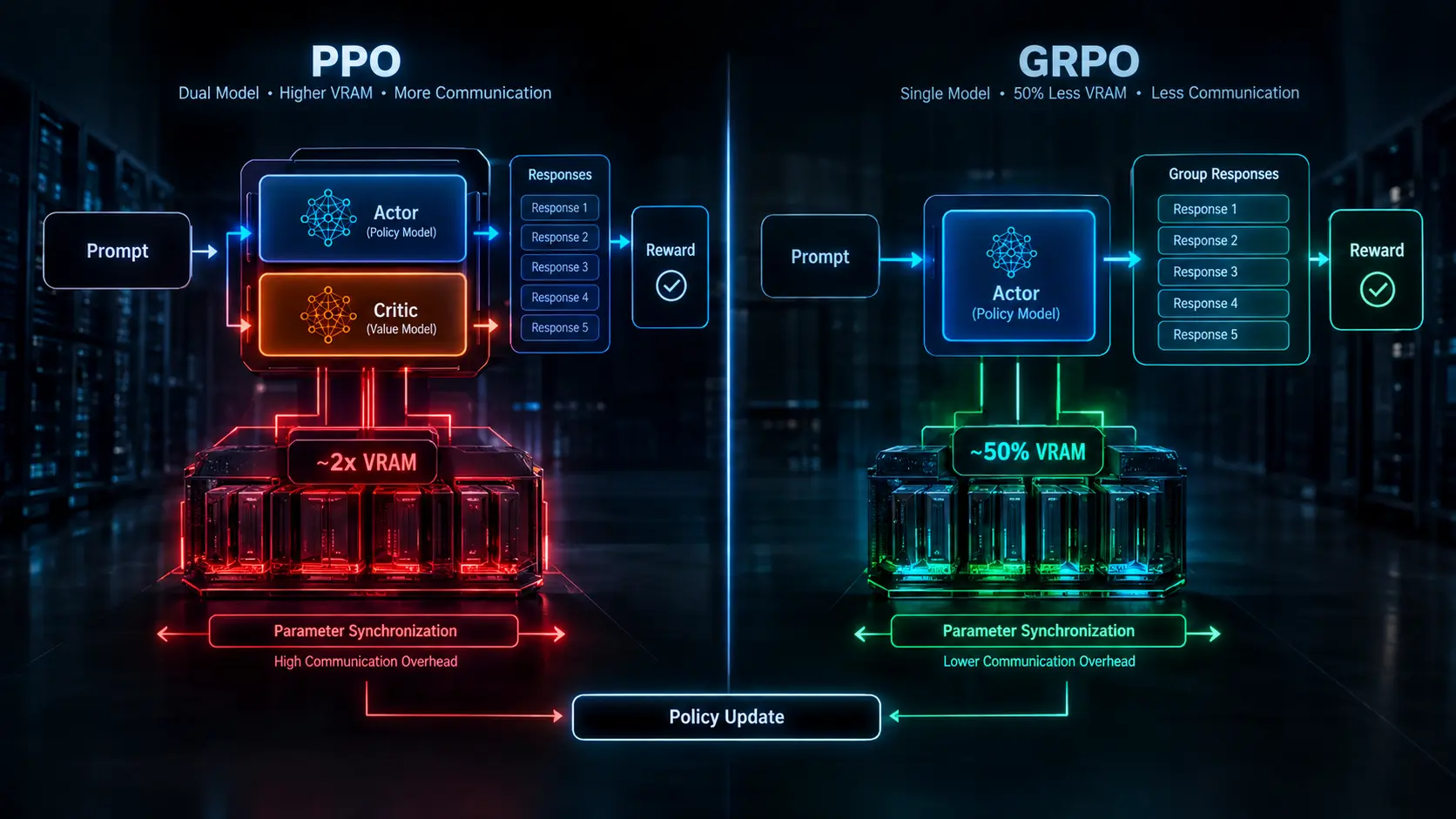
To train a frontier AI model using standard Proximal Policy Optimization (PPO), you must load a massive “critic” model alongside your primary AI, instantly doubling your hardware costs. For architectures exceeding 600 billion parameters, this dual-model requirement demands astronomical GPU clusters and causes severe parameter synchronization bottlenecks. The hardware barrier has effectively locked independent researchers and smaller cloud providers out of the reasoning arms race.
Vanguard researchers have mathematically eliminated the critic model. By abandoning traditional PPO in favor of GRPO, engineers stripped out the secondary evaluation model entirely. This architectural surgical strike slashes GPU memory requirements by 50% while simultaneously triggering emergent, super-human reasoning capabilities. GRPO proves that you do not need exponentially more hardware to build a smarter AI; you just need to rewrite the mathematical rules of how the AI grades its own homework.
At a Glance
- Concept: Eliminating the “teacher” model and letting the AI generate multiple answers to grade itself on a curve.
- Why it matters: It cuts the GPU memory (VRAM) required to train reasoning models in half, democratizing the creation of highly capable, specialized AI.
- Who uses it: Open-weight champions like DeepSeek (powering DeepSeek-R1 training) and advanced MLOps teams deploying RLVR (Reinforcement Learning with Verifiable Rewards).
- Biggest takeaway: GRPO relies heavily on absolute, verifiable rewards (like knowing the sum of 8+5 is exactly 13). It thrives in math, coding, and logic, proving models can “think” autonomously without human-labeled examples.
GRPO Explained Simply
Under traditional PPO (Proximal Policy Optimization), training an AI requires two distinct entities: an Actor (the student taking the test) and a Critic (the teacher grading the test). The Critic is a massive neural network whose sole job is to guess what the “average” score should be so the Actor knows if it did better or worse than expected. Keeping both the student and the teacher in the computer’s memory at the same time is incredibly expensive.
GRPO fires the teacher.
Instead, the student (the Actor) takes the exact same test five different times, generating five different answers. An automated system quickly checks which answers are factually correct. The student then looks at its own five attempts, calculates its own average score, and realizes: “Attempt #3 was much better than my average, so I will update my brain to think more like Attempt #3 in the future.” By grading on a curve against its own immediate outputs, the AI learns perfectly without needing the massive Critic model sitting in memory.
The VRAM Saturation Crisis
Prior to GRPO, aligning an open-source model using RLHF required a minimum of four models loaded into VRAM simultaneously: the Actor, the Critic, the Reference Model, and the Reward Model. The Critic alone scales linearly with the Actor. If you want to align a 70-billion-parameter model, the Critic adds another 70 billion parameters of dead weight.
This memory bloat triggers severe communication overhead. When scaling across multiple nodes, the GPUs must constantly stop generating tokens to synchronize gradients across both massive networks, resulting in “jittery” utilization where 20GB of VRAM might sit idle on an A100 chip.
GRPO eradicates the Critic. By halving the parameter count residing in VRAM, it instantly doubles the effective batch size a cluster can handle. It reduces network bandwidth requirements across distributed workers, transforming the training of massive 671-billion-parameter Mixture of Experts (MoE) models into feasible operations by slashing active parameter VRAM overhead.
Micro-Insight: The breakthrough of DeepSeek-R1 was not just what it learned, but how little silicon it required to learn it. GRPO is a hardware optimization disguised as an algorithmic optimization.
RLVR vs. RLHF: The Shift to Verifiable Rewards
For years, the AI industry relied heavily on armies of human labelers to rank which AI response “sounded” better, feeding that data into a PPO pipeline to train a generalized Critic model. GRPO forces a structural pivot toward Reinforcement Learning with Verifiable Rewards (RLVR). Because GRPO calculates advantage entirely mathematically, it demands environments where the reward is deterministic—did the code compile? Is the math theorem proven? This shift is evolving AI from a polite chatbot trained to please humans into an autonomous agent trained to solve hard physical logic.
How the GRPO Algorithm Works
Eliminating a massive neural network without crashing the learning process requires mathematical precision. To prevent WordPress rendering errors, the fundamental math is broken down into plain concepts below.
Advantage Estimation
In reinforcement learning, an AI must calculate its Advantage (A)—a metric dictating whether an action was better or worse than the baseline expectation. If A is positive, the AI reinforces the behavior; if negative, it avoids it. PPO calculates this by forcing a massive Critic network to predict the baseline. Training this Critic is highly unstable and computationally ruinous.
Group Sampling
GRPO abandons prediction for empirical observation. For a specific prompt, the policy model generates a group of distinct responses. Each response is evaluated against a strict, rule-based reward function (e.g., Accuracy = +1.0, Incorrect = 0.0).
Relative Advantage Normalization
Instead of asking a Critic what the baseline should be, GRPO extracts the baseline directly from the group’s performance. It calculates the group’s mean average (μ) and standard deviation (σ). The Relative Advantage (A) for a specific response is simply calculated by subtracting the mean from the score, and dividing by the standard deviation: A = (Score - μ) / σ. If a response scores higher than the group’s average, it receives a positive advantage. This beautifully simple normalization anchors the learning process without requiring a single parameter of a value network.
The Clipped Surrogate Objective
If the model suddenly finds an answer that works perfectly, it might update its internal weights too aggressively, destroying everything else it knows. To prevent this, GRPO utilizes the exact same safety mechanism as PPO: a probability ratio restricted by a clip function (restricting updates to a narrow window like [1 - ε, 1 + ε]). Even if the advantage is massive, the clip function forces the model to learn gradually and stably.
Built-In KL Divergence
A model trained purely on math rewards might start outputting endless streams of gibberish numbers to hack the reward system. To preserve natural language capabilities, GRPO integrates a Kullback-Leibler (KL) divergence penalty directly into the loss function. It compares the new policy against a frozen “Reference Model.” If the new policy deviates too radically from coherent human language, the KL penalty mathematically punishes the model.
PPO vs. GRPO VRAM Optimizer
Architectural Optimization: Critic Elimination & Empirical Advantage Normalization
Model Parameter Size
7B Parameters
RL Algorithm Architecture
Proximal Policy (PPO)
Group Relative (GRPO)
Active VRAM Footprint
250 GB
Advantage Calculation
Value Network V(s)
Sync / Comm. Overhead
Massive (2x)
GPU Cluster State & Logic Topology
IDLE
VRAM Consumption (GB) Over Time
Real-World Applications
GRPO is not an academic theory; it is the dominant, open-weight training architecture currently reshaping the global AI landscape.
- DeepSeek-R1-Zero (The Pure RL Cold Start): Researchers completely bypassed the traditional Supervised Fine-Tuning (SFT) phase. They took a base model and subjected it to pure GRPO reinforcement learning. Without a single human-provided example, the model organically learned to engage in long-horizon reasoning, self-correction, and “chain of thought” output simply by chasing verifiable mathematical rewards.
- Democratized Custom Reasoning Models: Because GRPO halves the VRAM requirement, MLOps teams can now fine-tune advanced reasoning models on standard, commercially available hardware. Startups leveraging frameworks like
verlorLLaMA-Factoryare using GRPO to train specialized, 3B to 8B parameter models dedicated to specific corporate tasks at a fraction of the traditional compute budget. - Automated Theorem Proving: Advanced math requires hundreds of logical steps. GRPO excels here because:
- It bypasses the step-wise “credit assignment” failures found in PPO.
- It relies on group-level normalization based strictly on the final, verifiable outcome.
- It organically generates extensive “chain of thought” reasoning traces.
Economic & Strategic Impact
The core strategic consequence of GRPO is the Deflation of the RL Compute Premium.
By optimizing the algorithm to require 50% less memory and significantly less inter-node networking bandwidth, deep-tech labs can achieve frontier reasoning capabilities with vastly inferior physical hardware. This deflationary pressure on compute requirements threatens the moat of hyper-funded Western AI labs, shifting the strategic high ground from raw GPU accumulation back to open-source algorithmic efficiency.
Advantages of GRPO over PPO
- VRAM Reduction: Completely eliminates the Critic value network, cutting GPU memory overhead by approximately 50% during the RL phase.
- Reduced Communication Overhead: Fewer parameters mean fewer gradients to synchronize across distributed nodes, allowing linear scaling on clusters without severe bandwidth throttling.
- Self-Correction Emergence: Grading on a curve against its own outputs forces the model to continuously beat its own average, organically generating advanced “chain of thought” and self-verification behaviors.
- Simpler Architecture: Deletes the complex loss calculations required to train and stabilize a discrete Value model.
Limitations
- Dependence on Verifiable Rewards: GRPO calculates advantage strictly from the raw score. If you cannot automate the score (like objective math or coding), the algorithm falters.
- Generation Time Overhead: While it saves VRAM, GRPO requires sampling multiple responses for every single prompt during training. This creates a massive generative compute load, shifting the bottleneck from memory capacity to raw token generation speed.
- Hyperparameter Sensitivity: The KL divergence penalty must be tuned perfectly. If the penalty is too low, the model reward-hacks and destroys its formatting. If it is too high, the model learns nothing.
Common Misconceptions
- Misconception: GRPO is an inference technique that makes models run faster for the user.
- Reality: GRPO is strictly a training algorithm. It makes the model cheaper and easier for the engineer to train in the data center, but does not increase consumer token generation speed.
- Misconception: GRPO completely replaces all forms of RLHF.
- Reality: Traditional PPO is still heavily utilized for general conversational alignment where human “vibes” and subjective preferences dictate the reward.
- Misconception: The model learns without any guardrails.
- Reality: While it drops the Critic, GRPO relies heavily on the KL divergence penalty mapped to a frozen Reference Model. This invisible tether constantly yanks the model back if it deviates too far from standard human language.
The Ouroboros Tuning Cycle & Synthetic Data
Because GRPO models are rewarded for showing their work and formatting their thoughts (e.g., utilizing <think> tags), the resulting model’s internal monologue is completely exposed.
MLOps engineers are now using the output of GRPO-trained models to generate massive, synthetic datasets of perfect reasoning traces. They then feed these traces back into smaller, 8-billion parameter models via standard Supervised Fine-Tuning. GRPO isn’t just creating smart frontier models; it is operating as an automated factory, printing the high-quality synthetic data required to make every other small model in the world smarter.
Here is a technical comparison of PPO vs GRPO for AI model training:
| Metric | PPO (Proximal Policy Optimization) | GRPO (Group Relative Policy Optimization) |
| Critic Model Required | Yes (Doubles VRAM overhead) | No (Eliminated entirely) |
| Advantage Estimation | Learned baseline via Value Network | Empirical normalization |
| VRAM Consumption | Extremely High | ~50% Reduction |
| Hardware Scaling Bottleneck | Inter-node gradient synchronization | Token generation speed (Sampling responses) |
| Primary Domain Success | Subjective conversational alignment | Math, coding, and verifiable logic |
Future Outlook
Next 12–24 Months: Open-Source Reasoning Proliferation
Through 2027, the success of the DeepSeek-R1 methodology will trigger a massive wave of open-weight reasoning models. Grassroots AI communities will leverage efficient RLVR frameworks to deploy GRPO-tuned models in the 3B to 8B parameter class. These specialized “micro-reasoners” will comfortably replace expensive proprietary APIs for highly specific enterprise tasks.
Next 3–5 Years: Hybrid Reward Architecture
By 2030, the strict boundary between verifiable logic and subjective human preference will blur. AI architects will develop hybrid loss functions that utilize GRPO’s memory-efficient group sampling for the logical core of an answer, while dynamically calling a lightweight, quantized Critic model strictly for stylistic and conversational alignment.
Next 10 Years: Continuous On-Device Alignment
By the mid-2030s, the memory efficiency of GRPO will transition from the cloud directly to consumer hardware. Because GRPO does not require an exorbitant Critic network, future smartphones equipped with advanced NPUs will continuously run localized GRPO loops in the background, updating policy weights directly on-device for true, real-time personalization.
Key Takeaways
- Traditional PPO requires an AI to maintain a massive “Critic” model in GPU memory just to calculate a baseline score, creating crippling VRAM bottlenecks.
- GRPO eliminates this Critic model entirely. It generates multiple responses to a single prompt and mathematically ranks them against each other using standard deviation.
- By deleting the Critic, GRPO slashes VRAM requirements by up to 50%, allowing engineers to train massive parameter models efficiently.
- The algorithm features a built-in clipping function and a KL divergence penalty to ensure the model learns gradually and doesn’t output gibberish.
- GRPO thrives in environments with verifiable, absolute rules (like math and coding), driving the “cold start” reasoning capabilities seen in breakthrough models like DeepSeek-R1.
Frequently Asked Questions (FAQ)
What is the difference between PPO and GRPO?
The primary difference is that Proximal Policy Optimization (PPO) uses a massive, secondary neural network (the Critic) to grade the AI’s performance, which doubles hardware memory requirements. Group Relative Policy Optimization (GRPO) mathematically grades the AI against its own generated answers, completely eliminating the need for the Critic model.
Does GRPO require human feedback?
No. GRPO is heavily utilized in Reinforcement Learning with Verifiable Rewards (RLVR). It relies on strict, objective rules (like whether code compiles successfully or a math equation is correct) rather than subjective human ratings, allowing the model to self-train autonomously.
Why did DeepSeek use GRPO for DeepSeek-R1?
DeepSeek utilized GRPO to drastically reduce the VRAM overhead required to train their massive 671-billion parameter model. By saving memory and relying on verifiable mathematical rewards, they successfully triggered emergent, superhuman reasoning capabilities at a fraction of the compute cost used by Western AI labs.
Glossary
Actor Model (Policy Network): The primary neural network in reinforcement learning that generates the actual text or actions in response to a prompt.
Advantage (A): A mathematical metric representing how much better or worse an action was compared to the expected baseline.
Critic Model (Value Network): A secondary neural network used in PPO whose sole job is to estimate the expected reward (baseline) for a given state. Eliminated in GRPO.
Group Relative Policy Optimization (GRPO): A memory-efficient reinforcement learning algorithm that omits the critic model, instead estimating the baseline from a group of localized scores.
Kullback-Leibler (KL) Divergence Penalty: A mathematical safeguard that prevents an AI model from straying too far from its original, coherent language capabilities while it optimizes for a reward.
Proximal Policy Optimization (PPO): The legacy standard reinforcement learning algorithm used in RLHF, known for stability but infamous for its massive memory overhead.
VRAM (Video Random-Access Memory): The highly specialized, ultra-fast memory embedded directly on a GPU. Running out of VRAM is the primary bottleneck in AI training.
Sources
- DeepSeek-AI: DeepSeek-R1: Incentivizing Reasoning Capability in LLMs via Reinforcement Learning
- Hugging Face (Weyaxi): The Engineering Handbook for GRPO + LoRA with Verl
- arXiv Preprints: DeepSeekMath: Pushing the Limits of Mathematical Reasoning in Open Language Models
- Cleveres AI (GitHub): Group Relative Policy Optimization (GRPO) Concepts
- Adiyogi Arts: GRPO vs PPO: Eliminating the Critic Model in LLM Fine-Tuning