Advertisement
)

AT A GLANCE
- Concept: Anti-Access: Long-range weapons designed to stop military forces from reaching the battlefield entirely.
- Concept: Area-Denial: Shorter-range systems that restrict an enemy’s ability to maneuver once inside the zone.
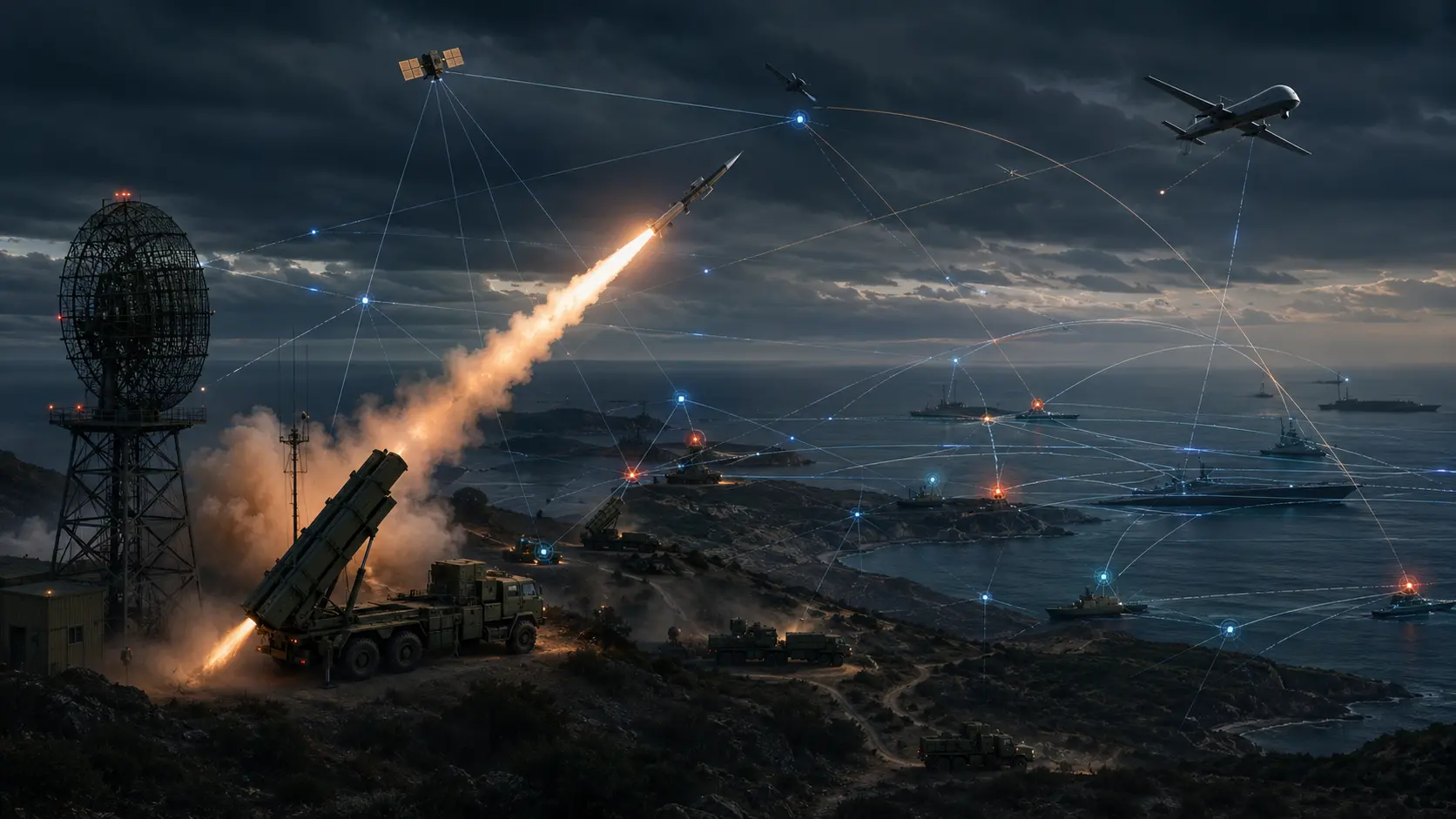
- Concept: The Kill Chain: The continuous electronic data link between a radar detecting a target and a missile destroying it.
- Concept: Anti-Ship Ballistic Missile: A massive, high-speed rocket designed specifically to strike the deck of a moving aircraft carrier.
IN SIMPLE WORDS
Imagine a medieval castle. To keep enemies away, the defenders do not just stand at the door. They dig a wide moat, place archers on the walls, and set traps in the surrounding forest.
Modern superpowers do the exact same thing, but instead of a forest, they use the ocean and the sky. Instead of archers, they use hypersonic missiles.
Anti-Access/Area-Denial (A2/AD) is an invisible, electronic dome of protection. If an enemy ship or jet crosses an invisible line hundreds of miles offshore, an alarm sounds. Coastal radars track the target, and land-based missiles fire automatically. This strategy forces rival militaries to keep their expensive aircraft carriers and bomber fleets far away. By making the cost of entering the bubble too high, nations can control vast territories and trade routes without firing a single shot.
HOW IT WORKS
An A2/AD network is not a single weapon. It is a highly synchronized system of systems designed to create an impenetrable defensive depth.
The foundation of the network relies on persistent domain awareness. Over-The-Horizon (OTH) radars bounce high-frequency radio waves off the ionosphere. This allows defenders to see aircraft carriers and bomber squadrons thousands of miles away, completely bypassing the physical curvature of the Earth.
Once an OTH radar detects a general target, it passes the data to specialized targeting satellites and maritime patrol drones. These advanced sensors refine the exact geographic coordinates and establish a continuous tracking lock, known as a kill chain.
For naval threats, the network employs Anti-Ship Ballistic Missiles (ASBMs). These massive rockets launch from mobile trucks hidden deep inland. They exit the atmosphere, travel through space, and drop maneuverable, high-speed warheads directly onto the decks of moving ships.
If an enemy successfully breaches the outer anti-access ring, they immediately face the area-denial layer. This consists of overlapping Surface-to-Air Missile (SAM) batteries positioned along the coast. These batteries network together, sharing radar data automatically to engage low-flying cruise missiles and stealth fighters that managed to slip past the outer defenses.
REAL WORLD EXAMPLE
The South China Sea serves as the most advanced A2/AD environment on Earth. China has aggressively dredged sand to create artificial islands across the Spratly archipelago. They paved these islands with military runways, deep-water ports, and advanced radar facilities.
These island outposts network directly with mainland DF-21D anti-ship missile batteries. This architecture creates a contiguous, overlapping threat ring that pushes the United States Navy outside the first island chain. American supercarriers must operate from thousands of miles away, drastically reducing the effective combat range and payload of their carrier-based fighter jets.
WHY IT MATTERS NOW
Since the end of World War II, Western militaries have operated with absolute freedom of navigation. The US Navy could park an aircraft carrier off the coast of almost any nation and project undisputed air superiority.
A2/AD technology permanently ends this era of uncontested power projection. Hostile nations can now hold multi-billion-dollar supercarriers at risk using shore-based missiles that cost a fraction of the price. This asymmetrical math alters the basic mechanics of geopolitical deterrence.
If a superpower knows it will lose a carrier strike group just trying to enter the theater, it is significantly less likely to intervene in regional conflicts. This dynamic specifically dictates the strategic calculus surrounding Taiwan and the Baltic Sea.
Militaries are realizing that traditional invasion forces are useless if they cannot reach the beach. The entire doctrine of modern warfare is shifting toward suppressing, blinding, and dismantling these sensor networks before surface troops ever leave their home ports.
COMMON MISCONCEPTIONS
- “An A2/AD network is an impenetrable dome.” It is an attrition mechanism, not an invincible shield. It is designed to make an attacker suffer unacceptable losses, but a massive, coordinated stealth strike can still punch physical holes in the network.
- “The strategy only relies on missiles.” The missiles are completely useless without the sensors. Electronic warfare, cyber-attacks, submarine sea mines, and communications jamming are equally critical area-denial weapons.
- “Only superpowers use this strategy.” Regional powers and proxy groups use cheap coastal defense cruise missiles and loitering munitions to create highly effective, localized area-denial zones over critical commercial shipping lanes.
WHAT MOST PEOPLE MISS
Defense commentators consistently fixate on the explosive yield and hypersonic speed of the missiles. They completely overlook the extreme fragility of the data links connecting the network.
An anti-ship ballistic missile is effectively blind. It relies entirely on a continuous stream of data from satellites and coastal radars to find a ship moving at 30 knots in the open ocean. If an attacker jams the communication frequencies or blinds the targeting satellite, the entire A2/AD network breaks down. The missiles remain fully armed but have absolutely no idea where to strike.
THE ECONOMIC AND STRATEGIC IMPACT
Defense budgets are shifting aggressively in response to these networks. Navies are redirecting sovereign capital away from massive, concentrated surface ships toward stealthy, long-range nuclear submarines that can slip beneath the A2/AD radar bubble undetected.
Aerospace contractors secure massive profit margins by developing “stand-off” weapons. These are extremely long-range stealth cruise missiles designed to be fired by bombers safely outside the enemy’s maximum radar range.
Economically, A2/AD installations near global choke points threaten the foundation of international trade. The sheer existence of shore-based anti-ship batteries near the Strait of Hormuz or the Malacca Strait drastically raises commercial shipping insurance premiums, heavily disrupting the global flow of energy and microchips.
THE TRAJECTORY
Next 12–36 Months: Militaries will aggressively adopt distributed lethality. Instead of concentrating massive command centers, defenders will network hundreds of small, mobile missile launchers that are highly camouflaged and impossible to target with a single preemptive strike.
Next Five Years: The integration of artificial intelligence into the kill chain. Automated command systems will rapidly fuse data from civilian ships, military satellites, and coastal radars. These algorithms will instantly select the optimal weapon to fire, operating far faster than a human commander’s reaction time.
Next Ten Years: The deployment of directed energy area-denial. High-powered microwave emitters and megawatt-class lasers will replace kinetic missiles for short-range point defense. These systems will create literal walls of electromagnetic energy to burn incoming drone swarms from the sky instantly.
What Could Go Wrong: A catastrophic false positive. Over-the-horizon radars frequently suffer from atmospheric noise and false radar tracks. If an automated A2/AD network mistakenly identifies a commercial airliner as an incoming threat, the system could fire automatically, causing a devastating international incident.
Most Likely Outcome: The offense-defense paradigm will heavily favor defense. The sheer cost efficiency of shore-based missiles compared to vulnerable naval warships ensures that geographic exclusion zones will dictate the borders of future geopolitical influence.
KEY TERMS
- Anti-Access (A2): Actions, weapons, and capabilities designed specifically to prevent an opposing military force from entering an operational area.
- Area-Denial (AD): Shorter-range actions and capabilities designed to restrict an opposing force’s freedom of action within an operational area.
- Over-The-Horizon (OTH) Radar: A specialized sensor that bounces radio waves off the ionosphere to detect targets thousands of miles past the physical curvature of the Earth.
- Anti-Ship Ballistic Missile (ASBM): A large rocket that travels into space and drops a high-speed maneuverable warhead precisely onto a moving naval vessel.
- The Kill Chain: The sequential, highly vulnerable process of identifying a target, transmitting the coordinates, aiming the weapon, and destroying the threat.
- Stand-Off Weapon: A stealthy missile or glide bomb fired from a safe distance outside the maximum range of enemy air defenses.
BEGINNER FAQ
What is an A2/AD bubble? It is a military term for a geographic area protected by overlapping layers of radars and missiles that make it highly dangerous for enemies to enter.
Why can’t ships just sail past it? The missiles are designed specifically to sink massive ships. Sailing an aircraft carrier into an A2/AD zone without destroying the missiles first is effectively a suicide mission.
How do they see ships from so far away? They use space satellites, patrol drones, and specialized Over-The-Horizon radars that bounce tracking signals off the upper atmosphere to see past the Earth’s curve.
Is this a new strategy? The concept of coastal defense is ancient. What is new is the extreme range, hypersonic speed, and digital integration of modern sensor networks.
Can the US Navy defeat it? Yes, but it requires highly complex tactics. The military must use stealth bombers and electronic jamming to blind the enemy radars before sending surface ships in.
Do these networks use nuclear weapons? Most A2/AD networks are designed for conventional, high-explosive weapons. However, many ballistic missiles are dual-capable and could carry a nuclear warhead if ordered.
Why is China building artificial islands? The islands act as unsinkable aircraft carriers. By placing radars and missiles on these islands, China pushes its defensive bubble deep into the Pacific Ocean.
What happens if the communication network fails? The entire system collapses. Without constant, real-time updates from the outer radars, the long-range missiles cannot find their moving targets in the ocean.
SOURCES
- Center for Strategic and Budgetary Assessments (CSBA) — Meeting the Anti-Access and Area-Denial Challenge
- RAND Corporation — China’s Anti-Access Area Denial Capabilities and the Implications for the U.S.
- Department of Defense (DoD) — Annual Report on Military and Security Developments Involving the People’s Republic of China
- United States Naval War College — The Evolution of the Kill Chain and Maritime Strike