Advertisement
)

AT A GLANCE
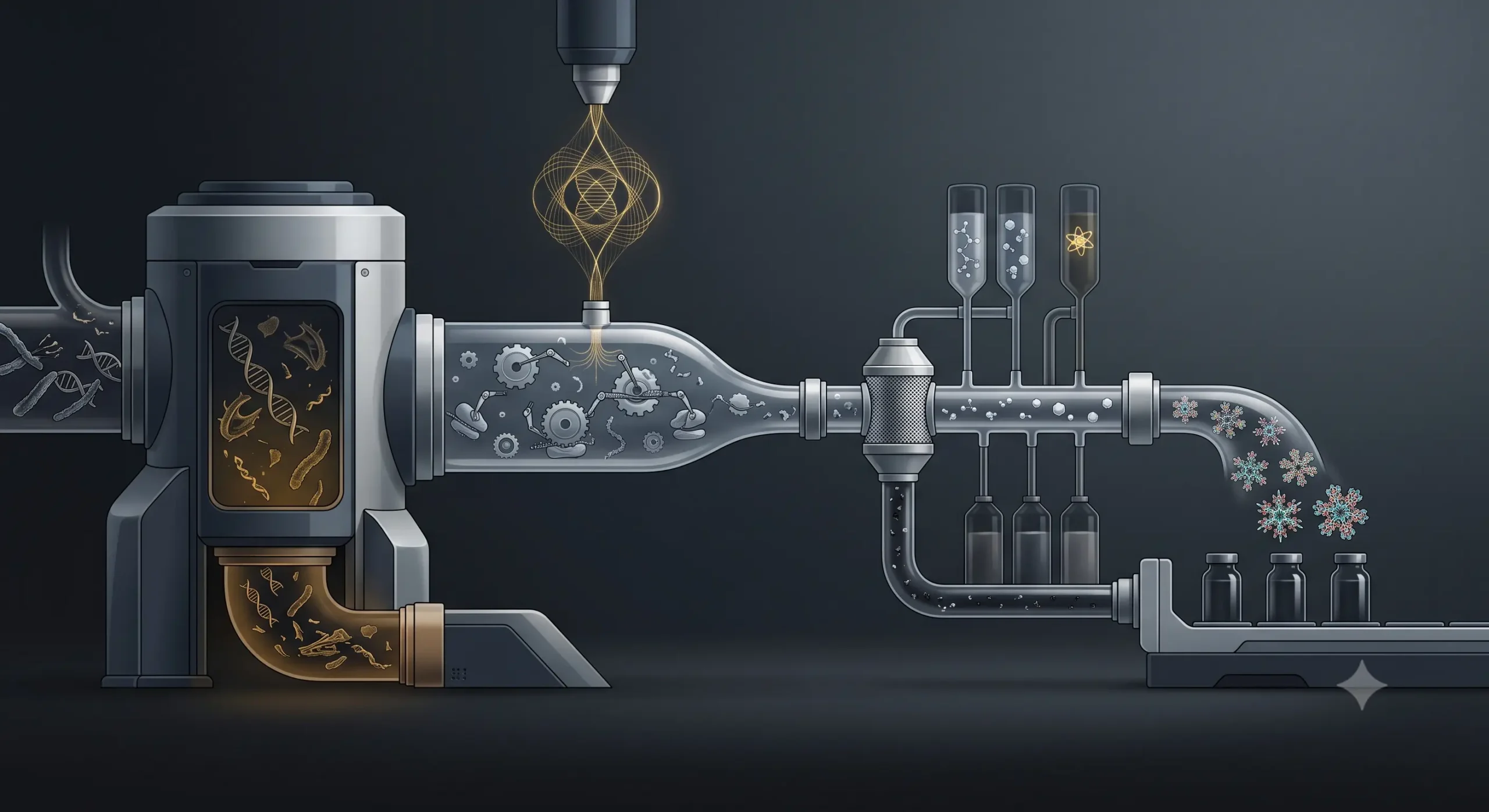
- Concept: Cellular Extraction: Engineers physically rupture living cells to harvest only the ribosomes and enzymes necessary for protein assembly.
- Concept: Open Environment: Removing the cell wall eliminates biological limitations involving toxicity, energy diversion, and growth cycles.
- Concept: On-Demand Production: Freeze-dried enzymatic powders activate instantly upon the addition of water and synthetic DNA instructions.
- Concept: Decentralized Manufacturing: Portable bio-production bypasses massive centralized steel bioreactors, enabling rapid military and medical countermeasures.
HOW IT WORKS
Traditional biomanufacturing relies entirely on living organisms. Engineers edit the genetic code of bacteria or mammalian cells, place them in massive steel bioreactors, and wait for them to multiply. The host cell diverts most of its energy to keeping itself alive, dividing, and managing internal waste, leaving only a fraction of its biological processing capacity for generating the target therapeutic protein.
Cell-free protein synthesis eliminates the living host entirely. Scientists physically rupture cells—typically Escherichia coli or Chinese Hamster Ovary cells—and carefully extract the internal biological machinery. They isolate the ribosomes, RNA polymerases, amino acids, and energy molecules, entirely discarding the cell wall and the host’s genetic reproductive material.
This physical extraction creates a concentrated, sterile biological soup capable of executing genetic instructions without the heavy metabolic overhead of sustaining life. When technicians introduce synthetic messenger RNA or plasmid DNA into this open biochemical environment, the suspended ribosomes immediately begin reading the code and assembling the target protein.
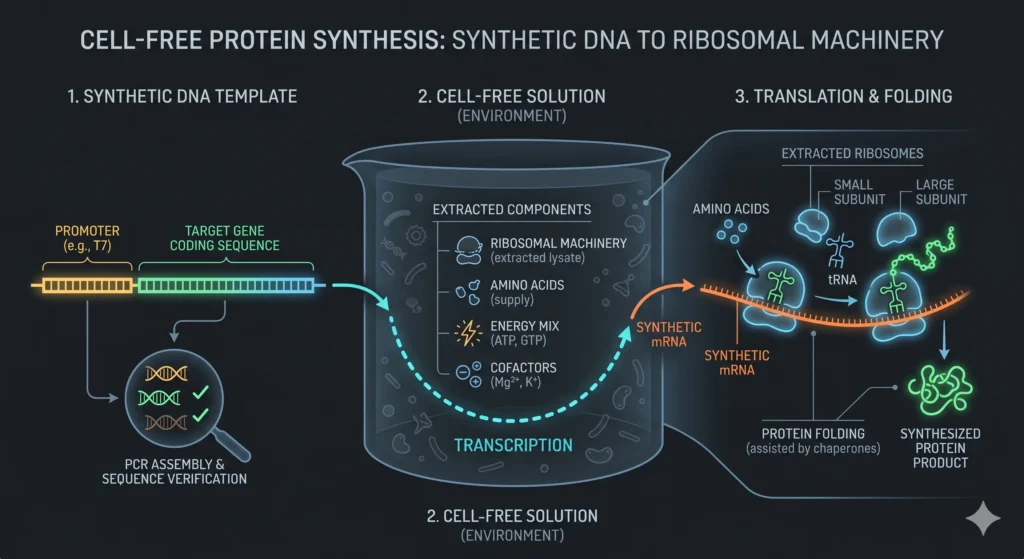
Because there is no cell membrane to cross, engineers achieve absolute chemical control over the reaction environment. They continuously feed raw amino acids and energy molecules directly into the solution while actively filtering out toxic byproducts.
This open fluid architecture allows for the direct synthesis of highly complex or toxic proteins. In traditional systems, generating toxic therapeutics would immediately kill the living host cell, permanently halting production before generating a usable pharmaceutical yield.
WHY IT MATTERS NOW
The architecture of global biodefense relies heavily on centralized, fragile infrastructure. Producing vaccines or monoclonal antibodies requires highly regulated facilities operating thousands of liters of bioreactor capacity. If a novel biological threat emerges, retrofitting these physical plants takes months, severely delaying the deployment of life-saving medical countermeasures.
Cell-free platforms transition biomanufacturing from a physical hardware bottleneck into a digital logistics solution. Instead of shipping massive vats of temperature-sensitive liquids across the globe, defense agencies can stockpile freeze-dried pellets containing the raw ribosomal machinery.
When an outbreak occurs, operators simply rehydrate the biological pellets, add a newly sequenced digital DNA blueprint, and begin producing pure therapeutics within hours. This eliminates the weeks of time traditionally required to grow and scale a living cell culture.
Organizations like the Biomedical Advanced Research and Development Authority (BARDA) recognize this distinct logistical asymmetry. They actively fund synthetic biology organizations like Ginkgo Bioworks to scale decentralized, cell-free production capabilities to secure national pharmaceutical supply chains. Establishing domestic rapid-response units guarantees sovereign nations can generate localized biological defenses even if global shipping networks collapse.
The financial implications for personalized medicine carry equal weight. Orphan drugs for rare genetic disorders frequently fail commercialization because building a custom bioreactor line for a patient population of a few hundred people breaks traditional unit economics. Cell-free manufacturing drastically compresses the capital expenditure required to brew these niche proteins, making ultra-targeted therapeutics financially viable for the first time.
WHAT MOST PEOPLE MISS
Most industry observers assume that living cells represent the ultimate manufacturing engines because millions of years of evolution optimized them for maximum efficiency. They fail to understand that biological survival directly competes with industrial yield. A living cell will actively shut down the production of a foreign therapeutic protein if it senses that the energy drain threatens its own replication cycle.
By executing a cellular extraction, engineers strip away this innate survival instinct entirely. The cell-free reaction channels one hundred percent of its adenosine triphosphate energy budget directly into synthesizing the target molecule.
This pure, unconstrained biochemical focus routinely generates specific protein yields that vastly outpace the physical limits of traditional in-vivo fermentation. Engineers stop fighting the cell’s complex regulatory networks and treat the extracted ribosomes purely as mechanical assembly lines executing a simple chemical loop.
THE TRAJECTORY
Next 12–36 Months: Pharmaceutical manufacturers will adopt cell-free systems exclusively for rapid prototyping, testing thousands of protein variants overnight before selecting the most stable candidate for traditional scale-up.
Next Five Years: Militaries will deploy automated, suitcase-sized bio-foundries to forward operating bases. Medics will download digital genetic sequences via satellite and print custom antibodies on demand to neutralize localized biological weapons or endemic pathogens.
Next Ten Years: Continuous-exchange cell-free systems will achieve commercial cost parity with massive mammalian cell bioreactors. This shift will decentralize global drug manufacturing, allowing local pharmacies to brew complex biologics on-site just hours before administering them to patients.
What Could Go Wrong: The extracted biochemical components are highly sensitive to enzymatic degradation. If manufacturers fail to perfectly stabilize the raw materials during the freeze-drying process, the ribosomal machinery will prematurely decay, rendering the emergency stockpiles completely useless.
Most Likely Outcome: Cell-free manufacturing will fundamentally bifurcate the pharmaceutical industry. Centralized mega-reactors will continue churning out high-volume, low-margin generic biologics, while decentralized cell-free platforms will dominate the high-margin markets of personalized oncology and immediate biodefense.
KEY TERMS
- Cell-Free Protein Synthesis (CFPS): The in-vitro production of proteins using biological machinery extracted from living cells.
- Ribosome: The complex molecular machine found within all living cells that serves as the site of biological protein assembly.
- Biomanufacturing: The commercial production of biological molecules and materials for use in medicines, food, and industrial applications.
- Recombinant Protein: A genetically engineered protein created by introducing foreign DNA into a host expression system.
- Lyophilization: The freeze-drying process used to preserve perishable biological material by removing water under a vacuum, allowing long-term, room-temperature storage.
SOURCES
- Biomedical Advanced Research and Development Authority (BARDA) — Distributed Biomanufacturing and Rapid Response Capabilities
- Journal of Biotechnology — Optimization of Cell-Free Protein Synthesis for Industrial Applications
- Nature Communications — Lyophilized Cell-Free Systems for Point-of-Care Diagnostics and Therapeutics
- Ginkgo Bioworks — Synthetic Biology Architectures for On-Demand Protein Expression