Advertisement
)
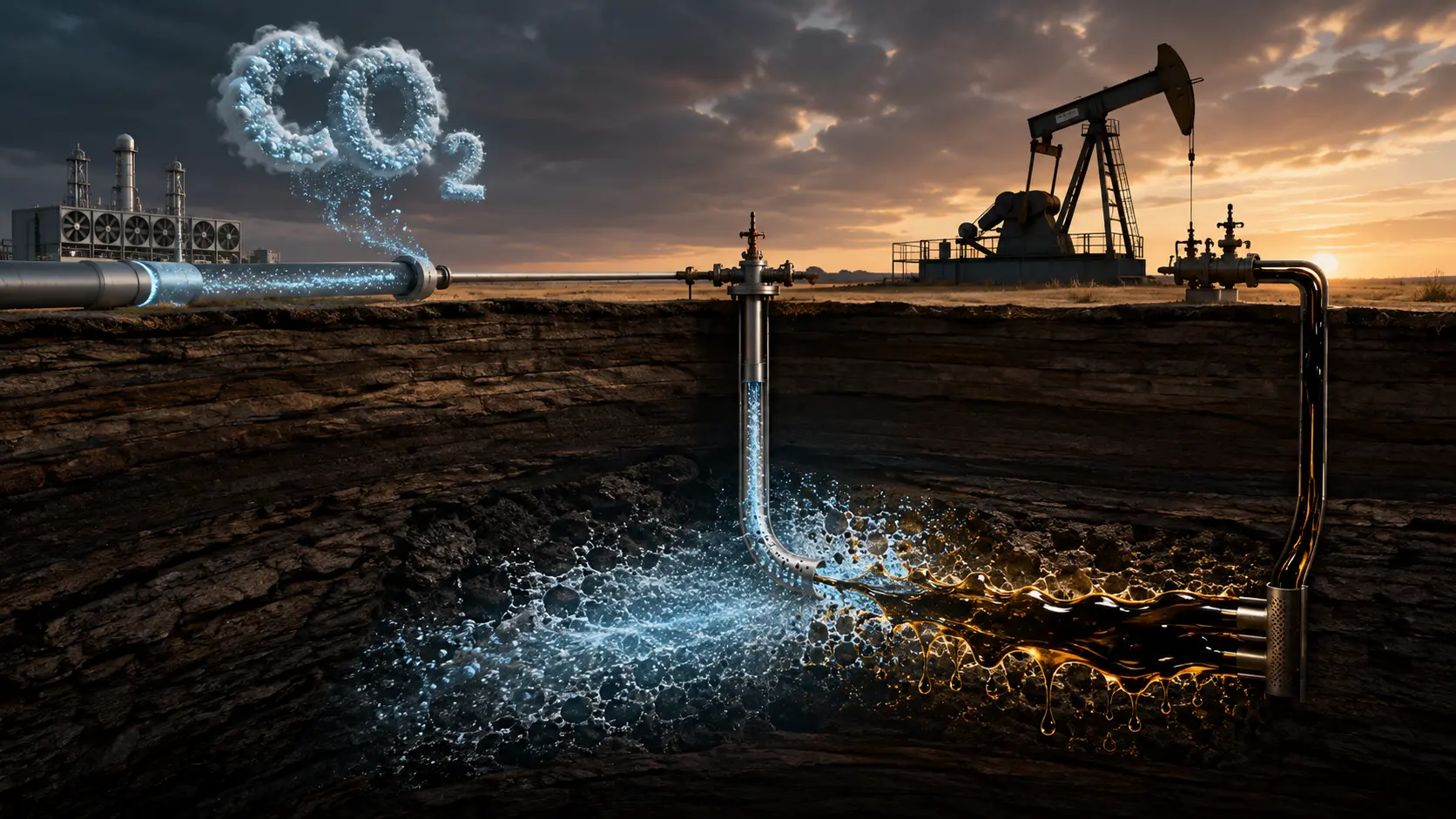

When an oil company declares that an oil well has “run dry,” it is a statistical lie. In reality, a depleted oil well is still overwhelmingly full of oil. Standard drilling and water-flooding techniques can only extract about 30% to 40% of the crude hidden in the microscopic pores of underground rock. The remaining 60% is tightly locked in place by capillary pressure and high viscosity. The oil is too thick, and the rock’s grip is too strong. For decades, billions of barrels of oil have been left stranded in these “dead” reservoirs because humanity lacked the technology to unstick it.
Today, the energy industry has found a radical solution that perfectly aligns with the global push to combat climate change. They are taking the exact pollution we are desperately trying to remove from the atmosphere—carbon dioxide—and pumping millions of tons of it directly into these dying wells. Why should you care right now? Because this process, known as CO2-Enhanced Oil Recovery (CO2-EOR), does not just push the stubborn oil out; it permanently traps the carbon dioxide inside the rock. Backed by massive, multi-billion-dollar government tax credits, the oil industry is turning atmospheric pollution into an industrial solvent, triggering a financial and thermodynamic arbitrage that is completely rewriting the geopolitics of carbon capture.
What is CO2-Enhanced Oil Recovery (EOR)?
CO2-Enhanced Oil Recovery (EOR) is an advanced tertiary extraction technique that injects pressurized carbon dioxide into depleted oil reservoirs. The CO2 mixes with the trapped crude oil, causing it to swell and reducing its viscosity, allowing it to flow to a production well. Crucially, a significant portion of the injected CO2 remains permanently trapped in the rock formations, acting as a form of geological carbon sequestration.
At a Glance
- Concept: Using extreme pressure to turn carbon dioxide into a powerful liquid-gas hybrid (a supercritical fluid) that washes stubborn oil out of microscopic rock pores like dish soap cutting through grease.
- Why it matters: It provides an immediate, highly profitable financial incentive for companies to build Carbon Capture and Storage (CCS) facilities. The trapped carbon is subsidized by massive federal tax credits.
- Who uses it: Major integrated oil companies (Occidental Petroleum, ExxonMobil, Chevron) operating in mature oil fields, heavily concentrated in the Permian Basin of West Texas.
- Biggest takeaway: This process birthed the controversial concept of “Carbon Negative Oil”—the claim that pumping captured atmospheric carbon into a well offsets the greenhouse gases emitted when the extracted oil is eventually burned in a car engine.
In Simple Words
Imagine a sponge soaked in thick, cold honey.
If you squeeze the sponge, only a little bit of honey comes out. If you pump water through the sponge (which oil companies do during “secondary recovery”), you might push a little more out, but water and honey don’t mix. Most of the honey stays stubbornly stuck inside the tiny holes of the sponge.
Now, imagine pumping a high-pressure, invisible chemical solvent through the sponge. This solvent mixes perfectly with the honey. It thins the honey out, making it slippery and watery, and causes it to swell up and expand. Suddenly, the honey easily slides right out of the sponge.
In CO2-Enhanced Oil Recovery, the sponge is deep underground rock. The honey is trapped crude oil. The chemical solvent is carbon dioxide. Oil companies pump massive amounts of CO2 into the rock. It dissolves into the oil, making it thin and slippery enough to be pumped to the surface. Even better, as the oil leaves, the microscopic holes in the rock act as a permanent, inescapable prison for the CO2, locking the greenhouse gas safely away from the atmosphere forever.
Why This Matters
The global push for Carbon Capture and Storage (CCS) faces a fatal flaw: capturing carbon from the air is incredibly expensive, and burying it in the ground generates zero revenue.
For Energy Investors and ESG Analysts, CO2-EOR is the critical financial bridge. By using the captured carbon to extract additional oil, energy companies generate massive commercial revenue from the extracted crude. Furthermore, under Section 45Q of the U.S. Inflation Reduction Act, the government pays companies up to $60 for every ton of industrial CO2 they permanently trap during this process. This dual-revenue stream (oil sales + tax credits) is currently the only standalone economic mechanism capable of financing the multi-billion-dollar scale-up of the global carbon capture industry.
The Economics of CO2-EOR and Carbon Sequestration
The mechanics of CO2-EOR have been utilized in the Permian Basin of Texas since the 1970s. However, historically, oil companies dug up naturally occurring CO2 from underground volcanic domes just to pump it into their oil wells.
That dynamic is reversing. The modern era of CO2-EOR relies exclusively on anthropogenic (human-made) CO2. Companies are constructing massive Direct Air Capture (DAC) facilities—like Occidental Petroleum’s “Stratos” plant—to vacuum carbon directly out of the sky. By proving that they can geologically sequester this atmospheric carbon via EOR, oil giants are attempting to secure their social license to operate for the next century, transitioning their business models from “oil extraction” to “carbon management.”
How CO2-Enhanced Oil Recovery Works: Thermodynamics
Injecting a greenhouse gas to extract oil requires hacking the fundamental laws of thermodynamics and fluid mechanics. Here is the first-principles breakdown of the process.
1. The Fundamental Problem: Capillary Forces
Inside a reservoir, oil is trapped in microscopic rock pores by interfacial tension (the repulsive force between water, rock, and oil). To physically push the oil out, you must overcome the capillary forces holding it in place. Water cannot do this effectively because it does not mix with oil.
2. The Core Mechanism: Supercritical Phase Transition
When CO2 is pumped thousands of feet underground, the natural temperature of the earth (above 31.1°C) and the immense pressure of the rock (above 1,070 psi) force the CO2 to cross a thermodynamic threshold. It becomes a Supercritical Fluid. In this phase, it is no longer just a gas or a liquid; it possesses the high density of a liquid (allowing it to exert physical force) and the high diffusivity of a gas (allowing it to effortlessly penetrate microscopic rock pores).
3. Technical Depth: Minimum Miscibility Pressure (MMP)
The magic of CO2-EOR lies in “miscibility”—the ability of two fluids to mix perfectly into a single phase.
For CO2 to mix with oil, the reservoir must be maintained above the Minimum Miscibility Pressure (MMP). If the pressure is above the MMP, the supercritical CO2 dissolves directly into the crude oil.
This chemical reaction achieves three things:
- Viscosity Reduction: The oil becomes drastically thinner and highly fluid.
- Oil Swelling: The oil expands by up to 10% to 20% in volume, physically pushing itself out of the tight rock pores.
- Surface Tension Reduction: It lowers the capillary number, eliminating the friction holding the oil to the rock.
The difficulty of extraction is mathematically defined by the Capillary Number (Nc), which must be significantly increased to liberate the oil:
Nc = (v * μ) / σ
(Where v is fluid velocity, μ is viscosity, and σ is interfacial tension. Supercritical CO2 crashes the σ value, wildly increasing the Capillary Number).
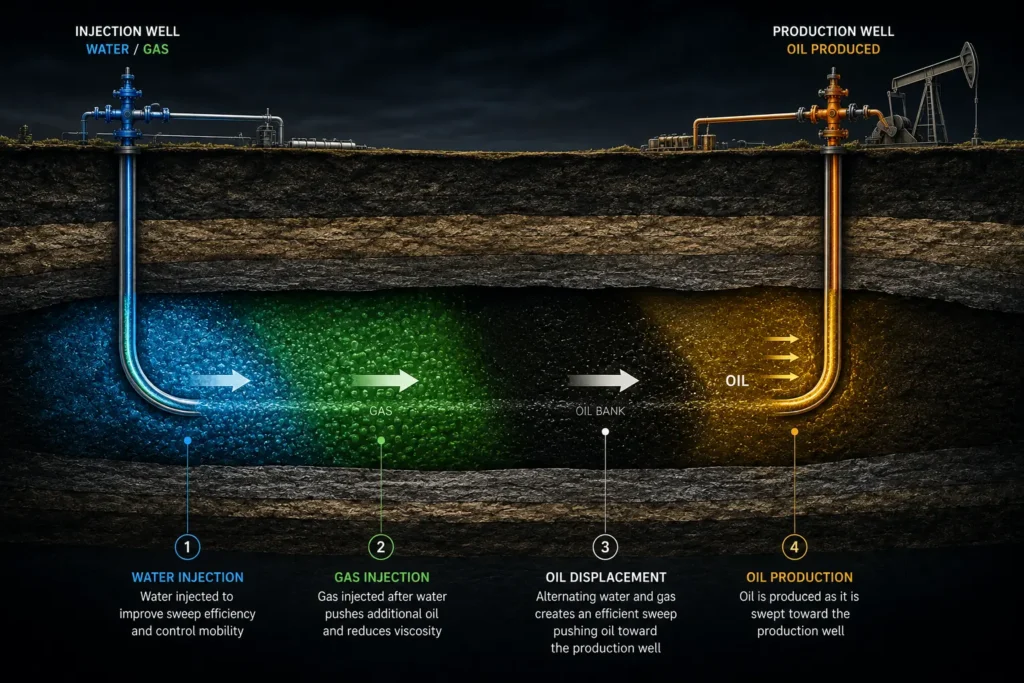
4. Real-World Consequences: Water-Alternating-Gas (WAG)
Because supercritical CO2 is highly mobile, it tends to “finger” or bypass the thicker oil, shooting straight to the production well without doing its job. To stop this, engineers use the Water-Alternating-Gas (WAG) method. They inject a massive slug of CO2, followed by a slug of water, repeating the cycle. The water acts as a physical wall, sweeping the CO2 evenly across the reservoir to maximize the total oil extraction.
5. The Sequestration: Capillary Trapping
When the mixed oil and CO2 reach the surface, the pressure is released. The CO2 bubbles out of the oil (like opening a warm soda). This CO2 is captured, re-pressurized, and pumped right back into the ground in a closed loop. Over time, due to a phenomenon called capillary pressure hysteresis, millions of microscopic bubbles of CO2 become permanently snapped off and physically locked inside the rock matrix, guaranteeing that the carbon will never return to the atmosphere.
Commercial Applications of CO2-EOR and Carbon Capture
CO2-EOR is the primary operational bridge connecting legacy fossil fuel extraction with advanced decarbonization technologies.
Direct Air Capture (DAC) Integration: Occidental Petroleum is constructing “Stratos” in Texas, the largest Direct Air Capture facility in the world. Stratos is designed to pull 500,000 tons of CO2 directly from the atmosphere annually. The facility is deliberately built directly on top of the Permian Basin so the captured atmospheric carbon can be immediately pumped underground for EOR, proving the commercial integration of climate tech and heavy industry.
Post-Combustion Industrial Capture: Heavy industries that cannot run on electricity (such as cement and steel manufacturing) produce massive amounts of CO2 exhaust. Companies are installing massive amine-scrubber capture units on their smokestacks. They compress this exhaust gas and sell it via pipeline to oil operators. This allows the cement factory to achieve carbon-neutrality while providing the oil company with the critical solvent required to rejuvenate aging oil fields.
Strategic Petroleum Reserves: As global demand for oil inevitably plateaus, national energy security shifts from finding new fields to maximizing the output of existing, secure domestic fields. CO2-EOR allows the United States to dramatically extend the life and output of mature, safe, onshore reservoirs, insulating the national energy grid from the geopolitical volatility of offshore and foreign drilling operations.
Economic & Strategic Impact
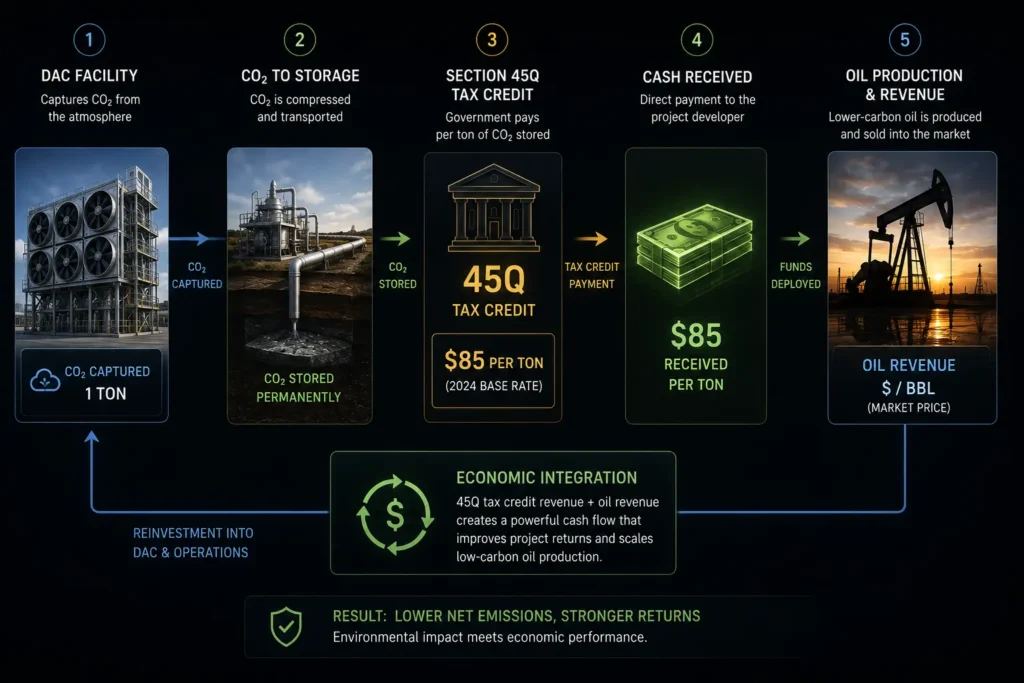
The entire CO2-EOR sector is currently driven by the Section 45Q Arbitrage.
Building a carbon capture pipeline and injection facility requires massive capital expenditure. Under standard market conditions, the extra oil extracted barely covers this cost. However, the U.S. Inflation Reduction Act radically expanded the Section 45Q tax credit.
If an oil company uses captured industrial CO2 for EOR, they receive a guaranteed tax credit of up to $60 per metric ton of permanently stored carbon. If they use CO2 from Direct Air Capture, the credit jumps up to $130 per ton. This essentially turns carbon dioxide into an aggressively subsidized financial commodity. Oil companies are aggressively retrofitting their wells not just to extract oil, but to generate thousands of these high-margin tax credits, fundamentally restructuring the profit-and-loss (P&L) statements of the global energy sector.
Advantages
- Massive Resource Unlocking: Recovers up to 20% of the original oil in place that is physically inaccessible via traditional primary pumping and secondary water-flooding techniques.
- Permanent Sequestration: The closed-loop recycling process ensures that virtually all the injected CO2 is eventually stranded deep within the geological formation through capillary trapping and mineral dissolution.
- Utilizes Existing Infrastructure: The pipelines, drill rigs, and injection wells are largely identical to standard oilfield equipment, meaning the industry can deploy the technology rapidly without inventing new construction techniques.
Limitations
- Geological Constraints: EOR requires specific geological conditions. If the reservoir is too shallow, the pressure cannot be raised high enough to reach the Minimum Miscibility Pressure (MMP), meaning the CO2 will remain a gas, won’t mix with the oil, and the process will fail.
- Corrosion Damage: When CO2 mixes with water underground, it forms carbonic acid. This highly corrosive acid attacks the steel casing of the wellbore and the surface pipelines, requiring the installation of intensely expensive, corrosion-resistant chrome-alloy steel infrastructure.
- The Sourcing Bottleneck: There is currently a massive shortage of cheap, pure anthropogenic CO2. Building the capture facilities on cement and power plants is currently proceeding too slowly to meet the aggressive EOR expansion targets set by the major oil producers.
Common Misconceptions
Misconception: EOR just causes more carbon emissions because the oil gets burned.
Reality: This is the core of the “Net-Zero” debate. Industry models claim that the volume of CO2 permanently trapped in the rock during EOR is roughly equal to (or greater than) the volume of CO2 emitted when the resulting barrel of oil is refined and burned in a car, theoretically resulting in a net-neutral or net-negative carbon cycle.
Misconception: The CO2 will eventually leak back out of the ground.
Reality: The oil has been trapped in these exact rock formations for millions of years under massive pressure without leaking. The impermeable “cap rock” that kept the oil trapped safely acts as the exact same foolproof seal for the injected carbon dioxide.
Misconception: Pumping CO2 underground causes major earthquakes.
Reality: Unlike high-pressure wastewater disposal (associated with hydraulic fracturing or “fracking,” which can lubricate fault lines and cause seismic activity), CO2-EOR carefully balances the reservoir pressure. As oil is removed, CO2 replaces it, maintaining a stable geomechanical equilibrium that rarely triggers detectable seismic events.
What Most People Miss
The critical distinction between Miscible and Immiscible Flooding.
Most generalized discussions assume all CO2-EOR is the same. In reality, it is strictly divided by thermodynamics.
If a reservoir is deep enough (high pressure and heat), the CO2 achieves Miscible Flooding. It becomes supercritical, acts as a solvent, perfectly mixes with the oil, and yields massive extraction rates.
However, in shallow, low-pressure reservoirs (often heavy, sludgy oil deposits), the CO2 cannot reach supercriticality. This is called Immiscible Flooding. The CO2 remains a gas. It does not mix with the oil; it simply swells the oil slightly and acts as a brute-force physical push. Immiscible flooding is vastly less efficient, yields significantly less oil, and is much harder to justify economically, highlighting that CO2-EOR is not a magic wand for every dying oil field on Earth.
Comparison Table
| Feature | Primary Recovery | Secondary Recovery (Water Flood) | Tertiary Recovery (CO2-EOR) |
| Extraction Mechanism | Natural reservoir pressure | Physical water displacement | Thermodynamic solvent miscibility |
| Total Oil Recovered | 10% – 20% | Additional 20% – 40% | Additional 10% – 20% |
| Fluid Phase | Liquid | Liquid | Supercritical Fluid (Liquid-Gas hybrid) |
| Capillary Forces | High (Traps oil) | High (Bypasses trapped oil) | Eliminated (Reduces surface tension) |
| Carbon Impact | Emits CO_2 | Emits CO_2 | Sequesters CO_2 permanently |
Case Study
Situation: The Permian Basin in West Texas is one of the most prolific oil-producing regions in history, but many of its conventional, vertically drilled fields were reaching the end of their secondary (water-flood) lifespan. Millions of barrels of high-quality crude remained geologically locked in place, threatening to strand billions of dollars in infrastructure.
Challenge: Rejuvenating these mature fields required a massive injection of a miscible solvent. Historically, the CO2 was sourced from natural underground volcanic domes in Colorado and piped in, which offered no climate benefit and was subject to high geographical transportation costs.
Solution (The Anthropogenic Pivot): Occidental Petroleum (Oxy), the dominant operator in the Permian, pivoted heavily to Anthropogenic CO2-EOR. They engineered a closed-loop system capturing CO2 from natural gas processing plants and agricultural ethanol facilities. They utilized the Water-Alternating-Gas (WAG) method to systematically sweep the mature reservoirs, pushing the reservoir pressure well past the Minimum Miscibility Pressure (MMP).
Outcome: The supercritical CO2 stripped the residual oil from the rock matrix, successfully elevating the total ultimate recovery factor of the targeted fields to nearly 65% of the original oil in place. Furthermore, Oxy successfully verified and audited the geologic sequestration of the CO2, allowing them to monetize the operation through Section 45Q tax credits and market the extracted crude as “Net-Zero Oil” to aviation and maritime buyers.
Lessons Learned: The Permian Basin demonstrated that EOR is no longer just a petroleum engineering strategy; it is a vital financial instrument. By proving that legacy oil infrastructure can double as the world’s most effective carbon sequestration network, major oil companies have successfully positioned themselves as indispensable partners in the global decarbonization roadmap.
Future Outlook
Next 12–24 Months
The era of Class VI Permitting Bottlenecks. As the financial incentives of the 45Q tax credit trigger a gold rush in carbon capture, companies must secure “Class VI” well permits from the Environmental Protection Agency (EPA) to legally inject CO2 for permanent storage. The EPA is currently facing a massive, multi-year backlog of permit applications. Over the next two years, the speed of bureaucratic approval—not engineering or capital—will serve as the absolute bottleneck dictating the deployment velocity of the U.S. carbon management industry.
Next 3–5 Years
The scaling of Offshore Carbon Sequestration and EOR. While onshore Permian operations dominate today, the mid-2020s will see the technology move aggressively offshore. The North Sea, driven by initiatives like Norway’s “Northern Lights” project, is targeting depleted offshore oil and gas platforms. Because these massive subsea geological formations are inherently secure and far away from populated residential areas, they offer the perfect, uncontested environment for multinational oil companies to execute high-volume CO2-EOR and permanent storage on a continental scale.
Next 10 Years
The transition to Direct Air Capture (DAC) Hegemony. By the mid-2030s, capturing exhaust from industrial smokestacks will be insufficient to meet global climate targets. The EOR market will rely entirely on massive fleets of Direct Air Capture facilities acting as the primary CO2 suppliers. This will finalize the closed-loop carbon cycle: vacuuming legacy CO2 out of the open atmosphere, pumping it deep underground to extract the final reserves of critical petroleum products, and permanently locking the carbon inside the Earth’s crust.
Most Likely Scenario
CO2-EOR is the pragmatic compromise of the energy transition. The reality is that the global economy will require liquid hydrocarbons for aviation, shipping, and petrochemicals for decades to come. By permanently linking the extraction of this necessary oil to the forced geological sequestration of carbon dioxide, EOR ensures that the final era of the fossil fuel industry serves as the foundational infrastructure for the nascent carbon-removal economy.
Key Takeaways
- CO2-Enhanced Oil Recovery (EOR) uses carbon dioxide to squeeze the final 10% to 20% of trapped oil out of a dying well, permanently burying the CO2 in the process.
- Deep underground, extreme pressure and heat turn CO2 into a “supercritical fluid”—a state of matter that mixes perfectly with crude oil, swelling it and dropping its viscosity.
- By mixing with the oil (miscibility), supercritical CO2 eliminates the capillary forces holding the oil to the rock, allowing it to be easily pumped to the surface.
- Engineers use the Water-Alternating-Gas (WAG) method—pumping slugs of CO2 followed by slugs of water—to sweep the reservoir evenly and prevent the gas from bypassing the oil.
- The U.S. government heavily subsidizes this process via Section 45Q tax credits, paying companies up to $130 per ton to permanently bury captured atmospheric carbon.
- The industry claims this creates “Carbon Negative Oil,” arguing the carbon buried underground mathematically cancels out the carbon emitted when the car eventually burns the extracted gas.
Glossary
Capillary Pressure: The physical force that holds fluids (like oil and water) inside the microscopic pores of underground rock. Supercritical CO2 is required to overcome this force.
Direct Air Capture (DAC): A highly advanced technology that uses massive fans and chemical scrubbers to suck ambient, legacy carbon dioxide directly out of the open atmosphere.
Minimum Miscibility Pressure (MMP): The specific underground pressure threshold that must be crossed for carbon dioxide to dissolve perfectly into crude oil and act as a liquid solvent.
Section 45Q: A critical U.S. tax credit that provides a guaranteed financial payout per ton of carbon dioxide that is captured and permanently sequestered, heavily incentivizing EOR.
Supercritical Fluid: A state of matter achieved at high temperatures and pressures where a substance possesses the high density of a liquid and the high diffusivity of a gas.
Water-Alternating-Gas (WAG): A common EOR technique where operators inject a volume of CO2 followed by a volume of water in alternating cycles to efficiently sweep the oil out of the rock.
Frequently Asked Questions
Does the CO2 come back up with the oil?
Yes, a portion of the CO2 mixes with the oil and returns to the surface. However, the production facility instantly separates the CO2 from the oil, recompresses it, and pumps it right back down the injection well in a continuous closed loop, ensuring it never vents into the atmosphere.
Why can’t they just use air or normal gas instead of CO2?
Air or standard natural gas will not achieve “miscibility” (they will not dissolve perfectly into the oil to act as a solvent) at normal reservoir pressures. CO2 has unique thermodynamic properties that allow it to turn into a powerful, oil-thinning supercritical fluid at relatively achievable underground pressures.
Who owns the rock after the oil is gone and it’s full of carbon?
This is a massive, emerging legal battle known as “pore space ownership.” In the United States, the ownership of the empty microscopic holes in the rock usually belongs to the surface landowner, requiring oil companies to negotiate complex leases not just to extract the oil, but to store the carbon.
Does this contaminate drinking water?
No. Oil reservoirs targeted for EOR are typically located thousands of feet (often 1 to 2 miles) below the earth’s surface. Fresh drinking water aquifers are located extremely close to the surface (usually within the first few hundred feet). There are multiple layers of solid, impermeable rock separating the two.
Is EOR actually profitable without government tax credits?
Historically, yes, but only if the oil company had access to naturally occurring, extremely cheap underground CO2 reserves. Using captured industrial CO2 from smokestacks is very expensive; without the 45Q tax credits, the math currently does not work out for most commercial operators.
Sources
[1] U.S. Department of Energy (DOE): Carbon Dioxide Enhanced Oil Recovery: Untapped Domestic Energy Supply and Long Term Carbon Storage
[2] International Energy Agency (IEA): The Role of CO2-EOR in the Global Energy Transition (2025/2026 Analysis)
[3] Clean Air Task Force (CATF): Section 45Q Tax Credit and the Economics of Carbon Capture and Sequestration
[4] Society of Petroleum Engineers (SPE): Thermodynamics of Supercritical CO2 Miscibility and Capillary Trapping Mechanisms
[5] Occidental Petroleum (Oxy): Stratos Direct Air Capture and Net-Zero Oil Operations Brief (2026 Reports)