Advertisement
)

AT A GLANCE
- Concept: Phase Interferometry: Measuring the exact fraction of a radio wave cycle to determine the incoming angle of a signal.
- Concept: Pseudo-Doppler Shift: Electronically switching between circular antennas to simulate physical motion and measure frequency changes.
- Concept: Non-Cooperative Targets: Geolocating enemies who use encrypted, stealth radios without needing to decrypt their actual communications.
- Concept: Line of Bearing: Multiple separated arrays triangulate intersecting angles to generate a highly precise, actionable military targeting coordinate.
HOW A COMINT DIRECTION FINDING ARRAY WORKS
Every radio transmission expands outward from its source like a physical ripple in a pond. When a hostile unit transmits an encrypted radio burst, it inadvertently broadcasts its physical location to anyone listening. Modern militaries hunt these invisible ripples using Communications Intelligence (COMINT) direction finding arrays.
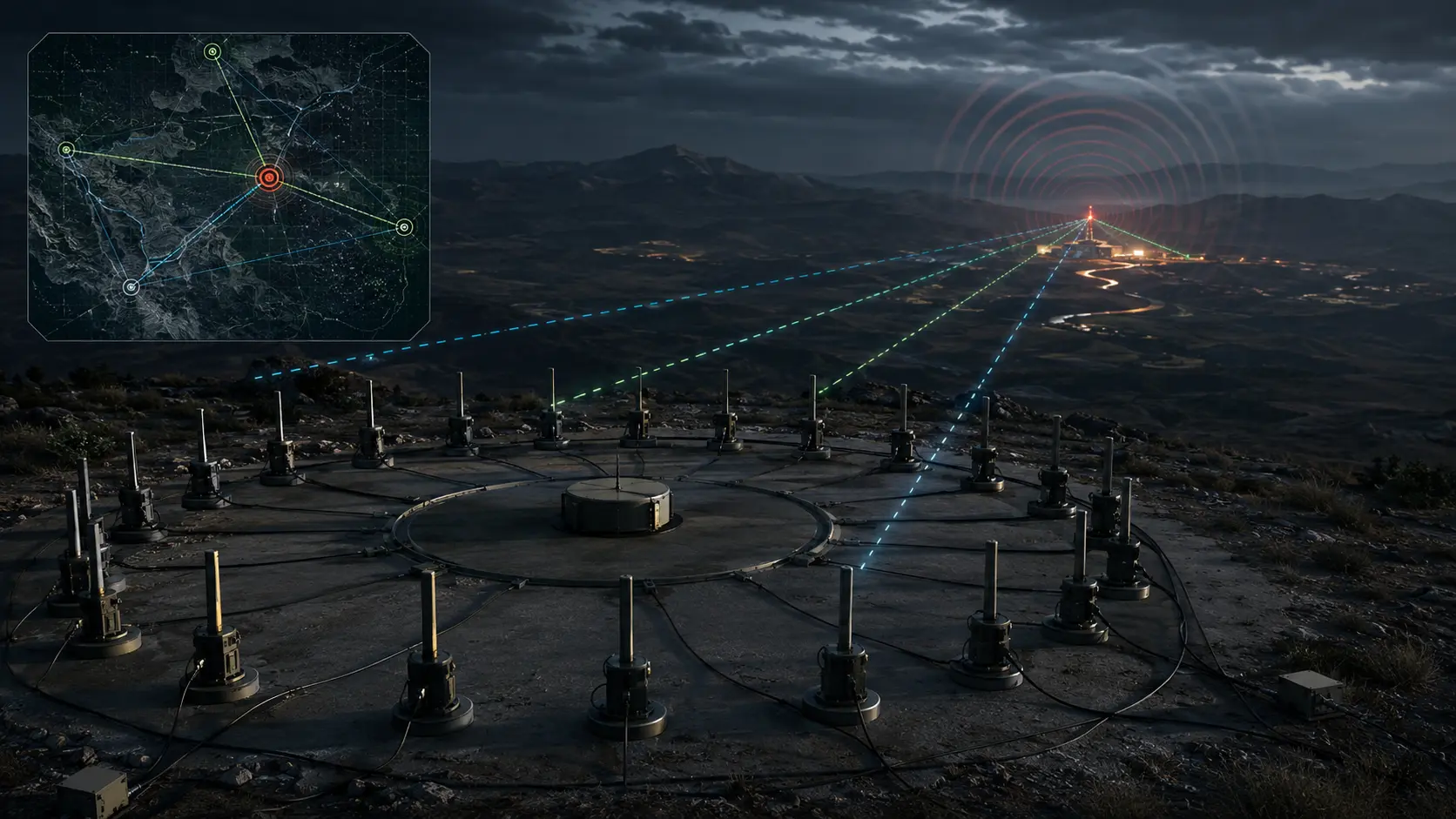
An array consists of multiple antennas arranged in a precise geometric pattern, typically a circle. When a radio wave washes over this array, it strikes the antenna closest to the enemy transmitter a fraction of a nanosecond before it hits the furthest antenna. This microscopic delay forms the absolute basis of electronic geolocation.
The system measures the phase difference (Δϕ) between the antennas. Using the known wavelength of the signal (λ) and the physical distance between the antenna elements (d), the backend processor calculates the exact Angle of Arrival (θ) using the strict mathematical relationship: Δϕ = (2πd / λ) * sin(θ).
To refine accuracy and eliminate blind spots, advanced arrays utilize a pseudo-Doppler mechanism. The system rapidly switches its active receiver around the circular ring of antennas thousands of times per second. This rapid electronic rotation simulates a single antenna physically moving in a circle at high speed.
This simulated motion induces a Doppler shift in the received signal frequency. As the electronic “rotation” moves toward the hostile transmitter, the frequency spikes; as it moves away, the frequency drops. The processor charts this frequency oscillation, and the phase of the resulting sine wave points mathematically directly back to the origin of the transmission.
WHY IT MATTERS NOW
Modern warfare relies on highly distributed, mobile units that actively hide from visual satellites. Camouflage netting, darkness, and heavy cloud cover easily blind optical intelligence platforms. However, infantry units, surveillance drones, and mobile artillery batteries must constantly transmit radio signals to coordinate their operations.
COMINT direction finding completely bypasses encryption. The intelligence officer does not care what the hostile radio message actually says. The array only analyzes the physical physics of the carrier wave itself.
This mechanism turns every single active radio, cell phone, and drone controller into a lethal vulnerability. In highly contested environments like Eastern Europe, artillery batteries use networked direction finding arrays to hunt hostile drone operators. Once a drone pilot keys their transmitter to send a control signal, multiple intersecting arrays instantly calculate a line of bearing.
The software mathematically intersects these lines on a digital map, generating a highly precise GPS coordinate for the enemy operator. This data feeds directly into automated fire control systems. An active emitter can be geolocated and bracketed by precision artillery fire in less than three minutes.
Surviving on a modern battlefield now requires absolute electromagnetic silence. Emitters act as instant death warrants. This physics-based reality forces global militaries to fundamentally redesign their entire command and control architectures around Low Probability of Intercept (LPI) communications and burst-transmissions.
WHAT MOST PEOPLE MISS
Popular media incorrectly assumes that tracking a target requires hacking into a GPS module or compromising a cellular network. They entirely miss that active radio frequency emission is inherently a physical, geometric vulnerability. You cannot hide the laws of electromagnetism behind a software firewall or a virtual private network.
Furthermore, observers vastly underestimate the computational complexity of multi-path propagation. In dense urban environments, a radio wave bounces off concrete buildings and steel bridges before reaching the array. The algorithm must differentiate between the true direct line-of-sight signal and the delayed, bounced echoes, requiring massive parallel processing to prevent the array from aiming artillery at a mirrored reflection.
THE TRAJECTORY
Next 12–36 Months: The mass deployment of distributed drone swarms acting as massive, airborne direction finding arrays. By linking dozens of cheap drones over a secure data link, militaries will expand the baseline distance between antennas from a few meters to several kilometers, achieving unprecedented millimeter-level geolocation accuracy.
Next Five Years: The integration of localized machine learning models to instantly classify and geolocate frequency-hopping signals. Advanced military radios change frequencies thousands of times per second to evade detection. AI algorithms will identify the unique physical fingerprint of the transmitter hardware itself, tracking the emitter even as it violently jumps across the spectrum.
Next Ten Years: Total battlefield electromagnetic transparency. Highly classified SIGINT constellations in low earth orbit will continuously map the exact location of every single emitting device on the planet in real time. The resulting database will provide a permanent, unblinking record of global military deployments based purely on ambient electronic noise.
What Could Go Wrong: Adversaries aggressively developing cognitive electronic warfare systems that transmit false, mathematically perfect ghost signals. These spoofed emissions could trick intersecting arrays into calculating coordinates for empty fields, causing militaries to exhaust high-value precision munitions on phantom targets.
Most Likely Outcome: The COMINT direction finding array will remain the apex predator of electronic warfare. The military that successfully manages its own electromagnetic signature while perfectly mapping the enemy’s physical emissions will systematically dismantle the opposing force.
KEY TERMS
- COMINT (Communications Intelligence): Intelligence gathered from the interception of foreign communications, focusing on the physical signal rather than the content.
- Pseudo-Doppler: A direction-finding technique that simulates physical antenna motion by rapidly switching a receiver across a circular array of stationary elements.
- Angle of Arrival (AoA): The specific calculated geometric direction from which a propagating radio frequency wave impacts a receiving antenna.
- Phase Interferometry: The mathematical measurement of the difference in phase between two identical signals arriving at two distinct spatial locations.
- Multi-Path Propagation: The phenomenon where radio signals reach the receiving antenna by two or more paths, often due to bouncing off physical structures.
SOURCES
- Department of Defense (DoD) — Electronic Warfare and Signals Intelligence Operations Architecture
- Institute of Electrical and Electronics Engineers (IEEE) — Advanced Pseudo-Doppler Direction Finding Algorithms and Phase Interferometry
- Defense Advanced Research Projects Agency (DARPA) — Radio Frequency Machine Learning Systems and Emitter Geolocation
- NATO Cooperative Cyber Defence Centre of Excellence — The Electromagnetic Spectrum as a Warfighting Domain