Advertisement
)

Electric vehicles are fundamentally constrained by the highly flammable liquid sloshing inside their floorboards. For decades, automotive engineers have compromised, wrapping traditional lithium-ion cells in hundreds of pounds of steel armor and complex liquid-cooling systems just to prevent them from combusting during a crash. This dead weight severely restricts driving range and limits how much energy a battery can physically hold. Why should you care right now? Because the automotive industry has finally eliminated the liquid.
After years of delayed promises, next-generation solid-state batteries are officially graduating from laboratory prototypes to commercial mass production in 2026. By replacing the volatile liquid with a rigid, non-flammable solid structure, manufacturers are aggressively breaking the elusive 350 Wh/kg energy density threshold. This breakthrough mathematically guarantees that the next generation of electric vehicles will be capable of charging in mere minutes, driving over 1,000 kilometers on a single charge, and enduring extreme thermal and physical abuse without any risk of fire.
What are Commercial Solid-State EV Batteries?
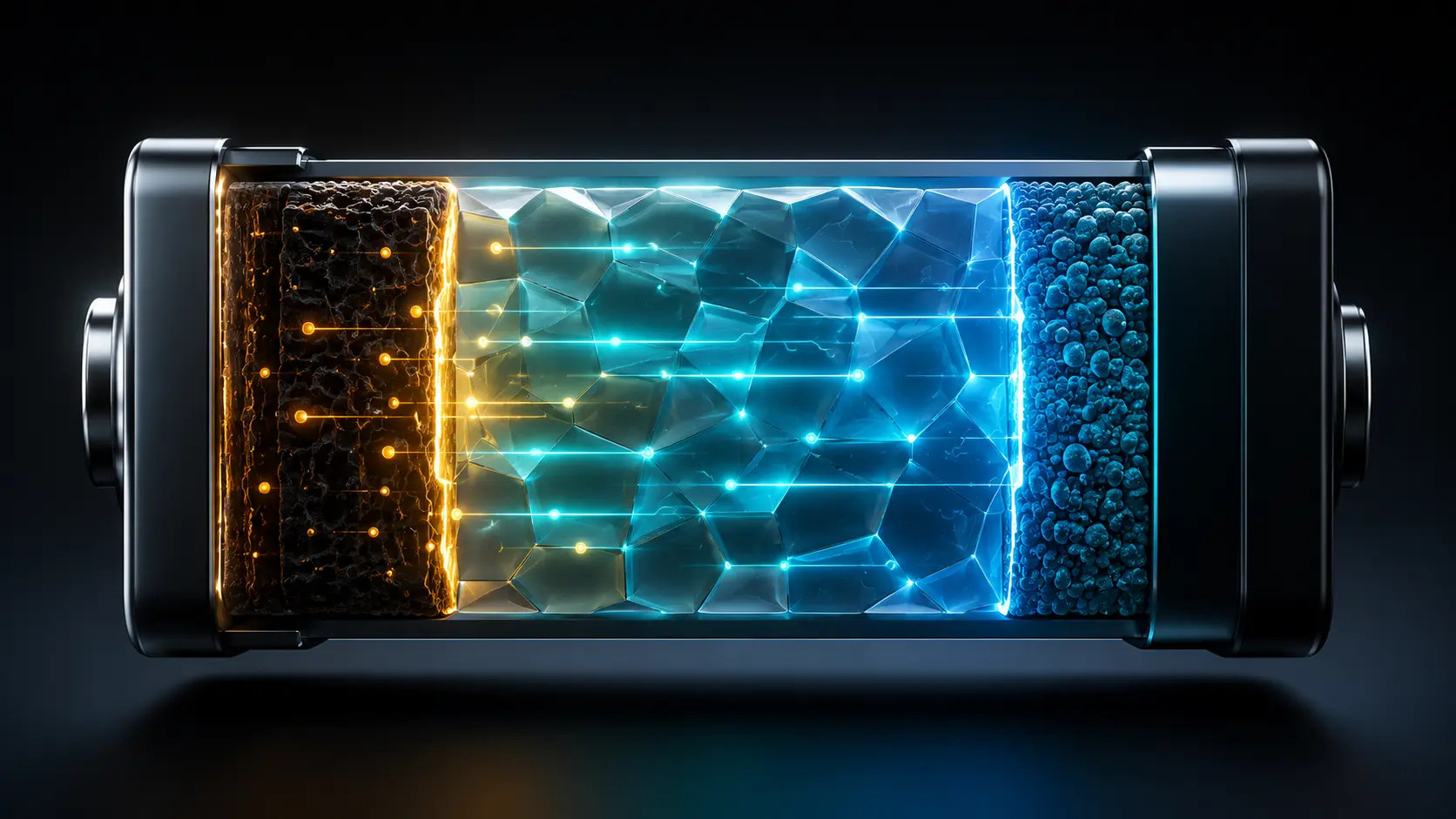
Commercial solid-state EV batteries are advanced energy storage systems that replace the highly flammable liquid electrolytes found in conventional lithium-ion cells with a rigid, solid conductive material. By utilizing high-density architectures like oxide-polymer composites, these batteries safely push energy densities beyond the 350 Wh/kg threshold, enabling massive range extensions and rapid charging capabilities without combustion risks.
At a Glance
- Concept: Eliminating liquid components inside a battery and replacing them with a solid ion-conducting barrier, drastically reducing volume while maximizing structural safety.
- Why it matters: Solid-state technology enables vehicles to shed roughly 30% of their battery weight compared to liquid-based counterparts. Lighter vehicles are more efficient, allowing automakers to reach 1,000-km ranges without building impractically massive cars.
- Who uses it: Top-tier automotive OEMs and battery manufacturers (e.g., Dongfeng Motor, Toyota, QuantumScape, CATL) aiming to dominate the second half of the 2020s.
- Biggest takeaway: Solid-state batteries decouple range from fire risk. They can survive temperatures reaching 170°C and catastrophic physical compression without igniting, completely rewriting modern automotive safety standards.
In Simple Words
Inside every standard battery, there are two ends (an anode and a cathode) separated by a chemical soup called a liquid electrolyte. When you drive, electrical particles (ions) swim through this liquid from one end to the other.
The problem is that this liquid soup is essentially highly flammable gasoline. If the battery gets too hot, or if it is punctured in a car crash, the liquid catches fire. Furthermore, because the liquid is unstable, engineers cannot use the most powerful, energy-dense materials (like pure lithium metal) for the battery’s ends, because they react violently with the liquid soup.
A Solid-State Battery drains the soup entirely. Instead of liquid, engineers insert a hard, solid piece of advanced ceramic or polymer. The ions can still move through this solid barrier, but the fire risk drops to absolutely zero. Because the battery is now structurally solid, engineers can safely pack it with vastly more powerful materials. This means you get a battery that is 30% lighter, holds enough power to drive from Beijing to Shanghai on a single charge, and won’t explode even if the car is crushed in a major accident.
Why This Matters
The global electric vehicle market is hitting a natural adoption ceiling. Early adopters were willing to tolerate “range anxiety” and slower charging speeds, but the mass-market consumer demands parity with the internal combustion engine.
For Automotive Engineers and Cleantech Investors, the 350 Wh/kg energy density mark achieved by late-2026 commercial solid-state cells is the ultimate inflection point. It allows automakers to build normal-sized, affordable vehicles that easily exceed 600 miles of range. Additionally, because the solid electrolyte is not prone to thermal runaway, the heavy, expensive cooling networks that snake through current Tesla and BYD battery packs can be significantly reduced. This simplifies the supply chain, accelerates manufacturing throughput, and fundamentally changes the unit economics of building an EV.
The Evolution of Solid-State EV Batteries: Oxide-Polymer Composites
The race to commercialize solid-state batteries has historically been divided into competing material factions: sulfides, oxides, and polymers.
Sulfides offer incredibly fast ion movement but are fragile, expensive, and react with moisture to create toxic gas. Pure polymers are cheap and easy to manufacture but suffer from poor conductivity at room temperature. Pure oxides are highly stable and conductive but are as brittle as glass, making them prone to cracking inside a vibrating, moving vehicle.
The commercial breakthrough of 2026 relies on convergence. The industry has broadly adopted oxide-polymer composite technology pathways. By blending the high conductivity and safety of oxide ceramics with the flexible, adhesive properties of polymers, manufacturers have finally created a solid electrolyte that performs perfectly at room temperature, withstands automotive shock, and is fully compatible with existing roll-to-roll manufacturing equipment.
How Solid-State EV Batteries Break the 350 Wh/kg Threshold
Extracting 350 Wh/kg of energy from a battery cell requires hacking the fundamental physics of intercalation and thermal limits. Here is the first-principles breakdown of the solid-state architecture.
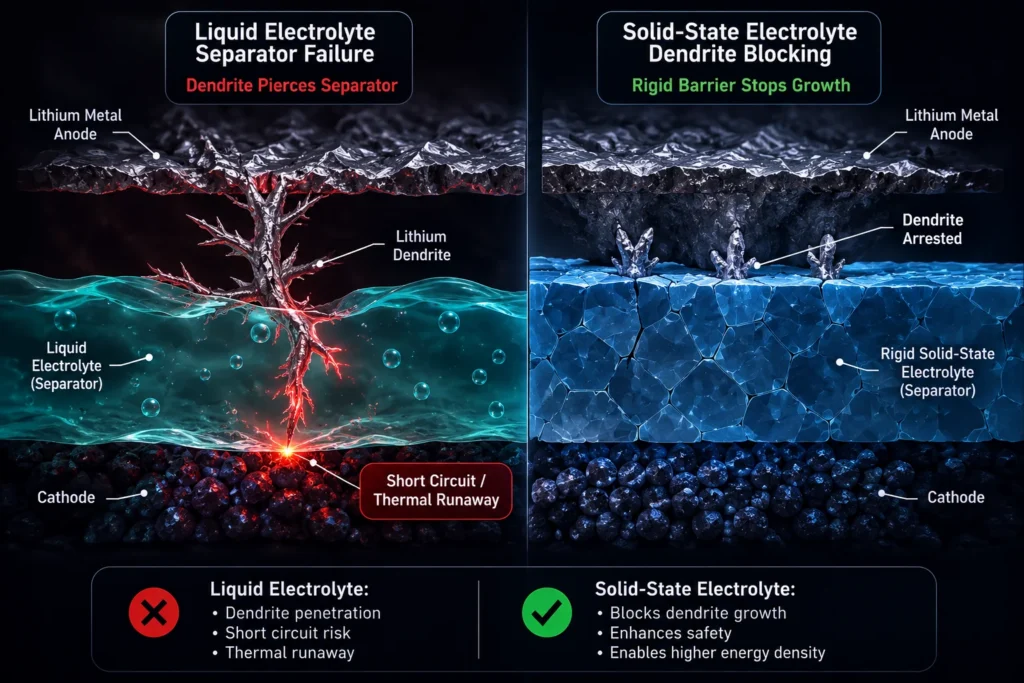
1. The Fundamental Problem: The SEI Layer and Dendrites
In liquid lithium-ion batteries, charging the battery too fast causes lithium ions to pile up on the anode instead of smoothly entering the structure. This creates “dendrites”—sharp, microscopic, needle-like spikes of lithium metal. Over time, these spikes grow until they physically pierce the separator, short-circuit the cell, and trigger a fiery explosion.
2. The Insufficiency of Liquid Separators
Standard batteries use a thin, porous plastic film to separate the positive and negative sides. This plastic is soft. If a dendrite grows, the plastic cannot stop it. To prevent dendrites, standard batteries use graphite anodes, which safely hide the lithium but take up massive amounts of physical space, killing energy density.
3. The Core Mechanism: The Solid Oxide-Polymer Electrolyte
A solid-state battery replaces the plastic film and the liquid with a dense, mechanically rigid solid electrolyte. The most viable commercial route uses an oxide-polymer composite. This material is physically hard enough to suppress the growth of dendrites.
4. Technical Depth: Activating the Lithium Metal Anode
Because the solid electrolyte stops dendrites from piercing through, engineers no longer need bulky graphite to hide the lithium. They can use a pure Lithium Metal Anode. Lithium metal has an incredibly high theoretical specific capacity (3,860 mAh/g), which is roughly ten times higher than standard graphite. This direct substitution is exactly what vaults the overall cell energy density past the 350 Wh/kg threshold.
5. Real-World Consequences: Extreme Abuse Tolerance
Because there is no volatile liquid to boil and no risk of internal short circuits from dendrites, the thermal stability window of the battery expands massively. The cells can endure staggering abuse: they continue to function even after being compressed to 50% of their original thickness and show zero signs of smoke or combustion when exposed to direct heat testing at 170°C.
Real-World Applications
The graduation of solid-state technology from the lab into the factory changes the logistical realities of major industries.
Long-Haul Passenger Vehicles: Range anxiety effectively dies in 2026. Vehicles equipped with 350 Wh/kg packs can execute routes like Beijing to Shanghai without requiring a single mid-trip charging stop. This fundamentally alters consumer behavior, aligning EV usage perfectly with historical combustion-engine driving habits.
Extreme Cold Weather Deployment: Liquid electrolytes freeze and become incredibly sluggish at low temperatures, causing severe range degradation during winter. Solid-state oxide-polymer batteries do not freeze in the same manner. During rigorous trials in Mohe (China’s northernmost city), commercial solid-state cells retained an astonishing 74% of their total capacity at -30°C, ensuring that a 1,000-km EV remains highly functional even in the dead of winter.
High-Performance and Aerospace Applications: Because solid-state cells are 30% lighter than traditional batteries for the same energy output, they are immediately attractive to high-performance hypercars and emerging eVTOL (Electric Vertical Takeoff and Landing) aircraft. Shedding mass while drastically lowering fire risk unlocks aviation use cases that were previously grounded by the weight of liquid-cooling systems.
Economic & Strategic Impact
The mass production of solid-state batteries shifts automotive leverage toward companies that achieve 100% Core Technology Self-Reliance.
Historically, automakers purchased battery cells from external suppliers (like LG or Panasonic) because the chemistry was heavily commoditized. The solid-state transition requires deep integration between the chassis, the cooling systems, and the cell itself.
Automakers that have built fully integrated R&D and production bases—managing everything from proprietary electrode material synthesis to full pack assembly—gain an insurmountable cost advantage. By owning the pilot lines and trial production facilities internally, these OEMs bypass supply chain bottlenecks and shield their gross margins from external battery cartels, setting the stage for a massive consolidation of power in the late 2020s auto industry.
Advantages
- Extreme Energy Density: Achieves 350 Wh/kg, enabling ranges exceeding 1,000 km without increasing the physical size of the battery pack.
- Absolute Thermal Safety: Replaces flammable liquids with stable solids. Cells survive 170°C heat and extreme 50% physical deformation without combustion.
- Weight Reduction: The elimination of heavy liquid electrolytes and complex cooling armor reduces total battery pack weight by approximately 30%.
- Manufacturing Compatibility: Oxide-polymer composite pathways are fully compatible with existing battery production equipment, lowering the capital expenditure needed to retrofit factories.
Limitations
- Interfacial Contact Resistance: Solids do not naturally conform to each other. Maintaining perfect, continuous microscopic contact between the solid electrode and the solid electrolyte as the battery expands and contracts during charging remains a long-term durability challenge.
- High Initial CapEx Limits: While compatible with existing lines, establishing the ultra-dry rooms and specialized pressing equipment required for early solid-state production runs demands immense upfront capital, temporarily raising the cost per kilowatt-hour relative to deeply commoditized LFP batteries.
- Pressure Requirements: Some solid-state architectures require significant external mechanical pressure applied to the battery pack to keep the internal layers tightly fused together, adding structural complexity to the vehicle chassis.
Common Misconceptions
Misconception: Solid-state batteries are still a decade away.
Reality: The technology has officially moved out of the laboratory. Major regional automotive players have established comprehensive trial and pilot lines, legally confirming mass production and direct vehicle integration for the second half of 2026.
Misconception: Solid-state means zero degradation over time.
Reality: While they eliminate liquid-based degradation, solid-state cells still suffer from mechanical fatigue. As lithium moves in and out of the electrodes, the physical volume changes, which can slowly cause microscopic fracturing in the solid layers over hundreds of charge cycles.
Misconception: All solid-state batteries are the exact same.
Reality: There are vastly different chemical pathways. Some automakers are betting entirely on sulfides, which offer great performance but are highly sensitive to moisture. The commercial winners of 2026 have largely adopted hybrid oxide-polymer composites because they offer the most viable, resilient path to rapid mass-market manufacturing.
What Most People Miss
The disruptive impact of the Mature Raw Material Supply Chain.
When evaluating next-generation battery technology, investors frequently obsess over the theoretical limits of the chemistry. What they miss is the logistics of procurement.
The primary reason oxide-polymer composites won the race to 2026 commercialization is not because they are theoretically perfect, but because their raw materials are readily available. Unlike exotic laboratory chemistries that require rare-earth elements or entirely unproven refining processes, the oxide-polymer route leverages a mature, global supply chain. This means manufacturers do not have to wait a decade for new mines to open; they can scale from gigawatt-hours to terawatt-hours almost immediately, utilizing existing chemical processing networks.
Comparison Table
| Feature | Liquid Lithium-Ion (NMC) | Liquid Lithium Iron Phosphate (LFP) | Oxide-Polymer Solid-State (2026) |
| Electrolyte State | Flammable Liquid | Flammable Liquid | Rigid Solid Composite |
| Max Energy Density | ~250 – 280 Wh/kg | ~160 – 190 Wh/kg | 350+ Wh/kg |
| Thermal Runaway Risk | Very High | Low to Moderate | Virtually Zero (Stable at 170°C) |
| Cold Weather Perf. | Severe Range Drop | Moderate to Severe Drop | Excellent (74% capacity at -30°C) |
| Weight Profile | Baseline | Heavy | 30% Lighter |
| Mass Production | Fully Commoditized | Fully Commoditized | Scaling H2 2026 |
Case Study: Dongfeng to Mass-Produce Solid-State Batteries in H2 2026
Situation: For years, solid-state batteries were criticized as perpetual “five years away” lab experiments. Legacy western automakers and startups struggled to scale up the manufacturing of fragile ceramic solid electrolytes without destroying their gross margins.
Challenge: Bringing a solid-state battery to automotive scale required balancing high ionic conductivity, extreme mechanical flexibility, and strict compatibility with existing gigafactory roll-to-roll manufacturing lines.
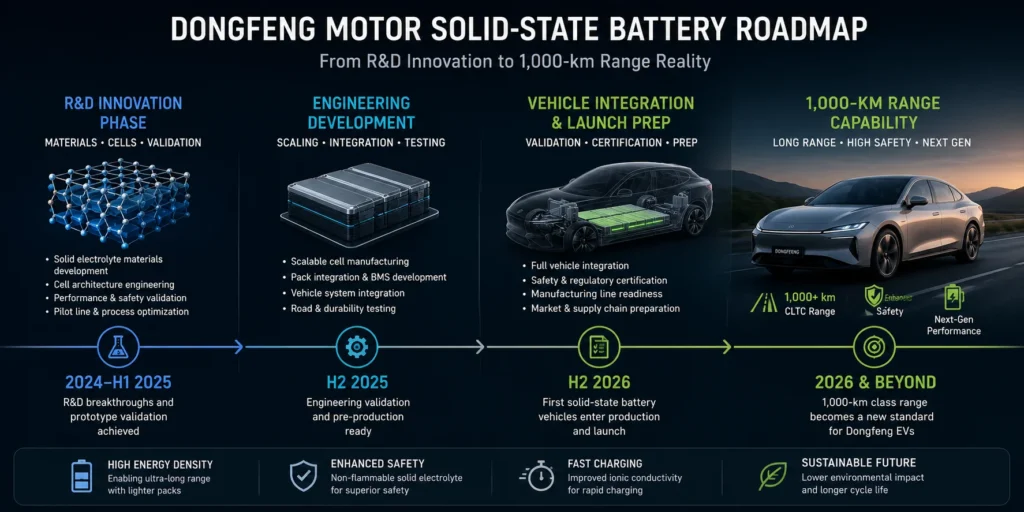
Solution (The H2 2026 Milestone): Chinese automaker Dongfeng Motor committed relentlessly to the oxide-polymer composite technology pathway. This specific chemical route perfectly blended the high safety of oxide ceramics with the flexible manufacturing properties of polymers. The company executed a strategy of absolute vertical integration, achieving 100% self-reliance across its core technologies, from electrode materials and solid electrolyte development to full battery pack assembly.
Outcome: Dongfeng’s newly established research and production campus validated the cells, achieving a confirmed energy density of 350 Wh/kg. In extreme abuse trials, the battery withstood physical compression to 50% of its original thickness and heat exposure up to 170°C with zero smoke or fire. Furthermore, it proved its winter capability in Mohe, China, retaining over 74% capacity at -30°C.
Lessons Learned: By validating the oxide-polymer route, Dongfeng proved that utilizing a hybrid materials approach bridges the massive gap between laboratory perfection and high-yield commercial execution. Their announcement to begin mass production and vehicle integration in the second half of 2026 signals a definitive timeline, putting immense pressure on legacy competitors to accelerate their own solid-state programs.
Future Outlook
Next 12–24 Months
The era of Flagship Vehicle Integration. Throughout late 2026 and 2027, commercial solid-state batteries will exclusively feature in premium, flagship electric vehicles (like Dongfeng’s eπ007 platform). These early integrations will serve as high-profile, real-world validation testbeds for 1,000-km ranges. Competing OEMs will closely monitor real-world degradation metrics and winter performance data, sparking a fierce marketing war where traditional lithium-ion vehicles are suddenly painted as technologically obsolete.
Next 3–5 Years
The Cost Curve Collapse and Mid-Market Adoption. As pilot lines transition into full-scale, dedicated solid-state gigafactories, economies of scale will take hold. By the end of the decade, the unit cost per kilowatt-hour of oxide-polymer batteries will drop sharply. Automakers will begin cascading the technology down into mid-market SUVs and sedans. The 30% reduction in battery pack weight will allow manufacturers to drastically reduce the amount of structural steel and suspension reinforcement required in EV chassis, yielding massive secondary cost savings across the vehicle assembly process.
Next 10 Years
The Complete Phase-Out of Liquid Electrolytes. By the mid-2030s, liquid lithium-ion batteries will be largely relegated to history for long-range transportation, heavily regulated out of the market due to their inferior fire safety profiles. Solid-state architectures will achieve the ultimate theoretical goal: the deployment of pure, unadulterated lithium metal anodes pushing energy densities toward 500 Wh/kg. This will enable commercial electric aviation (eVTOLs) and heavy-duty electric trucking to achieve true payload parity with diesel engines.
Most Likely Scenario
The commercialization threshold has been crossed. The oxide-polymer composite route has definitively solved the manufacturing bottlenecks that paralyzed the industry for a decade. As mass production scales in H2 2026, solid-state batteries will permanently sever the link between EV driving range and fire risk, establishing a new, unassailable baseline standard for global automotive engineering.
Key Takeaways
- Solid-state batteries replace flammable liquid electrolytes with stable, rigid solid materials, fundamentally eliminating the risk of combustion and explosion in EVs.
- By utilizing oxide-polymer composites, manufacturers have hit energy densities of 350 Wh/kg, enabling driving ranges that easily exceed 1,000 kilometers on a single charge.
- The technology vastly improves extreme-weather performance, maintaining 74% capacity in -30°C freezing conditions while surviving direct heat exposure up to 170°C.
- The solid architecture enables a 30% reduction in battery pack weight compared to traditional liquid counterparts, further extending vehicle efficiency.
- Companies like Dongfeng Motor are bypassing traditional suppliers by achieving 100% self-reliance in core electrode and solid electrolyte technologies.
- Mass production and vehicle integration of these batteries are officially scheduled for the second half of 2026, marking a profound paradigm shift in global automotive supply chains.
Glossary
Dendrites: Microscopic, needle-like structures of lithium metal that can grow inside a battery during charging, potentially piercing separators and causing short circuits. Solid electrolytes physically block their growth.
Electrolyte: The medium that allows electrical ions to travel back and forth between the anode and cathode. Traditional batteries use volatile liquids; solid-state batteries use safe, solid ceramics or polymers.
Energy Density (Wh/kg): A measurement of how much energy a battery can store relative to its physical weight. Higher energy density means more driving range without adding heavier batteries.
Lithium Metal Anode: The ultimate goal for battery engineers. Using pure lithium metal instead of bulky graphite drastically increases energy density, but it is only safe to use if paired with a solid electrolyte.
Oxide-Polymer Composite: A hybrid solid-state material that combines the high ionic conductivity and safety of oxide ceramics with the flexibility and manufacturing ease of plastics (polymers).
Thermal Runaway: A catastrophic, uncontrollable chain reaction inside a liquid lithium-ion battery where excess heat causes the liquid to boil and combust, resulting in violent fires.
Frequently Asked Questions
Are solid-state batteries actually fireproof?
Yes, in practical automotive terms. Because they entirely replace the flammable liquid electrolyte with a solid oxide-polymer composite, there is no combustible fuel source inside the cell to ignite, even when subjected to 170°C heat or crushed to 50% of its size.
Why did it take so long to mass-produce them?
Solid ceramics are brittle and hard to manufacture on standard assembly lines, while solid polymers have poor conductivity. It took years to perfect the “composite” blending of the two materials so they could be manufactured quickly and cheaply using existing factory equipment.
Will my current EV become obsolete?
Technologically, the shift is highly disruptive. While current EVs will remain fully functional, vehicles equipped with 2026 solid-state technology will boast 1,000-km ranges and superior safety profiles, likely accelerating the depreciation of older, heavy, liquid-based EV models.
Can solid-state batteries charge faster?
Yes. Because there is zero risk of the liquid boiling or dangerous dendrites forming rapidly at high currents, solid-state cells can accept massive amounts of electricity safely, radically reducing fast-charging times at highway stations.
Are these batteries heavier?
No, they are actually about 30% lighter than traditional liquid lithium-ion battery packs. By removing the liquid, the bulky graphite, and the heavy thermal-cooling armor, automakers can pack vastly more energy into a much lighter physical footprint.
Sources
[1] CarNewsChina: Dongfeng to mass-produce solid-state batteries in H2 2026, enabling 1,000 km+ range (June 2026)
[2] Battery-Tech: Dongfeng to Mass Produce Solid-State Batteries in H2 2026 (June 2026)
[3] CarsGuide: Dongfeng solid-state batteries to be mass-produced in 2026 with 1000km-plus of driving range (June 2026)
[4] YouTube: CONFIRMED FOR 2026! The 1000km+ Solid-State Battery That ENDS The Competition (June 2026)
[5] Gasgoo AutoNews: Dongfeng Motor to mass-produce next-generation solid-state batteries for vehicles in H2 (June 2026)