Advertisement
)

AT A GLANCE
- Concept: 5-Prime Cap: A chemical helmet placed at the start of an RNA strand ensuring biological stability.
- Concept: Immune Evasion: Specific molecular methylation patterns trick human cells into recognizing the synthetic strand as native.
- Concept: Co-Transcriptional Assembly: Enzymes attach the cap simultaneously as the RNA strand prints, maximizing manufacturing yield.
- Concept: Intellectual Monopoly: Patented capping architectures dictate the financial floor of global programmable medicine production.
HOW IT WORKS
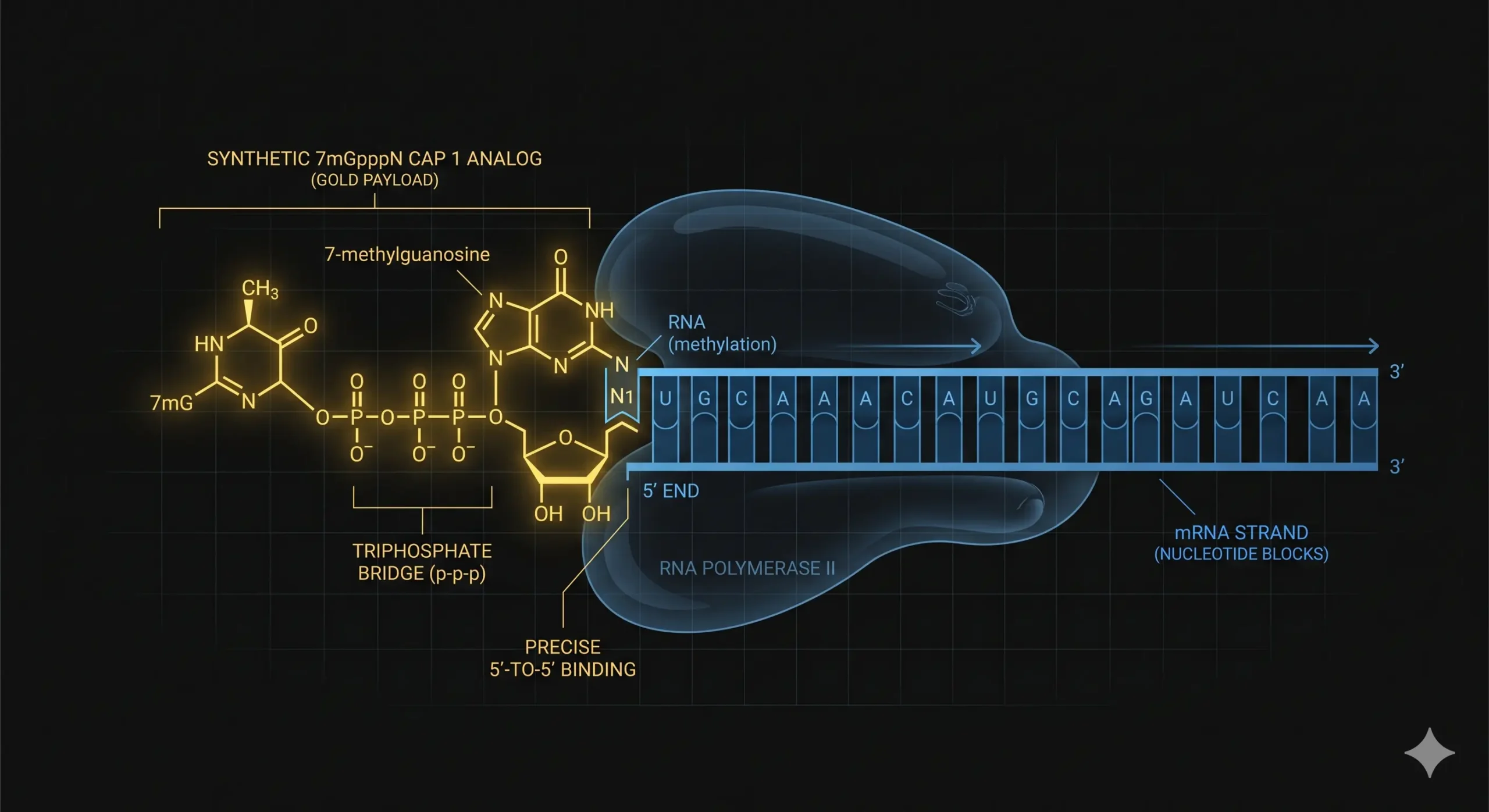
Human cells produce messenger RNA natively. When cellular machinery prints a natural RNA strand, it attaches a specialized molecule called a 7-methylguanosine cap to the starting point, known biologically as the 5-prime (5′) end.
This biological helmet serves two immediate mechanical functions. It provides a physical docking station for the ribosome to begin reading the genetic code, and it blocks destructive enzymes from shredding the exposed tip of the strand.
Synthetic mRNA therapies must perfectly replicate this exact molecular architecture. Engineers produce these therapeutics outside the human body in massive stainless steel bioreactors using a biochemical process called in vitro transcription.
In early industry iterations, manufacturers built the raw RNA strand first, then used a secondary enzymatic reaction to manually attach the cap. This two-step batch process proved highly inefficient, frequently leaving a large percentage of the therapeutic strands dangerously uncapped.
Modern biomanufacturing solves this constraint by using engineered cap analogs, such as the patented CleanCap system. These synthetic chemical structures allow for immediate co-transcriptional capping.
Engineers mix the cap analogs, the raw nucleotide building blocks, and the polymerase enzyme into a single fluid solution.
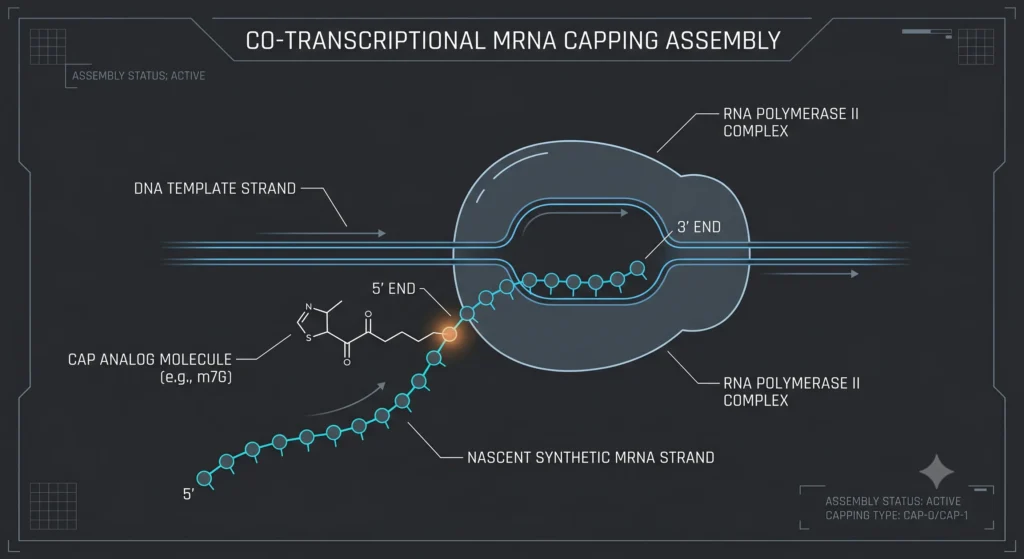
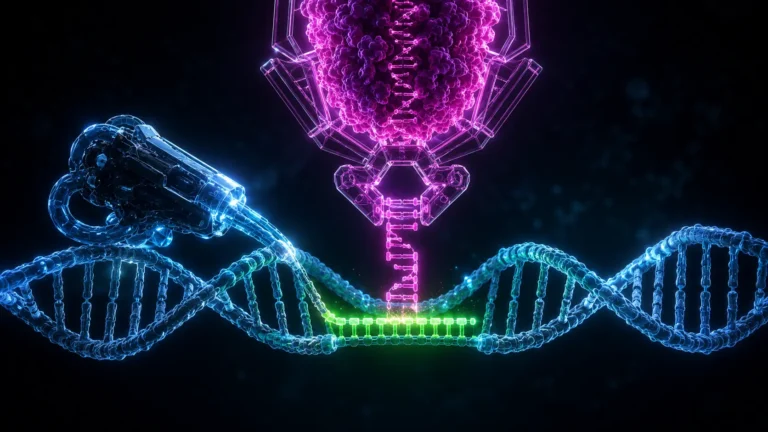
As the polymerase prints the synthetic RNA strand, it automatically grabs the cap analog and chemically welds it to the 5′ end. The synthetic analog features specific methylation at the Cap 1 position, structurally masking the synthetic nature of the delivered therapy.
WHY IT MATTERS NOW
Mainstream analysis attributes the success of mRNA therapeutics almost entirely to the lipid nanoparticle delivery casing. This focus overlooks the internal biochemical payload. An LNP can deliver a genetic strand perfectly into a cell, but if that strand lacks a precise Cap 1 structure, the therapy fails instantly.
The human innate immune system actively hunts for foreign RNA. Intracellular sensors like RIG-I and MDA5 constantly patrol the cytoplasm for viral intruders. When these sensors detect an RNA strand lacking the proper methylation cap, they immediately trigger an aggressive interferon cascade.
This immune alarm destroys the therapy and causes severe localized inflammation in the patient. Securing the molecular patents for these cap analogs creates an invisible, highly lucrative chokepoint in global pharmaceutical manufacturing.
Corporations like TriLink BioTechnologies effectively monopolized the co-transcriptional capping market. Any nation or corporation attempting to scale an mRNA vaccine or oncology therapeutic must pay massive licensing fees to access this specific biochemical architecture.
This monopoly directly controls the financial viability of next-generation medicine. Because co-transcriptional capping achieves over 95 percent efficiency in a single bioreactor step, it drastically reduces the required raw material inputs and purification costs.
WHAT MOST PEOPLE MISS
Biotech observers often assume that once RNA enters the cell, it produces medicine indefinitely. They miss the severe temporal limits dictated by molecular half-lives. Cellular enzymes called exonucleases continuously attack the 5′ end of the mRNA strand, physically chewing the code apart molecule by molecule.
The exact chemical design of the synthetic cap analog determines how long the strand survives this enzymatic assault. A perfectly engineered cap buys the RNA strand several additional hours of survival inside the cytoplasm. In pharmaceutical terms, this extended translation window dictates whether a microscopic dose generates enough target protein to become a commercial success.
THE TRAJECTORY
Next 12–36 Months: Global regulatory agencies will demand stricter quantification of uncapped RNA species in final therapeutic formulations. Biomanufacturers will deploy advanced mass spectrometry to prove that 99 percent of their product carries the precise Cap 1 analog to meet FDA purity mandates.
Next Five Years: Chemical engineers will synthesize entirely novel, non-natural cap analogs that exhibit extreme resistance to cellular exonucleases. These hyper-stabilized structures will extend the protein translation window from hours to weeks, enabling single-dose treatments for chronic metabolic disorders.
Next Ten Years: The industry will move beyond linear mRNA entirely, commercializing circular RNA architectures. By physically tying the ends of the RNA strand together into a closed loop, scientists will bypass the need for a 5′ cap completely, neutralizing current intellectual property monopolies.
What Could Go Wrong: Over-stabilizing the cap structure creates a unique biological hazard. If a synthetic mRNA strand resists natural cellular degradation for too long, it will overproduce the target protein, potentially triggering a severe autoimmune response against the host’s own organs.
Most Likely Outcome: Co-transcriptional cap analogs will remain the non-negotiable chemical standard for the programmable medicine industry. The intellectual property landscape will fragment as competitors engineer slight structural variants to bypass existing patents, ultimately lowering the unit cost of mRNA production globally.
KEY TERMS
- Cap Analog: A laboratory-synthesized chemical compound designed to mimic the natural structure found at the beginning of a native RNA strand.
- In Vitro Transcription (IVT): The biological manufacturing process of synthesizing RNA outside of a living cell using specific enzymes and raw genetic templates.
- Co-Transcriptional Capping: A highly efficient manufacturing technique where the protective cap is added to the RNA strand simultaneously as the strand is being synthesized.
- Interferon Response: A rapid, aggressive immune system reaction triggered when cellular sensors detect foreign or improperly structured genetic material.
- Exonuclease: A biological enzyme designed to break down and recycle RNA strands by chemically attacking the unprotected ends of the molecule.
SOURCES
- U.S. Food and Drug Administration (FDA) — Chemistry, Manufacturing, and Controls for mRNA-Based Therapeutics
- Nature Biotechnology — Co-transcriptional Capping Methods for Industrial-Scale mRNA Production
- Journal of Biological Chemistry — Recognition of 5′-Cap Structures by the Innate Immune System
- TriLink BioTechnologies — CleanCap Technology and mRNA Synthesis Parameters