Advertisement
)

AT A GLANCE
- Concept: Electromagnetic Latch: Coils generate magnetic fields to hold heavy control rods suspended above the active reactor core.
- Concept: Fail-Safe Physics: Cutting electrical power collapses the magnetic field instantly, guaranteeing a gravity-driven rod drop during emergencies.
- Concept: Neutron Absorption: Boron and silver-indium-cadmium alloys physically block the subatomic chain reaction within milliseconds of insertion.
- Concept: Hydraulic Dampening: Internal fluid buffers absorb the massive kinetic energy of falling rods to prevent catastrophic structural damage.
HOW IT WORKS
Nuclear fission operates on a strict subatomic multiplication principle. A uranium atom splits, releasing heat and multiple free neutrons. These free neutrons strike other uranium atoms, sustaining a continuous energy-generating chain reaction.
To control this reaction, engineers use specialized metallurgical alloys like boron carbide or silver-indium-cadmium. These materials act as neutron poisons. They feature a massive atomic cross-section that readily absorbs free neutrons without splitting themselves, suffocating the physical chain reaction.
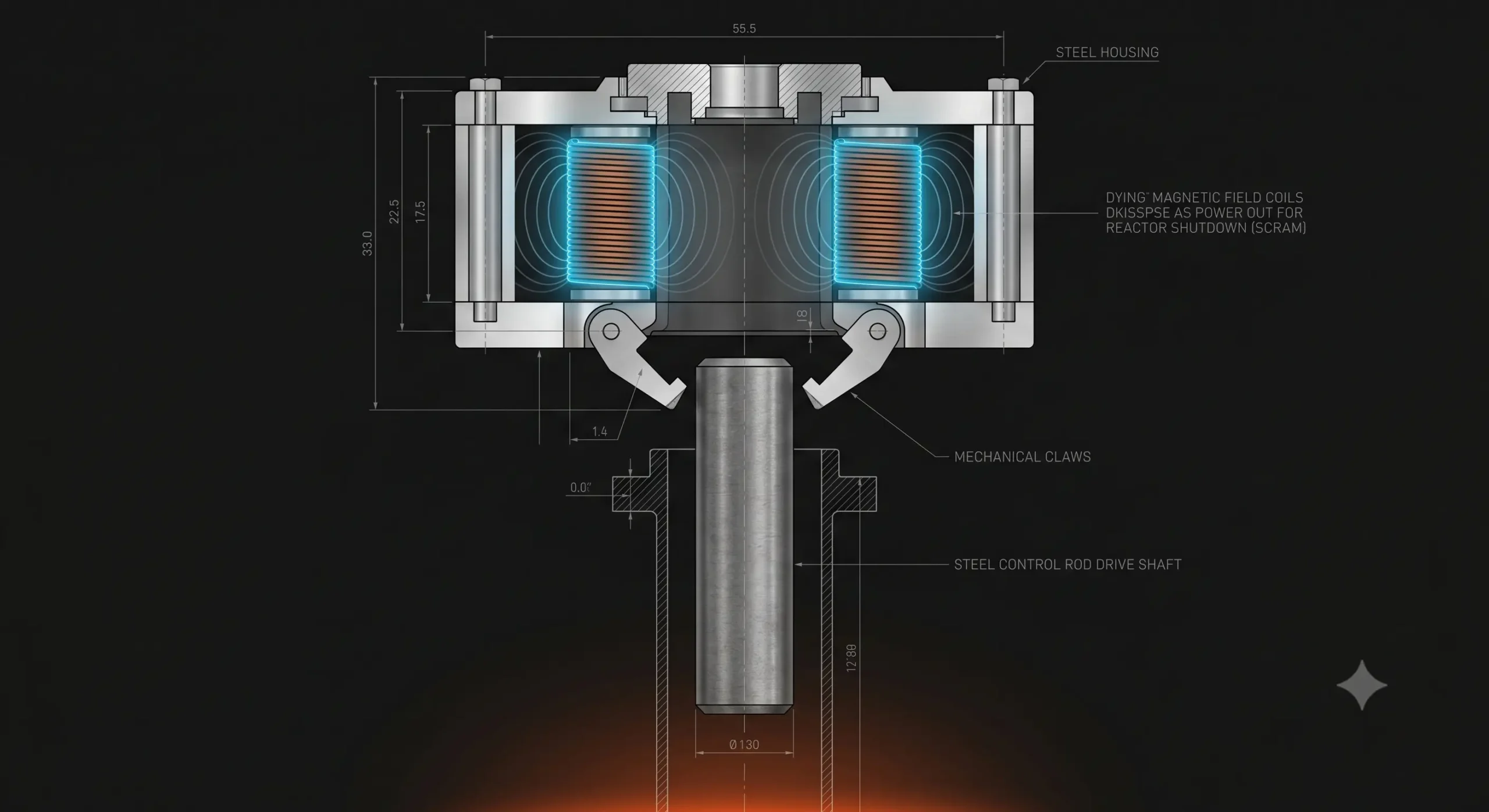
Operators suspend clusters of these neutron-absorbing rods directly above the reactor core using a control rod drive mechanism. During normal operation, direct current flows through heavy electromagnetic coils located outside the pressure boundary. This electrical current generates a focused magnetic field that physically engages movable latches inside the housing. These mechanical latches grip the drive rod, holding tons of physical material in vertical suspension above the nuclear fuel.
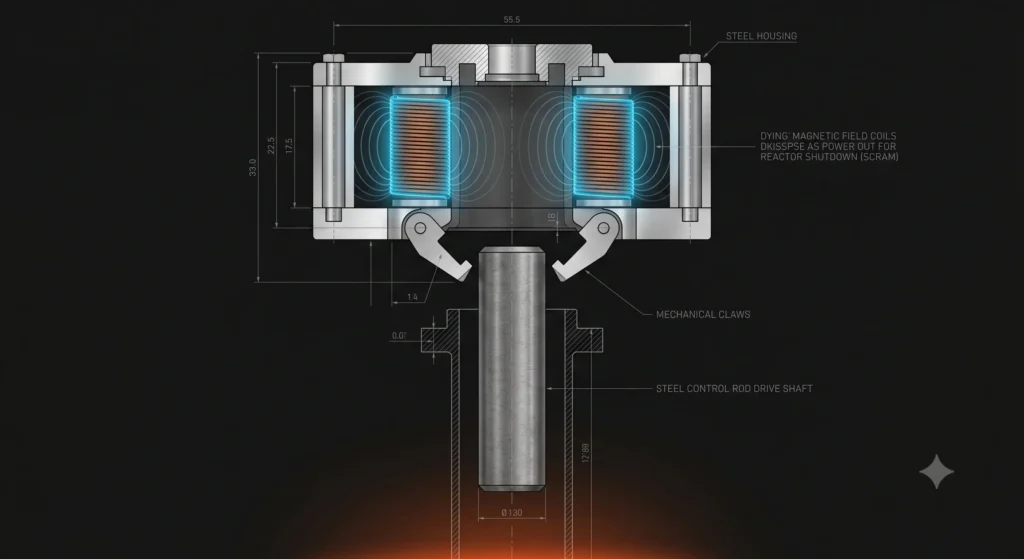
When the reactor control system detects a critical pressure or temperature anomaly, it initiates a scram. The safety relays physically sever the electrical power to the holding coils. Without electricity, the magnetic field collapses near the speed of light, releasing the mechanical latches instantly. Gravity takes absolute control, pulling the heavy control rods down into the fuel assembly in less than two seconds.
The initial holding capacity of the electromagnetic latch dictates this physical suspension, following the Maxwell stress tensor approximation:
$$F = \frac{B^2 A}{2 \mu_0}$$
Where F represents the gripping force, B is the magnetic flux density, A is the cross-sectional area of the magnetic pole, and μ_0 (mu zero) is the permeability of free space. The instant B drops to zero, the holding force mathematically vanishes.
As the heavy rods plummet into the core, they reach extreme kinetic velocities. If the steel rods hit the bottom at full speed, they would physically shatter the delicate fuel assemblies. To prevent this destruction, engineers install specialized hydraulic dampers at the base of the mechanism. These mechanical buffers force pressurized coolant water through narrow internal orifices, safely dissipating the kinetic energy of the falling rod as fluid friction.
WHY IT MATTERS NOW
The global demand for zero-carbon baseload electricity forces nations to extend the lifespans of legacy nuclear plants and aggressively fund next-generation reactors. This nuclear renaissance relies entirely on the mathematical certainty of reactor safety. The control rod drive mechanism acts as the ultimate physical failsafe standing between controlled energy generation and an uncontrollable thermal meltdown.
Regulatory bodies like the Nuclear Regulatory Commission base their entire operational licensing framework on the exact reliability of this specific hardware. If a control rod mechanism shows microscopic signs of physical binding, galling, or thermal degradation, operators must shut down the entire gigawatt-scale power plant. A single mechanical stutter translates immediately into millions of dollars in lost daily electricity revenue.
This extreme reliability requirement creates a severe industrial bottleneck. Manufacturing the magnetic coils, latch assemblies, and pressure housings demands microscopic metallurgical tolerances. The components must cycle flawlessly millions of times while surviving decades of intense radiation and high-pressure steam.
Companies like Westinghouse and Framatome command this highly consolidated supply chain. Only a handful of global facilities possess the specialized forging equipment capable of producing the superalloys required for the pressure housings. The pace of global nuclear deployment depends entirely on the output capacity of these specific manufacturing floors.
As the industry shifts toward Small Modular Reactors, engineers face extreme pressure to radically compress the physical footprint of these drive mechanisms. Legacy mechanisms extend dozens of feet above the reactor vessel, requiring massive containment domes. New designs demand internal mechanisms that fit entirely inside the pressurized vessel, forcing manufacturers to build electromagnets that operate completely submerged in 300-degree Celsius reactor coolant.
WHAT MOST PEOPLE MISS
Public policy debates treat nuclear safety as a software problem, assuming digital computers and artificial intelligence algorithms keep modern reactors safe. They completely miss the mechanical reality that software cannot stop a runaway nuclear reaction if the physical hardware jams. The absolute baseline safety of a nuclear plant relies entirely on analog physics.
The system derives its perfection from its default state. The drive mechanism does not require active power to shut the reactor down. It requires continuous, uninterrupted power just to keep the reactor running. If a massive earthquake severs all electrical grid connections and destroys every backup diesel generator, the complete loss of power automatically initiates the scram. The physical laws of gravity and electromagnetism guarantee subcriticality without any human intervention.
THE TRAJECTORY
Next 12–36 Months: Utility companies will accelerate predictive maintenance programs using acoustic sensors clamped to the external pressure housings. These hardware sensors will detect microscopic friction changes in the latch mechanisms, allowing operators to replace degrading components during scheduled refueling outages before they fail.
Next Five Years: Advanced reactor developers will commercialize fully submerged control rod drive mechanisms. By moving the electromagnetic coils inside the primary coolant loop, engineers will eliminate complex mechanical penetrations through the reactor pressure vessel head, significantly neutralizing the physical risk of coolant leaks.
Next Ten Years: High-temperature gas-cooled reactors will utilize advanced pneumatic or magnetic levitation drives. These architectures will completely eliminate physical contact between moving metal parts, removing friction from the equation and extending the mechanism’s operational lifespan to match the eighty-year life of the reactor block.
What Could Go Wrong: Extreme thermal cycling or unexpected chemical corrosion could warp the vertical guide tubes inside the reactor core. If the tubes warp out of alignment, the falling control rods will physically jam halfway down during a scram, leaving the lower half of the core actively generating heat and accelerating toward a localized meltdown.
Most Likely Outcome: The gravity-driven electromagnetic latch will remain the non-negotiable architectural standard for light-water reactor safety. The manufacturing of these highly specific mechanisms will become heavily subsidized national security priorities as Western nations attempt to secure domestic control over the global nuclear fuel supply chain.
KEY TERMS
- Scram: The emergency shutdown of a nuclear reactor triggered by the rapid physical insertion of neutron-absorbing control rods into the core.
- Electromagnetic Latch: A mechanical gripper controlled by a magnetic field that suspends heavy control rods and releases them instantly upon a loss of electrical power.
- Subcriticality: A physical state where a nuclear reactor produces fewer neutrons than it loses, causing the fission chain reaction to naturally terminate.
- Hydraulic Damper: A fluid-based mechanical shock absorber that dissipates the kinetic energy of falling control rods to prevent structural damage upon impact.
- Neutron Poison: A specialized material, such as boron or cadmium, featuring a massive atomic cross-section for absorbing free neutrons without undergoing fission.
SOURCES
- Nuclear Regulatory Commission (NRC) — Standard Review Plan for Control Rod Drive Systems
- American Society of Mechanical Engineers (ASME) — Design and Analysis of Nuclear Reactor Internal Structures
- Westinghouse Electric Company — AP1000 Control Rod Drive Mechanism Specifications
- Journal of Nuclear Engineering and Radiation Science — Thermal-Hydraulic and Kinetic Modeling of Reactor Scram Mechanisms