Advertisement
)

AT A GLANCE
- Concept: The Zero-Crossing Problem: Direct current provides constant voltage, lacking the natural zero-point that alternating current uses to break arcs.
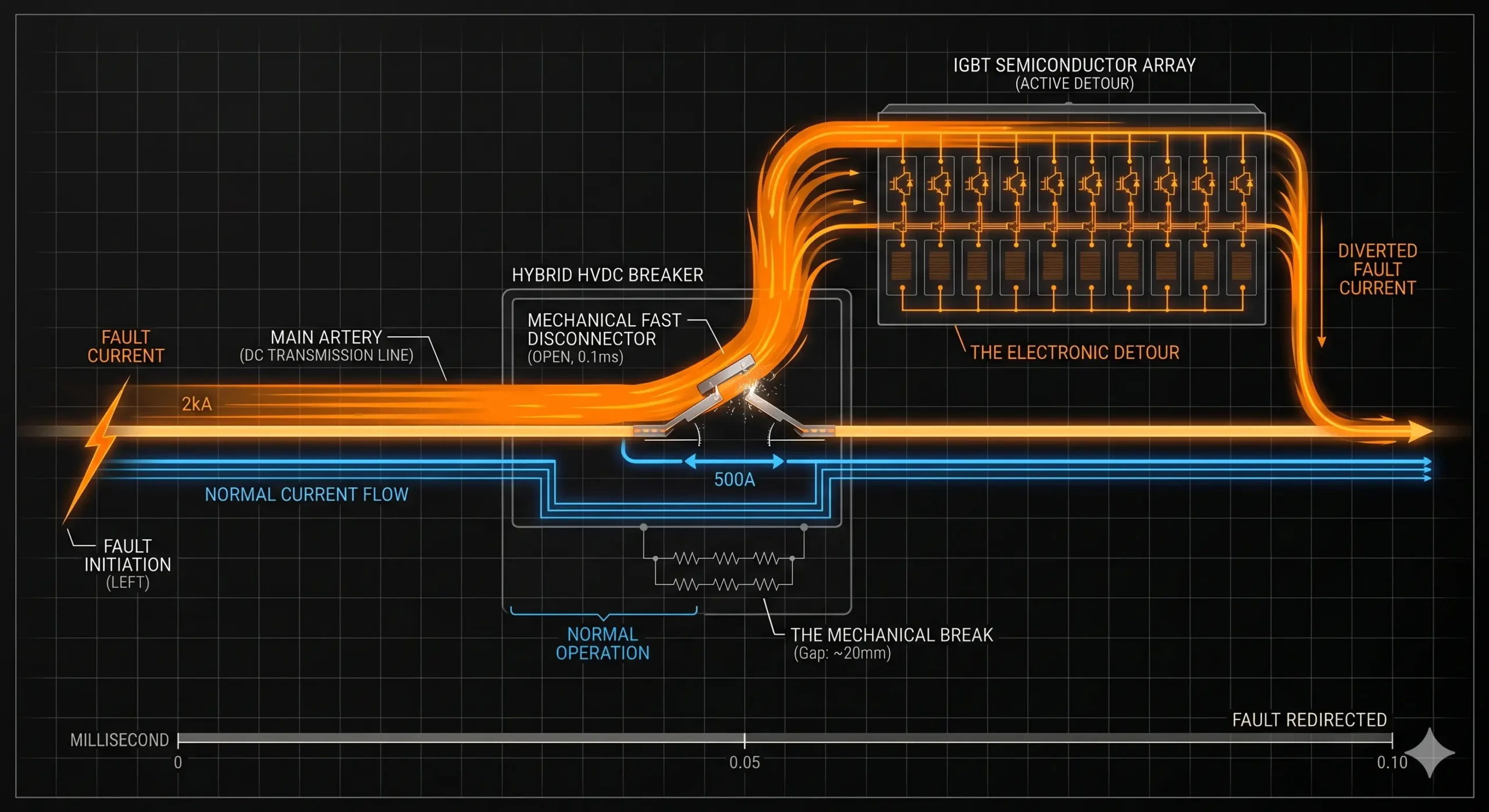
- Concept: Commutation Path: The breaker forces the massive fault current out of the mechanical switch and into a parallel electronic path.
- Concept: Arc Extinction: Fast-acting semiconductor modules counteract the direct current, driving the energy into surge arresters to dissipate as heat.
- Concept: Supergrid Enabling: Reliable fault isolation allows operators to connect multiple point-to-point HVDC lines into a unified continental network.
HOW IT WORKS
Standard alternating current naturally reverses direction fifty to sixty times per second. Every time the current switches direction, the voltage physically crosses zero. Mechanical circuit breakers use this brief zero-voltage instant to pull their metal contacts apart, safely extinguishing the electrical arc.
High-voltage direct current (HVDC) pushes electricity in one continuous, uninterrupted wave. It never crosses zero. If you physically pull two metal contacts apart while transmitting three gigawatts of continuous power, the current will simply tear electrons off the surrounding air molecules.
This creates a superheated plasma arc that bridges the physical gap, instantly melting the steel infrastructure. To sever this continuous flow, engineers must create an artificial zero-crossing point.
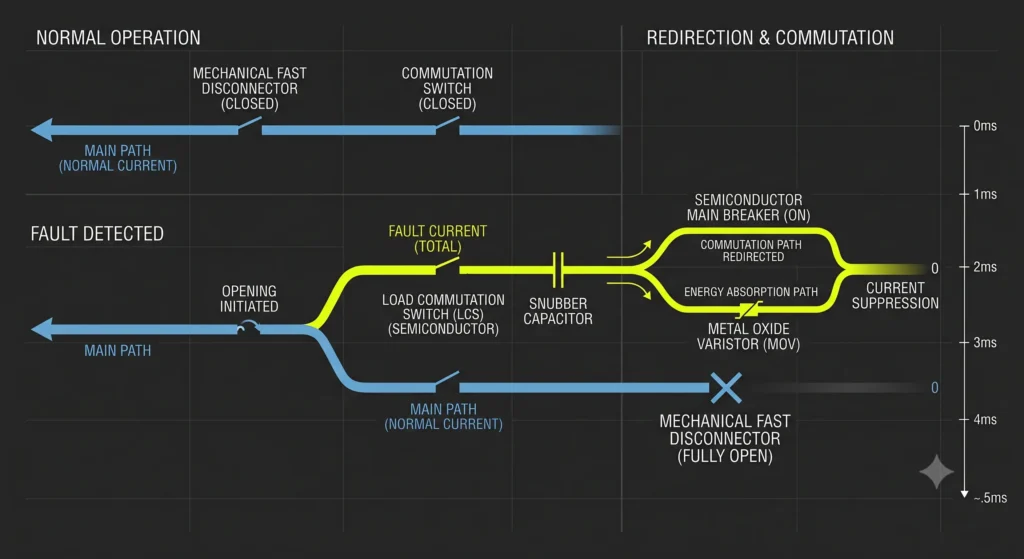
Modern hybrid HVDC breakers achieve this by splitting the current into two parallel paths. During normal operation, electricity flows through an ultra-fast mechanical switch. This generates zero electrical resistance and eliminates energy loss.
When a fault occurs, the system triggers a small auxiliary semiconductor block. This electronic switch actively shunts the massive electrical current out of the mechanical path and pushes it into a massive parallel bank of insulated-gate bipolar transistors (IGBTs).
Freed from the electrical load, the mechanical contacts snap open in less than two milliseconds. Once the physical gap is established, the main IGBT bank slams shut. The sudden electronic blockage forces the trapped kinetic energy of the grid into a bank of surge arresters, bleeding the fault out as harmless heat.
WHY IT MATTERS NOW
Nations currently build HVDC lines as simple point-to-point connections. They lay a single subsea cable to link an offshore wind farm directly to a coastal city.
Scaling renewable energy requires networking these isolated lines into a unified multi-terminal supergrid. A supergrid allows solar energy from the Sahara to seamlessly balance against wind energy generated in the North Sea.
This architectural leap is impossible without a functional HVDC circuit breaker. In a traditional point-to-point line, if a fault occurs, operators simply shut down the power converter stations at both ends.
In a multi-terminal grid, shutting down the entire network to clear a single localized short circuit would plunge half a continent into a total blackout. The grid requires a device that can isolate the exact damaged segment within five milliseconds while keeping the rest of the network actively flowing.
Manufacturing this hardware dictates the physical realization of the European Supergrid. Industrial giants like Hitachi Energy and Siemens Energy hold the proprietary power-electronic architectures required to commercialize these breakers, establishing a capital-intensive monopoly over the future of long-haul energy transport.
WHAT MOST PEOPLE MISS
Energy analysts model continental supergrids by drawing straight lines on a map, assuming wire capacity is the only logistical variable. They treat HVDC breakers as simple mechanical light switches that utility companies can purchase off the shelf.
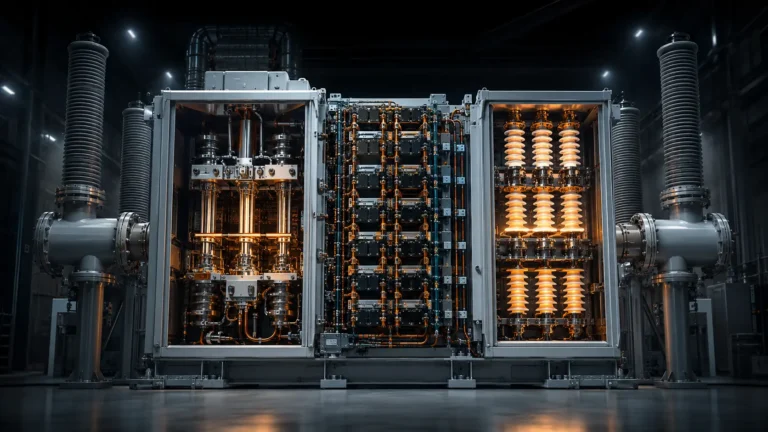
They ignore the extreme physical footprint of the power electronics. A single hybrid HVDC breaker is a multi-story building packed with thousands of liquid-cooled semiconductors and massive energy-absorbing resistor banks. The capital cost and physical space required to build these breaker stations fundamentally alter the economic viability of multi-terminal grids.
THE TRAJECTORY
Next 12–36 Months: Utility consortiums will commission the first true multi-terminal HVDC test nodes in the North Sea. These pilot projects will validate the interoperability of breaker systems manufactured by competing vendors.
Next Five Years: Hardware engineers will finalize solid-state DC breakers using advanced silicon carbide semiconductors. These pure-electronic breakers will eliminate moving mechanical parts entirely, drastically reducing maintenance cycles and physical site footprints.
Next Ten Years: Continental operators will establish meshed DC overlays operating in parallel with the legacy AC transmission network. HVDC breakers will autonomously route gigawatt-scale power flows instantly, turning the physical energy grid into a packet-switched routing network.
What Could Go Wrong: If a breaker fails to commutate the current within five milliseconds, the fault will cascade rapidly through the low-impedance DC network. This would trigger protective shutdowns across multiple interconnected countries, inducing a systemic pan-European blackout.
Most Likely Outcome: The hybrid HVDC breaker will serve as the mandatory physical router of the renewable energy transition. Nations will subsidize the extreme capital costs of these massive installations simply to unlock the geopolitical security of a fully integrated, multi-source continental power grid.
KEY TERMS
- High-Voltage Direct Current (HVDC): A bulk power transmission technology that uses direct current to move massive amounts of electrical energy efficiently over extremely long distances.
- Zero-Crossing: The specific instant when an alternating current waveform naturally passes through zero volts, allowing mechanical breakers to safely separate contacts.
- Commutation: The engineered process of forcing an electrical current to transfer from one physical conducting path to another.
- Insulated-Gate Bipolar Transistor (IGBT): A high-speed semiconductor device used extensively in power electronics to switch electrical power rapidly and efficiently.
- Multi-Terminal Grid: A power transmission network connecting more than two distinct converter stations, allowing for complex, multi-directional energy routing.
SOURCES
- CIGRE (International Council on Large Electric Systems) — Technical Requirements and Architectures for HVDC Grid Fault Clearing
- Hitachi Energy — Hybrid HVDC Breaker Technology and Multi-Terminal Grid Integration
- IEEE Transactions on Power Delivery — Commutation Mechanics and Energy Dissipation in DC Circuit Breakers
- European Network of Transmission System Operators for Electricity (ENTSO-E) — The Role of HVDC in the Pan-European Transmission System