Advertisement
)
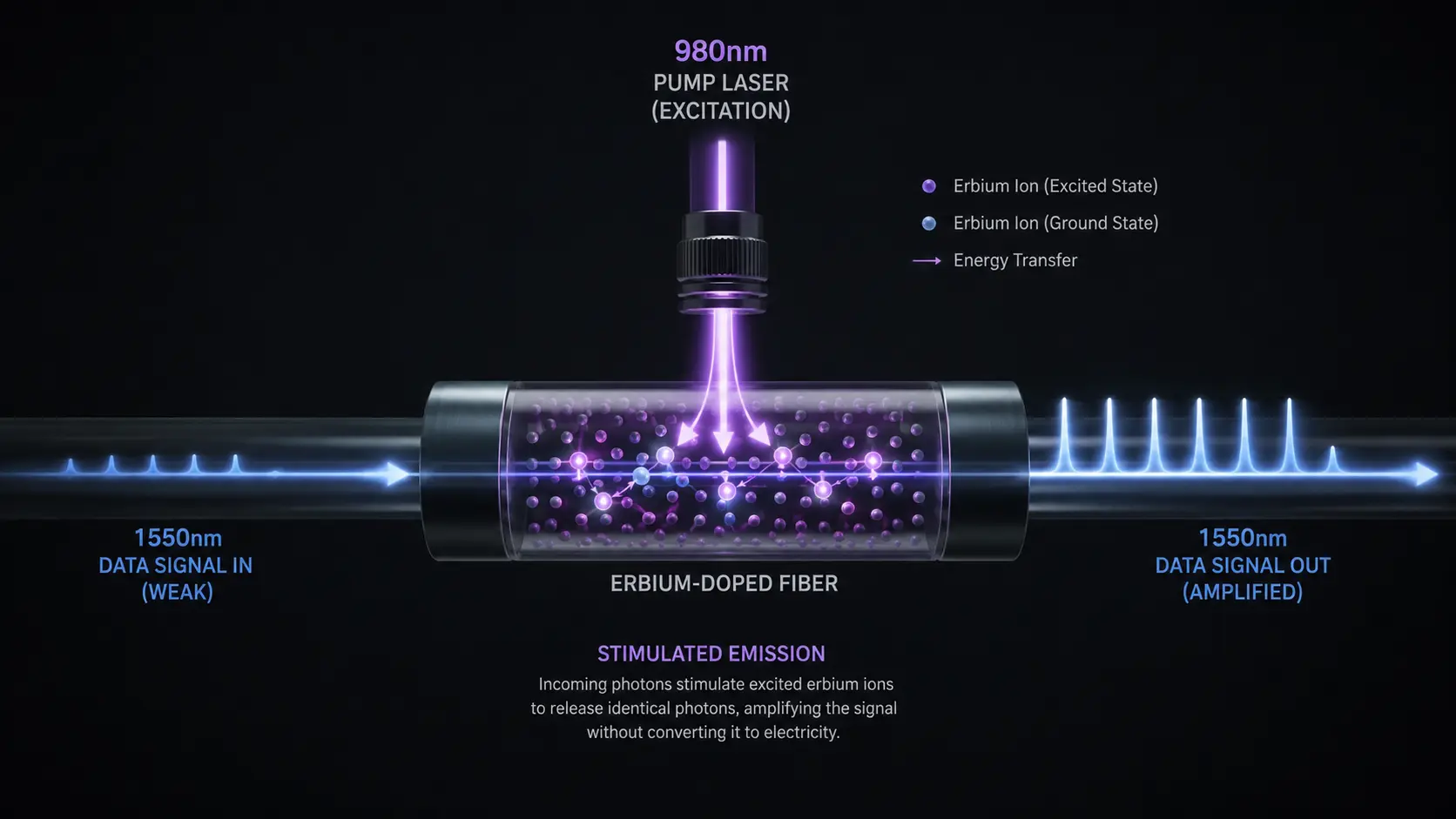

AT A GLANCE
- Concept: Optical Attenuation: Light naturally degrades over long distances, requiring periodic energy boosts to survive transoceanic transit.
- Concept: Erbium Doping: Engineers inject rare-earth elements into the silica glass to create an active amplifying medium.
- Concept: Pump Lasers: Auxiliary lasers continuously inject raw optical energy into the erbium to excite its electrons.
- Concept: Stimulated Emission: The incoming weak data signal triggers excited erbium to release identical, perfectly synchronized photons.
HOW IT WORKS
Light traveling through glass loses intensity due to scattering and absorption. A data signal leaving New York becomes completely unreadable before reaching London if left unamplified.
Instead of converting this weak light back into electricity—a process that introduces massive latency and mechanical failure points—engineers use an entirely optical solution. They splice a specialized ten-meter section of silica fiber directly into the main transoceanic cable.
Manufacturers heavily dope this specific section with erbium, a rare-earth element. An external pump laser continuously fires a steady beam of raw, unencoded light into this erbium-doped segment.
The erbium atoms absorb this raw energy, forcing their electrons into a highly excited, unstable state.
When the weakened 1550-nanometer data signal enters this charged section, it interacts directly with the excited erbium atoms. The incoming data photons stimulate the erbium electrons to drop back to their resting state.
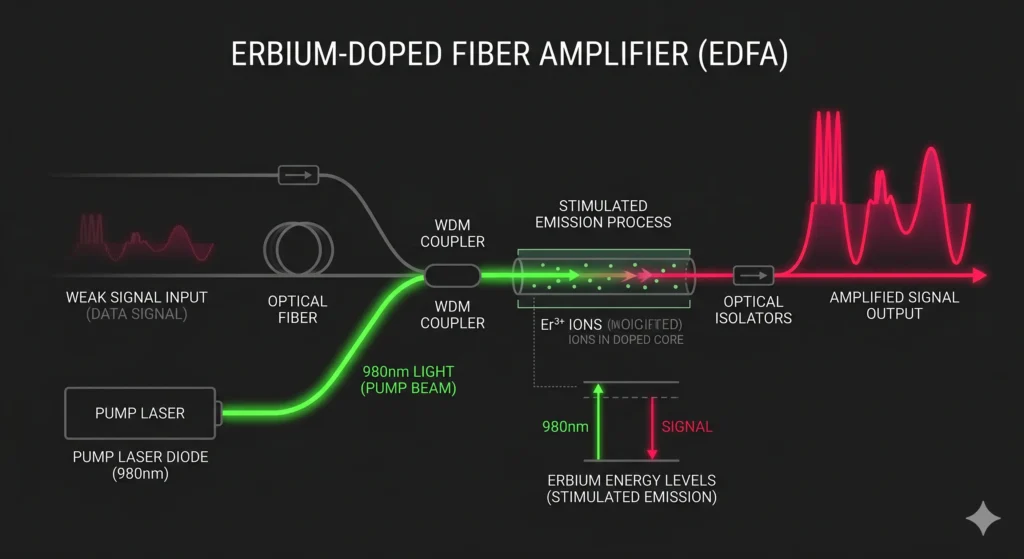
This physical drop releases new photons that perfectly match the exact phase, frequency, and direction of the incoming data stream.
The exponential optical gain relies on the population inversion of the erbium ions, defined mathematically by the optical amplification equation:
$$G = e^{(\sigma_e N_2 – \sigma_a N_1) L}$$
Where G represents the total signal gain, σ_e and σ_a are the emission and absorption cross-sections, N_2 and N_1 are the upper and lower state population densities, and L is the length of the doped fiber. This process mathematically clones the original signal, boosting its intensity by factors of a thousand before sending it onward to the next repeater node.
WHY IT MATTERS NOW
The global economy functions as a massive, continuous data transfer. High-frequency algorithmic trading, artificial intelligence model training, and global cloud synchronization rely entirely on subsea cables.
These cables form the physical backbone of the internet, carrying over 95 percent of all intercontinental data traffic. Bandwidth demand doubles roughly every two years, placing immense stress on existing subsea infrastructure.
Installing a new transoceanic cable costs hundreds of millions of dollars and takes years of geopolitical negotiation. Upgrading the optical amplifiers allows telecom operators to push exponentially more data through existing glass fibers without laying new cables.
The reliance on erbium dictates a strict material dependency. China dominates the global supply chain for rare-earth elements, controlling the mining and refinement of the exact metals required to manufacture these optical amplifiers.
This supply chain concentration turns the underlying hardware of the global internet into a primary geopolitical vulnerability. If geopolitical tensions restrict rare-earth exports, Western telecommunications companies will rapidly lose the physical capacity to maintain and expand the transoceanic data network.
WHAT MOST PEOPLE MISS
Public policy assumes internet speed is purely a software and routing challenge. Analysts obsess over data center locations and switching protocols while ignoring the physical speed limit dictated by the ocean floor.
They miss the extreme thermodynamic and electrical vulnerability of the amplifier housings. Because these amplifiers cannot run on optical energy alone, the subsea cable must also contain a continuous copper sheath carrying up to 10,000 volts of direct current to power the internal pump lasers.
If the copper shorts out due to a shifting tectonic plate or a deep-sea trawler strike, the optical amplification instantly dies. The data connection severs immediately, even if the glass fiber remains perfectly intact.
THE TRAJECTORY
Next 12–36 Months: Operators will deploy multi-band EDFAs using advanced dopant combinations like erbium-ytterbium. This structural upgrade will double existing cable capacity by opening previously unusable wavelengths in the L-band spectrum.
Next Five Years: Spatial division multiplexing will force engineers to redesign amplifier housings entirely. Subsea repeaters will transition from amplifying a few single-core fibers to powering dozens of multi-core fibers simultaneously, drastically increasing the required electrical payload on the ocean floor.
Next Ten Years: The industry will commercialize Raman amplification to operate alongside traditional EDFAs. By using the standard silica transmission fiber itself as the primary amplification medium, engineers will push repeaters further apart, reducing the total number of physical failure points across the Atlantic.
What Could Go Wrong: An extended global shortage of highly purified erbium would permanently halt the production of optical repeaters. Without replacement units, aging subsea cables would gradually fail, physically fracturing the global internet into isolated continental intranets.
Most Likely Outcome: The erbium-doped fiber amplifier will remain the non-negotiable physical enabler of intercontinental globalization. Nations will increasingly classify rare-earth optical components as national security infrastructure, subsidizing domestic refinement to protect their sovereign data transit capabilities.
KEY TERMS
- Erbium-Doped Fiber Amplifier (EDFA): An optical device that uses a rare-earth element to boost light signals without converting them to electrical impulses.
- Stimulated Emission: A quantum mechanical process where an incoming photon triggers an excited atom to release a second, identical photon.
- Pump Laser: A secondary laser that provides the raw optical energy required to excite the erbium ions inside the amplification medium.
- Signal Attenuation: The natural degradation and loss of optical signal strength as light travels over long physical distances through glass.
- Subsea Repeater: A pressurized, waterproof housing resting on the ocean floor that contains optical amplifiers and high-voltage power regulation equipment.
SOURCES
- International Telecommunication Union (ITU) — Characteristics of Optical Fibre Amplifiers
- Submarine Cable Almanac — Subsea Optical Amplification and Repeater Power Architectures
- Journal of Lightwave Technology — Erbium-Doped Fiber Amplifiers: Dynamics and System Applications
- Cisco Systems — Optical Transport Network Architecture and Dense Wavelength Division Multiplexing