Advertisement
)

AT A GLANCE
- Concept: Supercritical State: Carbon dioxide pressurized beyond its critical point acts simultaneously as a liquid and a gas.
- Concept: Brayton Cycle: The closed-loop system uses a continuous, dense fluid rather than boiling and condensing water.
- Concept: Turbomachinery Density: Extreme fluid density extracts massive kinetic energy using highly miniaturized mechanical turbines.
- Concept: Modular Portability: Shrinking the physical power block allows manufacturers to assemble complete nuclear generators in centralized factories.
HOW IT WORKS
For over a century, global baseload electricity has relied entirely on the Rankine cycle. Coal, nuclear, and natural gas plants use a heat source to boil water into steam, which expands to spin a turbine. The steam then enters a massive condenser, cools back into liquid water, and repeats the cycle. This physical phase change from liquid to gas requires immense amounts of thermal energy just to break the molecular bonds of the water.
The supercritical carbon dioxide (sCO2) cycle eliminates this phase change by utilizing the Brayton thermodynamic cycle. Engineers subject carbon dioxide to pressures above 7.39 megapascals and temperatures above 31.1 degrees Celsius. Crossing this specific boundary forces the compound into a supercritical state.
In this exotic phase, the carbon dioxide adopts the high density of a liquid but expands to fill a containment volume entirely like a gas. Because it acts like a dense liquid, the system requires very little mechanical work to compress it. Because it behaves like a highly expansive gas when heated by a nuclear core, it drives a turbine with extreme efficiency.
CLOSED-LOOP sCO2 BRAYTON CYCLE
Cycle Efficiency
42.5%
Net Power Output
212.5 MWe
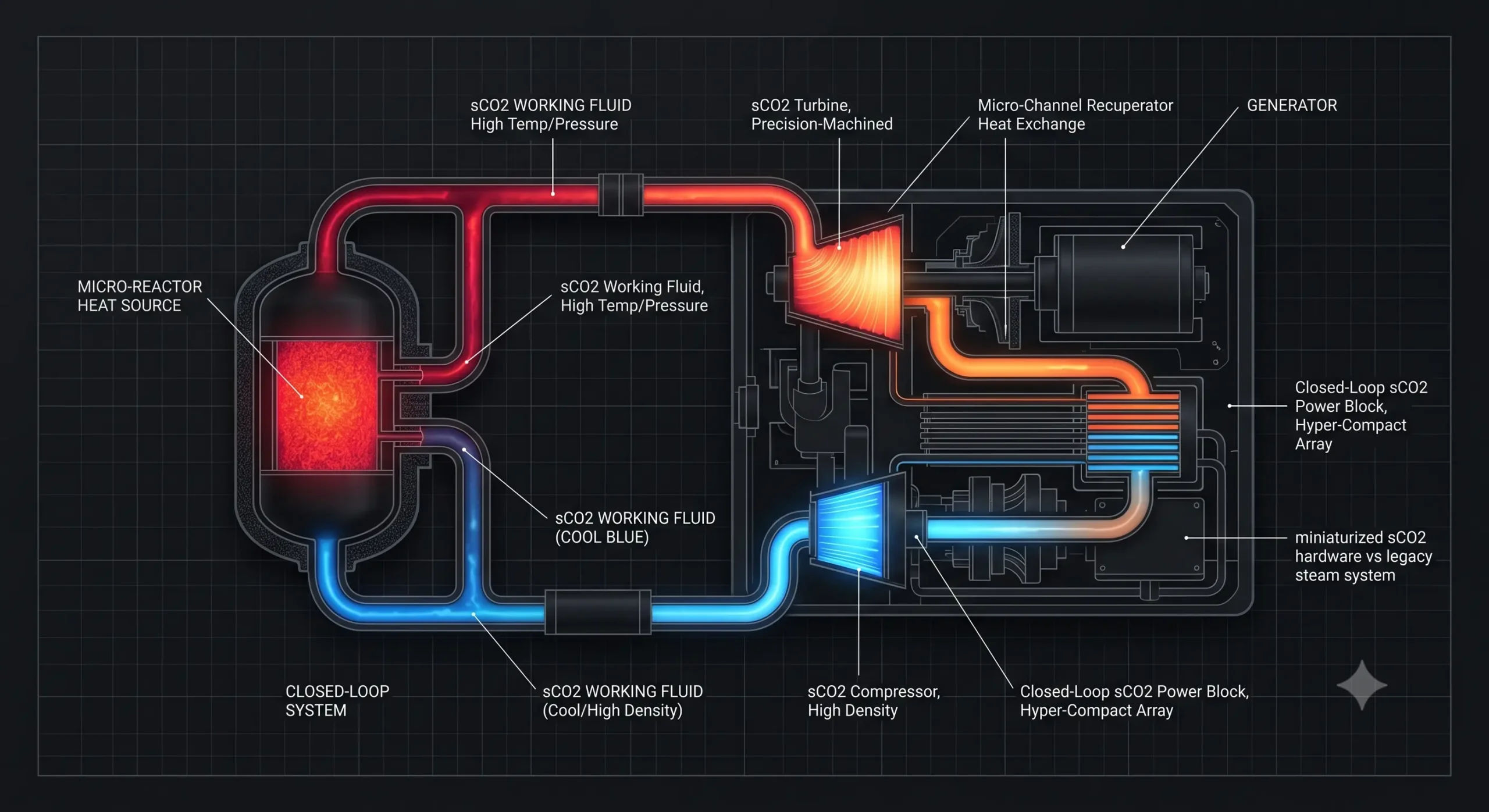
The closed loop continuously cycles the same carbon dioxide inventory. The dense sCO2 expands through the primary turbine to generate electricity. It then flows through a recuperator—a highly specialized heat exchanger—to pass its remaining thermal energy directly back to the cooler, incoming fluid.
The theoretical efficiency of this closed-loop Brayton process is governed by the pressure ratio across the compressor:
$$\eta = 1 – \left(\frac{P_1}{P_2}\right)^{\frac{\gamma-1}{\gamma}}$$
Where η is thermal efficiency, P_1 is the inlet pressure, P_2 is the exhaust pressure, and γ is the specific heat ratio of the carbon dioxide. By operating at extremely high pressures and avoiding the wasted energy of boiling water, sCO2 systems push thermal extraction efficiencies past fifty percent.
WHY IT MATTERS NOW
Traditional nuclear power plants fail economically because they are customized megaprojects. Pouring massive amounts of concrete and erecting multi-story steam turbines on-site frequently drives construction timelines decades over schedule and billions over budget. The global push for zero-carbon baseload energy requires shifting nuclear generation from construction sites to automated factory assembly lines.
Small Modular Reactors (SMRs) promise to achieve this manufacturing shift. However, pairing a compact, advanced nuclear core with a massive legacy steam turbine completely defeats the logistical purpose of modularity. If the power generation block remains the size of an entire warehouse, the facility still requires extensive, specialized on-site construction.
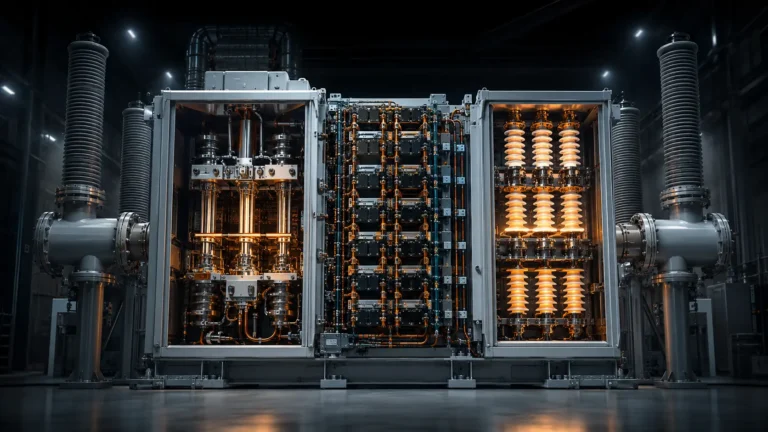
The sCO2 cycle physically solves this mechanical bottleneck. Because supercritical carbon dioxide is significantly denser than steam, it carries vast amounts of kinetic energy in a tiny physical volume. A 300-megawatt sCO2 turbine measures roughly one-tenth the size of an equivalent steam turbine, easily fitting onto a standard commercial shipping flatbed.
This physical miniaturization allows companies like TerraPower to assemble the entire power conversion block inside a controlled factory environment. Operators ship the finished, sealed module directly to the deployment site and plug it into the grid. This logistical capability makes micro-nuclear generation viable for isolated mining operations, remote military bases, and dense artificial intelligence data centers.
Furthermore, closed-loop sCO2 cycles do not require massive external bodies of water for cooling and condensation. By utilizing simple dry-air cooling, nations can deploy gigawatt-scale SMR arrays directly in arid deserts or inland regions previously deemed geographically impossible for nuclear development.
WHAT MOST PEOPLE MISS
General energy analysis treats the transition from water to carbon dioxide as a simple chemical swap. Analysts focus entirely on the reactor core designs—like molten salt or fast-neutron configurations—and assume the thermal-to-electric conversion process is an easily sourced commodity.
They ignore the severe metallurgical constraints of containing supercritical carbon dioxide. At extreme temperatures and pressures, sCO2 becomes highly corrosive and diffuses directly into standard steel matrices. Containing this fluid requires advanced nickel superalloys and extreme precision manufacturing compliant with strict ASME Section III regulatory codes. The extreme difficulty of fabricating these high-pressure micro-channel heat exchangers remains the primary industrial bottleneck preventing immediate commercialization.
THE TRAJECTORY
Next 12–36 Months: Commercial SMR developers will complete full-scale, non-nuclear sCO2 test loops to validate compressor aerodynamics and heat exchanger durability. These non-radioactive pilot plants will prove the long-term mechanical reliability of the turbomachinery before integration with nuclear fuels.
Next Five Years: The first integrated advanced micro-reactors will pair directly with sCO2 power blocks to generate commercial electricity. These initial deployments will prove that baseload nuclear generation can operate efficiently at extreme high temperatures without requiring multi-million-gallon water cooling reserves.
Next Ten Years: Heavy industry will begin retrofitting legacy fossil fuel sites. Operators will strip out massive, aging steam boilers and replace them with compact sCO2 loops connected to advanced thermal storage batteries or next-generation SMR cores, reusing existing transmission infrastructure while eliminating carbon emissions.
What Could Go Wrong: A severe pressure transient during an emergency load-following event could rupture the primary printed circuit heat exchangers. A physical breach would instantly depressurize the closed system, forcing the carbon dioxide out of its supercritical state and physically freezing the entire turbine solid as the gas rapidly expands.
Most Likely Outcome: The sCO2 Brayton cycle will permanently replace the Rankine cycle as the default thermodynamic engine for high-temperature nuclear generation. This transition will commoditize baseload power generation, shifting the industry from bespoke civil engineering projects to standardized aerospace-grade manufacturing.
KEY TERMS
- Supercritical Fluid: A state of matter reached when a substance exceeds specific temperature and pressure thresholds, exhibiting physical properties of both a liquid and a gas.
- Brayton Cycle: A thermodynamic process that uses a continuously flowing, pressurized fluid to spin a turbine and generate mechanical work without undergoing a phase change.
- Rankine Cycle: A traditional power generation cycle that extracts energy by repeatedly boiling water into high-pressure steam and condensing it back into a liquid.
- Small Modular Reactor (SMR): A physically compact nuclear fission design intended for centralized factory manufacturing and rapid on-site assembly.
- Printed Circuit Heat Exchanger: A highly compact thermal transfer device manufactured by diffusion-bonding micro-channel metal plates together to withstand extreme internal pressures.
SOURCES
- Department of Energy (DOE) — Supercritical Carbon Dioxide Tech Team and sCO2 Power Cycle Program
- American Society of Mechanical Engineers (ASME) — Section III Rules for Construction of Nuclear Facility Components
- Journal of Engineering for Gas Turbines and Power — Thermodynamic Comparison of sCO2 Brayton and Steam Rankine Cycles for SMRs
- Sandia National Laboratories — Supercritical CO2 Brayton Cycle Performance and Testing