Advertisement
)
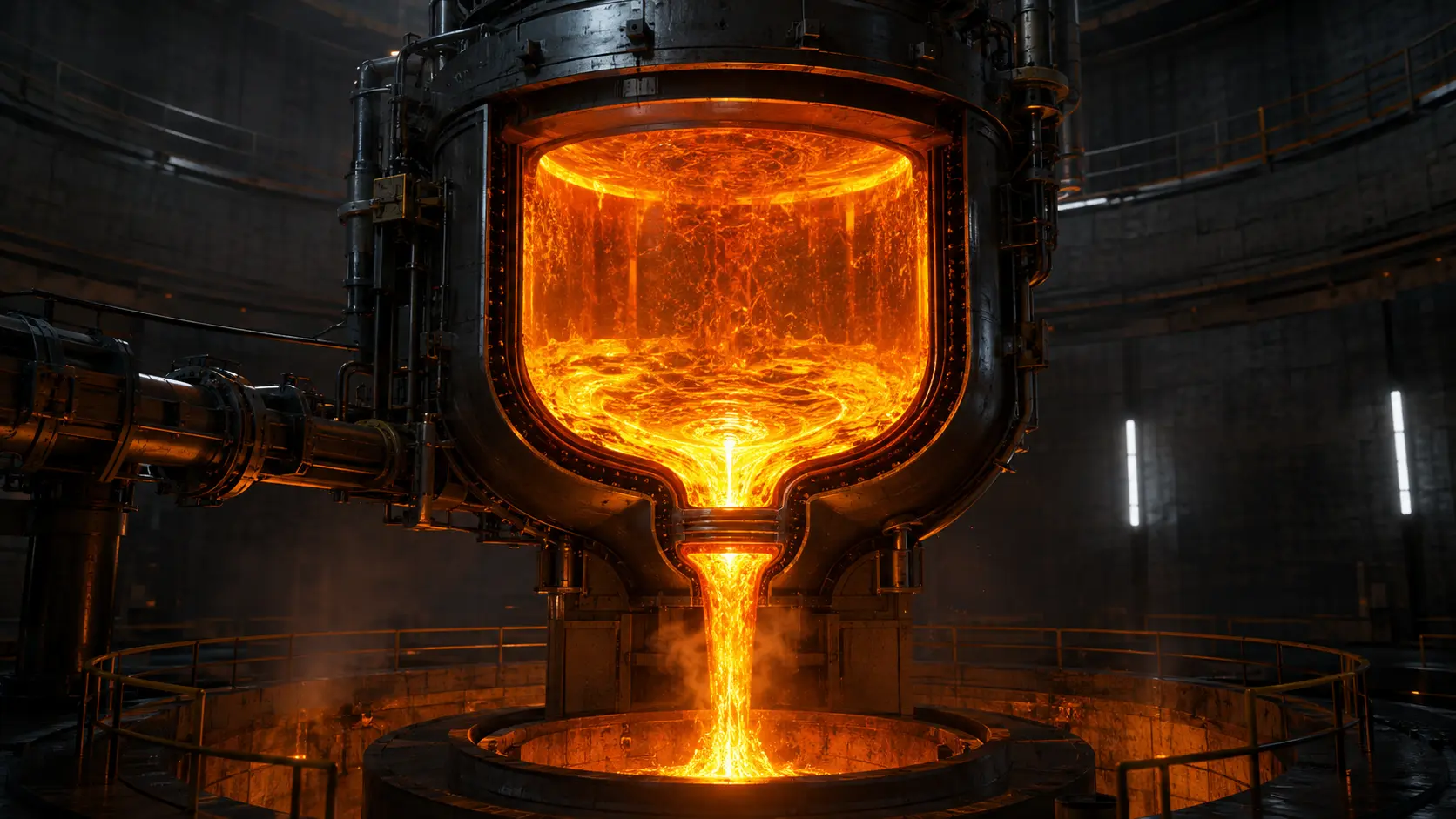

For seventy years, the global expansion of nuclear energy has been paralyzed by a singular, terrifying physical byproduct: weapons-grade plutonium. Every traditional uranium reactor operating today creates the exact fissile material required to build a nuclear arsenal. This inherent dual-use nature means that exporting clean, baseload energy to developing nations simultaneously exports the capacity for geopolitical annihilation. To solve the global climate crisis, the world desperately needs massive amounts of nuclear power, but it cannot afford the proliferation risks tied to standard uranium fuel rods.
What if you could build a reactor that physically cannot be weaponized? Why should you care right now? Because nuclear engineers are resurrecting a forgotten 1960s technology that completely abandons solid uranium. By dissolving an abundant, mildly radioactive metal called thorium into a liquid salt, scientists have engineered a reactor that burns perfectly clean, operates at safe atmospheric pressure, and renders its own waste too dangerously radioactive to ever be handled by a bomb-maker. This is the dawn of the Thorium Molten Salt Reactor—the only technology capable of providing infinite, zero-carbon energy to the globe without triggering a nuclear arms race.
What are Thorium Molten Salt Reactors (TMSR)?
Thorium Molten Salt Reactors (TMSR) are advanced nuclear systems that use liquid fluoride or chloride salts as both the primary coolant and the fuel medium. By utilizing abundant thorium instead of uranium, they operate safely at atmospheric pressure and produce an actively resistant, proliferation-proof fuel cycle devoid of long-lived plutonium waste.
At a Glance
- Concept: Instead of using solid metal fuel rods sitting in high-pressure water, a TMSR dissolves its nuclear fuel into a hot, liquid salt that flows freely through the reactor core at normal, everyday air pressure.
- Why it matters: It solves the three fatal flaws of traditional nuclear power: it cannot suffer a pressurized steam explosion (meltdown), it uses Thorium (which is 4 times more abundant than Uranium), and the waste cannot easily be turned into a nuclear weapon.
- Who uses it: The Chinese Academy of Sciences (which activated a prototype TMSR in the Gobi Desert), and Western advanced nuclear startups like Copenhagen Atomics and Flibe Energy.
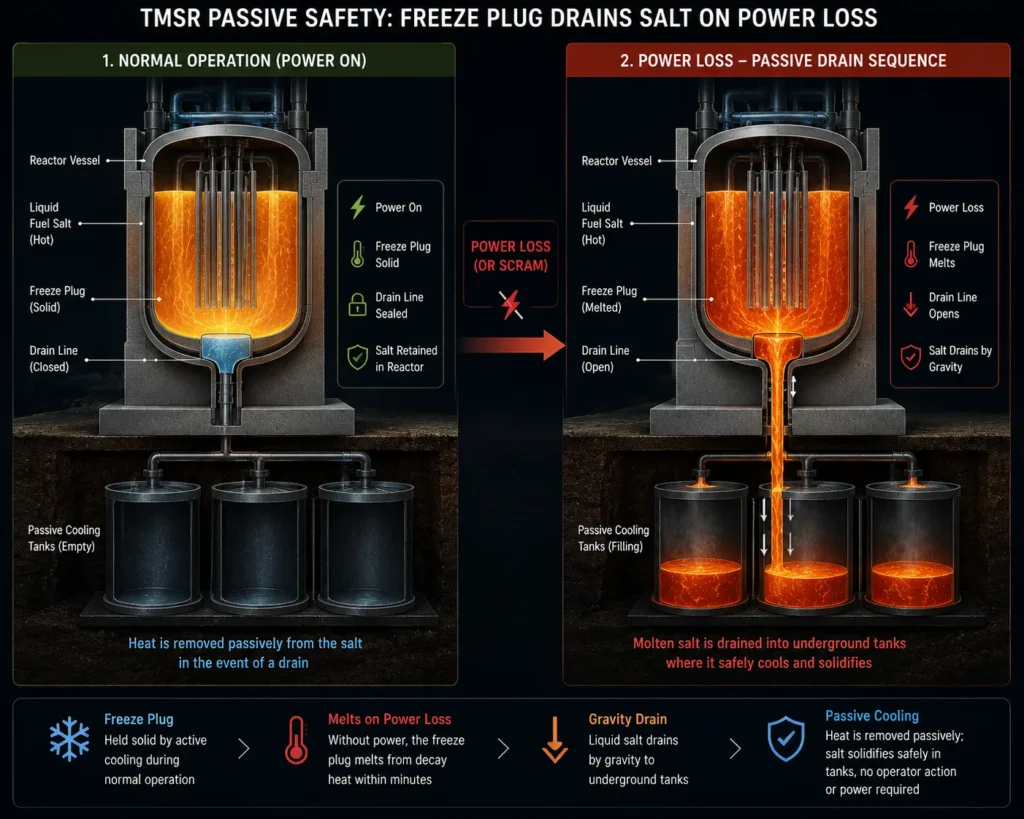
- Biggest takeaway: The reactor has a drain at the bottom plugged with frozen salt. If the power goes out and the humans abandon the facility, the plug naturally melts, and the liquid fuel safely drains into underground cooling tanks. A catastrophic Fukushima-style meltdown is physically impossible.
In Simple Words
A traditional nuclear reactor is like a high-pressure cooker. Inside, you have solid sticks of wood (uranium fuel rods) surrounded by boiling water. If the water pump breaks, the water boils away into steam, the pressure builds until the lid blows off, and the solid wood catches fire and melts down.
A Thorium Molten Salt Reactor is fundamentally different. It is like a pot of soup over a fire.
The fuel is not a solid stick; it is dissolved entirely into the liquid soup (the molten salt). Because the salt is already a liquid at 700°C and doesn’t boil until over 1,400°C, there is zero pressure inside the pot. If the pot gets too hot, it doesn’t explode. Furthermore, at the bottom of the pot is a plug made of frozen soup. If the power fails, the cooling fan keeping the plug frozen stops working. The plug melts, and the liquid nuclear soup simply drains via gravity into safe, fire-proof underground pans where it naturally cools off and hardens into rock. It requires zero human intervention to stop a disaster.
Why This Matters
For Energy Policy Makers and ESG Funds, the Thorium Molten Salt Reactor represents the holy grail of foreign policy and climate action.
The Western world is terrified to export traditional Light Water Reactors (LWRs) to politically unstable regions because standard reactors generate Plutonium-239, the core ingredient in nuclear warheads. A TMSR burns thorium, which breaks the plutonium breeding cycle. This allows Western powers to aggressively export advanced nuclear power plants to emerging economies in Africa, South America, and Southeast Asia, guaranteeing them sovereign energy security and decarbonization without requiring the United Nations to constantly monitor the facilities for covert weapons programs.
The History of Thorium Molten Salt Reactors
The TMSR is not a new invention; it is a suppressed one.
In the 1960s, Alvin Weinberg successfully built and ran the Molten Salt Reactor Experiment (MSRE) at the Oak Ridge National Laboratory in the United States. It operated flawlessly for years. However, during the Cold War, the U.S. government intentionally defunded thorium research. The military actively wanted the plutonium waste generated by standard uranium reactors to build the nuclear weapons stockpile. Thorium was shelved specifically because it was useless for warfare. Today, as the priority shifts from mutually assured destruction to climate survival, global superpowers are scrambling to recover Weinberg’s lost blueprints.
How Thorium Molten Salt Reactors Work
Extracting energy from liquid salts and fertile isotopes requires exploiting a highly specific set of nuclear physics. Here is the first-principles breakdown of the TMSR architecture.
1. The Fundamental Problem: Solid Fuel and High Pressure
In a traditional reactor, the uranium is trapped inside a solid zirconium cladding. Over time, fission gases build up inside the cladding, cracking the rod and forcing the reactor to shut down so the fuel can be replaced. Furthermore, because water boils at 100°C, operating a water-cooled reactor at 300°C requires crushing it under 150 atmospheres of pressure.
2. The Insufficiency of Light Water Reactors (LWRs)
To contain 150 atmospheres of pressure in the event of an accident, LWRs require massive, forged steel pressure vessels and concrete containment domes that are several feet thick. These bespoke, colossal structures are the reason traditional nuclear plants take 15 years and $15 billion to construct.
3. The Core Mechanism: Fertile Thorium and Liquid FLiBe
A TMSR relies on a liquid carrier salt, typically a mixture of Lithium Fluoride and Beryllium Fluoride (FLiBe). The fuel, Thorium-232 (Th-232), is dissolved into this salt.
Thorium-232 is “fertile.” When it is hit by a neutron, it does not split; it absorbs the neutron and undergoes beta decay to become Uranium-233 (U-233).
- Neutron Absorption: Th-232 absorbs a neutron, becoming Th-233.
- First Beta Decay: Th-233 decays into Protactinium-233 (Pa-233).
- Second Beta Decay: Pa-233 decays to become Uranium-233 (U-233).
The newly bred U-233 is “fissile.” It splits, releasing massive thermal energy into the liquid salt and releasing more neutrons to convert the next batch of thorium.
4. Technical Depth: The U-232 Proliferation Deterrent
If U-233 is fissile, why isn’t it a proliferation risk? Because breeding U-233 from thorium inevitably triggers a side reaction that produces Uranium-232 (U-232).
U-232 decays into Thallium-208 (Tl-208). Thallium-208 emits extremely “hard” 2.6 MeV gamma rays. These gamma rays are highly penetrating and lethal. If a rogue state attempts to steal the reactor salt to build a bomb, the intense gamma radiation will instantly fry the bomb’s detonation electronics, kill the scientists trying to handle the material, and act as a glowing beacon to international satellite surveillance. It is a self-sabotaging fuel cycle.
5. Real-World Consequences: Continuous Chemical Processing
Because the fuel is a liquid, a TMSR does not need to shut down to refuel. A small chemical processing plant attached to the side of the reactor continuously siphons off a tiny fraction of the salt, bubbles out the neutron-absorbing waste gases (like Xenon), adds a handful of fresh thorium powder, and cycles the clean salt back into the core. This allows the reactor to run non-stop for decades.
Applications for TMSR Technology
The deployment of molten salt architectures fundamentally alters where and how nuclear energy can be utilized.
High-Temperature Industrial Heat: Traditional water-cooled reactors top out around 300°C. TMSRs operate between 700°C and 850°C. This extreme thermal output allows TMSRs to be placed next to steel, cement, and chemical manufacturing plants, providing the zero-carbon, high-grade industrial heat required to decarbonize the sectors of the economy that cannot be run on electricity.
Water Desalination in Arid Geographies: Because TMSRs do not use water as a coolant, they do not need to be built next to rivers or oceans. They can be deployed in the middle of arid deserts. The waste heat generated by a TMSR can be routed directly into massive thermal desalination facilities, turning seawater into millions of gallons of fresh drinking water for drought-stricken regions.
Marine Propulsion: The maritime shipping industry is seeking alternatives to heavy bunker fuel. Because TMSRs operate at atmospheric pressure, they do not require massive, heavy containment domes, drastically shrinking their physical footprint. Advanced naval architects are drafting container ships powered by miniaturized molten salt reactors that can sail for 25 years without ever needing to refuel or emit a single ton of carbon.
Economic & Strategic Impact
The transition to thorium permanently alters the Geopolitics of the Nuclear Supply Chain.
Currently, the global uranium supply chain is heavily concentrated, with significant enrichment capacity controlled by Russia (Rosatom) and mining capacity dominated by Kazakhstan.
Thorium, conversely, is incredibly abundant and widely distributed. It is roughly four times more common in the Earth’s crust than uranium. More importantly, thorium is a naturally occurring, unwanted byproduct of rare-earth mineral mining. For decades, rare-earth miners have treated thorium as a radioactive liability they must pay to dispose of safely. A mature TMSR industry instantly transforms this geopolitical liability into a globally accessible, practically infinite domestic energy reserve, entirely bypassing the legacy uranium enrichment monopolies.
Advantages
- Walk-Away Passive Safety: Relies on a freeze plug that melts during a total power failure, safely draining the liquid fuel into passively cooled containment tanks via gravity.
- Atmospheric Pressure: Operates near 1 atmosphere of pressure, eliminating the threat of explosive steam dispersion and drastically reducing the cost of containment architecture.
- High Fuel Utilization: A standard LWR burns less than 5% of its uranium fuel before it must be replaced. A TMSR’s continuous chemical processing allows it to burn over 98% of its thorium, yielding exponentially less nuclear waste.
- Proliferation Resistance: The unavoidable production of U-232 and lethal Tl-208 gamma rays makes weaponization practically impossible without lethal consequences to the proliferator.
Limitations
- Extreme Material Corrosion: Molten fluoride and chloride salts are incredibly corrosive, especially at 800°C. If trace amounts of oxygen or moisture enter the reactor, the salt will rapidly eat through standard steel. TMSRs require advanced, expensive nickel-based alloys (like Hastelloy-N) to survive the chemical environment over a 40-year lifespan.
- Tritium and Beryllium Toxicity: If the carrier salt uses Beryllium (FLiBe), the reactor must manage beryllium toxicity risks. Furthermore, neutron bombardment of lithium produces Tritium (a radioactive hydrogen isotope) that can permeate through hot metal walls, requiring complex secondary containment systems.
- Regulatory Inertia: The global nuclear regulatory framework (like the US NRC) was written exclusively for high-pressure, solid-fuel water reactors. Certifying a liquid-fuel reactor requires rewriting decades of regulatory doctrine, creating a massive bureaucratic bottleneck for startups.
Common Misconceptions
Misconception: Thorium is a nuclear fuel just like uranium.
Reality: Thorium is not a fuel; it is a fertile “blanket.” You cannot build a reactor out of pure thorium and start a chain reaction. A TMSR requires a small amount of “seed” fissile material (like Low-Enriched Uranium or existing Plutonium waste) to provide the initial neutrons to kickstart the thorium breeding cycle.
Misconception: Molten salt reactors produce zero nuclear waste.
Reality: They produce exponentially less waste, and the waste they do produce decays to safe background levels in roughly 300 years (compared to 10,000+ years for standard uranium waste). However, they still produce highly radioactive fission products that must be secured.
Misconception: A liquid reactor is more likely to leak into the environment.
Reality: A leak in a high-pressure water reactor sprays explosive, radioactive steam into the atmosphere for miles. If a low-pressure liquid salt reactor leaks, the liquid salt hits the cool ambient air of the containment room and instantly freezes solid into a rock, halting the spread of radiation within a few feet.
What Most People Miss
The ability to Burn Existing Nuclear Waste.
The world currently has over 300,000 tons of highly radioactive, spent solid nuclear fuel sitting in concrete casks globally, waiting for permanent deep-geological repositories that face massive political opposition.
What most people miss is that TMSRs can solve this crisis. Because a TMSR operates on liquid salt, engineers can take the spent, highly toxic plutonium and transuranic waste from old 1980s water reactors, dissolve it directly into the hot fluoride salt, and use it as the “seed” fuel for the thorium cycle. The TMSR literally consumes the long-lived, dangerous waste of the previous generation to generate clean power, functioning as a high-tech incinerator for the world’s worst ecological liabilities.
Comparison Table
| Feature | Light Water Reactor (LWR) | Sodium Fast Reactor (SFR) | Thorium Molten Salt Reactor (TMSR) |
| Coolant | High-Pressure Water | Liquid Sodium Metal | Molten Fluoride/Chloride Salt |
| Fuel State | Solid Zirconium Rods | Solid Metal/Oxide Rods | Liquid (Dissolved in Coolant) |
| Operating Pressure | ~150 Atmospheres (Extreme) | Atmospheric (1 Atm) | Atmospheric (1 Atm) |
| Operating Temp. | ~300°C | ~550°C | ~700°C to 850°C |
| Meltdown Risk | Yes (Loss of coolant) | Yes (Coolant fires) | No (Fuel is already molten) |
| Proliferation Risk | High (Plutonium generation) | High (Plutonium breeding) | Extremely Low (U-232 gamma spike) |
Case Study
Situation: Following the 2011 Fukushima Daiichi disaster, China faced a brutal energy dilemma. To sustain economic growth while combatting lethal coal-induced air pollution, the nation needed massive nuclear expansion. However, scaling traditional high-pressure water reactors posed unacceptable safety risks and relied heavily on imported uranium.
Challenge: Develop a nuclear architecture that could safely operate in the arid, water-starved interior of the country, utilizing a domestic fuel source, with absolute immunity to the loss-of-coolant meltdowns that devastated Japan.
Solution (The TMSR-LF1 Prototype): The Chinese Academy of Sciences (CAS) launched a heavily funded initiative to resurrect the molten salt reactor. In 2023, the National Nuclear Safety Administration of China issued an operating license for the TMSR-LF1, an experimental 2-megawatt thermal liquid-fueled thorium reactor located in Wuwei, in the arid Gobi Desert.
Outcome: The reactor successfully initiated testing without requiring proximity to an ocean or major river for cooling. It validated the integration of Chinese-mined thorium with a molten FLiBe salt loop. By demonstrating the passive freeze-plug safety system and operating at near-atmospheric pressure, the Chinese prototype became the first operational liquid-fuel thorium reactor since Oak Ridge shut down the MSRE in 1969.
Lessons Learned: The TMSR-LF1 proved that molten salt technology is not a theoretical fantasy; it is a deployable engineering reality. It demonstrated that whoever masters the corrosion-resistant metallurgy and chemical processing of liquid salts will possess the defining energy technology of the late 21st century, sparking renewed urgency among Western governments to commercialize competing designs.
Future Outlook
Next 12–24 Months
The era of Non-Nuclear Molten Salt Testing. Before regulatory bodies allow startups to load radioactive fuel into commercial prototypes, they must prove the hardware works. Over the next two years, companies will build full-scale “non-nuclear” testing loops. They will circulate molten salts at 700°C using electrical heaters, rigorously testing the durability of Hastelloy-N pumps, valves, and heat exchangers to generate the mechanical reliability data required to satisfy the Nuclear Regulatory Commission (NRC).
Next 3–5 Years
The scaling of Small Modular Reactor (SMR) Integration. By the late 2020s, the first commercial TMSR prototypes will achieve criticality in North America and Europe. These will heavily utilize Small Modular Reactor (SMR) architectures. Rather than building massive, bespoke facilities, the reactor cores will be built on assembly lines, shipped on standard flatbed trucks, and slotted into pre-approved, underground concrete silos, drastically slashing the capital cost and construction timelines of early deployments.
Next 10 Years
The Global Decarbonization Export Model. By the mid-2030s, the “proliferation-proof” nature of the U-232 thorium cycle will bear geopolitical fruit. Western nations will confidently sign massive export contracts, deploying modular TMSRs to rapidly growing, energy-starved economies across the Global South. These reactors will operate autonomously for decades, providing the unyielding baseload power required to industrialize developing nations without accelerating climate change or risking nuclear weapon proliferation.
Most Likely Scenario
Thorium Molten Salt Reactors are the inevitable successor to the Light Water Reactor. While the immediate transition is bottlenecked by regulatory inertia and the extreme metallurgy required to contain hot, corrosive salts, the sheer physical superiority of a reactor that cannot melt down, cannot build bombs, and consumes its own waste ensures that TMSRs will become the foundational baseload architecture of a post-carbon global grid.
Key Takeaways
- Thorium Molten Salt Reactors (TMSR) dissolve nuclear fuel into a liquid salt, allowing the reactor to operate at safe, atmospheric pressure and eliminating the risk of steam explosions.
- Because the fuel is already a liquid, it physically cannot “melt down” like the solid uranium fuel rods in traditional reactors (e.g., Chernobyl, Fukushima).
- A “freeze plug” at the bottom of the reactor acts as an ultimate passive safety mechanism. If power fails, the plug melts, and the liquid fuel safely drains into cooling tanks via gravity.
- Thorium is a fertile element; it absorbs neutrons to create Uranium-233, an efficient, clean-burning nuclear fuel. Thorium is roughly four times more abundant than uranium.
- The thorium fuel cycle produces an unavoidable byproduct (Uranium-232) that emits lethal, highly penetrating gamma radiation, effectively preventing the fuel from being stolen or used in nuclear weapons.
- TMSRs operate at incredibly high temperatures (up to 850°C), making them perfect for decarbonizing heavy industrial heat applications and massive water desalination projects.
Glossary
Fertile Material: An element (like Thorium-232) that cannot sustain a nuclear chain reaction by itself, but can be transformed into a fissile material (like Uranium-233) when it absorbs a neutron.
Fissile Material: An element (like Uranium-235 or Plutonium-239) that can sustain a continuous nuclear chain reaction, splitting apart to release massive amounts of energy.
FLiBe: A specific type of molten salt made from Lithium Fluoride and Beryllium Fluoride. It is the most common carrier salt used in TMSR designs due to its excellent heat transfer and neutron-stability properties.
Freeze Plug: A passive safety device made of actively cooled, frozen salt blocking a drain pipe at the bottom of the reactor core. If power fails, the active cooling stops, the plug melts, and the reactor safely drains itself.
Hastelloy-N: A specialized, high-nickel alloy originally developed in the 1960s specifically to withstand the extreme corrosive environment of molten fluoride salts.
Light Water Reactor (LWR): The dominant technology used in almost all current global nuclear power plants. It relies on solid uranium fuel rods and highly pressurized water to generate steam.