Advertisement
)
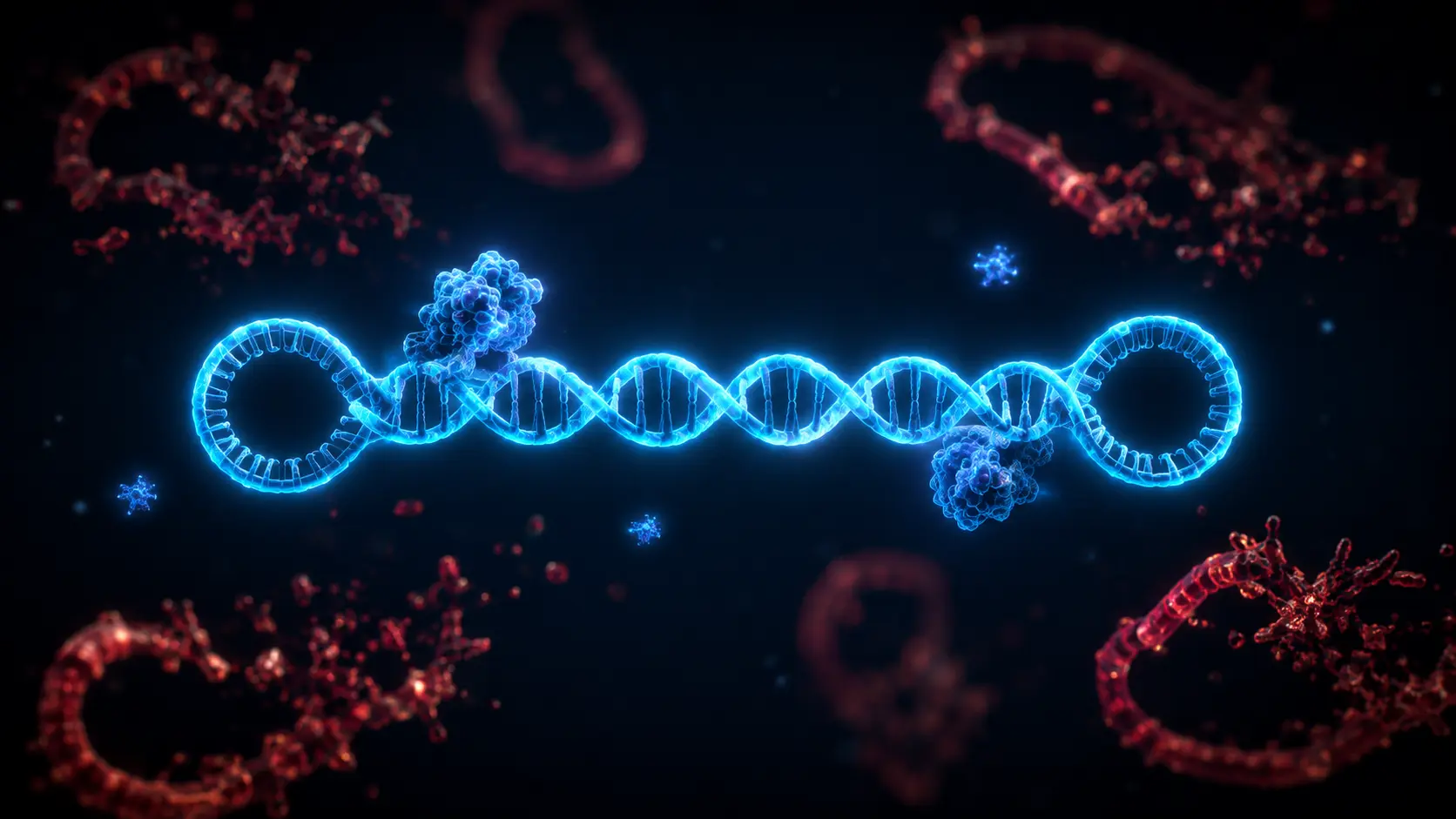

To cure a patient with a cutting-edge mRNA vaccine or a million-dollar viral gene therapy, modern medicine relies on a shockingly archaic foundation: brewing massive vats of E. coli bacteria. For decades, the only way to mass-produce the DNA instructions required for these advanced therapies was to insert the code into a bacterial plasmid, feed the bacteria in a giant steel tank for weeks, and then violently rupture the cells to harvest the DNA. This biological process is slow, prone to contamination, and highly inefficient. Worse, it forces manufacturers to include unwanted bacterial “junk” DNA—including antibiotic-resistance genes—into the final medical product just to keep the bacteria alive during fermentation.
Why should you care right now? Because biotechnology has officially decoupled DNA manufacturing from living organisms. By deploying a technology known as Doggybone DNA (dbDNA), bioengineers are now “printing” commercial-scale batches of pure DNA entirely inside a test tube. Using specialized enzymes that replicate and seal the genetic code into unbreakable, closed-ended loops, this cell-free process condenses a multi-month manufacturing bottleneck into a few days. This leap from biological farming to enzymatic printing is permanently crashing the capital costs of genetic medicine, shifting the industry toward a safer, infinitely scalable supply chain.
What is Doggybone DNA (dbDNA)?
Doggybone DNA (dbDNA) is a linear, double-stranded, covalently closed DNA vector produced entirely through cell-free enzymatic synthesis. It eliminates the need for bacterial fermentation, producing a highly pure genetic template consisting only of the target gene and regulatory sequences, capped with hairpin loops that prevent cellular degradation.
At a Glance
- Concept: Instead of using living bacteria to copy a DNA blueprint millions of times, scientists use isolated enzymes to rapidly print the exact same blueprint in a sterile liquid bath.
- Why it matters: It removes the bacterial “junk” DNA from the final medicine. This makes the therapy fundamentally safer, as it eliminates the risk of accidentally transferring antibiotic-resistance genes into a human patient.
- Who uses it: Contract Development and Manufacturing Organizations (CDMOs), mRNA vaccine developers, and advanced cell and gene therapy startups utilizing AAV or lentiviral vectors.
- Biggest takeaway: The molecule gets its name from its shape. Special enzymes cut the DNA and instantly glue the ends shut, creating protective hairpin loops at both ends that make it look like a microscopic dog bone, preventing the patient’s immune system from chewing it up.
In Simple Words
Imagine you need to print a million copies of a specific recipe for a cake.
The Traditional Method (Plasmid DNA) is like hiding the recipe inside a living rabbit, waiting for the rabbit to breed into a million rabbits, and then dissecting all the rabbits to get your recipes back. It takes months, you need a massive facility to house the animals, and your recipe is covered in rabbit DNA that you have to aggressively clean off.
The dbDNA Method is like taking the recipe to a high-speed digital printing press. You don’t use animals or bacteria at all. You put the original recipe in a sterile machine, pour in some liquid “ink” (enzymes), and the machine rapidly prints a million perfect copies in a matter of days. Furthermore, the machine binds the edges of the paper so they can’t be easily ripped. It is faster, drastically smaller, and perfectly clean.
Why This Matters
For Bioprocess Engineers, Gene Therapy Executives, and Biotech Investors, dbDNA solves the ultimate chokepoint in modern medicine: The Plasmid Bottleneck.
Whether a company is making an mRNA vaccine, a CAR-T cell therapy, or an Adeno-Associated Virus (AAV) gene therapy, the absolute first step is acquiring massive amounts of high-quality template DNA. During the biotech boom, the waitlist to secure a manufacturing slot at a bacterial fermentation facility stretched beyond 12 to 18 months. By moving from massive 1,000-liter bacterial bioreactors to 10-liter enzymatic benchtop reactors, dbDNA bypasses this entire supply chain crisis. It allows biotech startups to transition from early research to clinical-grade manufacturing in weeks, saving millions of dollars in capital expenditure (CapEx) and operational overhead.
The Shift from Plasmids to Cell-Free DNA Synthesis
The shift to dbDNA represents the broader industrial pivot toward Cell-Free Synthesis.
Biology is messy. Living organisms mutate, require complex thermal and nutrient controls, and produce toxic byproducts (like endotoxins) that cost fortunes to filter out. The ultimate goal of biomanufacturing is to abstract the useful mechanisms of biology (the enzymes) while discarding the unpredictable host organism (the bacteria). dbDNA proves that by isolating the specific molecular machines responsible for DNA replication, humanity can achieve industrial-scale genetic manufacturing with synthetic, mathematical precision.
How Doggybone DNA (dbDNA) Manufacturing Works
Printing pure DNA without a living host requires orchestrating a specific sequence of isolated viral and bacterial enzymes. Here is the first-principles breakdown of the architecture.
1. The Fundamental Problem: The Bacterial Backbone
To grow DNA in E. coli, the target gene must be attached to a “bacterial backbone.” This backbone includes an origin of replication (so the bacteria will copy it) and an antibiotic-resistance gene. The antibiotic is used in the fermentation tank to kill off any bacteria that didn’t absorb the DNA. When the DNA is harvested, this dangerous antibiotic-resistance gene is permanently stuck to the medical payload.
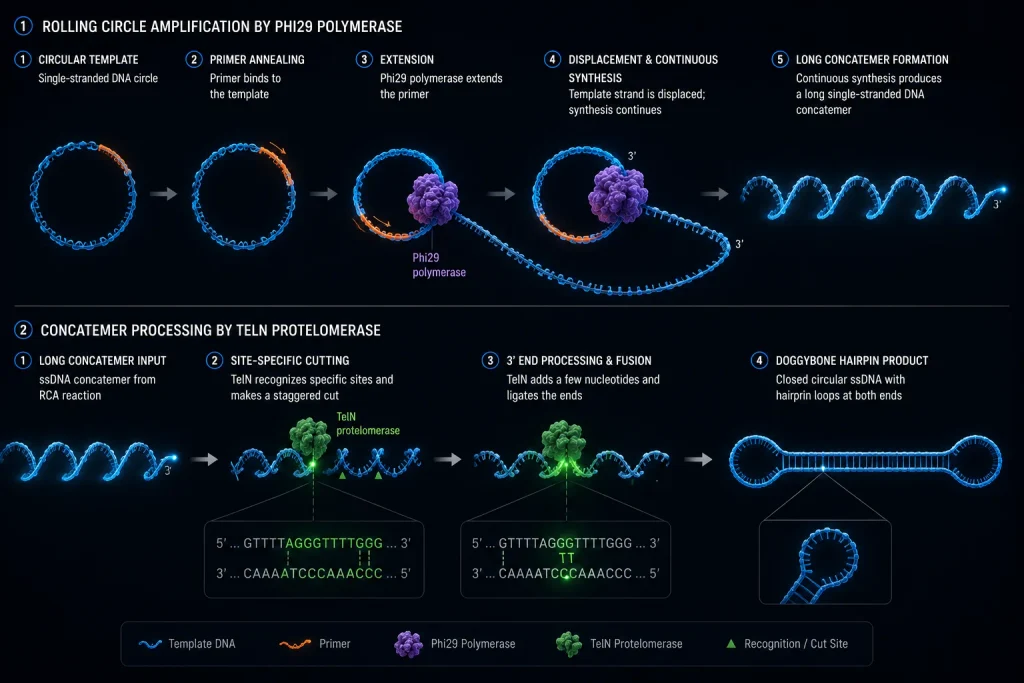
2. The Core Mechanism: Rolling Circle Amplification
dbDNA eliminates the backbone. The process begins with a circular piece of template DNA containing only the target gene. An enzyme called Phi29 DNA polymerase (derived from a bacteriophage virus) is introduced. Phi29 is highly processive; it latches onto the circle and continuously reads around and around, copying the code endlessly. This creates a massive, long chain of DNA (a concatemer) containing thousands of repeating copies of the target gene.
3. Technical Depth: Protelomerase Cleavage
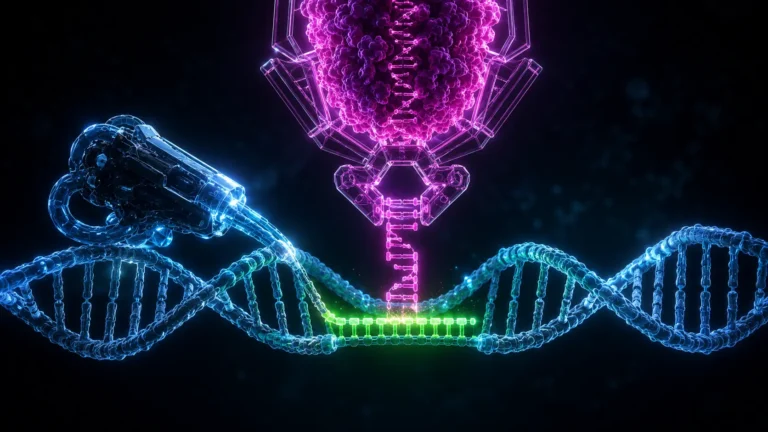
Once the massive chain is printed, a second enzyme is introduced: a Protelomerase (specifically TelN, derived from the E. coli phage N15). Protelomerases possess a unique, elegant capability. They scan the long DNA chain, find the specific junction between each repeating gene, and cleanly cut the chain into individual therapeutic units.
4. The Hairpin Loop Closure
Crucially, the protelomerase does not just cut the DNA. The moment it severs the double helix, it chemically bends the two loose strands backward and fuses them together into a covalently closed hairpin loop. Because both ends are glued shut, the resulting linear DNA molecule resembles a doggy bone.
5. Real-World Consequences: Exonuclease Resistance
The human body is filled with exonuclease enzymes that act as a defense mechanism, aggressively hunting down and destroying free-floating DNA that has exposed, loose ends (which often signals a viral infection). Because the protelomerase perfectly seals the ends of the dbDNA, it has no exposed ends. The molecule becomes highly resistant to exonuclease degradation, ensuring it survives long enough inside the patient or the manufacturing bioreactor to execute its genetic instructions.
Commercial Applications in mRNA and Gene Therapy
dbDNA is rapidly displacing bacterial plasmids as the foundational raw material across multiple advanced therapeutic verticals.
mRNA Vaccine and Therapeutic Templates: To manufacture mRNA, companies must use a DNA template to guide the transcription process. Historically, they used linearized plasmid DNA. dbDNA provides a significantly cleaner template. Because dbDNA lacks the long poly(A) tail instability issues often encountered in bacterial plasmids, it allows for highly precise, uninterrupted mRNA transcription, making it the preferred starting material for next-generation mRNA cancer vaccines.
AAV and Lentiviral Vector Production: Gene therapies rely on hollowed-out viruses (like Adeno-Associated Viruses or Lentiviruses) to deliver healthy genes into a patient’s cells. Manufacturing these viral vectors requires transfecting human host cells with massive amounts of DNA. Using dbDNA instead of pDNA drastically reduces the toxicity to the host cells during manufacturing, significantly increasing the total yield of functional viral vectors per batch and lowering the million-dollar price tag of commercial gene therapies.
CRISPR Homology-Directed Repair (HDR) Templates: When CRISPR-Cas9 acts as “molecular scissors” to cut out a defective gene, the cell needs a new, healthy piece of DNA to paste into the gap (the HDR template). Because dbDNA is capped with protective hairpin loops, it resists being chewed up by the cell’s defense mechanisms, drastically improving the insertion rate and overall efficiency of complex CRISPR gene-editing procedures.
Economic & Strategic Impact
The transition to cell-free synthesis triggers a massive De-Risking of the CDMO Supply Chain.
Contract Development and Manufacturing Organizations (CDMOs) spend hundreds of millions of dollars building massive cleanroom facilities to house 1,000-liter and 2,000-liter stainless steel fermentation bioreactors. These facilities require immense electrical, water, and specialized labor overhead.
Because dbDNA relies on highly concentrated enzymatic chemistry rather than bulky biological growth, it achieves massive yields in microscopic footprints. A 10-liter benchtop dbDNA reactor can output the same amount of clinical-grade DNA as a 1,000-liter bacterial fermentation tank. This allows pharmaceutical companies to completely bypass the multi-year queue at traditional CDMOs. They can bring DNA manufacturing in-house with minimal CapEx, reclaiming total control over their proprietary supply chains and accelerating their speed to clinical trials.
Advantages
- Unmatched Manufacturing Speed: Condenses a complex, multi-month biological fermentation process into a predictable, multi-day chemical reaction.
- Absolute Genetic Safety: Completely eliminates the bacterial backbone, meaning zero antibiotic-resistance genes or bacterial origin-of-replication sequences are accidentally injected into human patients.
- Reduced Immunogenicity: Bacterial plasmids contain unmethylated “CpG motifs” which the human immune system recognizes as an infection, triggering unwanted inflammation. dbDNA avoids these motifs, creating a “stealthier” therapeutic payload.
- Minimal Capital Footprint: Replaces massive, multi-story bioreactor infrastructure with small, scalable benchtop enzymatic equipment.
Limitations
- Cost of Proprietary Enzymes: While the physical footprint is smaller, the highly purified, proprietary enzymes (Phi29 and TelN) required for the synthesis are exceptionally expensive at commercial volumes, shifting the cost burden from physical infrastructure to biochemical raw materials.
- Construct Size Limits: While dbDNA is highly efficient for standard genes, attempting to amplify and circularize incredibly massive, complex genetic constructs (exceeding tens of thousands of base pairs) can reduce the efficiency of the enzymatic cleavage process.
- Regulatory Inertia: The FDA and EMA are intimately familiar with standard pDNA impurities. Transitioning a commercially approved drug to a novel dbDNA manufacturing process requires agonizing, highly expensive comparability studies to prove to regulators that the new drug is identical to the old one.
Common Misconceptions
Misconception: dbDNA is a new type of gene editing, like CRISPR.
Reality: It is not an editing tool; it is a manufacturing substrate. It is the raw material (the ink and paper) used to build the medicines, not the medicine itself.
Misconception: The “doggybone” shape makes it function differently in the cell.
Reality: The hairpin loops at the ends simply act as caps to prevent degradation. Once inside the nucleus, the target gene behaves and transcribes exactly the same as any other piece of double-stranded DNA.
Misconception: Cell-free synthesis means no biology is involved at all.
Reality: The enzymes used (Phi29 and Protelomerase) are still biological proteins derived from viruses. While the final reaction happens in a test tube without living cells, the enzymes themselves must still be manufactured using biological processes upstream.
What Most People Miss
The disruptive intelligence value of Complex Poly(A) Tail Preservation.
Most analysts focus entirely on the speed of dbDNA production. What they miss is its structural supremacy in resolving the primary failure point of mRNA manufacturing: the poly(A) tail.
For an mRNA molecule to survive in the human body, it needs a long, perfect tail of Adenine nucleotides (the poly(A) tail). When scientists try to grow a DNA template with a long poly(A) sequence inside E. coli bacteria, the bacteria often view the sequence as a mistake and spontaneously delete or shorten it (recombination). Because dbDNA is printed enzymatically in a test tube without a living organism trying to “fix” it, the long, complex poly(A) tails are preserved with absolute mathematical perfection, guaranteeing vastly superior mRNA stability and potency.
Comparison Table
| Feature | Traditional Plasmid DNA (pDNA) | Doggybone DNA (dbDNA) |
| Manufacturing Method | E. coli Bacterial Fermentation | Cell-Free Enzymatic Synthesis |
| Production Timeline | 4 to 8 Weeks | 3 to 6 Days |
| Bacterial Backbone | Present (Requires removal/filtering) | Completely Eliminated |
| Antibiotic Resistance | Used as a selection marker | Zero |
| Structure Ends | Circular (or exposed if linearized) | Covalently Closed Hairpin Loops |
| Infrastructure Needed | Massive (1,000L+ Bioreactors) | Minimal (10L Benchtop Reactors) |
Case Study
Situation: The rapid expansion of the mRNA vaccine market and advanced cell therapies (like CAR-T) created an unprecedented global shortage of GMP-grade (Good Manufacturing Practice) plasmid DNA. Emerging biotech firms found their clinical trials delayed by over a year simply because they could not secure a slot in a biological fermentation facility.
Challenge: Validate a cell-free manufacturing alternative that could produce commercial-scale, highly pure DNA in a fraction of the time, while successfully passing the rigorous safety and comparability audits of global health regulators.
Solution (Touchlight’s FDA Master File): Touchlight, the UK-based biotechnology firm that invented and patented dbDNA, aggressively scaled its enzymatic manufacturing platform. To break the regulatory barrier, they compiled extensive structural and safety data proving dbDNA’s superiority and comparability to pDNA for viral vector and mRNA production.
Outcome: In 2023, Touchlight successfully achieved a major milestone by receiving an FDA Drug Master File (DMF) for its dbDNA manufacturing process. This was a watershed moment. It allowed pharmaceutical clients to seamlessly reference Touchlight’s pre-validated manufacturing data in their own Investigational New Drug (IND) applications. By early 2024, Touchlight secured major licensing deals with global pharma giants like Pfizer and Lonza, officially cementing dbDNA as a commercially viable, regulatorily de-risked alternative to bacterial plasmids.
Lessons Learned: The advancement proved that the biotech industry’s reliance on bacterial fermentation was a legacy habit, not a biological necessity. By securing the FDA DMF, Touchlight demonstrated that standardizing and validating the enzymatic synthesis process unlocks a massively agile, decentralized manufacturing model, permanently resolving the primary bottleneck of the genetic medicine revolution.
Future Outlook
Next 12–24 Months
The era of Clinical IND Dominance. Over the next two years, dbDNA will become the default starting material for newly filed Investigational New Drug (IND) applications. Because early-stage biotech startups are not burdened by legacy pDNA manufacturing infrastructure, they will universally adopt cell-free synthesis to accelerate their path to Phase 1 clinical trials. We will see a surge in strategic partnerships between Touchlight and massive CDMOs (like Catalent and Thermo Fisher) offering “rapid-print” dbDNA services to bypass their own strained fermentation bottlenecks.
Next 3–5 Years
The scaling of In Vivo Direct Injection. Currently, dbDNA is primarily used as a template to make mRNA or viral vectors in a lab. However, as its extreme safety profile and exonuclease resistance are proven, researchers will begin injecting dbDNA directly into patients. Encapsulated in Lipid Nanoparticles (LNPs), dbDNA will act as a direct, non-viral gene therapy. Because it lacks immunostimulatory bacterial junk, patients can receive repeated doses of dbDNA to treat chronic diseases without triggering the violent immune reactions associated with traditional viral vectors.
Next 10 Years
The Obsolescence of Biological Fermentation for DNA. By the mid-2030s, the concept of using a 1,000-liter tank of E. coli to manufacture a DNA template will be viewed as archaic and unacceptably risky. Global regulatory bodies (FDA, EMA) will actively discourage the use of bacterial plasmids due to the inherent risks of antibiotic-resistance marker gene transfer. Cell-free enzymatic synthesis will be the universally mandated standard, turning DNA production into a purely mathematical, chemical printing process executed entirely on automated benchtops.
Most Likely Scenario
Doggybone DNA is the definitive architectural upgrade for the raw material of modern medicine. It systematically eradicates the biological noise, timeline delays, and safety hazards of the 20th-century fermentation era. As the demand for bespoke, personalized genetic therapies explodes, the ability to print perfect, closed-loop DNA in a matter of days guarantees that cell-free enzymatic synthesis will dominate the biomanufacturing supply chain for the next several decades.
Key Takeaways
- Doggybone DNA (dbDNA) is a fast, safe, cell-free method of manufacturing the DNA needed for mRNA vaccines and gene therapies.
- Traditionally, DNA is grown slowly inside massive vats of E. coli bacteria, a process that accidentally includes unwanted bacterial “junk” and antibiotic-resistance genes.
- dbDNA completely eliminates bacteria. It is “printed” in a test tube using a polymerase enzyme that copies the gene, and a protelomerase enzyme that cuts it into individual units.
- The cutting enzyme immediately glues the ends of the DNA shut, creating a closed loop that looks like a doggy bone. This prevents the human body’s defense enzymes from chewing it up.
- The process shrinks manufacturing timelines from months to days, allowing biotech companies to avoid the massive delays at traditional commercial fermentation facilities.
- By removing the bacterial backbone and antibiotic markers, dbDNA creates a vastly safer, “stealthier” genetic payload for next-generation medicine.
Glossary
Antibiotic-Resistance Marker: A gene traditionally included in bacterial plasmids to help scientists identify which bacteria successfully absorbed the DNA. It is a major safety risk if accidentally transferred to a human patient.
Cell-Free Synthesis: Manufacturing biological molecules (like DNA or proteins) using isolated enzymes in a test tube, entirely completely bypassing the need to use living cells or bacteria.
Concatemer: A long, continuous DNA molecule that contains multiple copies of the exact same DNA sequence linked together in a chain.
Exonuclease: An aggressive enzyme found in cells that hunts down and destroys DNA by chewing on exposed, loose ends.
Phi29 DNA Polymerase: A highly efficient viral enzyme used in dbDNA manufacturing to rapidly copy circular DNA into a massive, repeating chain (Rolling Circle Amplification).
Protelomerase (TelN): The specialized enzyme that cuts the long chain of DNA into individual pieces and instantly fuses the ends shut into protective hairpin loops.
Sources
Touchlight: Doggybone DNA (dbDNA) Technology and Platform Overview
Nature / Gene Therapy: Enzymatic production of synthetic DNA for gene therapy
BioProcess International: Moving Beyond Plasmids: The Rise of Cell-Free DNA Synthesis
U.S. Food and Drug Administration (FDA): Touchlight receives FDA Drug Master File for dbDNA
Pharmaceutical Technology: Addressing the Plasmid DNA Bottleneck with dbDNA