Advertisement
)

At a Glance
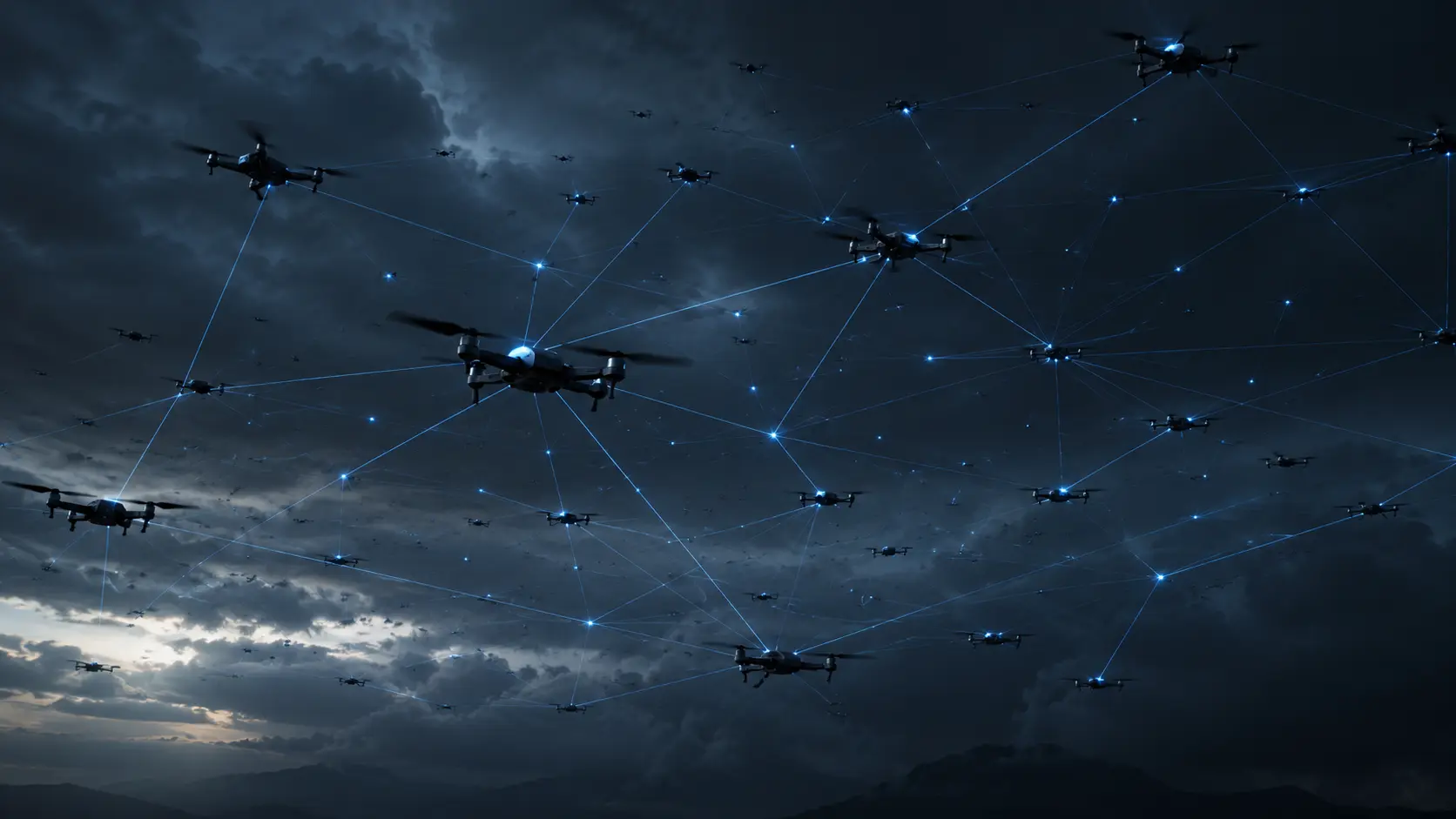
Concept: Hundreds of cheap drones acting as one collective intelligence.
Why it matters: Swarms overwhelm expensive, traditional air defense systems through sheer volume.
Who uses it: Advanced militaries, defense startups, and asymmetric insurgent groups.
Biggest takeaway: Modern warfare is shifting from expensive, highly survivable platforms to cheap, expendable masses.
In Simple Words
Consider how a flock of birds flies together. They do not have a leader shouting commands, nor do they map out their flight paths in advance. Instead, each bird follows a few simple rules based on the position of the birds immediately next to it.
A drone swarm works exactly the same way. In the past, flying an unmanned military drone required a dedicated human pilot sitting in a control room holding a joystick. A swarm removes the human from the direct flight controls. An operator simply gives the entire swarm a single goal, such as “search this forest for hidden vehicles.”
Using artificial intelligence, the drones talk to each other to figure out the best way to accomplish the task. If one drone finds a target, it instantly alerts the rest. If twenty drones are shot down, the remaining eighty seamlessly reorganize themselves and continue flying. By networking cheap hardware with intelligent software, militaries can overwhelm massive, billion-dollar defense systems.
Why This Matters
The global defense industry is currently facing a catastrophic math problem.
For the last fifty years, advanced militaries focused on building exquisite, highly survivable platforms. A modern fighter jet costs around $80 million. A single Patriot interceptor missile, used to shoot down incoming aerial threats, costs approximately $4 million. This economic model worked perfectly when adversaries were also flying expensive jets.
Drone swarms completely destroy this financial logic. If an adversary launches a swarm of one thousand autonomous drones that cost $2,000 each, the entire attack costs $2 million. If the defending army uses $4 million missiles to shoot them down, the defender will bankrupt their own economy long before the attacker runs out of drones. Military strategists call this the “attritional cost-exchange ratio,” and it is the most urgent vulnerability facing traditional armies today.
Furthermore, swarms fundamentally change the speed of warfare. A human radar operator simply cannot track, prioritize, and engage three hundred individual targets moving erratically at low altitudes. To survive a swarm, defense systems must become fully autonomous. This creates a terrifying geopolitical reality: autonomous weapons fighting autonomous defenses at computational speeds that human brains cannot process.
HOW DRONE SWARMS WORK
A true drone swarm is not just a large group of drones flying in the same direction. It is a highly integrated software system.
Here is exactly how the network functions.
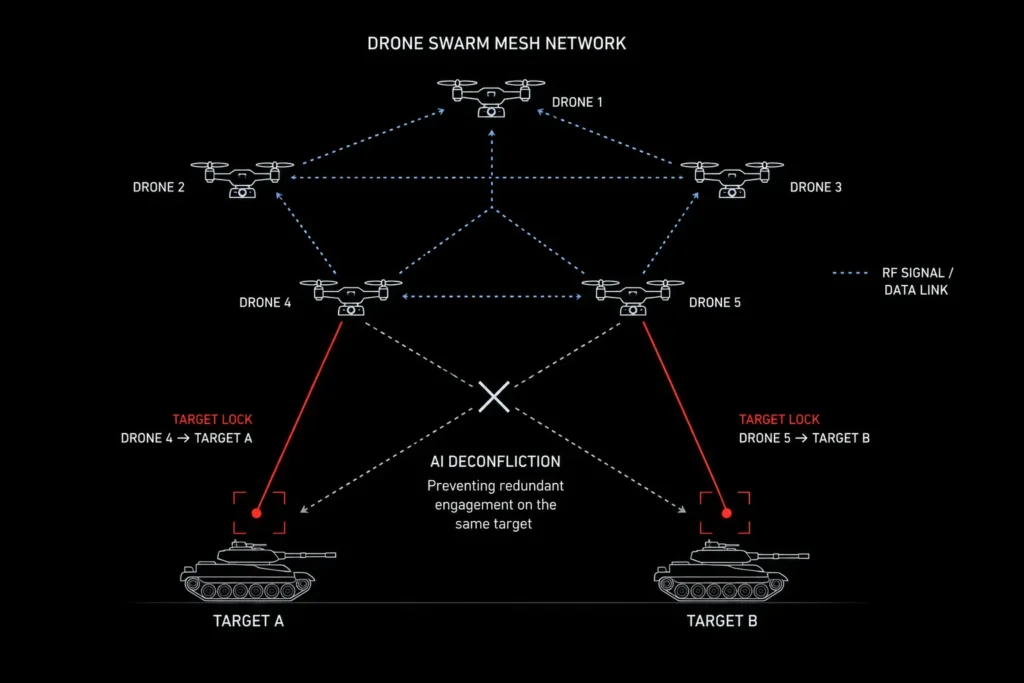
1. The Mesh Network: For a swarm to function, the drones must communicate. However, relying on a central command tower or satellite is too dangerous; if the tower is destroyed, the whole swarm falls. Instead, drones use a decentralized mesh network. Every single drone acts as a flying router. They transmit radio frequency (RF) signals to the drones immediately surrounding them. If a drone in the front spots a target, it passes the data to the drone behind it, which passes it down the line. If an enemy jams the signal of one drone, the network simply routes the data around it.
2. Algorithmic Deconfliction: When hundreds of machines occupy the same airspace, they run the risk of crashing into each other. Engineers solve this using spatial computing algorithms. Each drone constantly calculates its own position relative to its neighbors, maintaining a digital bubble. If the wind blows one drone off course, the surrounding drones automatically shift their positions to prevent a collision.
3. Distributed Sensing: Traditional military aircraft carry massive, expensive radar arrays. A swarm breaks that massive sensor down into tiny pieces. One drone might carry an infrared camera. Another might carry an acoustic sensor to listen for engine noise. A third might carry a small radar. The mesh network fuses all this data together in real-time. The swarm, as a collective entity, gains a multi-spectral view of the battlefield that is highly accurate and incredibly difficult to blind.
4. Terminal Engagement: When the swarm identifies an enemy target, the artificial intelligence takes over the attack sequence. To prevent wasting ammunition, the software uses algorithmic target deconfliction. If three drones lock onto the same tank, the algorithm instantly calculates which drone has the best angle and assigns it to strike, ordering the other two to break off and search for new targets.
5. System Limitations: Swarms have a critical physical weakness: battery capacity. Because the drones are small, they can only fly for a limited time—often less than an hour—before running out of power. Additionally, if a defender possesses advanced electronic warfare (EW) equipment, they can flood the battlefield with broad-spectrum radio noise, drowning out the mesh network. Without communication, a coordinated swarm instantly degrades into a collection of blind, isolated machines.
Real-World Applications
The deployment of autonomous swarms is actively shifting tactical doctrines worldwide.
Suppression of Enemy Air Defenses (SEAD): Militaries use swarms as decoys. Hundreds of cheap drones are flown directly into heavily defended enemy territory. When the enemy turns on their radar to shoot the drones down, they reveal their exact physical location. The attacking military then fires a heavy cruise missile at the exposed radar site.
Naval Saturation Attacks: Modern destroyers use advanced radar and rapid-fire cannons to protect themselves from missiles. However, if a ship is attacked by a swarm of surface drone-boats simultaneously approaching from 360 degrees, the defense systems become saturated. The ship simply cannot spin its guns fast enough to engage every target before one breaks through.
Urban Reconnaissance: In dense city environments where GPS signals fail, militaries deploy micro-drone swarms. These drones fly into buildings, navigate through hallways using optical cameras, and beam a 3D map of the interior back to infantry units before they ever open the door.
Economic & Strategic Impact
The economics of defense contracting are being violently restructured.
Historically, massive aerospace companies dominated defense spending by building heavy, manned platforms that took decades to engineer. Today, the most valuable military technology is often developed by nimble software startups. The value is no longer in the titanium airframe; it is in the artificial intelligence algorithms that coordinate the fleet.
Strategically, drone swarms democratize airpower. In the past, only wealthy nations could afford a functional air force. Today, non-state actors, insurgencies, and smaller nations can purchase commercial drones, modify them with open-source software, and field an air force capable of paralyzing a traditional superpower.
This shifts the global balance of power. The technological advantage has moved from the defender—who must protect a massive area with expensive missiles—to the attacker, who only needs a few cheap drones to slip through the net.
Advantages
Cost Asymmetry: Swarms force adversaries to spend millions of dollars to shoot down thousands of dollars’ worth of equipment.
Fault Tolerance: If a traditional fighter jet is shot down, the mission fails. If 30% of a drone swarm is shot down, the remaining 70% automatically adapts and finishes the objective.
No Human Risk: Autonomous swarms can be sent into highly toxic, heavily defended, or irradiated environments without risking pilots’ lives.
Cognitive Overload: Swarms present too many simultaneous threats for human operators to process, paralyzing traditional command centers.
Limitations
Electronic Warfare Vulnerability: The mesh network requires clear radio frequencies; heavy jamming can sever the swarm’s ability to coordinate.
Payload Constraints: Small, cheap drones cannot carry heavy, bunker-busting explosives, limiting their ability to destroy fortified targets.
Range Limits: Small batteries restrict how far the swarm can travel from its launch point.
Friendly Fire Risks: If the artificial intelligence misidentifies a target, a fully autonomous swarm could execute an attack before a human operator has time to abort it.
Common Misconceptions
Misconception: A drone swarm is just fifty pilots flying fifty drones at the same time.
Reality: That is a coordinated group, not a swarm. A swarm is controlled by a single operator who issues high-level commands, while the drones pilot themselves.
Misconception: Swarms rely heavily on GPS to navigate.
Reality: Because GPS is easily jammed in combat, modern swarms use machine vision. They look at the ground through cameras and compare it to pre-loaded satellite maps to know exactly where they are.
Misconception: Drone swarms are unstoppable.
Reality: They are highly vulnerable to Directed Energy Weapons (DEW). Militaries are deploying high-energy lasers and high-power microwaves that can burn drones out of the sky for pennies per shot.
What Most People Miss
The most dangerous part of a drone swarm is not the explosives it carries; it is the sensor network it creates.
When people think of drone swarms, they imagine flying bombs. In reality, a swarm’s primary function is intelligence gathering. When a hundred drones spread out over a city, they act as an un-jammable, low-altitude surveillance grid. They record optical, thermal, and electronic data, instantly passing it back to artillery units miles away.
Even if the swarm never fires a single weapon, its ability to strip away the “fog of war” and provide perfect, real-time visibility over a massive area is what truly makes it a strategic game-changer.
Comparison Table
| Feature | Traditional Precision Airstrike | Autonomous Drone Swarm |
| Purpose | Destroy high-value, fortified targets. | Overwhelm defenses and hunt dispersed targets. |
| Platform Cost | $50M – $100M+ per aircraft. | $1,000 – $10,000 per drone. |
| Survivability Model | Avoid detection (stealth) and fly fast. | Accept massive losses; overwhelm with numbers. |
| Targeting | Human pilot or pre-programmed GPS. | AI-driven machine vision and collective sensing. |
| Defensive Counter | Radar detection and anti-air missiles. | Electronic jamming and directed energy (lasers). |
| Best Fit | Deep strikes against hardened bunkers. | Urban combat, air defense suppression, reconnaissance. |
Case Study
Situation: During modern trench warfare in Eastern Europe, military forces heavily fortified their front lines with intense Electronic Warfare (EW) systems.
Challenge: These EW systems created invisible domes of radio interference. When soldiers tried to fly standard, human-piloted kamikaze drones into the trenches, the video feeds would cut out, and the drones would drop from the sky before reaching their targets.
Solution: Engineers deployed early iterations of autonomous swarming software. A pilot would fly the drone to the edge of the jamming dome and lock the camera onto an enemy tank. Once locked, the drone’s onboard artificial intelligence took over.
Outcome: Even when the EW system completely severed the connection between the drone and the human pilot, the drone no longer cared. It used optical tracking to steer itself into the tank autonomously during the final mile.
Lessons Learned: Electronic warfare can defeat remote control, but it cannot defeat autonomy. As drones become smarter, jamming their communications becomes irrelevant if the machine can finish the kill on its own.
Future Outlook
Next 12–24 Months: The integration of machine vision will become standard. Drones will stop relying on GPS entirely, using basic optical cameras to navigate and identify targets in heavily jammed environments. Militaries will rush to procure cheap, kinetic interceptor drones to knock enemy swarms out of the sky.
Next 3–5 Years: High-Power Microwave (HPM) weapons will be mounted on standard armored vehicles. Instead of trying to shoot down individual drones with bullets, tanks will emit invisible cones of microwave energy that instantly fry the circuits of any swarm flying within a mile.
Next 10 Years: Swarms will become multi-domain. A single AI commander will coordinate underwater drone torpedoes, surface drone boats, and aerial drone swarms simultaneously. They will execute perfectly synchronized, multi-axis attacks that no human defense system can calculate or repel.
Most Likely Scenario: The fundamental unit of military maneuver will change. Infantry squads and armored columns will no longer move without a dedicated swarm acting as their vanguard. The cost of warfare will drop, but the complexity and speed of engagements will push humans entirely out of the tactical decision-making loop.
Key Takeaways
A drone swarm operates as a single artificial intelligence distributed across hundreds of cheap machines.
Swarms defeat advanced militaries by ruining the cost-exchange ratio, forcing defenders to use expensive missiles on cheap plastic.
Drones communicate using decentralized mesh networks, ensuring the group survives even if many drones are destroyed.
Algorithmic deconfliction allows the swarm to fly in tight formations and assign targets without wasting ammunition.
The primary weakness of a swarm is electronic warfare, which can disrupt the radio frequencies they use to talk.
Swarms shift military power toward the attacker, heavily favoring mass and expendability over expensive stealth platforms.
Future defense requires directed energy weapons, like lasers and microwaves, to shoot down swarms economically.
Glossary
Attritional Cost-Exchange Ratio: A military calculation comparing the cost of an incoming attack against the financial cost required to defend against it.
Decentralized Mesh Network: A communication system where each device connects directly to the others around it, rather than relying on a central router or tower.
Directed Energy Weapon (DEW): A system that damages targets using highly focused energy, including lasers and high-power microwaves, rather than physical projectiles.
Electronic Warfare (EW): The use of the electromagnetic spectrum (like radio waves) to jam, deceive, or disrupt enemy communications and radar.
Machine Vision: Artificial intelligence that allows a computer to process, analyze, and understand visual data from a camera in real-time.
Spatial Computing: Technology that allows machines to understand and interact with the physical 3D space around them.
Suppression of Enemy Air Defenses (SEAD): Military operations designed to destroy or neutralize enemy radar and anti-aircraft systems.
Terminal Engagement: The final phase of an attack where a weapon locks onto and strikes its target.
Frequently Asked Questions
Can one person control a whole drone swarm? Yes. The operator does not fly the drones with a joystick. They use a tablet to draw a box on a map and issue a command, and the swarm’s software calculates the individual flight paths.
How do drones in a swarm not crash into each other? They use spatial computing and algorithmic deconfliction. Each drone broadcasts its exact location to its neighbors multiple times a second, creating a repelling digital force field that prevents collisions.
What happens if the main drone is shot down? There is no “main” drone. A true swarm is decentralized. If any drone is destroyed, the rest of the network instantly reconfigures and continues the mission without interruption.
Are drone swarms fully autonomous? Most current systems keep a “human in the loop” to authorize lethal force. However, the technology for fully autonomous engagement already exists and is being rapidly pushed to the battlefield due to electronic jamming.
How do you defend against a drone swarm? Traditional bullets and missiles are too expensive and slow. The most effective defenses are electronic warfare (jamming their communications) and directed energy weapons (using microwaves to fry their circuits).
Do drone swarms need the internet to work? No. They create their own localized mesh network using radio frequencies. They do not rely on cellular towers, satellite internet, or external infrastructure to talk to each other.
Can drone swarms be used for non-military purposes? Absolutely. Swarms are used for agricultural mapping, searching for lost hikers in dense forests, and coordinating massive, synchronized light shows at public events.
Why are drone swarms so cheap to build? They rely on commercial off-the-shelf (COTS) components. The motors, batteries, and cameras are the exact same mass-produced parts used in civilian consumer drones and smartphones.
Sources
Center for a New American Security (CNAS): The Future of Autonomous Swarming
Defense Advanced Research Projects Agency (DARPA): OFFensive Swarm-Enabled Tactics (OFFSET) Program
Royal United Services Institute (RUSI): The Evolution of Unmanned Systems in Modern Warfare
Modern War Institute at West Point: Electronic Warfare and the Drone Revolution