Advertisement
)

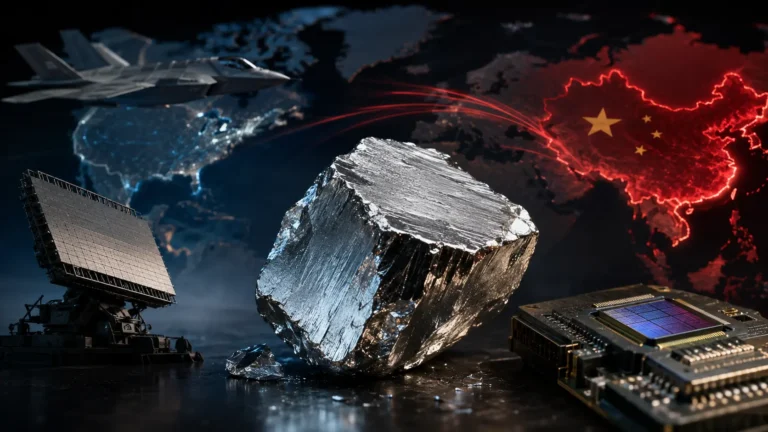
At a Glance
- Concept: Utilizing highly toxic, multi-stage solvent extraction (SX) loops to chemically divide heavy rare earth elements that are otherwise identical in nature.
- Why it matters: The permanent magnets powering wind turbines, modern defense systems, and EV drivetrains fail at high heat. Dysprosium and terbium fix this. Without the ability to separate these specific elements, a nation’s clean energy and defense manufacturing sectors will grind to a halt.
- Who uses it: State-backed Chinese conglomerates (like China Rare Earth Group), and emerging Western challengers like Lynas Rare Earths, Energy Fuels, and MP Materials.
- Biggest takeaway: Mining rare earths is not the bottleneck; refining them is. Breaking the geopolitical monopoly requires building the billion-dollar midstream chemical plants that turn mixed rare earth mud into 99.9% pure, separated elemental oxides.
In Simple Words
Imagine having a massive bucket filled with 17 different colors of fine sand, completely mixed together. Your job is to pull out only the dark blue sand (dysprosium).
Because the grains of sand are identical in size and weight, you cannot use a sieve. You cannot use a magnet. The only way to separate them is to pour thousands of gallons of highly specific, toxic chemicals into the bucket that happen to stick to the dark blue sand just a tiny bit more than the other colors.
You mix the sludge, let it settle, and scoop off the top. You have to repeat this washing, mixing, and scooping process hundreds of times in a row just to get a single handful of pure dark blue sand.
This is the reality of Heavy Rare Earth Separation. It is a brutally inefficient, massive chemical operation. Because dysprosium and terbium are required to build the electric motors inside Teslas and the guidance systems inside military missiles, the countries that own these massive chemical washing plants effectively control the future of global hardware.
Why This Matters
The global transition to net-zero carbon emissions is built on the back of the permanent magnet (NdFeB).
Global demand for heavy rare earth metals is projected to exceed 80,000 metric tons annually by the end of 2026, with the defense and technology sectors accounting for over 75% of consumption. A modern electric vehicle motor operates at blistering temperatures (often between 180°C and 200°C). At these temperatures, a standard neodymium magnet loses its magnetic field. By adding a small percentage of dysprosium or terbium to the alloy, the magnet achieves high-temperature stability.
The geopolitical crisis stems from a hyper-concentrated supply chain. China controls over 90% of global terbium refining capacity. In 2025, Beijing instituted phased export controls on rare earth processing technologies and raw oxides, aggressively tightening the supply available to the West. This triggered severe price volatility—terbium spiked over 20% in a single month in April 2026, hitting $970/kg. Consequently, establishing domestic, non-Chinese heavy rare earth separation capacity is now the single highest priority for Western industrial policy.
The Big Picture
It is vital to distinguish between “Light” and “Heavy” rare earths.
Light Rare Earth Elements (LREEs) like neodymium and praseodymium are relatively abundant and easier to process. Western companies successfully cracked the light rare earth monopoly in the early 2020s.
Heavy Rare Earth Elements (HREEs) are a completely different challenge. They are incredibly scarce and almost exclusively found in complex ores, such as the ion-adsorption clays of southern China (Jiangxi, Guangdong, and Fujian provinces). The state-consolidated China Rare Earth Group (CREG) manages these deposits, acting as the absolute swing supplier for the global market. Breaking the broader rare earth monopoly ultimately relies on conquering the midstream chemical separation of these heavy elements outside of Asian jurisdictions.
HOW HEAVY RARE EARTH SEPARATION WORKS
Separating elements that sit directly next to each other on the periodic table requires exploiting microscopic variations in atomic radius. Here is the first-principles breakdown.
1. The Fundamental Problem: Chemical Twins
All 17 rare earth elements are chemically nearly identical. When mined, they are blended together in the same host rock. You cannot simply smelt them in a furnace to separate them by melting point, as you would with iron or copper.
2. The Insufficiency of Standard Refining
While it is relatively straightforward to separate Light Rare Earths, the Heavy Rare Earths (dysprosium, terbium, yttrium, europium) require vastly more aggressive and precise chemical processing to isolate due to their higher atomic weights and unique electron configurations.
3. The Core Mechanism: Solvent Extraction (SX)
The industry standard for separating these elements is a process called liquid-liquid solvent extraction. The mixed rare earth ore is dissolved in highly corrosive acid. This acidic liquid is then pumped into a tank and mixed with a specialized organic solvent. Because different rare earths have microscopic differences in how they bind to the solvent, a tiny fraction of the target metal (e.g., dysprosium) transfers from the acid into the solvent via specific anionic or cationic extraction agents.
4. Technical Depth: Multi-Stage Mixer-Settler Cascades
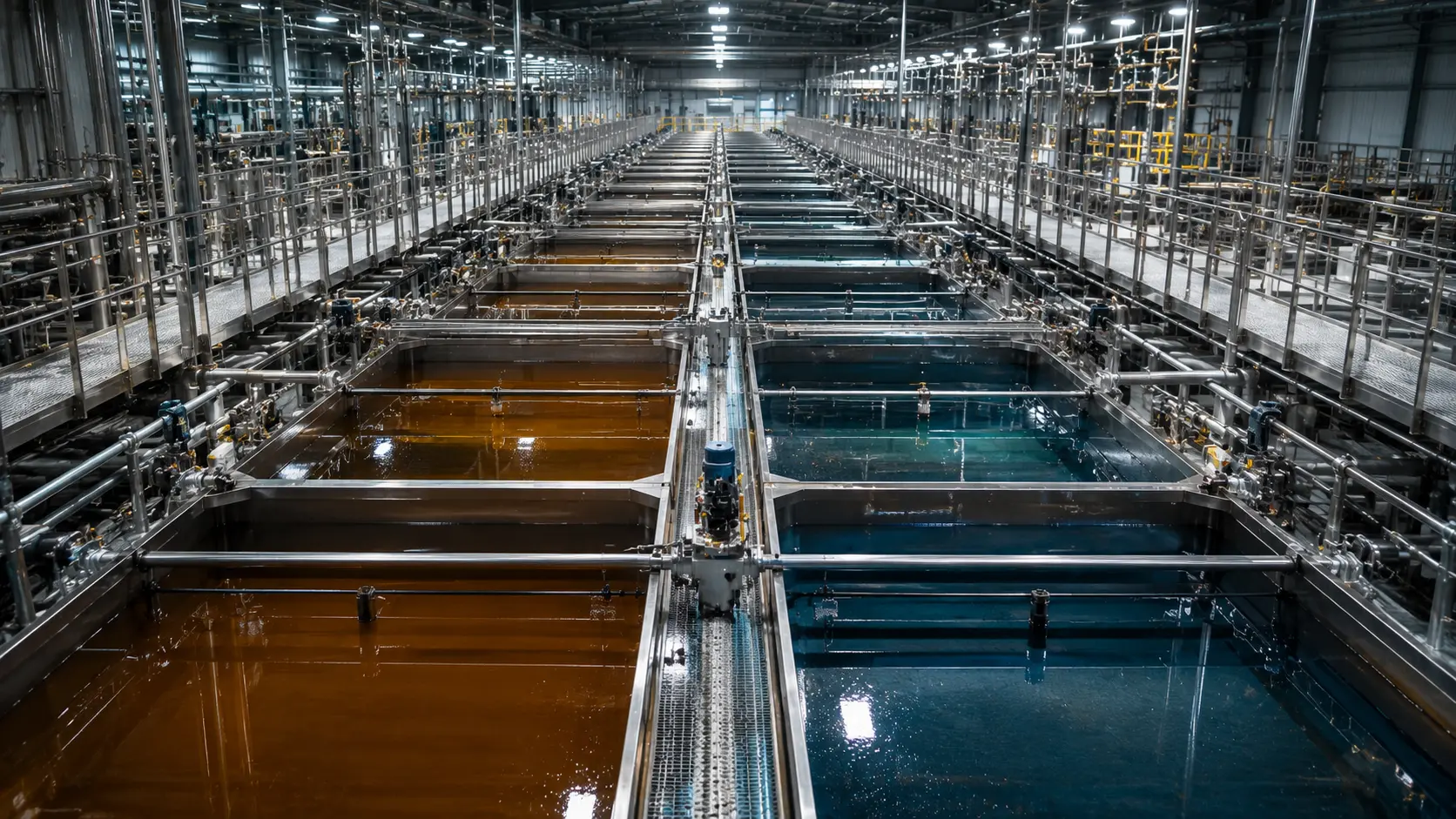
Because the chemical differences are so minuscule, a single mixing tank only separates a fraction of a percent of the metal. To achieve the 99.9% purity required for commercial applications, the liquid must cascade through hundreds—sometimes over a thousand—sequential “mixer-settler” stages. The fluid is aggressively agitated (mixed), allowed to separate (settle), and then piped to the next tank in a massive, energy-intensive continuous loop.
5. Real-World Consequences: The Coercivity Chokepoint
Why endure this toxic, multi-billion-dollar process? Because of “coercivity.” The permanent magnets inside wind turbines and electric vehicle motors operate under extreme stress. Dysprosium and terbium act as chemical anchors, locking the magnetic fields in place and preventing demagnetization. Without the massive mixer-settler plants required to produce these heavy rare earths, the advanced hardware manufacturing capabilities of an entire continent can be effectively turned off.
Real-World Applications
Heavy rare earths dictate the performance of the world’s most advanced technologies.
Electric Vehicle (EV) Drivetrains: The majority of modern EVs use permanent magnet synchronous motors because they are highly efficient and compact. Dysprosium and terbium are blended into the NdFeB magnets of these motors to ensure they do not permanently lose their torque when the motor runs hot on the highway.
Defense and Aerospace Systems: The defense sector represents the fastest-growing demand segment for heavy rare earths, with requirements projected to jump over 36% between 2025 and 2026. Dysprosium and terbium are critical components in the precision actuators, laser rangefinders, radar platforms, and guidance systems of modern stealth aircraft and hypersonic munitions.
Offshore Wind Turbines: A single multi-megawatt offshore wind turbine generator requires hundreds of kilograms of permanent magnets. Because replacing a demagnetized generator in the middle of the ocean is economically catastrophic, heavy rare earths are heavily dosed into these magnets to guarantee a 25-year operational lifespan under immense mechanical friction.
Economic & Strategic Impact
The heavy rare earth supply chain is heavily weaponized as a tool of macroeconomic leverage.
The regulatory framework governing strategic minerals is shifting away from reactive trade tariffs and toward integrated industrial architecture. Centralized control over >90% of refining capacity creates a systemic vulnerability that exposes the defense and clean energy sectors of allied nations to immediate supply shocks.
In response, Western governments are mobilizing blended finance mechanisms and strategic stockpiles to derisk capital investments. Because a commercial-scale solvent extraction plant costs hundreds of millions of dollars and requires years to permit, government intervention is necessary to provide the guaranteed off-take agreements that private capital demands before competing with state-subsidized Asian monopolies.
Advantages (of Domestic Separation)
- Supply Chain Sovereignty: Eliminates single-point-of-failure reliance on foreign adversaries for the most critical components of national defense and energy infrastructure.
- Price Stability: Buffers domestic manufacturers from sudden export quotas and artificial price spikes initiated by dominant state-owned swing suppliers.
- Environmental Accountability: Mandates that the highly toxic chemical byproducts of solvent extraction are managed under transparent, Western environmental regulations rather than being dumped indiscriminately into developing ecosystems.
Limitations (The Barriers to Entry)
- Extreme Capital and Lead Times: Building a 1,000-stage mixer-settler facility takes roughly five to seven years of engineering, testing, and environmental permitting.
- Toxic Byproducts: Liquid-liquid extraction utilizes harsh acids and volatile organic solvents. Disposing of the resulting wastewater safely is astronomically expensive and faces severe pushback from local environmental groups.
- Metallurgical Knowledge Gap: Operating a continuous solvent extraction loop is an incredibly delicate dark art. A slight temperature shift or pH imbalance can ruin weeks of production. China has spent 30 years perfecting this talent pool; the West is effectively starting from scratch.
Common Misconceptions
Misconception: We are running out of rare earths in the ground.
Reality: Rare earths are not actually rare; they are relatively abundant in the Earth’s crust. The true scarcity is not the rock, but the highly specialized refining capacity required to separate the elements out of the rock.
Misconception: You can just mine heavy rare earths in the U.S. or Europe to fix the problem.
Reality: You can pull the ore out of the ground in California or Australia, but if you do not have the billion-dollar chemical separation plant, you simply possess radioactive mud. Until recently, virtually all Western-mined heavy rare earths were shipped to Asia for processing.
Misconception: Electric vehicles cannot exist without dysprosium.
Reality: Automakers can build induction motors that use zero rare earths. However, these motors are generally heavier, larger, and less battery-efficient than permanent magnet motors. Automakers pay the premium for heavy rare earths to maximize the range of the vehicle.
What Most People Miss
The engineering triumph of Grain Boundary Diffusion (GBD).
Historically, manufacturers mixed dysprosium and terbium directly into the molten alloy of the entire magnet (bulk alloying). This wasted massive amounts of the world’s rarest metals inside the dead core of the magnet, where they provided almost no thermodynamic benefit.
To bypass the geopolitical monopoly, advanced magnet manufacturers optimized magnet microstructures using Grain Boundary Diffusion. Engineers bake a standard neodymium magnet, coat the outside of it with a microscopic layer of dysprosium or terbium, and apply extreme heat. The heavy rare earths seep only into the microscopic boundaries between the crystal grains of the magnet. This targeted application provides the exact same high-temperature heat resistance while slashing the required heavy rare earth volume by 50% to 70%, fundamentally altering the long-term demand calculus.
Comparison Table
| Feature | Light Rare Earths (LREEs) | Heavy Rare Earths (HREEs) |
| Key Elements | Neodymium (Nd), Praseodymium (Pr) | Dysprosium (Dy), Terbium (Tb) |
| Primary Function | Raw magnetic strength | High-temperature coercivity (heat resistance) |
| Relative Scarcity | High abundance | Extreme scarcity |
| Separation Complexity | Moderate | Extremely High (Hundreds of SX stages) |
| Geopolitical Monopoly | Broken (Western scaling achieved) | Intact (China controls >90% refining capacity) |
Case Study
Situation: In early 2025, stringent export controls were introduced by dominant Asian suppliers on rare earth technologies and separated oxides, aggressively tightening the supply of critical heavy rare earths to non-Chinese buyers.
Challenge: Western defense contractors and automotive manufacturers faced a crisis. They desperately required ultra-pure terbium and dysprosium for guided munitions and EV drivetrains, but fundamentally lacked domestic commercial separation facilities.
Solution (The Western Midstream Pivot): Energy Fuels and Lynas Rare Earths accelerated their domestic processing infrastructure. Lynas pressed forward with a dedicated heavy rare earth separation facility in Seadrift, Texas. Simultaneously, Energy Fuels utilized monazite feedstock through its advanced rare earth separation circuit at the White Mesa Mill in Utah.
Outcome: In March 2026, Energy Fuels successfully produced the first kilogram of 99.9% pure terbium oxide on U.S. soil in decades. While initial pilot production hovered around 1 kg per week, the facility established a roadmap to scale commercial output to 12 tonnes annually by 2027, rising to 35 tonnes of dysprosium by 2029.
Lessons Learned: The milestone proved that the midstream solvent extraction bottleneck could be broken outside of Asia. However, the multi-year lead times, intensive capital expenditures, and reliance on state-level funding underscored that achieving true supply chain resilience requires sustained, strategic industrial policy, rather than reactive market adjustments.
Future Outlook
Next 12–24 Months
The market will experience continued price volatility as recent export controls fully bind the global spot market. Western automakers will aggressively audit their tier-2 and tier-3 suppliers, attempting to map exactly where their magnet manufacturers are sourcing their dysprosium. The primary focus of U.S. and allied governments will be accelerating the final investment decisions (FID) for major processing sites like Browns Range in Australia (targeting an FID by late 2026) to bring localized supply online.
Next 3–5 Years
The scaling of alternative non-Chinese processing networks. Facilities in Malaysia, Australia, and the U.S. Gulf Coast will begin consistently delivering commercial volumes of separated dysprosium and terbium. Concurrently, Western companies will attempt to unlock new feedstock sources, such as the Serra Verde ionic clay deposit in Brazil or the Makuutu project in Uganda, proving that the highly prized heavy-enriched clay deposits are not strictly confined to southern China.
Next 10 Years
The technological leap to Stage-Minimized Separation. The industry will slowly transition away from the toxic, massive liquid-liquid mixer-settler loops of the 20th century. Next-generation technologies, including solid-phase extraction resins and electro-membrane systems, will mature. These systems promise to separate heavy rare earths using a fraction of the chemicals and energy, allowing localized, environmentally compliant refining facilities to be built directly next to automotive gigafactories.
Most Likely Scenario
China’s absolute monopoly on heavy rare earth refining will slowly erode into an oligopoly over the next two decades, stabilizing at roughly 60% of the global market. The West will secure just enough domestic heavy rare earth separation capacity to supply its critical defense and aerospace sectors, while the broader commercial automotive market will increasingly rely on Grain Boundary Diffusion and alternative magnet chemistries to structurally engineer dysprosium out of the supply chain entirely.
Key Takeaways
- Heavy rare earth separation is a midstream supply chain chokepoint required to produce elements like dysprosium and terbium.
- Dysprosium and terbium are essential additives in NdFeB permanent magnets, providing the heat resistance (coercivity) necessary for EV motors and wind turbines to function.
- The separation process uses highly toxic, liquid-liquid solvent extraction, requiring hundreds of chemical mixing stages to achieve commercial purity.
- China controls over 90% of global terbium refining capacity, utilizing this leverage via export controls to dictate global hardware manufacturing.
- Western companies like Energy Fuels (Utah) and Lynas Rare Earths (Texas) are actively building and validating domestic separation plants to secure allied supply.
- Advanced engineering techniques like Grain Boundary Diffusion (GBD) are actively reducing the volume of dysprosium required per magnet, easing overall demand pressure.
Glossary
Coercivity: The resistance of a magnetic material to changes in magnetization. High coercivity means the magnet will not lose its power when exposed to high heat or competing magnetic fields.
Grain Boundary Diffusion (GBD): A manufacturing technique where heavy rare earths are infused only into the microscopic borders between crystals in a magnet, slashing the total amount of material required.
Heavy Rare Earth Elements (HREEs): A sub-group of rare earth elements with higher atomic weights, most notably Dysprosium (Dy) and Terbium (Tb), known for their extreme scarcity and complex extraction.
Ion-Adsorption Clays: Unique geological deposits, predominantly found in southern China, that contain an unusually high percentage of highly profitable heavy rare earth elements.
Mixer-Settler: The industrial tank used in solvent extraction where aqueous acid and organic solvents are aggressively mixed together and then allowed to separate into distinct layers.
NdFeB (Neodymium-Iron-Boron): The chemical composition of the world’s strongest and most commonly used permanent magnets.
Solvent Extraction (SX): The chemical process of separating compounds based on their relative solubilities in two different immiscible liquids, usually water (acid) and an organic solvent.
Frequently Asked Questions
Why don’t we just use regular magnets instead of rare earth magnets?
Standard ferrite or ceramic magnets are incredibly weak and heavy. To achieve the necessary horsepower for an electric vehicle using standard magnets, the motor would be too large and heavy to fit inside a normal car chassis.
Is dysprosium toxic or radioactive?
Dysprosium itself is not highly toxic or radioactive. The environmental danger comes from the separation process, which requires thousands of gallons of harsh acids and solvents, and from the host ores (like monazite), which often contain radioactive thorium and uranium that must be safely managed.
How does China maintain its monopoly?
Decades of state-sponsored industrial policy. They heavily subsidized the massive capital costs of solvent extraction plants, accepted lower environmental standards for waste disposal, and vertically integrated the entire supply chain from the mine to the final magnet factory.
What happens if a magnet demagnetizes?
If the permanent magnets inside an EV motor lose their magnetic field due to high heat, the motor immediately loses its torque and efficiency. The vehicle would experience a catastrophic loss of power and the motor would effectively be destroyed.
Can we recycle dysprosium from old electronics?
Yes, but it is incredibly difficult. Extracting the microscopic amounts of dysprosium blended inside a crushed hard drive or old wind turbine requires the exact same complex chemical separation techniques as mining virgin ore.
Sources
- Rare Earth Mining News: Top 10 Terbium Producers in 2026
- Farmonaut: Heavy Rare Earth Metals: Key Demand & Trends 2026
- ResearchGate: Breaking China’s Rare Earth Monopoly: Technical Innovations and Policy Pathways for a Multipolar Supply Chain (November 2025)
- Discovery Alert: Breaking China’s Rare Earth Monopoly: Regulatory Solutions for 2026
- GoVeda: PROCESS FOR SEPARATION AND PURIFICATION OF HEAVY RARE EARTHS BY LIQUID/LIQUID EXTRACTION
- International Energy Agency (IEA): Executive summary – Rare Earth Elements