Advertisement
)

AT A GLANCE
- Concept: Hash Verification: Software receives a unique mathematical fingerprint that exposes any unauthorized code alterations immediately.
- Concept: Asymmetric Cryptography: Developers sign software using a private key; operating systems verify it using a public key.
- Concept: The Trust Chain: Individual developer keys inherit their trust mathematically from a master Root Certificate Authority.
- Concept: Kernel Ring Access: The Windows operating system strictly blocks any hardware driver lacking a valid cryptographic signature.
HOW IT WORKS
Software is simply a long string of binary data. To prove this data is authentic, the developer runs the compiled code through a cryptographic hash function, such as SHA-256. This algorithm generates a fixed-length string of characters mathematically unique to that exact version of the software. If a hacker alters even a single line of code, the hash changes completely.
The developer then encrypts this hash using their own secret mathematical private key. This encrypted hash becomes the digital signature attached to the software executable. Any computer can use the developer’s widely distributed public key to decrypt the signature and reveal the original hash. The computer then calculates its own hash of the downloaded software. If the two hashes match perfectly, the software is physically intact.
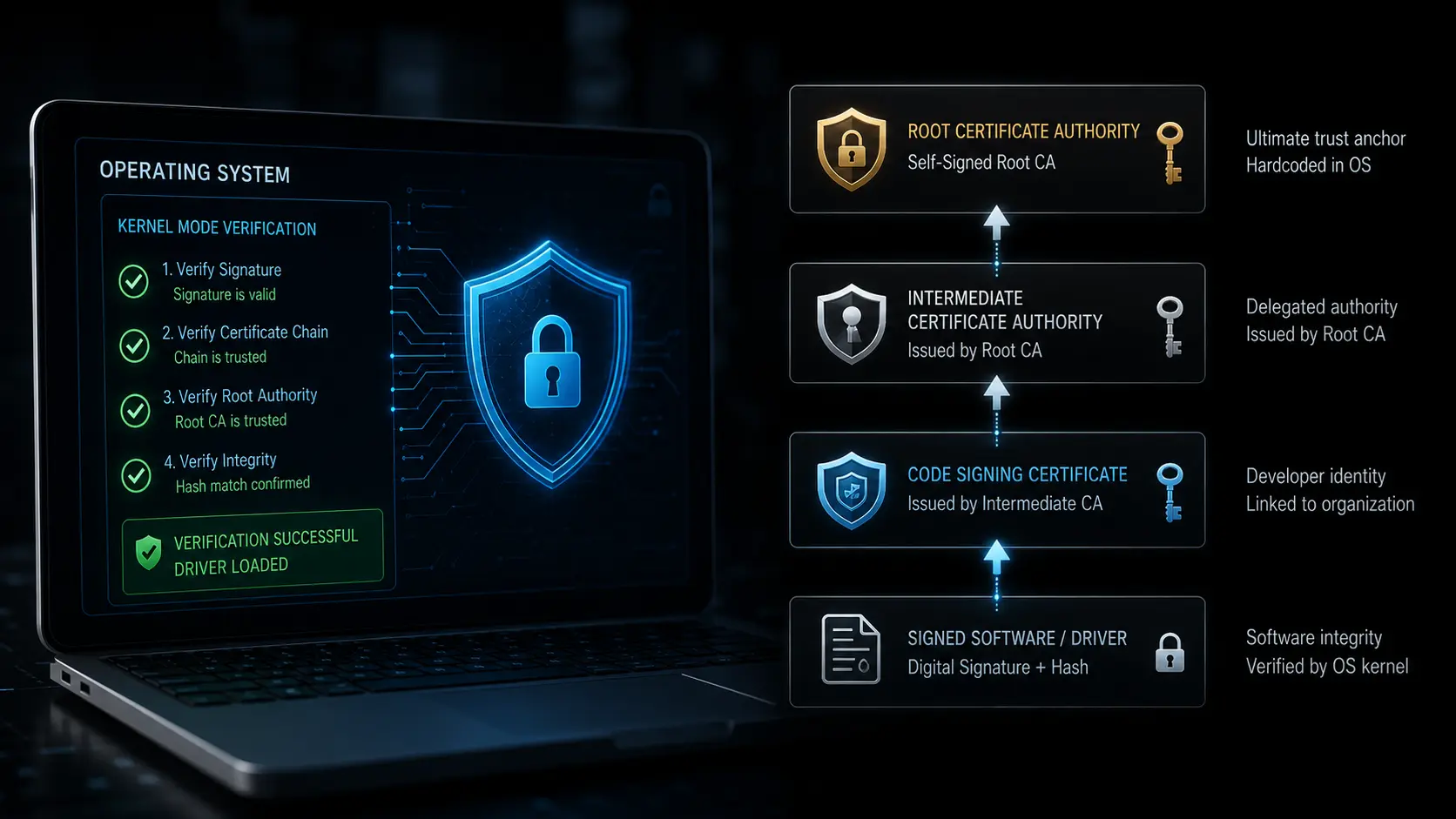
However, anyone can generate a private key. The operating system needs a reason to trust that the specific public key actually belongs to the claimed developer. This requires a Public Key Infrastructure (PKI) managed by a Certificate Authority (CA) like DigiCert or RSA Security. The developer proves their legal corporate identity to the CA. Once verified, the CA uses its own highly guarded private key to sign the developer’s public key, linking them together cryptographically.
When a user attempts to install a hardware driver, the Windows Kernel executes a strict mathematical verification sequence. It reads the developer’s digital signature and traces the CA signatures upward, layer by layer, until it hits a master Root CA hardcoded into the Windows operating system itself. If the chain remains unbroken and the decrypted hash matches the software hash, the Kernel grants the driver deep system access.
WHY IT MATTERS NOW
Modern enterprise networks rely entirely on endpoint detection and response (EDR) software to stop malware. However, these defense systems are blind to threats operating at the lowest level of the operating system, known as Kernel Mode (Ring 0). To prevent malware from entering Ring 0, Microsoft enforces strict Driver Signature Enforcement. The Windows Kernel mathematically refuses to load any driver that lacks a valid code signing certificate chained to an approved Root CA.
This strict enforcement forces elite adversaries—like state-sponsored intelligence agencies—to alter their attack vectors. They no longer write brute-force malware that fights antivirus software directly. Instead, they actively steal or compromise the private keys of legitimate software developers.
If a state actor steals a private key from a major hardware manufacturer, they can cryptographically sign their own malicious rootkit. When this rootkit hits a corporate server, the Windows Kernel mathematically recognizes the stolen signature as completely legitimate. The operating system actively protects the malware, granting it absolute, invisible control over the server hardware while bypassing all standard cybersecurity alarms.
The entire multi-trillion-dollar global software supply chain rests upon the absolute secrecy of a few dozen Root CA private keys. If a primary root key is compromised, trust in digital infrastructure collapses instantly. Governments and financial institutions spend billions to physically air-gap the servers holding these root keys, storing them in subterranean vaults protected by armed guards, biometrics, and multi-person physical access protocols.
WHAT MOST PEOPLE MISS
System administrators frequently assume that a valid digital signature guarantees the software itself is safe. They completely miss the reality that cryptography only guarantees identity and integrity, not intent. A mathematically perfect certificate chain simply proves that the code was signed by the key holder and arrived unaltered; it does not prove the code is free of zero-day exploits or intentionally poor engineering.
The fatal flaw in this architecture is revocation latency. If a developer realizes their private key was stolen, they notify the CA to revoke the certificate, adding the serial number to a Certificate Revocation List (CRL). However, if the targeted computer operates on an isolated, highly secure industrial network—like a nuclear power plant—it cannot reach out to the internet to download the updated CRL. The local Windows Kernel blindly accepts the compromised, revoked certificate, allowing the malware to execute flawlessly against the most sensitive infrastructure on Earth.
THE TRAJECTORY
Next 12–36 Months: Major operating systems will mandate hardware-bound signing keys. Developers will be forced to store their private keys inside physical Hardware Security Modules (HSMs) or cloud-based secure enclaves, physically preventing the key from being exported or stolen via network intrusion.
Next Five Years: The industry will deprecate static Certificate Revocation Lists in favor of continuous, short-lived certificates. Software signatures will automatically expire every 72 hours, mathematically neutralizing stolen private keys before adversaries possess the time to engineer and distribute complex supply chain attacks.
Next Ten Years: Quantum computing will physically break the RSA and Elliptic Curve algorithms securing current Root CA keys. The global internet will undergo a massive, highly disruptive migration to Post-Quantum Cryptography (PQC), requiring operating systems to replace their entire hardcoded root trust stores simultaneously.
What Could Go Wrong: A major, globally trusted Root CA could suffer an undetected internal breach. If an adversary mints thousands of fraudulent, perfectly valid certificates over several years, the retroactive cancellation of that Root CA would instantly disable millions of servers, pacemakers, and financial clearing engines worldwide.
Most Likely Outcome: Code signing will shift from a decentralized private market into a heavily regulated sovereign utility. National security agencies will assume direct control over the ultimate root trust anchors, treating cryptographic identity verification as critical national defense infrastructure.
KEY TERMS
- Certificate Authority (CA): A trusted third-party organization that mathematically binds a software developer’s identity to a specific public cryptographic key.
- Private Key: A secret cryptographic string used by a developer to mathematically sign their software, proving they are the true origin of the code.
- Hash Function: A one-way mathematical algorithm that converts software code into a fixed-length string of characters, acting as a digital fingerprint.
- Root Certificate: The ultimate, self-signed cryptographic anchor hardcoded into an operating system that establishes trust for all subsequent certificates in the chain.
- Kernel Mode: The highly privileged, foundational layer of an operating system where core hardware drivers execute without restriction.
SOURCES
- National Institute of Standards and Technology (NIST) — Security Considerations for Code Signing and Certificate Management
- Microsoft Security Response Center — Windows Kernel-Mode Code Signing and Driver Signature Enforcement
- DigiCert — Public Key Infrastructure Architecture and Root Certificate Key Generation Protocols
- Cybersecurity and Infrastructure Security Agency (CISA) — Mitigating the Threat of Compromised Code Signing Certificates