Advertisement
)

AT A GLANCE
- Concept: Passive Sonar: The array emits absolutely no sound, making it entirely invisible to passing submarines.
- Concept: Acoustic Cavitation: Spinning propellers boil microscopic water bubbles that collapse violently, generating distinct low-frequency noise.
- Concept: The Deep Sound Channel: A specific ocean temperature layer that traps and carries sound waves for thousands of miles.
- Concept: Signal Processing: Supercomputers mathematically subtract whale songs and seismic rumbling to isolate mechanical propulsion frequencies.
HOW A HYDROPHONE ARRAY WORKS
Water conducts sound rapidly and efficiently. A submarine displaces thousands of tons of water, relying on a massive spinning propeller for propulsion. As the propeller blades slice through the ocean, they create localized zones of extreme low pressure.
This low pressure physically boils the surrounding water, forming microscopic vapor bubbles. When these bubbles immediately collapse under the surrounding ocean pressure, they create a sharp acoustic shockwave. This mechanical process, known as cavitation, acts as the unavoidable acoustic fingerprint of a nuclear submarine.
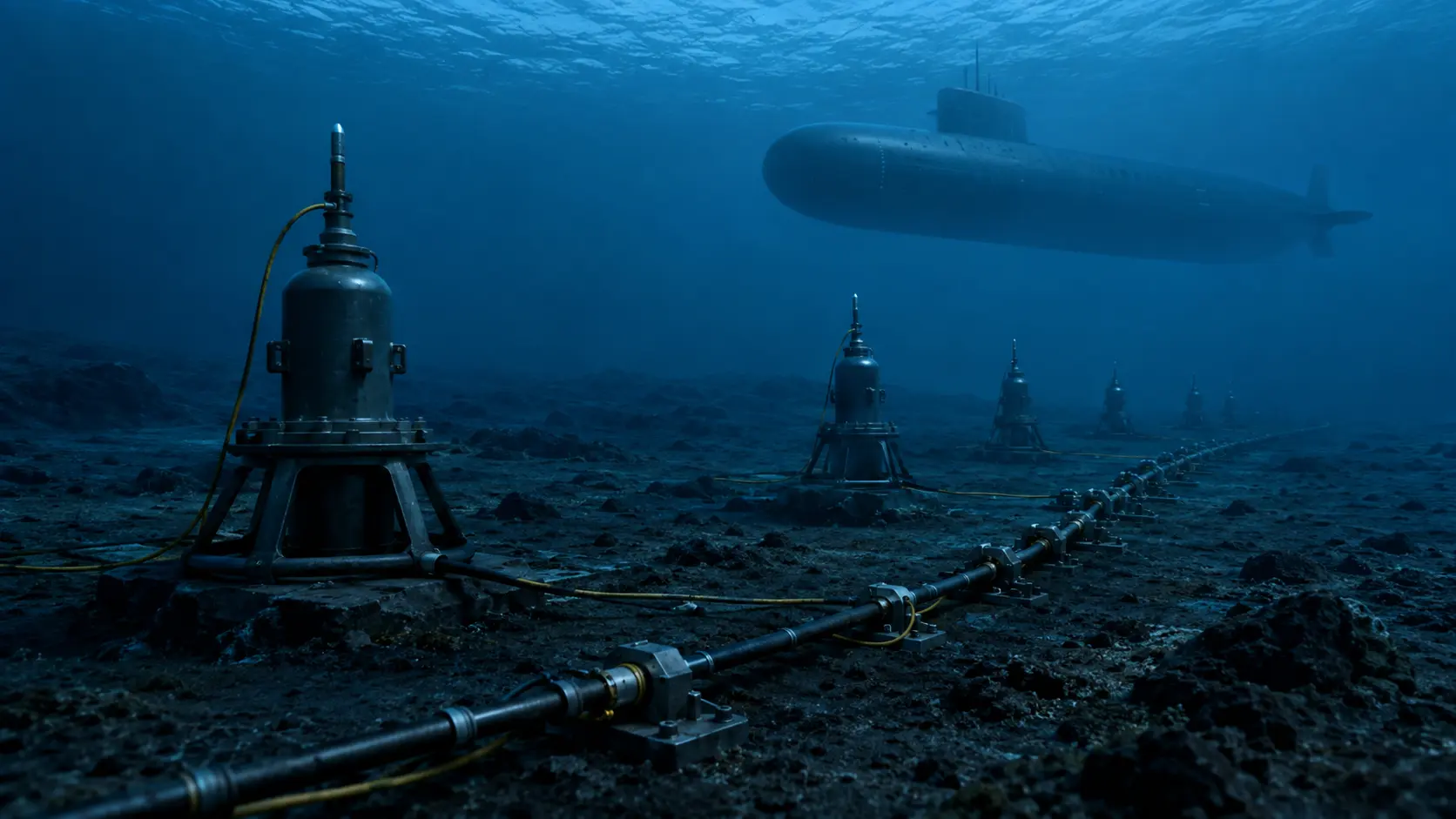
To hunt these signatures, navies deploy the Sound Surveillance System (SOSUS). Engineers sink miles of heavily armored cables directly into the seabed along strategic maritime chokepoints. These cables connect to dozens of passive hydrophones, which act as highly sensitive underwater microphones listening without emitting any active ping.
The hydrophones exploit the Deep Sound Channel, a natural acoustic waveguide located roughly 1,000 meters below the surface. Cold temperatures and high water pressure physically bend sound waves back toward the center of this channel. This thermal trapping allows low-frequency cavitation noise to travel across entire ocean basins without losing kinetic energy.
Raw audio from the deep ocean sounds like chaotic static, filled with seismic shifts, surface shipping, and biological life. Shore-based processing facilities use advanced fast Fourier transform algorithms to strip away this ambient noise.
The software mathematically isolates the exact harmonic frequencies of a specific submarine class. It then triangulates the vessel’s precise geographic location by measuring the microsecond arrival delays between different hydrophones distributed across the seabed.
WHY IT MATTERS NOW
The physical layout of the seabed dictates the geopolitical balance of naval power. Submarines provide the absolute foundation of second-strike nuclear deterrence. If a nation can track adversary submarines continuously, they mathematically neutralize that nation’s ability to wage strategic war.
Geopolitics forces adversarial navies to navigate through restrictive geographical chokepoints. For the Chinese People’s Liberation Army Navy (PLAN) to reach the open Pacific, its submarines must transit the First Island Chain. This physical constraint forces their hulls directly over heavily instrumented American and Japanese SOSUS arrays.
Modern active sonar is highly effective, but it functions like a flashlight in a dark room; turning it on immediately reveals the hunter’s location to the target. Bottom-mounted passive arrays provide persistent, invisible surveillance. They collect baseline acoustic intelligence (ACINT) constantly, feeding massive data libraries that train algorithmic threat models.
This acoustic intelligence dictates defense budgets. The mere existence of advanced SOSUS arrays forces rival nations to spend hundreds of billions of dollars re-engineering their submarine fleets. They must develop complex pump-jet propulsors and acoustic anechoic tiles simply to lower their decibel output below the detection threshold of the seafloor sensors.
WHAT MOST PEOPLE MISS
Naval analysts frequently evaluate submarine stealth by measuring raw acoustic decibel reduction. They miss the reality that modern tracking relies heavily on hydrodynamic wake detection, not just direct noise. Even a perfectly silent submarine displaces water, creating invisible, low-frequency internal waves that alter the ambient acoustic environment around the hull, which an advanced array can detect as a localized anomaly.
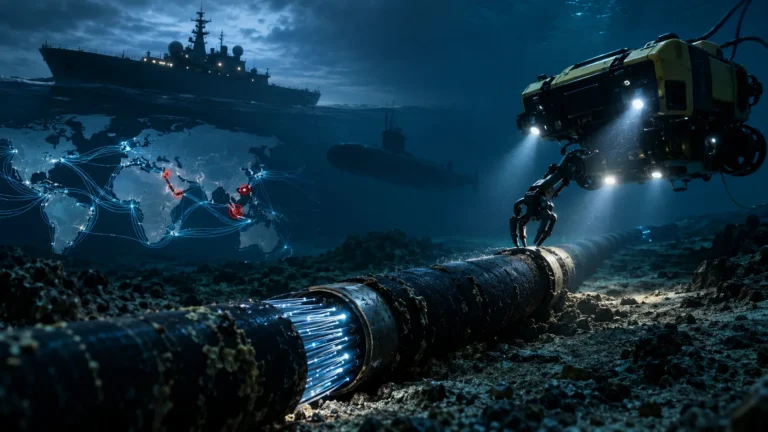
Furthermore, the primary vulnerability of a SOSUS network is not the underwater hydrophone, but the physical cable connecting it to the shore. These fiber-optic trunk lines run exposed across the continental shelf. Adversarial deep-diving submersibles map these precise cable routes in peacetime, preparing to physically sever the data links during the opening minutes of a kinetic conflict to blind the host nation’s acoustic intelligence.
THE TRAJECTORY
Next 12–36 Months: The mass deployment of Unmanned Underwater Vehicles (UUVs) as mobile hydrophone nodes. Navies will tether these autonomous gliders to fixed seabed arrays, dynamically extending the acoustic listening net into heavily contested, shallow littoral waters.
Next Five Years: The integration of quantum magnetometers into standard acoustic arrays. Future seabed sensors will combine acoustic hydrophones with extreme-sensitivity magnetic anomaly detectors, verifying the presence of a silent submarine by measuring its microscopic distortion of the Earth’s local magnetic field.
Next Ten Years: The weaponization of the acoustic data stream. Fixed arrays will connect directly to hypersonic anti-submarine missile batteries. The system will detect a hostile cavitation signature, mathematically calculate the intercept vector, and launch a weapon autonomously without a human operator ever reviewing the sonar waterfall display.
What Could Go Wrong: Severe acoustic masking from commercial activity. As deep-sea mining conglomerates deploy massive robotic dredging equipment across the Pacific seafloor, the resulting mechanical noise will physically overwhelm the SOSUS algorithms. This civilian acoustic pollution will create massive, deafening blind spots that adversarial submarines can use to transit undetected.
Most Likely Outcome: Fixed hydrophone arrays will remain the absolute backbone of global Anti-Submarine Warfare (ASW). The algorithms processing the sound will improve exponentially, permanently ending the era of total acoustic invisibility for large, mechanical nuclear submarines.
KEY TERMS
- Acoustic Cavitation: The formation and rapid collapse of vapor bubbles caused by extreme low pressure behind a spinning propeller blade.
- Deep Sound Channel: A specific layer of the ocean where the speed of sound reaches its minimum, physically trapping and channeling low-frequency waves over vast distances.
- Passive Sonar: A detection method that relies entirely on listening to the ambient environment without emitting any sound waves that could reveal the sensor’s position.
- Fast Fourier Transform: A mathematical algorithm used by digital signal processors to rapidly separate a complex, noisy audio signal into its distinct individual frequencies.
- Acoustic Intelligence (ACINT): The collection and analysis of underwater sound signatures to identify, track, and categorize specific classes of naval vessels.
SOURCES
- Office of Naval Intelligence (ONI) — Acoustic Signatures and Anti-Submarine Warfare Mechanics
- Defense Advanced Research Projects Agency (DARPA) — Distributed Agile Submarine Hunting and Acoustic Signal Processing
- Naval War College Review — The Evolution of the Sound Surveillance System (SOSUS) and Cold War ASW
- Institute of Electrical and Electronics Engineers (IEEE) — Hydrophone Array Telemetry and Deep Ocean Acoustic Waveguides