Advertisement
)

AT A GLANCE
- Concept: Aerodynamic Heating: Atmospheric friction converts immense kinetic energy into thousands of degrees of surface heat.
- Concept: Plasma Sheath: Extreme temperatures strip electrons from air molecules, enveloping the weapon in ionized gas.
- Concept: Carbon-Carbon Composites: Interlocking graphite fibers resist structural melting, allowing the airframe to survive atmospheric reentry.
- Concept: Telemetry Blackout: The surrounding plasma absorbs radio waves, severely complicating mid-course guidance and target updates.
HOW IT WORKS
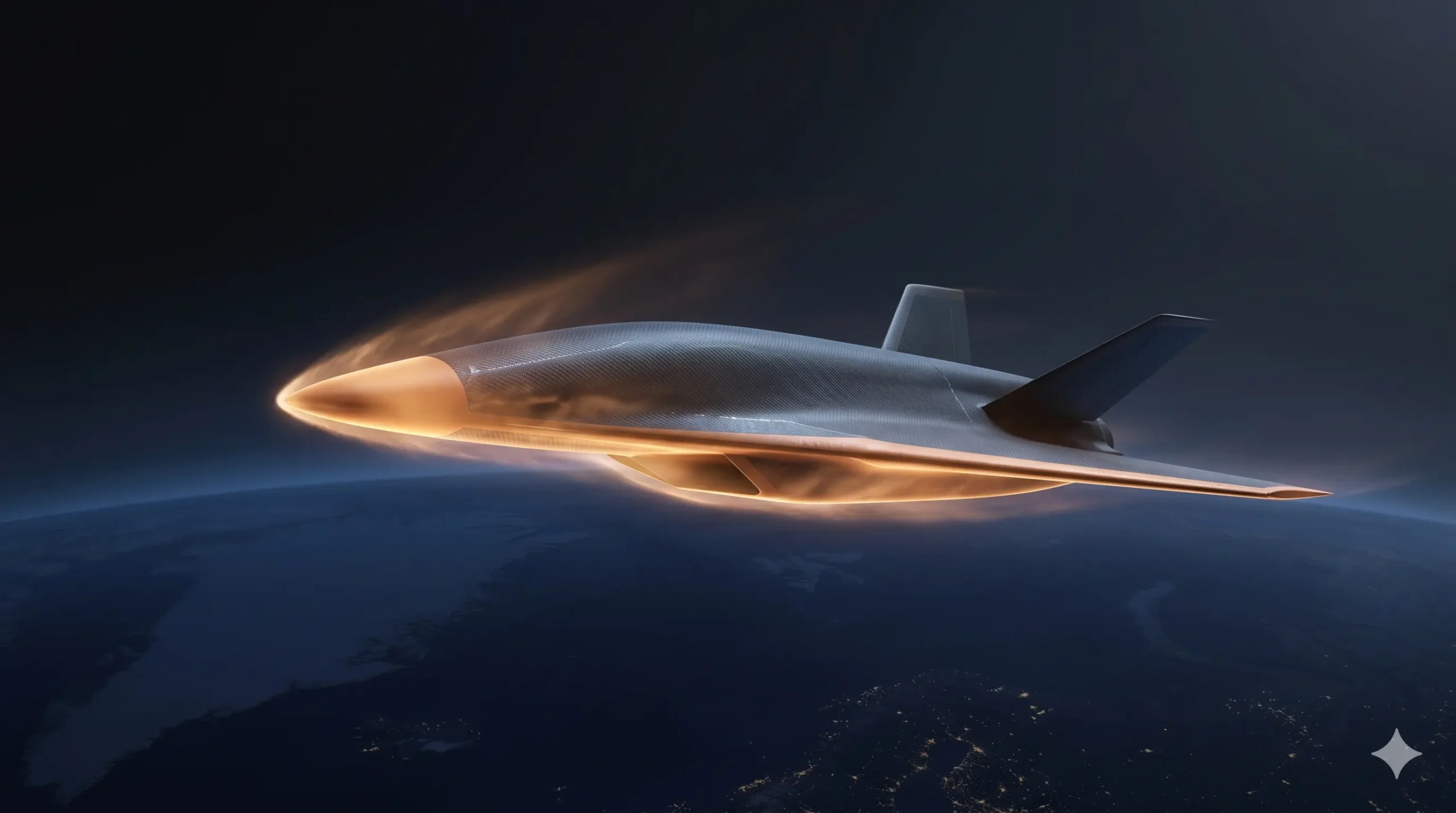
Hypersonic glide vehicles separate from ballistic rocket boosters high in the stratosphere. Unlike traditional nuclear warheads that follow a predictable, parabolic trajectory through the vacuum of space, these unpowered airframes pitch downward to ride the dense upper layers of the atmosphere. They generate aerodynamic lift at extreme velocities, allowing them to execute sharp lateral maneuvers while hurtling toward a target.
Flying at speeds exceeding one mile per second forces the airframe to confront severe fluid dynamics. As the wedge-shaped vehicle violently compresses the air directly in front of it, the shockwave generates massive localized pressure. This pressure converts the vehicle’s kinetic energy into extreme thermal energy, subjecting the leading edges to temperatures surpassing 2,000°C.

To survive this thermal assault, engineers wrap the airframe in carbon-carbon composites. These materials weave graphite fibers into a solid matrix that actively radiates heat away from the structural core rather than melting. The stagnation point—the exact tip of the nose cone where airflow velocity drops to zero—absorbs the absolute maximum thermal load, requiring constant material ablation to protect internal guidance electronics.
The intense heat fundamentally alters the surrounding atmospheric chemistry. The extreme temperature strips electrons from nitrogen and oxygen molecules, encasing the entire vehicle in a superheated layer of ionized gas known as a plasma sheath. This boundary layer flows over the control surfaces, continuously threatening to burn through the thin aerodynamic flaps required for evasive steering.
WHY IT MATTERS NOW
Prompt global strike capabilities completely rewrite the geometry of nuclear and conventional deterrence. Traditional intercontinental ballistic missiles grant adversaries up to thirty minutes of early warning time. Hypersonic glide vehicles compress this decision window to mere minutes, flying below the horizon line of deep-space infrared sensors and terrestrial early-warning radars.
This compressed timeline forces geopolitical rivals into hyper-reactive postures. The Chinese military demonstrated this reality with the test of The Chinese military demonstrated this reality with their August 2021 hypersonic test. By utilizing a fractional orbital bombardment trajectory, the system proved it could bypass hypersonic glide vehicle. By utilizing a fractional orbital bombardment trajectory, the system proved it could bypass traditional North American aerospace defense architectures entirely.
Intercepting these platforms exceeds the physical limits of current air defense kinematics. Systems like the Patriot or THAAD calculate intercept vectors based on predictable ballistic arcs. A glide vehicle executing a sudden high-G lateral turn bleeds off speed but mathematically invalidates the firing solution of the interceptor missile mid-flight.
To field these weapons, defense primes like Lockheed Martin and Raytheon consume massive sums of national capital. The bottleneck lies entirely in material science and testing infrastructure. Wind tunnels capable of simulating continuous Mach 8 aerothermodynamics cost billions to build, turning specialized high-temperature metallurgy into the ultimate sovereign defense asset.
WHAT MOST PEOPLE MISS
Mainstream defense commentary obsesses over the raw speed of hypersonic weapons. Observers assume that flying at Mach 10 automatically guarantees a successful, unstoppable precision strike.
They miss the severe operational penalty imposed by the plasma sheath. The ionized gas layer that protects the vehicle also physically absorbs radio frequencies, creating a complete communications blackout during the terminal glide phase. If the weapon cannot receive mid-course GPS updates or transmit radar telemetry through this plasma cloak, it must rely entirely on internal inertial navigation, causing its targeting accuracy to drift precisely when it needs to hit a moving naval carrier.
THE TRAJECTORY
Next 12–36 Months: Militaries will deploy specialized antenna arrays that transmit through the plasma sheath using ultra-high frequency magnetic induction. This hardware upgrade will allow glide vehicles to maintain continuous satellite telemetry during evasive terminal maneuvers.
Next Five Years: Material scientists will transition from standard carbon composites to ultra-high-temperature ceramics infused with hafnium diboride. These advanced matrices will increase the maximum survivable temperature threshold, allowing vehicles to fly at lower, denser altitudes without structural vaporization.
Next Ten Years: Major nuclear powers will integrate autonomous optical targeting sensors directly into the nose cone. Because GPS signals cannot pierce the ionized boundary layer, the vehicle will use visual terrain-matching algorithms to correct its final trajectory independently.
What Could Go Wrong: An unpredictable shift in high-altitude atmospheric density could induce asymmetric heating across the airframe. Uneven thermal expansion would warp the control surfaces slightly, throwing the unpowered glider into a catastrophic, unrecoverable hypersonic spin.
Most Likely Outcome: Hypersonic glide vehicles will remain an extremely expensive, low-volume strategic capability reserved exclusively for high-value targets. The extreme cost of carbon-carbon manufacturing will prevent mass deployment, limiting their use to decapitation strikes against command-and-control nodes and deep-water aircraft carriers.
KEY TERMS
- Aerothermodynamics: The branch of fluid dynamics that studies the interaction between high-speed gases and solid surfaces at elevated temperatures.
- Plasma Sheath: A layer of highly ionized, electrically conductive gas that forms around an object moving at extreme hypersonic velocities.
- Stagnation Point: The specific location on the leading edge of an aerodynamic body where the local fluid velocity is completely brought to zero.
- Carbon-Carbon Composite: A specialized engineered material consisting of carbon fiber reinforcement suspended within a graphite matrix to withstand extreme heat.
- Telemetry Blackout: The total loss of radio communication caused by electromagnetic wave absorption within the surrounding plasma layer.
SOURCES
- Defense Advanced Research Projects Agency (DARPA) — Hypersonic Technology Vehicle 2 (HTV-2) Flight Test Data
- Journal of Spacecraft and Rockets — Aerothermodynamic Design and Analysis of Hypersonic Glide Vehicles
- American Institute of Aeronautics and Astronautics (AIAA) — Plasma Sheath Transmission and Telemetry Mitigation Strategies
- Congressional Research Service (CRS) — Hypersonic Weapons: Background and Issues for Congress