Advertisement
)

Imagine buying an electric vehicle that matches the 400-mile driving range of a luxury Tesla but is priced like a budget Honda Civic. Historically, the laws of chemistry made this impossible. To get high driving range, automakers had to build batteries using nickel and cobalt (NMC or NCA chemistries). These metals are incredibly dense in energy, but they are astronomically expensive, ethically problematic to mine, and highly prone to catching fire. As a cheaper alternative, the industry pivoted to Lithium Iron Phosphate (LFP) batteries. LFP uses abundant iron and phosphorus, making it exceptionally safe and cheap, but it is physically heavy and lacks the voltage to provide premium driving ranges. Automakers were trapped in a permanent compromise between cost, safety, and performance.
Why should you care right now? Because materials scientists have fundamentally broken this compromise by injecting a single, abundant element into the chemical lattice: manganese. By doping the cheap iron battery with manganese, engineers have successfully raised the operating voltage of the battery, unlocking a massive boost in energy density without using a single drop of nickel or cobalt. This breakthrough—Lithium Manganese Iron Phosphate (LMFP)—is officially moving from the laboratory to the factory floor in 2026. It is the definitive chemistry poised to power the next generation of affordable, high-range mass-market electric vehicles, permanently rewriting the geopolitics of the global battery supply chain.
What is LMFP Battery Chemistry?
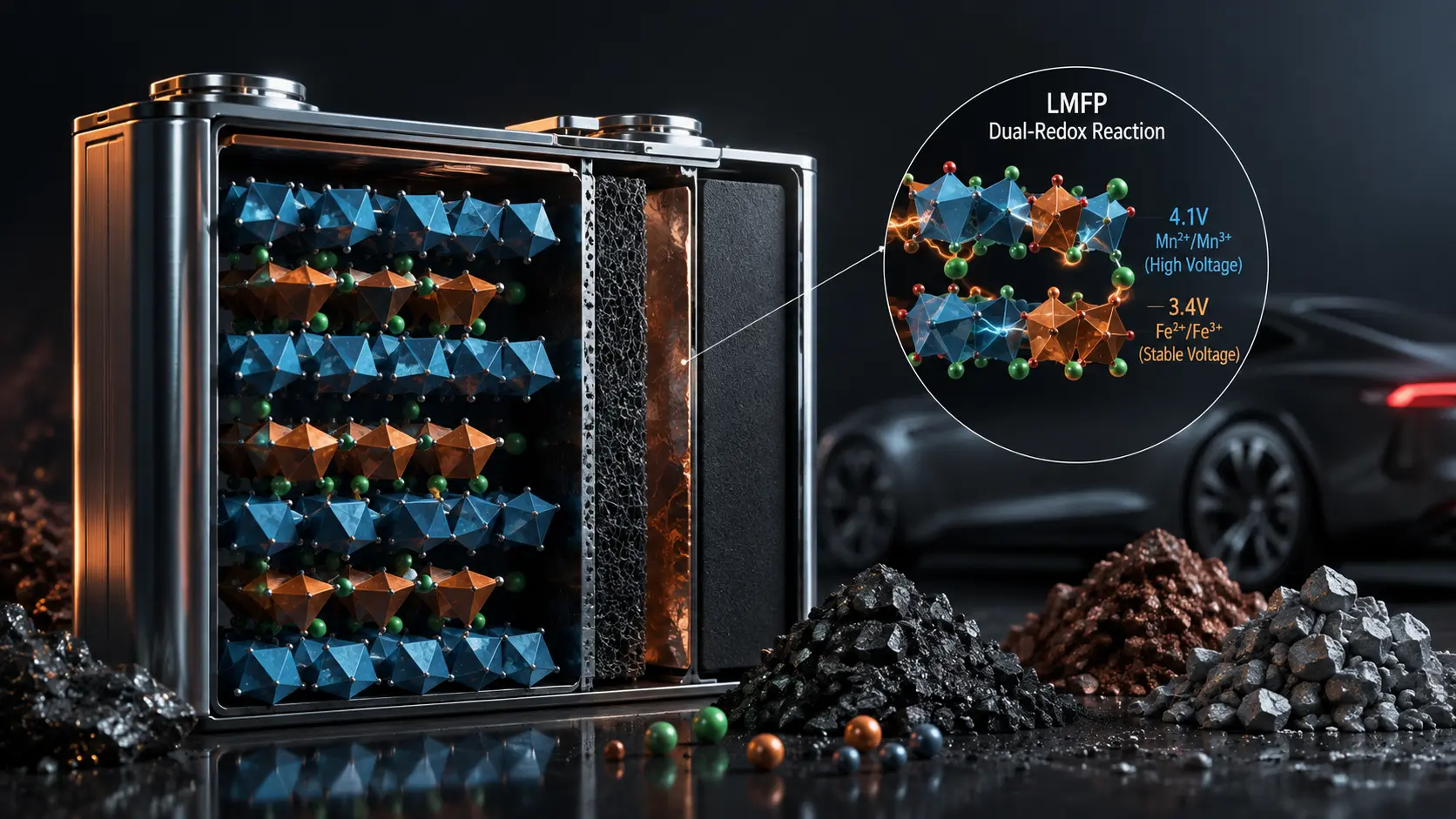
LMFP Battery Chemistry is an advanced lithium-ion cathode material that integrates manganese into a traditional lithium iron phosphate (LFP) crystal structure. This chemical substitution creates a dual-redox reaction that increases the battery’s nominal voltage from 3.2V to roughly 3.7V, providing 15% to 20% higher energy density while maintaining exceptional thermal stability and a cobalt-free composition.
At a Glance
- Concept: Taking a standard, cheap iron battery (LFP) and replacing some of the iron atoms with manganese atoms to push the voltage higher.
- Why it matters: It delivers 180 to 230 Wh/kg of energy density. This bridges the gap between cheap LFP and expensive NMC, offering high ranges for mid-tier EVs.
- Who uses it: Mega-tier battery manufacturers (like CATL and Gotion) and global automotive OEMs pivoting to cost-effective, high-range architectures.
- Biggest takeaway: The addition of manganese creates a structural vulnerability called “Jahn-Teller distortion”. The defining intellectual property race of the 2020s is finding the perfect mix of metallic dopants (like magnesium) and carbon coatings to stop the battery from physically degrading during fast charging.
In Simple Words
Think of a battery like a water tower holding water (energy). The height of the tower represents the “voltage,” and the size of the tank represents the “capacity.”
A standard LFP battery is a very wide tank, but it is built very low to the ground. Because the tower is short, the water pressure (voltage) coming out is relatively low (about 3.2V). To get a lot of power out of it, you have to build a massively heavy tank, which weighs down the electric car.
An LMFP battery uses the exact same cheap materials to build the tank, but it mixes in manganese to build the tower taller. The manganese acts like scaffolding, raising the height of the water tower. Now, the water pressure (voltage) coming out is much stronger (up to 4.1V at its peak). Because the pressure is higher, the car gets more energy without needing a bigger, heavier tank. You get more miles out of the same physical space, keeping the car cheap, light, and safe.
Why This Matters
The global electric vehicle market is currently locked in a brutal price war. Early adopters were willing to pay $60,000 for a luxury EV with an NMC battery, but the remaining 80% of global consumers require EVs priced under $30,000.
For Cleantech Investors and Supply Chain Executives, LMFP is the ultimate market-clearing technology. Valued at $1.02 billion in 2025, the LMFP materials market is aggressively scaling to a projected $3.62 billion by 2031, expanding at an extraordinary 23.78% CAGR. By delivering a 15% to 20% energy density premium over LFP at a nearly identical raw material cost, LMFP allows automakers to launch profitable, high-range mass-market vehicles. Furthermore, it completely severs the industry’s reliance on nickel and cobalt—minerals plagued by intense price volatility, geopolitical choke points, and severe human rights concerns in the Democratic Republic of the Congo.
The Rise of LMFP Battery Chemistry
The commercial transition to LMFP is no longer theoretical; it is actively displacing legacy architectures.
LFP chemistry already surpassed nickel-based chemistries in total EV deployments in 2025. Because LMFP utilizes the exact same olivine crystal framework as LFP, battery manufacturers do not need to build entirely new factories. They can utilize highly flexible LFP-LMFP production lines. This compatibility allowed companies like CATL to launch their manganese-rich “M3P” platform rapidly, achieving commercial scale in vehicles like the Zhijie S7 (which boasts a 700 km range). By late 2026, pure-use LMFP formulations from manufacturers like Ronbay have entered small-batch vehicle deployments, signaling the official death knell for standard LFP in mid-tier passenger vehicles.
How LMFP Battery Chemistry Works
Extracting high voltage from an olivine crystal requires intense electrochemical manipulation. Here is the first-principles breakdown of the architecture.
1. The Fundamental Problem: The LFP Voltage Ceiling
Conventional Lithium Iron Phosphate (LiFePO4) is exceptionally stable, but it relies exclusively on the Fe²⁺/Fe³⁺ redox couple. This chemical reaction occurs at a very flat, low nominal voltage of 3.2 V vs. Li/Li+ . Because total Energy is determined by Capacity multiplied by Voltage (E = C * V), the low voltage mathematically caps the energy density, making the batteries heavy and voluminous.
2. The Insufficiency of NMC Chemistries
To increase voltage and density, the industry historically used layered oxides like Nickel Manganese Cobalt (NMC). However, these layered structures are inherently unstable. At high temperatures or under stress, they release oxygen, triggering catastrophic thermal runaway (battery fires).
3. The Core Mechanism: Isomorphic Substitution
LMFP solves this by retaining the stable, non-flammable phosphate framework of LFP while replacing a fraction of the iron (Fe) atoms with manganese (Mn) atoms. This creates the chemical formula LiMnxFe1-xPO4.
4. Technical Depth: Dual-Redox Plateaus
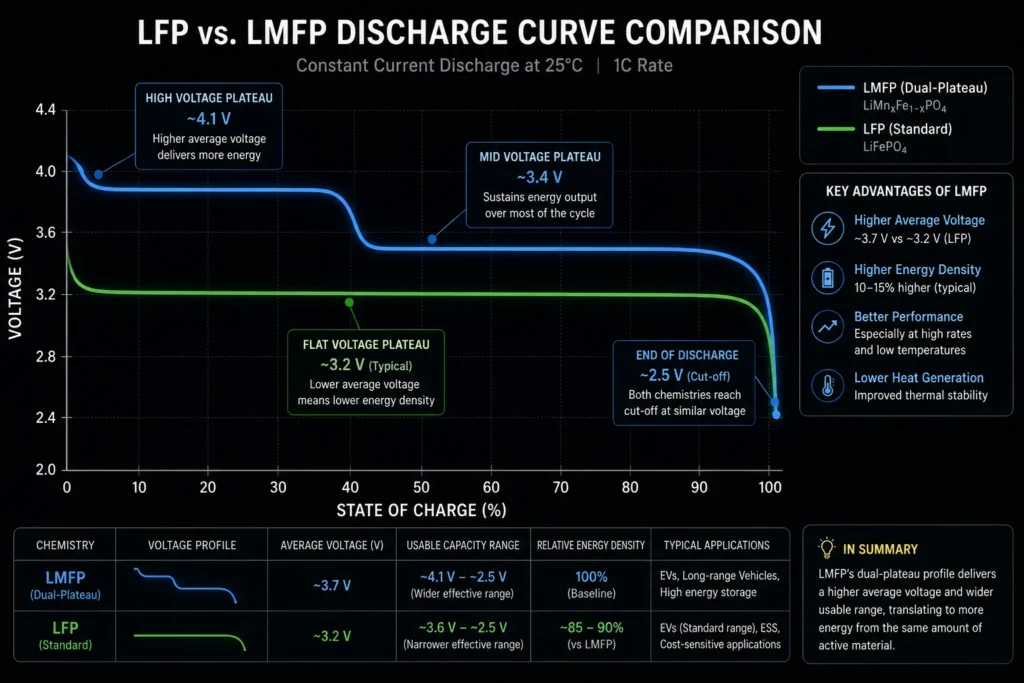
Unlike standard LFP, LMFP operates via a Dual Redox Reaction. When the battery discharges, it generates two distinct voltage plateaus:
- First, the Mn²⁺/Mn³⁺ redox pair activates at a high voltage of approximately 4.1 V.
- Second, the Fe²⁺/Fe³⁺ redox pair activates near 3.4 V.
This combination raises the average nominal cell voltage to roughly 3.6 V to 3.8 V. By increasing the “V” in the energy equation, the battery delivers an energy density of 180 to 230 Wh/kg without altering the physical footprint.
5. Real-World Consequences: Suppressing the Jahn-Teller Effect
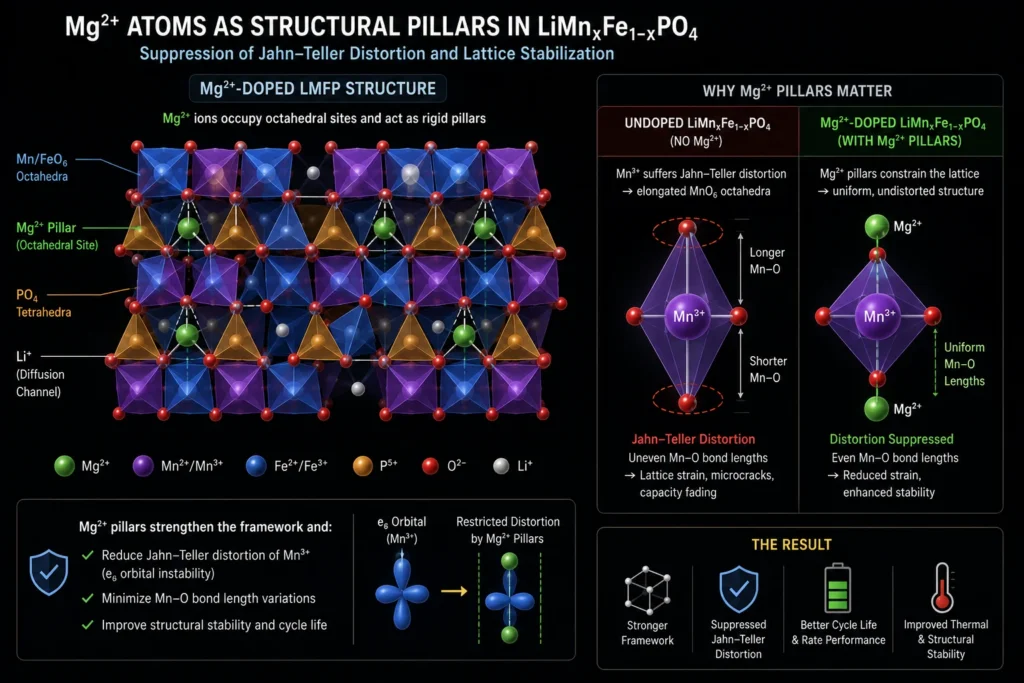
The inclusion of manganese introduces a massive chemical flaw: the Jahn-Teller distortion. During the charging phase, the Mn3+ ions undergo a geometric distortion in their electron orbitals, causing severe anisotropic lattice strain (the crystal physically warps and stretches). This causes the manganese to dissolve into the liquid electrolyte, rapidly killing the battery’s capacity over time.
To counteract this, engineers deploy multi-element doping. By introducing small amounts of magnesium (Mg2+) at the Fe/Mn sites, the robust magnesium atoms act as structural pillars, suppressing the Jahn-Teller distortion and preventing the crystal lattice from collapsing under stress.
EV and Grid Applications for LMFP
The deployment of LMFP is uniquely suited for cost-sensitive, high-durability infrastructure.
Mid-Range Passenger EVs: This is the primary driver of market adoption. While 700+ mile ultra-premium vehicles will continue using high-nickel NMC or solid-state batteries, the global mass market is standardizing on LMFP. The chemistry provides enough energy density to comfortably achieve 400 to 500 kilometers of range, making it the default choice for family sedans and compact SUVs produced by global OEMs aiming for price parity with internal combustion engines.
Grid-Scale Battery Energy Storage Systems (BESS): Stationary energy storage requires immense scale, profound thermal safety, and multi-decade cycle life. LFP has historically dominated this sector, but LMFP is aggressively encroaching. Because stationary batteries do not have strict weight limits, the 15% to 20% increase in energy density allows utilities to pack significantly more megawatt-hours (MWh) into standard 20-foot shipping containers, drastically lowering the land and infrastructure footprint of mega-scale grid projects.
Solid-State Blending and Hybrids: In ultra-advanced applications, pure LMFP is being physically blended with NMC materials. By coating LMFP particles and mixing them into an NMC cathode, battery manufacturers create a hybrid cell. The LMFP acts as a structural and thermal stabilizer, drastically reducing the fire risk of the NMC while bridging the energy density gap, creating highly customized power profiles for performance vehicles.
Economic & Strategic Impact
The transition to LMFP definitively localizes the Battery Material Supply Chain.
The refining of nickel and cobalt is highly concentrated in specific geopolitical zones (Indonesia, Russia, and the DRC), exposing Western automakers to severe supply chain blackmail and price shocks.
By contrast, iron, manganese, and phosphorus are geologically abundant and cheap across the globe. The integration of LMFP allows North American and European gigafactories to onshore their material sourcing, dramatically lowering geopolitical risk. Furthermore, as battery recycling regulations tighten, the recovered manganese from early-generation EVs provides a closed-loop, domestic supply of raw materials, permanently suppressing the long-term material cost of the global EV fleet.
Advantages
- Higher Voltage and Energy Density: Elevates the operating voltage to yield up to 230 Wh/kg, unlocking 15% to 20% more energy storage than standard LFP within the exact same physical package.
- Absolute Thermal Safety: Inherits the unbreakable phosphate (PO_4) framework of LFP. It exhibits virtually zero oxygen release under physical trauma, essentially eliminating the risk of explosive thermal runaway fires seen in nickel-rich batteries.
- Low Cost and Cobalt-Free: Entirely eliminates expensive, toxic cobalt and nickel, securing a cost structure identical or superior to legacy LFP batteries while delivering premium performance.
Limitations
- The Jahn-Teller Distortion: As the battery charges and discharges, the
Mn3+ions structurally warp and stretch the crystal lattice. Without complex metallic doping (like magnesium) and advanced synthesis methods, this physical stretching destroys the battery’s capacity rapidly over time. - Low Electronic Conductivity: The addition of manganese exacerbates the already poor electrical conductivity of phosphate materials (clocking in at a sluggish
~10^-9 S/cm) This requires intense, expensive carbon coating to allow lithium ions to move fast enough for rapid charging. - Battery Management Complexity: LMFP possesses a “step-function” dual-voltage curve. Legacy Battery Management Systems (BMS) are designed for flat voltage curves; updating software to accurately read the mid-state voltage drop of an LMFP cell requires complex new algorithms to prevent the car from misreporting its remaining range.
Common Misconceptions
Misconception: LMFP is a completely new, untested technology.
Reality: It relies on the exact same ordered olivine crystal structure (space group Pnma) as traditional LFP. It is an evolutionary upgrade, not a revolutionary gamble. This allows it to be manufactured using existing, proven coprecipitation and solid-state reaction methods already scaled globally.
Misconception: More manganese automatically means a better battery.
Reality: The ratio is highly delicate. Finding the exact atomic balance (the Mn:Fe ratio) is critical. If you use too much manganese, the electronic conductivity collapses and the Jahn-Teller distortion destroys the cell. If you use too little, you lose the voltage advantage.
Misconception: LMFP will replace solid-state batteries.
Reality: Solid-state batteries represent the ultimate ceiling for energy density and safety, but their commercialization at affordable prices is over a decade away. LMFP is the immediate, pragmatic solution designed to dominate the 2020s and 2030s mass market, not compete with high-end, futuristic luxury tech.
What Most People Miss
The critical reliance on High-Energy Ball Milling and Carbon Sintering.
Most analyses focus on the chemistry, but the true barrier is manufacturing. Because LMFP has such terrible natural conductivity, you cannot simply mix the chemicals together.
What most people miss is that the precursor materials (iron oxalate, manganese carbonate) must undergo intense, high-energy ball milling for up to 24 hours to smash them into microscopic nanoparticles. Furthermore, carbon (like glucose or acetylene black) is injected into the mill. During the 900°C thermal sintering process, this carbon physically melts and coats every single nanoparticle, creating an artificial, highly conductive highway for the electricity to flow through. The mastery of this in-situ carbon coating is the definitive intellectual property that separates Tier-1 battery makers from failing startups.
Comparison Table
| Feature | Conventional LFP (LiFePO4) | LMFP (LiMnFePO4) | High-Nickel (NMC / NCA) |
| Nominal Voltage | ~3.2 V | ~3.5 V to 3.8 V | ~3.6 V to 3.7 V |
| Energy Density | 140–180 Wh/kg | 180–230 Wh/kg | 250+ Wh/kg |
| Thermal Safety | Excellent (No fire risk) | Excellent (No fire risk) | Poor (High thermal runaway risk) |
| Raw Material Cost | Very Low | Very Low | Very High |
| Discharge Curve | Flat, highly predictable | Dual-plateau, complex (3.4V & 4.1V) | Sloped, predictable |
| Cobalt/Nickel Content | 0% | 0% | High |
Case Study
Situation: By the mid-2020s, global EV adoption hit a structural growth phase, requiring OEMs to produce vehicles capable of 700 km ranges without utilizing volatile, expensive nickel-based batteries. Conventional LFP simply lacked the energy density to achieve these high ranges without making the vehicle prohibitively heavy.
Challenge: Battery manufacturers needed to commercialize the higher voltage potential of manganese while suppressing the fatal Jahn-Teller distortion and overcoming the material’s naturally sluggish lithium-ion diffusion rates.
Solution (The CATL M3P Platform): Contemporary Amperex Technology Co. Limited (CATL), the world’s largest battery manufacturer, engineered the “M3P” battery. The M3P utilized an LMFP backbone but deployed advanced, proprietary multi-element doping (incorporating magnesium and zinc to stabilize the crystal lattice) and sophisticated nanometer-scale carbon coating to accelerate electron transport.
Outcome: The M3P chemistry successfully cleared validation and powered the Zhijie S7 (a vehicle co-developed by Chery and Huawei), achieving a verified 700 km range. By delivering a 15% energy density improvement over their standard LFP cells at an equivalent cost structure, CATL proved that manganese-doped phosphate chemistries could safely and profitably displace NMC batteries in mid-range automotive platforms.
Lessons Learned: The M3P deployment verified that the theoretical limitations of LMFP (conductivity and structural distortion) were purely engineering challenges, not fundamental dead ends. By mastering atomic-level doping, the industry secured the highly coveted “Goldilocks” battery: possessing the safety of iron, the voltage of nickel, and the cost of dirt.
Future Outlook
Next 12–24 Months
The era of Multi-Element Doping and Pure-Use Scaling. Throughout late 2026 and 2027, the market will transition from “blended” LMFP cathodes to pure-use LMFP architectures. R&D centers (like Agratas Energy’s $400 million facility in Bengaluru) will finalize the integration of magnesium and zinc doping at the Fe/Mn sites. This atomic substitution will permanently suppress the Jahn-Teller distortion, allowing pure LMFP cells to guarantee the 4,000+ cycle life demanded by automotive and grid-storage warranties.
Next 3–5 Years
The explosion of BMS Algorithmic Calibration. As LMFP floods the global supply chain, the hardware bottleneck will shift to software. By 2030, automotive OEMs will have perfected the Battery Management System (BMS) algorithms required to read the complex, dual-plateau discharge curve. Software updates will map the sharp 20% voltage change occurring near the mid-state of charge, ensuring vehicles perfectly estimate their remaining range regardless of temperature or degradation.
Next 10 Years
The Global Default for Grid and Automotive Storage. By the mid-2030s, standard LFP will be largely relegated to extreme low-cost, low-speed applications (like golf carts or e-bikes). LMFP will be universally recognized as the baseline chemistry for all standard-range global passenger vehicles and multi-gigawatt utility energy storage systems. The $3.6 billion market forecast of 2031 will be easily eclipsed as North American and European gigafactories complete their localized supply chains, permanently dethroning nickel-cobalt chemistries outside of niche, hyper-performance luxury sports cars.
Most Likely Scenario
LMFP is not an experimental disruption; it is the inevitable, logical conclusion of phosphate chemistry. Because it seamlessly utilizes existing LFP production lines and cheap, globally abundant minerals, the economic friction of adoption is virtually zero. LMFP will serve as the undisputed bedrock of the global electrification transition for the next decade.
Key Takeaways
- LMFP (Lithium Manganese Iron Phosphate) enhances standard LFP batteries by adding manganese, which boosts the operating voltage and increases energy density by 15% to 20%.
- It operates using a dual-redox reaction, generating a complex, two-step discharge voltage curve (a 4.1V plateau for Manganese and a 3.4V plateau for Iron).
- It retains the flawless thermal safety of LFP, meaning it does not catch fire easily, and remains completely free of expensive, problematic cobalt and nickel.
- The primary challenge is the “Jahn-Teller distortion”—the manganese physically warps during charging, destroying the battery over time.
- Engineers solve this by doping the crystal with magnesium (
Mg2+) and wrapping the particles in carbon to stabilize the structure and improve electrical flow. - Major players like CATL (with their M3P chemistry) have already brought LMFP to the commercial EV market, driving a multi-billion-dollar shift away from premium NMC batteries.
Glossary
BMS (Battery Management System): The software and computer hardware that monitors a battery’s health, temperature, and remaining charge. LMFP requires complex new BMS software to handle its dual-plateau voltage curve.
Energy Density: A measure of how much energy a battery can hold relative to its weight (Wh/kg). Higher density means a car can drive further without the battery becoming too heavy.
Isomorphic Substitution: Replacing one atom in a crystal structure with a different atom of a similar size. In LMFP, manganese atoms physically replace some iron atoms in the lattice.
Jahn-Teller Distortion: A chemical phenomenon where certain ions (likeMn3+) naturally distort their physical shape to lower their energy state. In a battery, this stretching physically damages the crystal lattice and reduces cycle life.
NMC / NCA: Premium lithium-ion battery chemistries that use Nickel, Manganese, and Cobalt (or Aluminum). They hold extreme energy but are expensive and prone to thermal runaway (fires).
Redox Couple: The chemical pairing that allows a battery to charge and discharge by trading electrons. LMFP uses two distinct pairs: Fe²⁺/Fe³⁺ and Mn²⁺/Mn³⁺.
Frequently Asked Questions
Why is manganese added to LFP batteries?
Manganese increases the cathode’s operating voltage. Because total energy is a product of capacity multiplied by voltage, this higher voltage allows the battery to store and deliver significantly more energy (15-20% more range) without making the battery physically larger or heavier.
Do LMFP batteries catch fire like phone or laptop batteries?
No. They use a phosphate (PO_4) chemical framework that holds onto its oxygen atoms extremely tightly, even when damaged or overheated. This drastically reduces the probability of thermal runaway, making them exceptionally safe for EVs and homes.
Why wasn’t this done years ago?
While the chemistry was understood, the materials engineering was lacking. Manganese causes structural warping (Jahn-Teller distortion) and dissolves into the electrolyte, killing the battery quickly. It took years to perfect the exact magnesium doping ratios and nano-scale carbon coatings needed to make the battery survive thousands of charge cycles.
Does an LMFP battery need special charging stations?
No. From the consumer’s perspective, charging a car with an LMFP battery is identical to charging any other EV. The differences are entirely managed internally by the vehicle’s onboard software and hardware.
Will this make electric vehicles cheaper?
Yes. By delivering the high range of expensive nickel-based batteries but using the cheap, dirt-abundant materials of iron and manganese, LMFP allows automakers to build long-range EVs at a significantly lower raw material cost.
Sources
- SciOpen: Lithium manganese iron phosphate materials: Design, progress, and challenges
- Evlithium: LMFP Cathode Material Design: Complete Guide to High-Energy Lithium Manganese Iron Phosphate Batteries
- Mordor Intelligence: Lithium Manganese Iron Phosphate (LMFP) Battery Materials Market Size, Share & 2031 Growth Trends Report
- Global Market Insights: LFP & LMFP Cathode Market Size, Forecasts Report 2026-2035
- Patsnap Eureka: Magnesium Doped Lithium Manganese Iron Phosphate: Advanced Cathode Material
- vimaterial: 5 Astonishing Insights on LMFP vs LFP and Why LMFP Is Gaining Momentum