
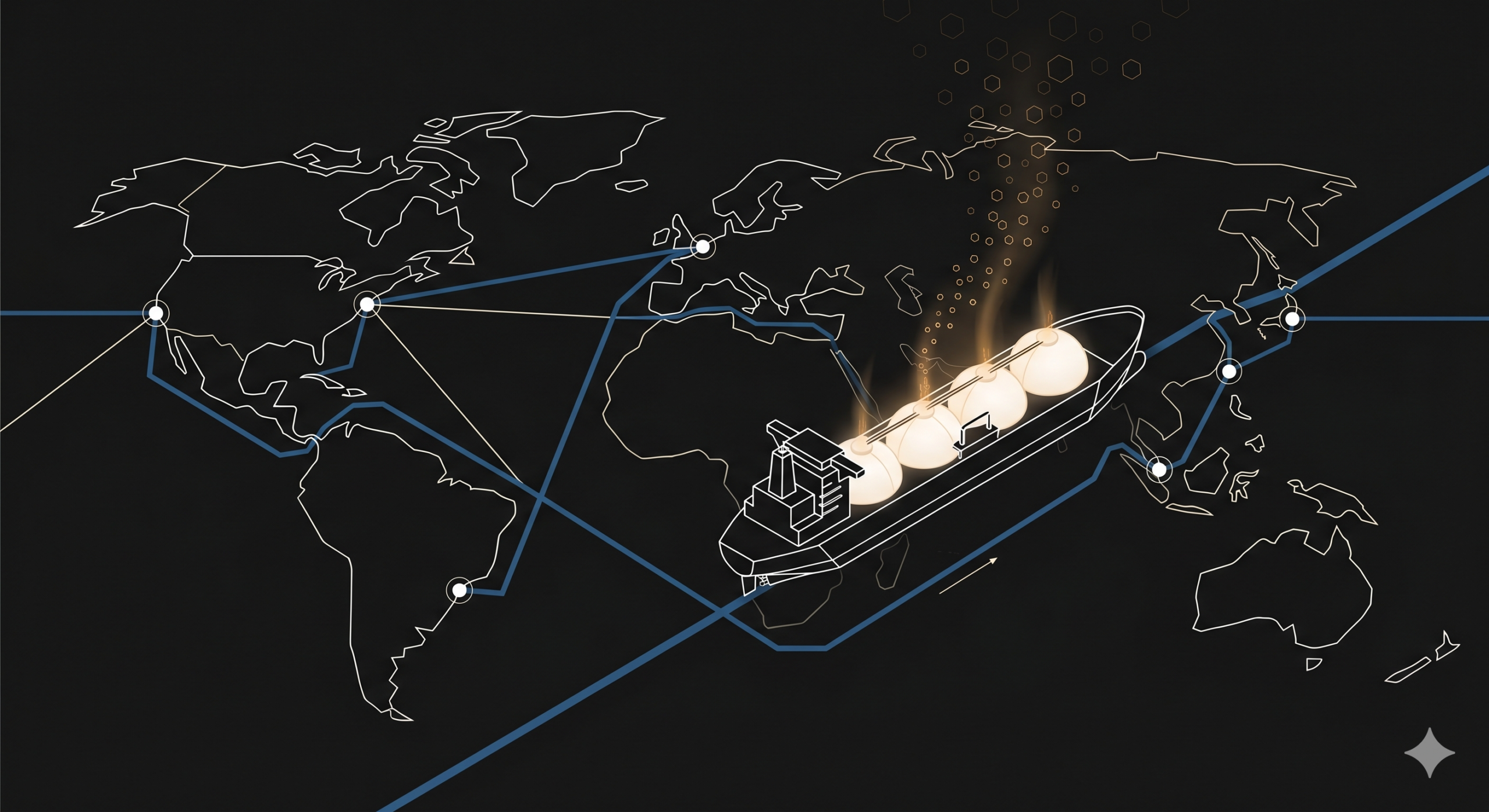
AT A GLANCE
- The Daily Bleed: Modern LNG carriers lose roughly 0.1% to 0.15% of their total cargo volume every single day to evaporation.
- Volume Loss: A standard 160,000 cubic meter vessel loses up to 240 cubic meters of liquid cargo daily.
- Thermal Reality: Natural gas must remain at exactly -163°C (-260°F) to stay liquid. Any heat ingress instantly triggers expansion.
- Detour Economics: Geopolitical rerouting around the Cape of Good Hope adds weeks to transit times, completely destroying calculated arbitrage margins through excess boil-off.
HOW IT WORKS (The Mechanism)
Liquefied Natural Gas (LNG) operates near absolute freezing temperatures. It sits inside massive, heavily insulated thermos bottles on the ship. The insulation is excellent but imperfect. The ocean and the sun constantly bombard the hull with heat.
This heat slowly bleeds through the steel and insulation. The liquid absorbs this heat. It boils. It converts back into methane gas. Engineers call this Boil-Off Gas (BOG). Gas requires 600 times more physical space than liquid. If trapped, it rapidly pressurizes the tank until the steel shatters.
To prevent an explosion, the ship must continuously bleed this gas. Modern vessels capture the BOG. They route it directly into the ship’s engines to generate propulsion, or they run massive onboard refrigeration plants to re-liquefy the gas and dump it back into the tank.

WHY IT MATTERS NOW (The Human Impact)
Boil-off gas dictates global energy arbitrage. Commodity traders purchase LNG in the United States and sell it in Asia to capture price spreads. They calculate their profits down to the penny. When geopolitical friction forces ships to avoid the Suez Canal and detour around Africa, transit times double. The daily boil-off rate remains constant. A 30-day extended voyage burns an additional 3% to 4.5% of the total cargo. For a vessel carrying $50 million of LNG, that equals millions of dollars physically vanishing into the atmosphere. Energy majors must constantly decide whether to burn the BOG for faster ship speeds or slow down and run expensive reliquefaction plants. The physics directly control the final delivery price.
WHAT MOST PEOPLE MISS
Most analysts assume cargo loss is a fixed, predictable line item. It is highly volatile. LNG composition determines the evaporation rate. Methane boils off first, leaving behind heavier, denser elements like ethane and propane. This process is called “ageing.” As the voyage progresses, the remaining liquid becomes heavier and hotter. The physical energy content of the tank fundamentally changes between the loading terminal in Qatar and the receiving terminal in Germany. A trader does not just lose volume; they lose the highest-quality, most volatile chemical components of the fuel.
THE TRAJECTORY (What Happens Next)
Over the next 12 to 36 months, maritime regulations like the FuelEU mandate will force operators to deploy advanced custody transfer measurement systems (CTMS) to rigorously audit exact methane slip and boil-off fuel usage, penalizing older vessels lacking full onboard reliquefaction capacity.
KEY TERMS
- Boil-Off Rate (BOR): The daily percentage of total liquid cargo volume that evaporates due to ambient heat ingress.
- Boil-Off Gas (BOG): The vaporized methane created when cryogenic liquid absorbs heat during transit or storage.
- Reliquefaction Plant: An onboard refrigeration system that compresses and cools boil-off gas back into a liquid state.
- Ageing: The chemical alteration of LNG during transit where lighter methane boils off, increasing the concentration of heavier hydrocarbons.
- Custody Transfer Measurement System (CTMS): The highly calibrated sensor network used to determine the exact volume and energy content of the cargo during loading and unloading.
SOURCES
- International Maritime Organization (IMO) – “Boil-Off Gas Management and Methane Slip Guidelines” (2025).
- DNV – “Understanding the Regulatory Status of LNG Carriers Using Boil-Off Gas” (2026).
- Global Maritime Hub – “LNG in Shipping Faces New Challenges from Boil-Off Gas at Berth” (2026).
- GTT (Gaztransport & Technigaz) – “Thermal Performance and Boil-Off Gas Optimization” (2025).
RELATED TOPICS
- Read Next: The ADC Linker: The Kinetic Chemistry of Systemic Toxicity
- Read Next: The Ultra-Deepwater Blowout Preventer: Hydrostatic Pressure Dynamics and Containment Physics
- Read Next: The RTGS Architecture: Inside the FedWire Liquidity Matrix
- Read Next: The Separative Work Unit (SWU): The Kinetic Math of Uranium Enrichment Cascades