Advertisement
)


Imagine trying to buy a gallon of water, but the price changes every five minutes depending on exactly which street corner you are standing on and how clogged the pipes are between you and the reservoir. If the pipe leading to your house is too narrow, the water company has to hire a fleet of expensive helicopters to air-drop the water into your backyard, and they pass that massive delivery cost directly to you. In the world of wholesale electricity, this is not an analogy; it is the absolute physical reality.
Electricity is the most volatile commodity on Earth because it must be consumed the exact millisecond it is generated. For the grid to survive, supply and demand must match perfectly across thousands of miles of high-voltage wire. When transmission wires get full, the cheapest power plants cannot deliver their energy to the cities that need it, forcing the grid to turn on vastly more expensive, localized power plants. Why should you care right now? Because the artificial intelligence boom has collided with the physical limits of the 20th-century power grid. Wall Street and Silicon Valley are pouring trillions of dollars into massive data centers and wind farms, only to discover that their profitability is entirely dictated by a localized, five-minute pricing algorithm called Locational Marginal Pricing (LMP). Understanding this algorithm is the key to surviving the greatest infrastructure bottleneck of the modern era.
What is Locational Marginal Pricing (LMP)?
Locational Marginal Pricing (LMP) is a pricing mechanism used in wholesale electricity markets that reflects the real-time cost to serve the next increment of electrical demand at a specific physical location on the grid. It is calculated by combining the base energy price, transmission congestion costs, and marginal energy losses.
At a Glance
- Concept: Pricing electricity based on physical geography and the actual capacity of the transmission wires required to deliver it.
- Why it matters: It exposes the true cost of grid congestion. If a 1-gigawatt AI data center connects to a weak node, the LMP algorithm will trigger massive price spikes, destroying the facility’s operating margins.
- Who uses it: Independent System Operators (ISOs) and Regional Transmission Organizations (RTOs) like ERCOT (Texas), PJM (East Coast), and CAISO (California) to dispatch power plants economically.
- Biggest takeaway: LMP forces the market to be efficient. It pays power plants more money to build near areas that desperately need power, and it penalizes power plants (with negative prices) for building in remote areas where the grid wires are already completely full.
In Simple Words
Think of the power grid like a massive, interconnected highway system, and electricity is the cars.
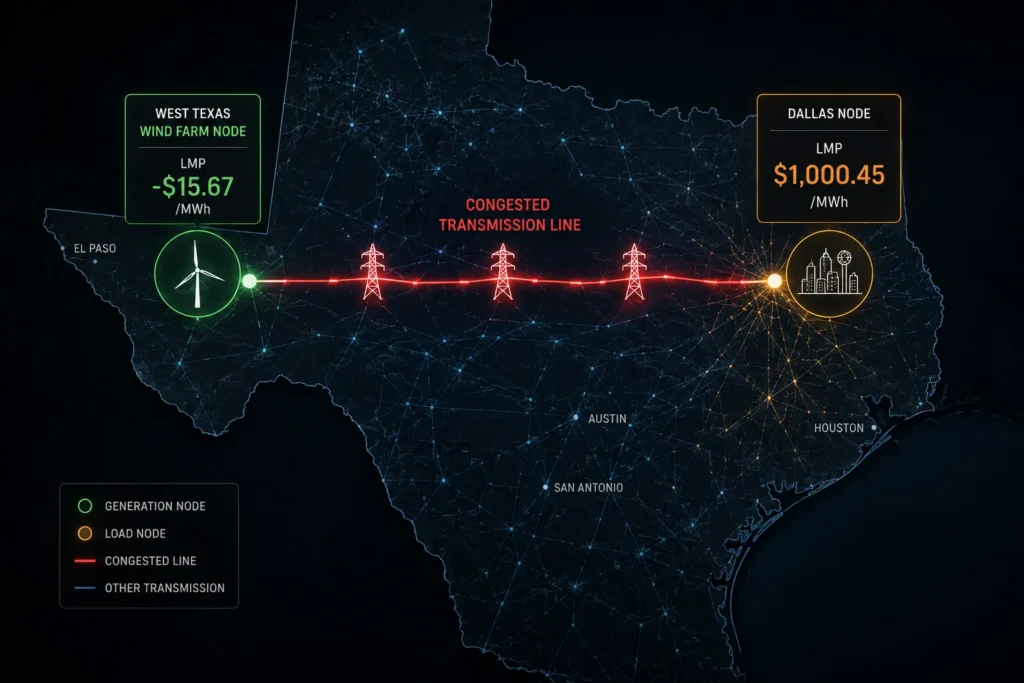
There is a massive wind farm in West Texas generating extremely cheap electricity ($20 per megawatt). There is a huge city in East Texas that needs that power.
If the highway (the transmission line) connecting them is wide open, the cheap electricity drives straight to the city. The price in the city is $20.
But what happens if that highway gets stuck in a traffic jam? The cheap wind power cannot get through. To keep the city’s lights on, the grid operator has to turn on an old, expensive natural gas plant located right inside the city limits. That gas plant charges $100 per megawatt. Because the highway is blocked, the price of electricity in the city instantly jumps to $100, even though power is still $20 in West Texas.
Locational Marginal Pricing (LMP) is the computer algorithm that tracks every single “traffic jam” on the power grid, calculating a unique price for thousands of different locations (nodes) every five minutes based on the physical limits of the wires.
Why This Matters
For decades, the physical location of a data center was primarily dictated by tax incentives and fiber-optic internet availability. Electricity was treated as an afterthought—an infinite, flat-rate utility.
The era of flat-rate assumptions is dead. For Grid Investors, Utility Execs, and Data Center Developers, the LMP algorithm is now the ultimate arbiter of project viability. If a developer builds a $5 billion AI training cluster on a congested node in PJM, the real-time LMP could easily swing from $30/MWh to $1,000/MWh during a summer heatwave when the transmission lines max out. This spatial price volatility, known as “basis risk,” can wipe out a hyperscaler’s energy budget in a matter of hours. The ability to forecast long-term LMP congestion patterns is now the most highly compensated skill in infrastructure private equity.
Day-Ahead vs. Real-Time Wholesale Electricity Markets
The United States power grid is not a single entity; it is a patchwork of independent regional markets managed by ISOs and RTOs.
These organizations run two parallel markets: the Day-Ahead Market and the Real-Time Market.
In the Day-Ahead market, algorithms calculate expected LMPs based on weather forecasts and scheduled power plant outages, allowing buyers to lock in prices for tomorrow.
In the Real-Time market, the algorithm corrects for reality—a sudden drop in wind, a snapped transmission line, or a massive heatwave. Real-time LMPs fluctuate wildly every five minutes. The financial discrepancy between the Day-Ahead LMP and the Real-Time LMP has spawned an entire industry of quantitative energy traders who use algorithmic high-frequency trading to arbitrage the physics of the grid.
How the Locational Marginal Pricing Algorithm Works
Calculating the exact cost of electricity at 10,000 different points across a continent simultaneously requires massive computational power. Here is the first-principles breakdown of the LMP architecture.
1. The Fundamental Problem: Kirchhoff’s Laws
Unlike data on the internet, which can be easily routed around a broken server, electricity blindly follows the path of least resistance according to Kirchhoff’s circuit laws. You cannot “direct” a specific electron to a specific house. If too much power flows across a specific wire, the wire overheats, sags, touches a tree, and causes a cascading blackout.
2. The Insufficiency of Zonal Pricing
Historically, grids used “Zonal Pricing,” charging everyone in a massive geographic zone the exact same average price. This was highly inefficient. It hid the true cost of local bottlenecks, meaning power plants had no financial incentive to build closer to the cities where the power was actually needed.
3. The Core Mechanism: Security-Constrained Economic Dispatch (SCED)
To solve this, modern grids use SCED algorithms. Every five minutes, the ISO’s supercomputers analyze the bids from every power plant (how much they charge to turn on) and the exact physical limits of every transmission line. The algorithm mathematically optimizes the grid to find the absolute cheapest way to keep the lights on without melting a single wire.
4. Technical Depth: The LMP Equation
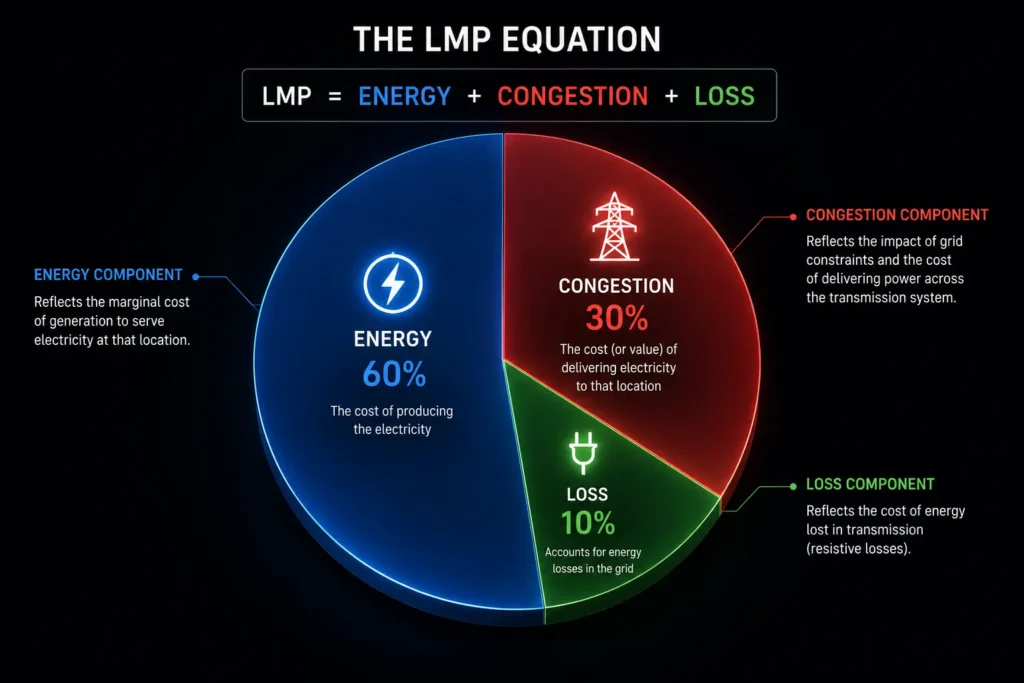
The output of this optimization is the LMP for a specific node k, defined by three distinct mathematical components:
LMPk = λ + μk + αk
- λ (System Energy Price): The base cost to serve the next megawatt of demand if the grid had infinite, perfect wires with zero resistance and no traffic jams.
- μk (Marginal Congestion Cost): The localized financial penalty. If cheap power is blocked by a full transmission line, the algorithm must dispatch a more expensive, local plant. This component captures that exact price difference.
- αk (Marginal Loss Cost): The physics penalty. As electricity travels through wires, some of it is lost as heat. Delivering power to a node 500 miles away requires generating more than one megawatt just to ensure one megawatt arrives.
5. Real-World Consequences: Negative Pricing
Because of congestion, LMPs frequently drop below zero. If a massive wind farm in a remote area is generating maximum power, but the transmission lines leaving the area are completely full, the power has nowhere to go. Because wind farms receive federal tax credits for every megawatt they produce, they will actually pay the grid to take their power, driving the local LMP to -$20/MWh, while a city just 100 miles away might be paying $100/MWh.
Commercial Applications of LMP and Nodal Pricing
The visibility provided by LMP algorithms dictates the deployment of hundreds of billions of dollars in hard infrastructure.
Data Center Siting and Co-Location: Hyperscalers no longer search for cheap real estate; they search for cheap nodes. By analyzing historical LMP heat maps, data center developers identify locations with consistently low or negative LMPs. Furthermore, to bypass grid congestion entirely, Amazon and Microsoft are executing “co-location” agreements, building data centers directly on the physical node of a nuclear power plant (like the Susquehanna steam electric station) to secure behind-the-meter, zero-congestion pricing.
Battery Arbitrage (BESS): Utility-scale Battery Energy Storage Systems (BESS) generate massive profits entirely through LMP volatility. A 100-megawatt battery facility located on a volatile node will charge itself when the wind is blowing and the LMP is negative (getting paid to take power). Hours later, when the sun sets, demand spikes, and transmission lines congest, the battery discharges that stored power back onto the grid at $500/MWh, executing a flawless, physics-based financial arbitrage.
Virtual Power Plants (VPPs): Modern grids are aggregating thousands of residential smart thermostats and electric vehicles into Virtual Power Plants. If a specific node in a city experiences a massive congestion spike ($1,000/MWh), the grid operator can ping the VPP. The VPP automatically turns off 10,000 home air conditioners located specifically on that congested node for 15 minutes, instantly relieving the thermal limit on the wire, collapsing the localized LMP price, and saving the utility millions of dollars.
Economic & Strategic Impact
The greatest financial risk in wholesale electricity markets is Basis Risk, which spawned the creation of Financial Transmission Rights (FTRs).
Basis risk is the financial spread between the node where a power plant generates electricity and the node where a customer consumes it. If a company signs a Power Purchase Agreement (PPA) to buy $30/MWh solar power from a farm in West Texas to power a factory in Dallas, they are highly vulnerable. If the line between them congests, the solar farm gets paid $0 (or negative), while the factory is forced to buy $500 power from the local node.
To hedge this risk, financial institutions trade FTRs (or Congestion Revenue Rights). An FTR is a derivative contract that pays the holder the exact price difference between two specific nodes. Wall Street quantitative hedge funds deploy massive machine-learning models to predict weather patterns and transmission line outages, actively trading billions of dollars in FTRs to profit off the algorithmic spread of grid congestion.
Advantages
- Extreme Market Efficiency: LMP sends accurate, mathematically flawless price signals. It tells the market exactly where new transmission lines desperately need to be built and where new power plants are useless.
- Prevents Blackouts: By financially penalizing operators for overloading transmission lines, the SCED algorithm ensures that the physics of the grid (thermal limits) are strictly respected, preventing cascading hardware failures.
- Incentivizes Flexibility: LMP volatility creates the definitive economic use case for grid-scale batteries, rewarding assets that can dynamically react to five-minute market intervals.
Limitations
- Extreme Volatility: Nodes can jump from -$50/MWh to $5,000/MWh in a single five-minute interval if a transmission line is struck by lightning, exposing unhedged industrial consumers to catastrophic financial ruin.
- Complex Hedging: Managing the basis risk across a large corporate footprint requires highly specialized energy trading desks and complex derivative instruments (FTRs), effectively turning manufacturers into energy hedge funds.
- Geographic Inequality: Two identical factories located ten miles apart can have vastly different energy operating costs simply because they happen to sit on opposite sides of a historically congested transformer.
Common Misconceptions
Misconception: The price of electricity is just the cost of burning natural gas or coal.
Reality: The cost of the fuel (System Energy Price) is often the smallest component of the LMP during peak hours. In a constrained grid, the Marginal Congestion Cost dominates the price. You aren’t paying for the electricity; you are paying a massive premium for the right to move it through a crowded wire.
Misconception: Building more wind and solar automatically lowers electricity prices for everyone.
Reality: Building renewable energy in remote locations without building high-voltage transmission lines to connect it to cities is useless. It drives the local LMP at the remote wind farm to zero, but the city still pays high prices because the cheap power is physically trapped behind congestion.
Misconception: The grid operator manually sets the price to make a profit.
Reality: ISOs and RTOs are non-profit entities. The LMP is entirely emergent. It is an algorithmic output generated strictly by the intersection of private market bidding behavior and the absolute laws of electrical physics.
What Most People Miss
The strategic weaponization of Load Shaping by Artificial Intelligence.
Historically, electricity demand was rigid; a factory had to run, and humans turned their lights on at dusk. Supply had to bend to meet demand.
What most people miss is that massive AI training clusters are “interruptible workloads.” An AI model does not care if its training is paused for 30 minutes. Advanced hyperscalers are building automated software that reads real-time LMP feeds. If the LMP at a Virginia data center spikes to $800/MWh due to congestion, the AI software automatically pauses the training run in Virginia, instantly transfers the compute workload to a data center in Ohio where the LMP is $25/MWh, and resumes training. This transforms data centers from passive consumers into aggressive, geographic energy arbitragers.
Comparison Table
| Feature | Flat Retail Pricing | Zonal Wholesale Pricing | Nodal Pricing (LMP) |
|---|---|---|---|
| Granularity | Single price for an entire utility territory | Single price for a massive geographic region | Unique price for thousands of specific grid nodes |
| Price Update Frequency | Annually or Seasonally | Hourly | Every 5 Minutes (Real-Time) |
| Congestion Visibility | Completely Hidden | Averaged out and mutualized | Highly transparent, localized price spikes |
| Incentivizes Batteries | Low | Moderate | Extreme (High volatility creates arbitrage) |
| Primary User | Residential / Small Commercial | Legacy Grid Architectures (Europe) | Advanced US ISOs/RTOs (ERCOT, PJM, CAISO) |
Case Study
Situation: In the summer of 2023, the Electric Reliability Council of Texas (ERCOT) grid faced unprecedented strain. An intense, multi-week heatwave pushed residential air conditioning demand to record highs, exactly as solar generation plummeted during the critical sunset hours (the duck curve).
Challenge: Massive amounts of cheap wind power were actively spinning in the remote Texas Panhandle, but the transmission corridors carrying that power toward the massive demand centers in Dallas and Houston hit their absolute physical thermal limits.
Solution (The Algorithmic Response): ERCOT’s Security-Constrained Economic Dispatch algorithm aggressively managed the physics of the grid. To prevent the transmission lines from melting, the algorithm halted the flow of West Texas wind, forcing the dispatch of highly expensive, fast-ramping natural gas “peaker” plants located immediately outside Houston.
Outcome: The LMP algorithm functioned flawlessly, but the financial disparity was violent. Nodes in West Texas saw prices collapse to near $0/MWh because the power was trapped. Simultaneously, the specific nodes surrounding Houston violently spiked to the ERCOT market cap of $5,000/MWh.
Lessons Learned: The event perfectly demonstrated that electricity is a spatial commodity. Unhedged industrial facilities in Houston faced multi-million-dollar power bills for operating during those specific intervals. It validated that the defining metric of modern energy infrastructure is not total megawatt capacity, but localized transmission availability.
Future Outlook
Next 12–24 Months
The era of Dynamic Line Ratings (DLR). Currently, grid operators calculate transmission capacity using static, conservative estimates (assuming the wire is always hot and sagging). Over the next two years, utilities will aggressively deploy advanced IoT sensors on transmission towers to read the exact temperature and wind speed of the wire in real-time. By dynamically increasing the allowed power capacity of the wire on cool, windy days, DLRs will unlock massive amounts of hidden grid capacity, temporarily collapsing congestion costs and smoothing out LMP volatility without pouring a single yard of new concrete.
Next 3–5 Years
The explosion of Behind-the-Meter (BTM) Nuclear Co-location. As grid congestion and multi-year interconnection queues cripple AI expansions, the hyperscalers will bypass the LMP market entirely. By 2030, we will see dozens of massive data centers built directly “behind the meter” of existing gigawatt-scale nuclear power plants. Because the power flows straight from the reactor to the servers without ever touching the public transmission grid, the data center entirely bypasses transmission tariffs, marginal loss costs, and LMP congestion spikes, achieving absolute energy price certainty.
Next 10 Years
The Automated Grid Topology Reconfiguration. By the mid-2030s, the physical architecture of the grid will become dynamic. Utilizing massive high-voltage direct current (HVDC) valves and power flow controllers, AI-driven grid software will physically re-route electricity around congested bottlenecks in real-time, just like internet routers reroute data packets. By dynamically changing the topology of the grid every five minutes to match the shifting supply of renewables, extreme nodal LMP spikes will be mathematically engineered out of existence.
Most Likely Scenario
As power demand violently increases due to AI and electrification, the geographical disparity of the grid will intensify. LMP will transition from an obscure utility pricing mechanism into the most critical real estate metric in the global economy. Companies that fail to master nodal forecasting will face paralyzing operating costs, while those that align their infrastructure with the algorithmic physics of the grid will capture the margins of the AI revolution.
Key Takeaways
- Locational Marginal Pricing (LMP) is the algorithm that calculates the real-time cost of electricity at thousands of specific locations (nodes) across the power grid.
- The price is made of three parts: the base cost of energy, the cost of power lost as heat over distances, and the massive financial penalty for transmission congestion.
- When a transmission line is full, cheap power is trapped. The grid must turn on expensive, local power plants, causing the LMP at that specific node to violently spike.
- Because of congestion, electricity prices can be -$20/MWh in a remote wind farm and $1,000/MWh in a city just 100 miles away at the exact same moment.
- Hyperscalers and grid batteries actively hunt for nodes with specific LMP profiles to minimize operating costs and execute high-margin energy arbitrage.
- Financial Transmission Rights (FTRs) are the complex derivative contracts Wall Street uses to hedge against this extreme, hyper-localized price volatility.
Glossary
Basis Risk: The financial risk that the price of electricity at the node where power is generated differs significantly from the price at the node where the power is consumed, usually caused by congestion.
Congestion Cost: The premium paid when the cheapest electricity cannot be delivered to a location because the transmission wires connecting them have hit their physical capacity limits.
Financial Transmission Right (FTR): A financial derivative contract that entitles the holder to a stream of revenues (or charges) based on the locational marginal price difference between two specific grid nodes.
Independent System Operator (ISO) / Regional Transmission Organization (RTO): The non-profit, federally regulated entities (like PJM or ERCOT) that monitor the grid and run the computer algorithms that match supply with demand.
Node: A specific physical point on the electrical grid (usually a substation or a large generator) where electricity is injected or withdrawn and where an LMP is calculated.
Security-Constrained Economic Dispatch (SCED): The mathematical algorithm used by grid operators to determine the absolute cheapest way to run power plants while strictly ensuring no transmission lines melt or fail.
Sources
[1] U.S. Federal Energy Regulatory Commission (FERC): Energy Primer: A Handbook of Energy Market Basics (2024 Updates)
[2] PJM Interconnection: Understanding Locational Marginal Pricing (LMP) and Congestion Management
[3] ERCOT: Real-Time Market and Security-Constrained Economic Dispatch Operations (2025/2026 Analysis)
[4] U.S. Department of Energy (DOE): The Impact of Artificial Intelligence and Data Centers on Nodal Pricing and Grid Infrastructure (2026 Report)
[5] ISO New England (CAISO): Day-Ahead and Real-Time Market Fundamentals