Advertisement
)


AI data centers are facing an imminent mathematical wall. The foundational architecture behind modern generative AI—the Transformer—relies on an “attention” mechanism that suffers from a fatal flaw: its computational requirements quadruple every time the input size doubles. To process a short document, it requires standard computing power; to process an entire library of medical records or genomic sequences simultaneously, it requires a supercomputer. This “quadratic bottleneck” has placed a hard ceiling on the sequence lengths modern AI can ingest without completely exhausting global GPU memory capacities.
Why should you care right now? Because the artificial intelligence industry is aggressively pivoting away from pure Transformers toward a vastly more efficient algorithmic framework. Researchers have successfully deployed advanced State Space Models (SSMs), specifically an architecture named Mamba, which replaces memory-hogging attention with continuous-time differential equations and selective memory. By executing matrix math with linear efficiency, Mamba scales to millions of tokens flawlessly, dramatically slashing inference costs and providing up to a 5x acceleration in generation speed. It is actively rewriting the hardware and software economics of the multi-trillion-dollar cloud infrastructure sector.
What are State Space Models (SSMs)?
State Space Models (SSMs) are a neural network architecture derived from control theory that maps continuous-time input sequences to outputs through a latent state representation. Advanced implementations, like the Mamba architecture, utilize selective state updates and hardware-aware algorithms to process incredibly long data sequences with linear time complexity.
At a Glance
- Concept: Discarding the Transformer’s self-attention mechanism (which compares every word to every other word) in favor of a compressed, updating “hidden state” that filters information continuously.
- Why it matters: Transformers have an
O(n²)time and memory complexity, meaning sequence processing degrades rapidly. Mamba scales linearly atO(n), reducing compute exponentially for long context windows. - Who uses it: Open-source AI developers, genomic sequence researchers, and enterprise AI companies (like AI21 with their Jamba series) targeting massive-context applications.
- Biggest takeaway: The release of Mamba-2 in 2024 proved mathematically that SSMs and linear attention are basically the same thing (State Space Duality), allowing the model to finally utilize ultra-fast GPU Tensor Cores.
In Simple Words
Imagine you are reading a 1,000-page mystery novel and trying to figure out who the killer is.
If you are a Transformer, every time you read a new word on page 500, you stop and re-read all the previous 499 pages to perfectly cross-reference how the new word relates to every single word that came before it. By page 900, reading a single new word takes an agonizing amount of time and mental energy because you are constantly scanning the entire history of the book.
If you are Mamba (an SSM), you do not look back. Instead, you carry a small notepad (a hidden state). As you read, you selectively write down important clues on the notepad and erase things that don’t matter (like descriptions of the weather). When you reach page 900, you only look at your highly compressed notepad, not the previous 899 pages. Because you never look backward, your reading speed never slows down, no matter how long the book gets.
Why This Matters
For Cloud Architects and MLOps Engineers, memory allocation dictates the ultimate profit margin of an AI service.
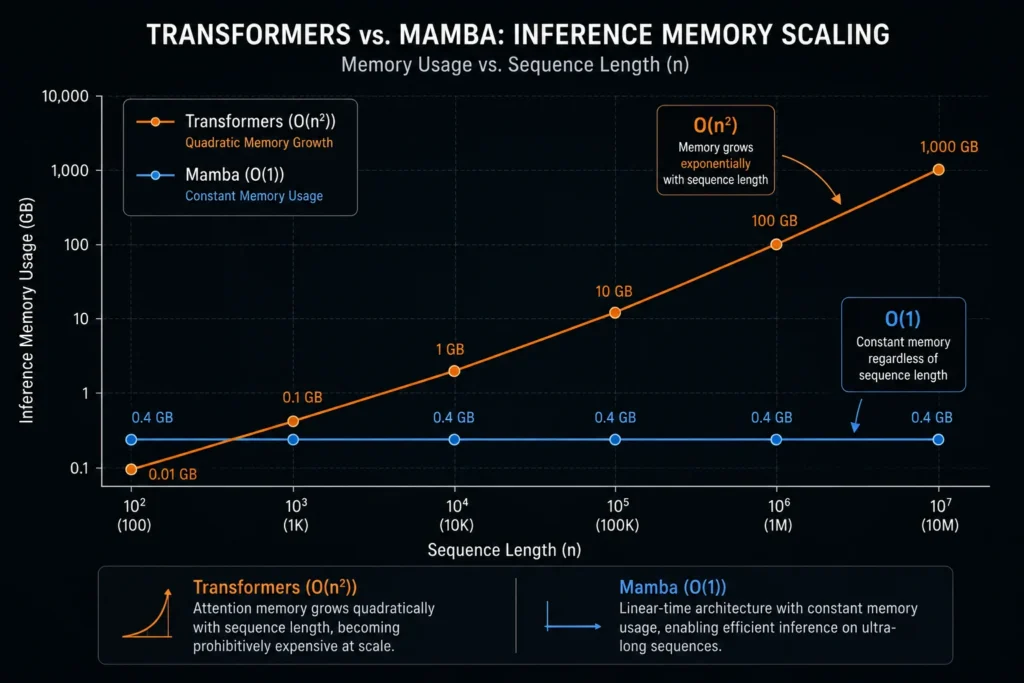
When hosting a Transformer model (like GPT-4 or Claude) for millions of users, the system must hold a massive “KV Cache” (Key-Value cache) in the GPU memory for every active conversation. As context windows expand to millions of tokens, this cache growth becomes financially paralyzing. Mamba requires constant memory during inference; the size of its “notepad” (the hidden dimension) is fixed, completely independent of the sequence length. By eliminating the linear growth of the KV cache, Mamba allows data centers to host vastly more concurrent users on significantly fewer GPUs, fundamentally changing the unit economics of AI deployment.
The Evolution of State Space Models (SSMs)
State Space Models are not new; their mathematical lineage stretches back to continuous-time differential equations used in control theory to map signals like audio waveforms or pixel-level vision. Models like S4 pioneered this approach, but they suffered from Linear Time Invariance (LTI). In LTI models, the mathematical matrices governing how the model learns were fixed across time; the model couldn’t alter its behavior based on the specific content of the input.
The breakthrough arrived in late 2023 when researchers Tri Dao and Albert Gu introduced Mamba. Mamba became a discrete-time model heavily optimized for tokenized data (language), but crucially, it introduced a Selection Mechanism. By making the model parameters functions of the input data, Mamba gained the ability to dynamically choose what information to remember and what to forget, allowing it to rival the language-modeling efficacy of massive Transformers for the very first time.
How the Mamba Architecture Works
Overcoming the O(n²) quadratic bottleneck requires profound algorithmic and hardware co-design. Here is the first-principles breakdown of the Mamba architecture.
1. The Fundamental Problem: The Attention Matrix
In a Transformer, the self-attention mechanism computes pairwise scores between every single token in the input sequence. The complexity of this operation is O(n²d), where n is sequence length. If you increase a context window from 10,000 tokens to 100,000 tokens, the computation does not increase by 10x; it increases by 100x.
2. The Core Mechanism: Selective State Spaces
Mamba defines a discretized state space model using parameters A, B, C, and D. At each step, a hidden state h(t) is updated:
h(t) = A * h(t-1) + B * x(t)
and the output is generated:
y(t) = C * h(t) + D * x(t)
Unlike previous LTI models, Mamba makes matrices B, C, and the discretization parameter Δ direct functions of the input x. This allows the model to dynamically filter the input, absorbing salient data into h(t) while ignoring irrelevant tokens.
3. Technical Depth: Hardware-Aware Memory Management
Mamba-1 solved the memory transfer bottleneck via a custom GPU kernel. Instead of moving massive amounts of data back and forth from the GPU’s slow, high-capacity High-Bandwidth Memory (HBM), Mamba-1 loads the parameters directly into the ultra-fast, small-capacity SRAM. It performs the discretization and a parallel associative scan entirely within the SRAM, and only writes the final output back to the HBM, completely avoiding the materialization of the massive D \times N state.
4. The Tensor Core Paradox
Despite O(n) linear complexity, Mamba-1 was paradoxically slower than Transformers during training. Modern NVIDIA GPUs (like the H100) have specialized Tensor Cores built explicitly to perform Matrix Multiplication (matmul) at terrifying speeds (e.g., 989 TFLOPS of BF16 matmul vs only 67 TFLOPS of standard FP32 math). Because Mamba-1 relied on a parallel scan algorithm instead of pure matrix multiplication, it could not access the full power of these Tensor Cores, while Transformers exploited them perfectly.
5. Real-World Consequences: Mamba-2 and State Space Duality (SSD)
In 2024, Gu and Dao solved this with Mamba-2 by discovering Structured State Space Duality (SSD). SSD proves that SSMs and linear attention are mathematically connected. By turning the Mamba-1 model into a 1-semiseparable matrix, they could apply a block matrix decomposition algorithm. This algorithm chunks the matrix into blocks that can be calculated using heavy, batched matrix multiplications, finally allowing the Mamba architecture to unleash the full teraflop potential of modern GPU Tensor Cores.
Enterprise Applications for Mamba Models
The transition to linear-scaling architectures is unlocking capabilities previously deemed impossible for artificial intelligence.
Genomic Sequence Processing: Human DNA is effectively a biological language, but a single genome contains billions of “tokens.” Transformers cannot process sequences this long without chunking them into isolated segments, which destroys the global contextual relationships. Mamba’s linear scaling allows bioinformatics platforms to ingest massive genomic sequences in a single, unbroken context window, drastically accelerating the identification of long-range genetic mutations and disease markers.
Multi-Hour Audio and Video Transcription: Audio processing inherently generates massive token counts. A standard two-hour podcast transcribed phonetically completely overwhelms the context limits of early LLMs. Mamba enables continuous, streaming ingestion of multi-hour audio files, acting as the perfect continuous-time receptor for perceptual signals and high-definition video frame processing.
Enterprise Document Analysis: Corporate AI systems are tasked with reading thousands of interconnected legal contracts, medical records, and financial filings simultaneously. Because Mamba achieves up to 5x higher inference throughput on long sequences, fintech and legal-tech platforms can deploy enterprise search tools that scan vast proprietary databases in milliseconds, rather than the heavy latency delays associated with processing large contexts through Transformer attention layers.
Economic & Strategic Impact
The core economic disruption of Mamba lies in Inference Cost Arbitrage.
Training a frontier AI model costs hundreds of millions of dollars, but the inference cost—running the model for end-users every second of every day—eventually eclipses the training cost. Because Transformers must hold the KV Cache in memory, hyperscalers must rent thousands of ultra-expensive GPUs (like NVIDIA H100s) just to have enough VRAM to support their users.
Because Mamba requires constant memory proportional only to its hidden dimension (independent of sequence length), it eliminates the KV cache bloat entirely. A 1.4B parameter Mamba model achieves 1,446 tokens per second on a single A100 GPU, compared to just 344 tokens per second for a similarly sized Transformer. For cloud architects, this translates to a massive reduction in operational expenditure (OpEx); they can serve five times the number of users per GPU, radically undercutting the pricing models of competitors locked into legacy Transformer infrastructure.
Advantages
- True Linear Scaling: Mamba’s computational complexity is O(T * N²) (where T is sequence length and N is a fixed, small state dimension). Doubling the sequence length only doubles the compute, bypassing quadratic inflation.
- Constant Memory Footprint: During generation (inference), Mamba’s memory usage remains completely flat and fixed, eliminating the massive memory scaling bottleneck caused by Transformer KV caches.
- Massive Throughput Gains: By utilizing hardware-aware memory allocation (SRAM discretization) and linear complexity, Mamba achieves up to a 5x increase in token generation throughput on long sequences compared to attention-based models.
Limitations
- In-Context Learning Weakness: Pure Mamba architectures struggle with zero-shot and few-shot in-context learning. On standard benchmarks (like MMLU 5-shot), pure Mamba scores lower (29.2%) than a comparable Transformer (46.3%).
- Precise Recall Deficits: Transformers perfectly retain all data in their attention window. Because Mamba’s hidden state acts as a lossy, compressed representation, it occasionally deletes critical information. It underperforms Transformers in “needle-in-a-haystack” benchmarks where the model must retrieve one specific, tiny detail buried deep in a massive document.
- Lack of Inherent Bidirectionality: Self-attention is inherently position-independent, viewing the whole text at once. Mamba processes tokens implicitly left-to-right (recurrently). Tasks requiring deep bidirectional encoding require structural modifications to the Mamba framework.
Common Misconceptions
Misconception: Mamba will completely replace Transformers tomorrow.
Reality: The Transformer is far from obsolete. Because Mamba struggles with in-context learning and precise retrieval, the immediate future is dominated by “Hybrid” architectures (like AI21’s Jamba) that weave a few Transformer attention layers into a mostly-Mamba network, combining the precise recall of attention with the computational efficiency of SSMs.
Misconception: Linear complexity means Mamba is always faster.
Reality: Wall-clock speed depends on hardware. For short sequences (under 1,000 tokens), highly optimized Transformers using “Flash Attention” can actually outperform pure Mamba in raw speed, because GPUs are so heavily over-optimized for pure matrix multiplication. Mamba’s structural advantage only pulls away aggressively when sequence lengths stretch past approximately 2,000 tokens.
Misconception: Mamba models are continuous-time systems.
Reality: While the foundational theory of State Space Models (like S4) involves continuous-time systems, Mamba is expressly designed as a discrete-time model heavily optimized for tokenized, discrete data like human language.
What Most People Miss
The architectural revolution of Sequence Parallelism and Context Parallelism.
Because Transformers compute pairwise attention across the whole sequence, splitting a massive prompt across multiple GPUs is incredibly complex and requires massive communication overhead (like Ring Attention).
What most developers miss is how easily Mamba-2 solves sequence and context parallelism. Thanks to the State Space Duality (SSD) framework and block matrix decomposition, an input sequence can be cleanly chunked. Each GPU computes its local output and final states in absolute isolation, then simply passes the small, compressed final state to the next GPU using lightweight communication primitives. This allows hyperscalers to distribute the computation of a million-token prompt across dozens of GPUs seamlessly, a hardware optimization that is mathematically nightmarish for traditional attention mechanics.
Comparison Table
| Feature | Transformer (e.g., GPT-4) | Mamba-1 (Pure SSM) | Mamba-2 (SSD) |
| Computational Complexity | O(n²) (Quadratic) | O(n) (Linear) | O(n) (Linear) |
| Inference Memory (KV) | Scales linearly with context | Constant O(1) | Constant O(1) |
| Hardware Core Alignment | Perfectly saturates Tensor Cores | Parallel scan (Poor Tensor usage) | Matrix decomposition (High Tensor usage) |
| In-Context Learning | State-of-the-Art | Weak | Improving / Best in Hybrids |
| Retrieval Capability | Perfect (Full context access) | Lossy (Compressed state) | Lossy (Compressed state) |
Case Study
Situation: The enterprise AI sector demanded models that could ingest entire corporate knowledge bases, legal repositories, and codebase histories simultaneously. However, scaling Transformer-based LLMs to handle multi-million token context windows forced inference costs to astronomical levels, making these services unprofitable for large-scale SaaS deployment.
Challenge: Re-engineering the foundation model architecture to eliminate the quadratic memory bottleneck of self-attention, without losing the precise reasoning and in-context learning capabilities that enterprise clients expect from flagship models.
Solution (AI21’s Jamba Architecture): Recognizing the limitations of both pure Transformers and pure SSMs, developer AI21 Labs engineered the Jamba series. Jamba utilizes a hybrid framework, interleaving highly efficient Mamba SSM layers with traditional Transformer attention layers.
Outcome: By utilizing Mamba layers for the vast majority of the network’s processing, Jamba successfully achieved massive reductions in memory footprint and latency while analyzing long documents. Simultaneously, the sparse inclusion of attention layers preserved the model’s ability to perform exact “needle-in-a-haystack” retrieval and strong few-shot learning.
Lessons Learned: The deployment of hybrid architectures proved that the immediate future of AI does not require the complete destruction of the Transformer. Instead, by mathematically isolating the attention mechanism to where it is strictly necessary, developers can leverage Mamba’s linear scaling to achieve the best of both algorithmic worlds, driving down enterprise MLOps costs without sacrificing state-of-the-art accuracy.
Future Outlook
Next 12–24 Months
The era of Hybrid Model Dominance. Over the next two years, pure Transformers will be increasingly relegated to short-context tasks. For anything requiring long context, the industry will consolidate around hybrid models (like Mistral’s integrations or advanced Jamba variants) that fuse SSM and attention layers. Open-source developers will aggressively fine-tune Mamba-2 architectures, utilizing State Space Duality to train massive models using standard matrix-multiplication scripts without requiring esoteric, custom parallel-scan GPU kernels.
Next 3–5 Years
The scaling of Hardware-Native SSD Compilers. Currently, GPUs are physically hardwired to optimize the exact matrix math required by Transformers (thanks to NVIDIA’s multi-billion-dollar R&D focus on Tensor Cores). As Mamba-2’s block decomposition algorithms prove their worth, chip manufacturers will release specialized compilers and physical tensor architectures specifically tailored to accelerate semiseparable matrix operations. This hardware-algorithm co-design will unlock an additional paradigm of training speed for selective state spaces.
Next 10 Years
The Continuous Multimodal Singularity. By the mid-2030s, the concept of a fixed “context window” will become obsolete. Because Mamba models can ingest data continuously without ballooning memory costs, future models will operate as persistent, “always-on” continuous-time receptors. An AI assistant will simply listen to your audio, watch your video feed, and read your text endlessly for years, selectively compressing and updating its internal hidden state indefinitely. This continuous absorption of life-long context is mathematically impossible with O(n²) attention, cementing State Space Models as the definitive architecture for Artificial General Intelligence (AGI) agents.
Most Likely Scenario
The Transformer is the internal combustion engine of AI—revolutionary, but ultimately bound by physical heat and inefficiency. Mamba and the broader SSM family represent the electric motor. While hybrid transition vehicles will bridge the immediate gap, the unyielding math of linear time complexity ensures that State Space Models will dictate the deep-future architecture of hyperscale computing.
Key Takeaways
- State Space Models (SSMs), specifically the Mamba architecture, offer a linear-time alternative to the Transformer, eliminating the massive computational drag known as the quadratic bottleneck.
- Standard Transformers require
O(n²)compute, meaning doubling the input quadruples the cost. Mamba processes sequences atO(n), making it drastically cheaper for long documents. - Unlike older SSMs, Mamba uses a “Selection Mechanism” allowing its parameters to dynamically filter input data, selectively remembering important clues and forgetting irrelevant noise.
- Mamba achieves up to a 5x increase in inference throughput and operates with a fixed, constant memory footprint, completely bypassing the massive KV cache bloat of traditional models.
- Mamba-2 introduced State Space Duality (SSD), proving SSMs and linear attention are mathematically linked. This allows the model to use heavy matrix multiplication, unlocking the massive power of GPU Tensor Cores.
- Because pure Mamba struggles slightly with precise “needle-in-a-haystack” retrieval and in-context learning, the immediate future is dominated by Hybrid models (like Jamba) that combine both Mamba and Transformer layers.
Glossary
Hidden State: A compressed, internal mathematical representation of data. In Mamba, the model continuously updates this small “notepad” rather than looking back at the entire history of the document.
KV Cache (Key-Value Cache): The memory storage used by Transformers to remember past tokens during generation. It grows linearly with sequence length, causing severe memory bottlenecks.
Linear Time Complexity (O(n)): An algorithmic growth rate where the time required to process data increases directly in proportion to the amount of data (e.g., 10x data = 10x compute).
Quadratic Time Complexity (O(n²)): The fatal flaw of Transformer attention. The compute time increases squarely with the data (e.g., 10x data = 100x compute).
State Space Duality (SSD): A theoretical framework introduced in Mamba-2 that connects SSMs and linear attention through structured matrices, allowing the model to use ultra-fast tensor core matrix multiplications.
Tensor Cores: Highly specialized hardware units inside modern GPUs (like NVIDIA H100s) built explicitly to perform Matrix Multiplication (matmul) at terrifying speeds.
Frequently Asked Questions
Why did it take so long to replace the Transformer?
The Transformer was uniquely suited to the hardware of the late 2010s. GPUs are heavily optimized for matrix multiplication, which Transformers use exclusively. Early alternative models required custom algorithms that couldn’t harness this raw GPU power until structural breakthroughs like State Space Duality (SSD) emerged.
Does Mamba “forget” things?
Yes, by design. Because it compresses data into a fixed-size hidden state, it must selectively forget irrelevant information to make room for new clues. This makes it incredibly fast, but slightly worse at retrieving one highly specific, random detail from a massive text compared to a Transformer.
Is Mamba open-source?
Yes. The architectures and core code for Mamba models, including open-weight variants like Mistral’s Codestral Mamba, are highly accessible to the developer community.
Will ChatGPT switch to Mamba?
OpenAI relies heavily on traditional Transformer architectures for GPT models. However, the entire industry is closely evaluating Hybrid architectures (combining attention with SSMs) to reduce the massive inference costs of serving millions of global users.
What makes Mamba-2 different from Mamba-1?
Mamba-1 used a parallel scan algorithm that was mathematically elegant but struggled to use the fastest parts of a GPU (Tensor Cores). Mamba-2 uses State Space Duality to break the math down into blocks of matrix multiplications, making it drastically faster to train on modern hardware.