Advertisement
)

AT A GLANCE
- Concept: Liquid Fuel vs. Solid Fuel: Advanced reactors dissolve the uranium fuel directly into the liquid coolant, meaning the nuclear chain reaction occurs inside a flowing fluid.
- Concept: Ambient Pressure Safety: Unlike traditional water-cooled reactors that operate at 150 times atmospheric pressure, molten salt reactors operate at ambient pressure, eliminating the physical risk of a steam explosion.
- Concept: The 700-Degree Threshold: The liquid fluoride salts required for this process only become fluid at extreme temperatures, immediately freezing solid into a rock if the system cools down.
- Concept: The Corrosive Barrier: Fluoride salts rapidly eat through standard steel, forcing engineers to construct the pumps using exotic, highly expensive nickel-based alloys like Hastelloy-N.
HOW IT WORKS
Traditional light-water nuclear reactors utilize solid uranium pellets stacked inside zirconium metal tubes. Massive pumps force highly pressurized water past these tubes to extract heat. A Molten Salt Reactor (MSR) abandons this architecture. The uranium fuel is dissolved entirely into a chemical mixture of fluoride or chloride salts. The fuel and the coolant are the exact same fluid.
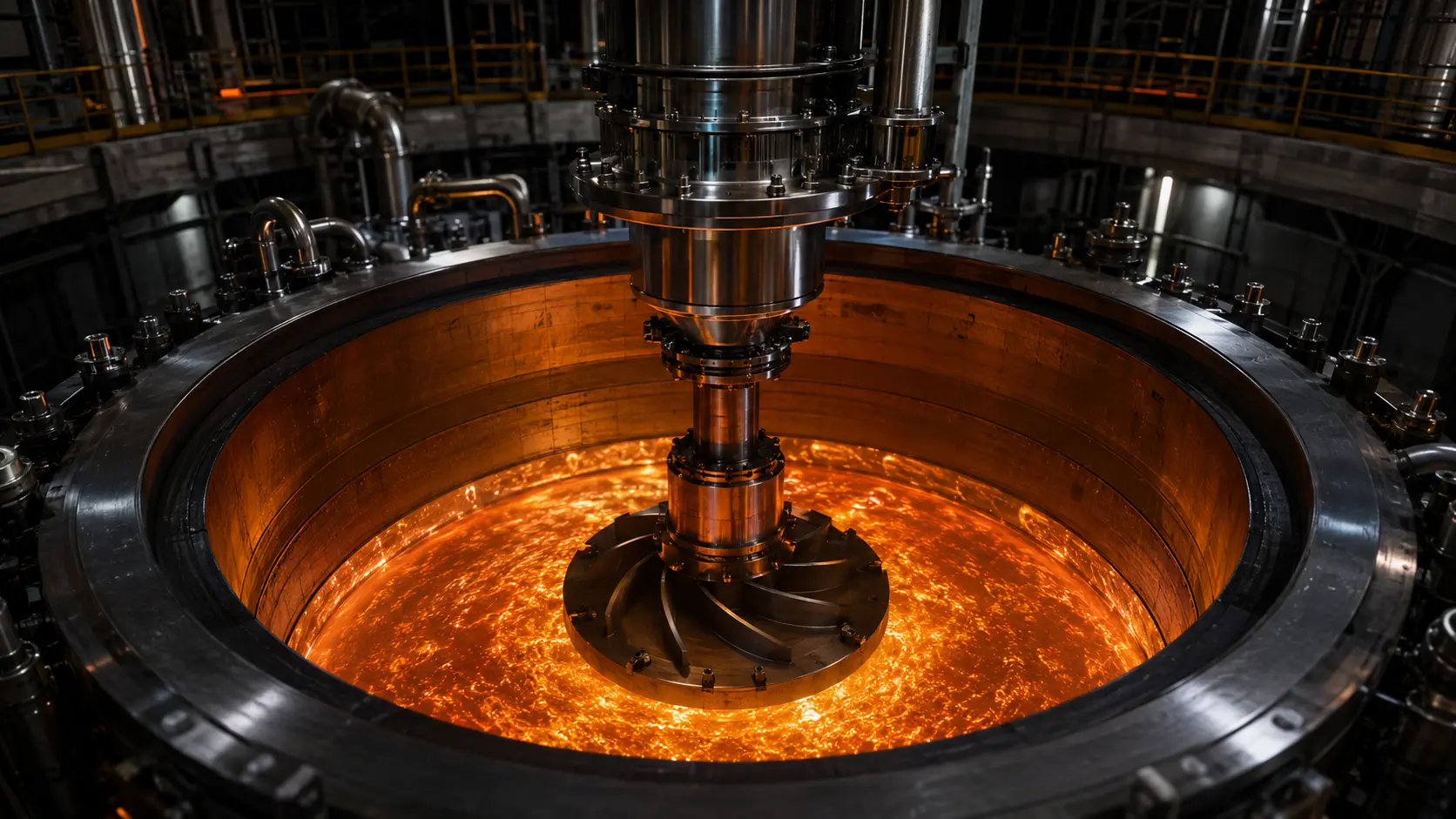
This radioactive, 700-degree Celsius liquid must continuously circulate through the graphite moderator core to sustain fission, and then through a primary heat exchanger to extract the thermodynamic energy. Pumping this fluid is the most severe mechanical engineering challenge in modern nuclear physics. The system relies on a cantilevered centrifugal pump.
To prevent the electric motor from melting, engineers place it far above the reactor core. A long, vertically suspended metal shaft extends downward into the boiling radioactive salt, terminating in a spinning impeller. Because the pump handles radioactive material, it cannot use mechanical seals that wear out and leak.
Instead, the system utilizes a hydrodynamic fluid bearing. The liquid salt itself acts as the lubricant for the spinning shaft. However, at 700 degrees Celsius, liquid fluoride salts are ferociously corrosive, eagerly stripping chromium out of standard steel alloys. To survive, the impeller and shaft must be cast from exotic nickel-molybdenum alloys, primarily Hastelloy-N.
Furthermore, to prevent radioactive fission gases (like Xenon) from creeping up the shaft and destroying the motor, engineers inject a continuous, highly pressurized stream of inert Argon gas downward through the shaft housing. This invisible gas barrier physically blocks the radioactive isotopes, ensuring the mechanical drive systems remain isolated from the brutal chemical and radiological environment below.
WHY IT MATTERS NOW
The global energy transition mathematically requires continuous, zero-carbon baseload power to replace coal and natural gas. Small Modular Reactors (SMRs) are heavily subsidized by Western governments to fill this gap. Molten Salt Reactors represent the ultimate theoretical end-state of SMR design because they are inherently meltdown-proof. If a station loses all electrical power, a frozen plug of salt at the bottom of the reactor passively melts, draining the liquid fuel into underground, sub-critical cooling tanks entirely by gravity.
However, the commercial deployment of MSRs by companies like Terrestrial Energy and Westinghouse is currently stalled by a single mechanical bottleneck: the primary circulation pump.
If an MSR pump fails, you cannot simply send a mechanic to fix it. The pump is heavily irradiated and completely inaccessible to humans. The entire reactor must shut down. To satisfy the strict economic requirements of utility operators, these pumps must spin flawlessly, without maintenance, while submerged in boiling corrosive molten salt, for a minimum of seven continuous years.
This mechanical reality shifts the primary constraint of next-generation nuclear power away from theoretical neutron physics and directly onto metallurgy and fluid dynamics. Mastering the exact wear tolerances of hydrodynamic bearings in liquid fluoride dictates whether an MSR generates cheap, reliable gigawatt-hours or spends half its lifespan offline awaiting multimillion-dollar robotic maintenance interventions.
WHAT MOST PEOPLE MISS
Nuclear policy debates frequently fixate on the proliferation risks of the uranium fuel cycle. They entirely miss that the operational lifespan of a modern reactor is dictated by microscopic material corrosion.
Liquid salts do not just dissolve metals; they execute highly complex, temperature-driven mass transfer. Because the pump impeller sits in the hottest part of the reactor, the salt chemically strips microscopic atoms of chromium from the metal. As the fluid flows to the cooler heat exchanger, it deposits those exact same atoms, creating dangerous metallic sludge blockages. The pump isn’t just surviving heat and radiation; it is constantly fighting the fluid’s thermodynamic desire to physically relocate the pump’s own structural atoms across the reactor loop.
THE TRAJECTORY
Next 12–36 Months: The Nuclear Regulatory Commission (NRC) will finalize the specific testing parameters for liquid-fueled reactor components. National laboratories will complete multi-year thermal-hydraulic stress tests on full-scale Hastelloy-N pump impellers, establishing the strict mechanical wear baselines required for initial commercial licensing.
Next Five Years: Reactor developers will integrate magnetic levitation (maglev) bearings into the pump shafts. By completely eliminating physical contact between the spinning shaft and the pump housing, maglev architecture will bypass the corrosive friction limits of hydrodynamic bearings, pushing the theoretical maintenance-free lifespan of the pump past fifteen years.
Next Ten Years: Advanced MSRs will reach commercial operation for heavy industry. Rather than simply generating electricity for the grid, the extreme 700-degree output of these reactor loops will be piped directly into chemical manufacturing facilities, providing the massive, zero-carbon process heat required to cleanly synthesize hydrogen, ammonia, and structural steel.
What Could Go Wrong: Even microscopic impurities in the argon cover gas (such as trace oxygen or water vapor) instantly turn the liquid fluoride salts violently acidic. If the gas purification system fails for a few hours, the resulting chemical spike will aggressively corrode the pump shaft, inducing a catastrophic mechanical failure that instantly halts the multi-billion-dollar reactor.
Most Likely Outcome: The molten salt pump will remain the single most heavily engineered, expensive, and critical component of advanced fission architectures. The companies that successfully master the exotic metallurgy required to pump boiling radioactive liquids will secure an absolute monopoly over the next fifty years of global nuclear deployment.
KEY TERMS
- Molten Salt Reactor (MSR): A class of advanced nuclear fission reactor where the primary coolant, or even the fuel itself, is a molten salt mixture.
- Hydrodynamic Bearing: A mechanical bearing that uses a thin film of highly pressurized fluid (in this case, the liquid salt itself) to support a spinning shaft without metal-on-metal contact.
- Hastelloy-N: A specialized, highly expensive nickel-molybdenum-chromium alloy specifically invented to resist the extreme corrosion of hot fluoride salts in nuclear environments.
- Fission Product Gases: Radioactive gases, such as Xenon and Krypton, that bubble out of the liquid fuel during the nuclear reaction and must be carefully managed and captured.
- Cantilever Pump: A pump design where the spinning impeller is suspended at the end of a long, unsupported shaft, separating the delicate electric motor from the extreme hazard zone.
SOURCES
- Department of Energy (DOE) — Advanced Reactor Demonstration Program and Molten Salt Pump Component Testing
- Oak Ridge National Laboratory (ORNL) — Historical Data from the Molten Salt Reactor Experiment (MSRE) and Hastelloy-N Corrosion Kinetics
- International Atomic Energy Agency (IAEA) — Status of Liquid Metal and Molten Salt Fast Reactor Technology
- Nuclear Regulatory Commission (NRC) — Regulatory Framework for Non-Light Water Advanced Nuclear Reactors