Advertisement
)
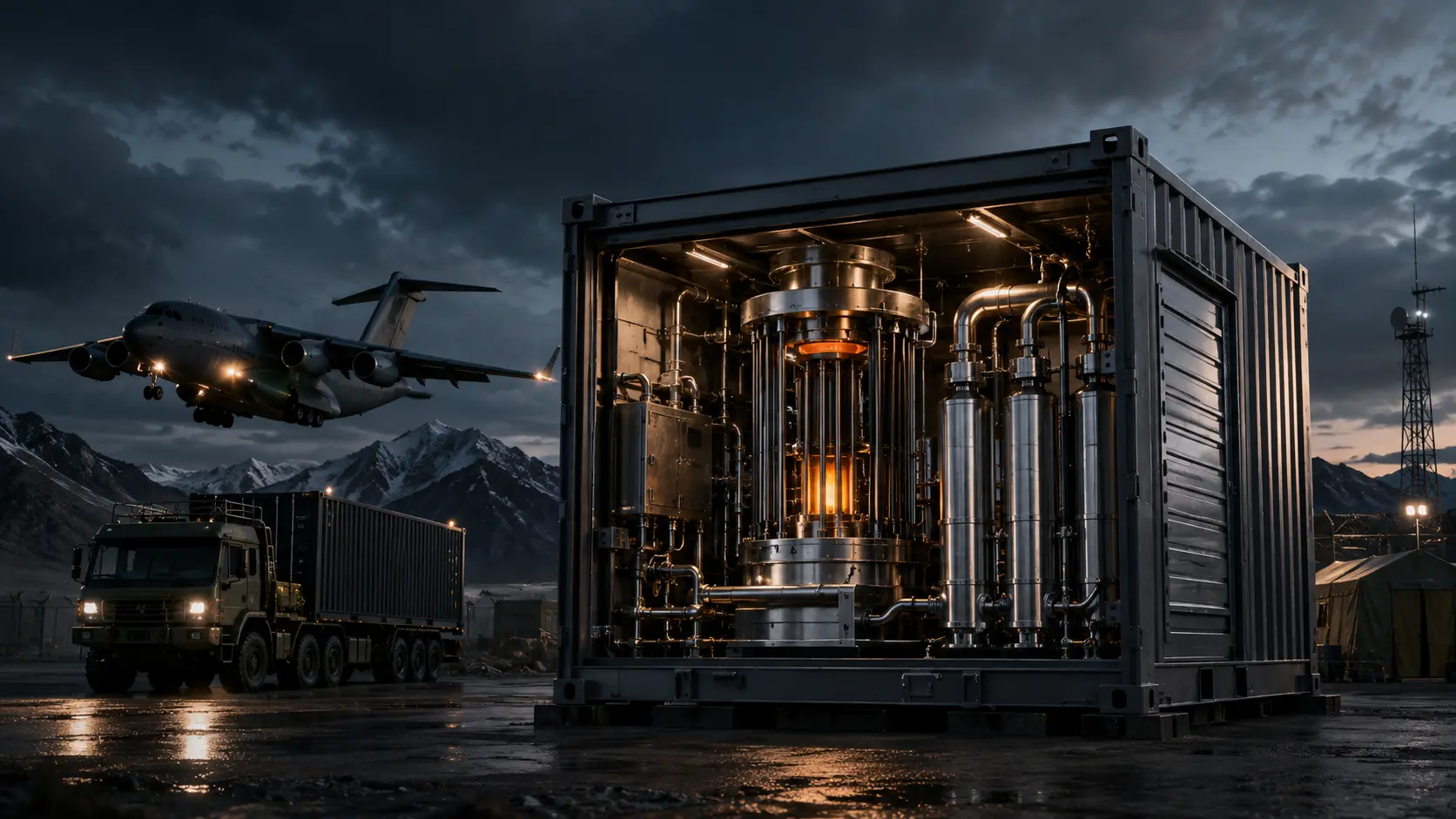

To keep an American military forward operating base (FOB) powered in a hostile theater, the Pentagon must dispatch endless convoys of diesel fuel trucks across unsecured terrain. These convoys are slow, highly explosive, and routinely targeted by insurgents. The “fully burdened” cost of moving a single gallon of diesel to a remote combat outpost can exceed $400, not accounting for the lethal human toll of defending the supply lines. The military has a massive, deadly logistics vulnerability: traditional energy is a physical tether that limits strategic reach.
But what if a military base didn’t need a fuel delivery for ten years? To sever the diesel tether, nuclear engineers have miniaturized the atom. By combining next-generation, meltdown-proof uranium pellets with passive cooling technology, they have engineered full-scale nuclear power plants small enough to fit on the back of a standard semi-truck. Why should you care right now? Because this technology is no longer theoretical. The U.S. Department of Defense is actively building these mobile reactors to establish absolute, off-grid energy dominance. In doing so, they are commercializing a “plug-and-play” energy solution that will soon power remote data centers, Arctic mining operations, and disaster relief zones across the globe.
What are Nuclear Microreactors?
Nuclear microreactors are highly compact, self-contained nuclear power plants capable of generating 1 to 10 megawatts of electricity. Designed to fit inside standard shipping containers, they use passive cooling and advanced fuels to operate safely without water, providing uninterrupted, zero-carbon power to remote military bases, mining operations, and disaster zones.
At a Glance
- Concept: Shrinking a nuclear reactor down to the size of a shipping container so it can be built in a factory, transported anywhere on Earth, and turned on instantly.
- Why it matters: It solves the logistics of remote power. Remote towns and military bases currently rely on imported diesel, which is expensive and highly vulnerable to supply chain shocks. Microreactors run for 10 to 20 years on a single fuel load.
- Who uses it: The U.S. Department of Defense (Project Pele), the Department of Energy, and heavy industry conglomerates operating off-grid mines.
- Biggest takeaway: Microreactors eliminate the risk of a “meltdown” through the laws of physics, not software. They use specialized fuel pellets (TRISO) that simply cannot melt at the temperatures the reactor is capable of reaching.
In Simple Words
Imagine trying to power a remote town in Alaska. You can’t build a massive dam, and solar panels don’t work during the six months of winter darkness. Currently, you have to fly or truck in millions of gallons of diesel fuel every year. It is incredibly expensive and pollutes the pristine environment.
A Nuclear Microreactor changes the math completely. Instead of building a massive, concrete nuclear plant over ten years, a company builds a tiny reactor in a factory, puts it inside a steel shipping box, and drives it to the town on a truck.
You plug it into the town’s grid, turn it on, and walk away. It produces enough electricity to power a few thousand homes, silently, with zero emissions, for a decade. It doesn’t need to be hooked up to a river for cooling water, and if the power ever goes out, it automatically cools itself down using the natural flow of heat. When it eventually runs out of fuel ten years later, a truck simply picks up the entire box, takes it back to the factory, and drops off a fresh one.
Why This Matters
The global energy transition is facing a harsh geographic reality: high-density power is required in places where the grid physically cannot reach.
For Defense Contractors and Energy Policy Makers, microreactors represent absolute operational autonomy. A military base powered by a microreactor is immune to cyberattacks on the civilian power grid and immune to fuel supply blockades. Furthermore, as artificial intelligence data centers seek to bypass multi-year utility connection queues, the ability to deploy a 10 MW “plug-and-play” baseload generator anywhere on Earth completely disrupts traditional utility real estate models.
SMRs vs. Nuclear Microreactors
Microreactors are distinctly different from Small Modular Reactors (SMRs).
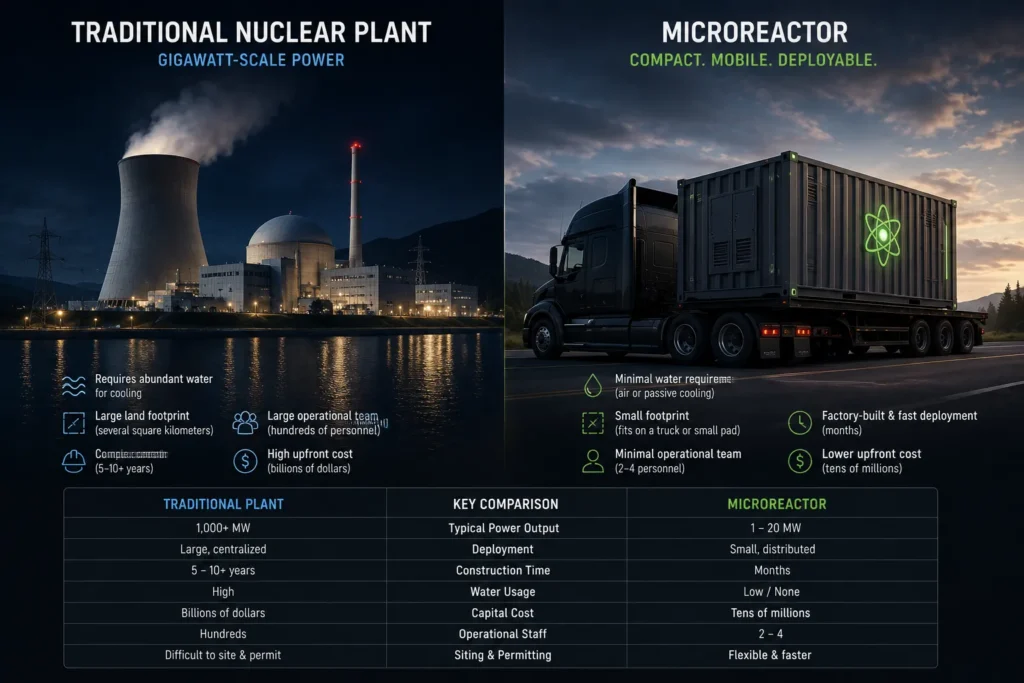
An SMR generates roughly 50 to 300 megawatts. While they are smaller than legacy gigawatt plants, SMRs still require permanent, poured-concrete facilities, massive water access, and years of site preparation. They are designed to power medium-sized cities.
A Microreactor generates 1 to 10 megawatts. It is a completely mobile, encapsulated appliance. It does not require water, it does not require poured concrete, and it is designed to be operational within 72 hours of arriving on site. It is not designed to power a city; it is designed to power a specific, localized microgrid.
How Nuclear Microreactors Work: TRISO Fuel and Heat Pipes
Eliminating the massive cooling towers and complex water pumps of a traditional nuclear plant requires a fundamental shift in core physics and materials science. Here is the first-principles breakdown of the technology.
1. The Fundamental Problem: Meltdown Risk and Active Cooling
Traditional reactors use uranium rods submerged in water. The water carries the heat away to spin a turbine. If the water pumps lose power (like at Fukushima), the water boils away, the uranium rods overheat, and the metal cladding melts, causing a catastrophic radiation leak. Microreactors must eliminate the physical possibility of this sequence entirely.
2. The Core Mechanism: TRISO Fuel
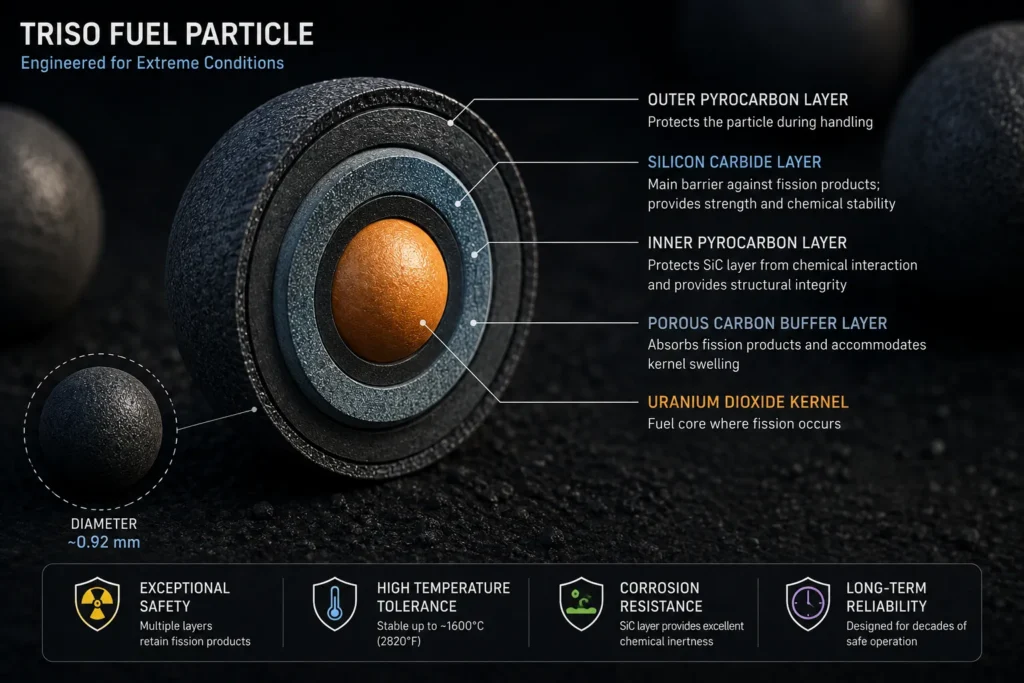
The foundation of microreactor safety is Tri-structural Isotropic (TRISO) particle fuel. Instead of long metal rods, the uranium is formed into a microscopic kernel (the size of a poppy seed). This kernel is coated in three layers of carbon and silicon carbide. Silicon carbide is one of the hardest materials on Earth and physically cannot melt below 1,800°C. Because the reactor cannot physically generate temperatures that high, the radioactive material is permanently trapped inside its tiny shell. The fuel is physically meltdown-proof.
3. Technical Depth: Passive Heat Pipes
Because TRISO fuel doesn’t need to be bathed in water, microreactors use solid-state heat removal. The reactor core is a solid block of metal (often steel or graphite) with holes drilled through it. The TRISO pellets sit in some holes, and “Heat Pipes” sit in the others.
A heat pipe is a sealed metal tube containing a small amount of liquid metal (like sodium or potassium). When the uranium gets hot, the liquid sodium at the bottom of the tube vaporizes, shoots to the top of the tube, releases its heat to a heat exchanger, turns back into a liquid, and runs back down the sides via capillary action.
Q = ṁ · h_fg
This thermodynamic cycle requires absolutely zero pumps, zero moving parts, and zero electricity to function. If the power goes out, the heat simply continues to passively radiate away.
4. Real-World Consequences: Closed-Brayton Cycles
The heat transferred to the top of the heat pipes is used to heat a gas (usually helium or nitrogen). This super-heated gas spins a compact turbine connected to a generator (a Closed-Brayton Cycle) to create electricity. Because the system uses gas instead of steam, it is vastly smaller, more efficient at high temperatures, and requires zero external water access.
Commercial and Military Deployments (Project Pele)
The deployment of microreactors is spearheaded by sovereign mandates, specifically targeted at locations where conventional energy physics break down.
Project Pele (The Pentagon’s Mobile Reactor): The U.S. Department of Defense’s Strategic Capabilities Office initiated Project Pele to build a mobile, generation-IV microreactor. Designed by BWXT Technologies, the reactor is built into standard 20-foot shipping containers. It is designed to be transported by a C-17 aircraft, driven to a forward operating base, and brought to full power within days. In a hostile theater, this grants the U.S. military total energy independence, eliminating the need to defend vulnerable diesel fuel convoys.
Arctic and Remote Mining: Heavy industry in northern Canada and Alaska relies heavily on diesel. A remote gold or lithium mine can consume tens of millions of dollars of diesel annually, subject to extreme price volatility. A 5 MW microreactor provides constant, clean baseload power, allowing mining companies to electrify their heavy hauling fleets and stabilize their operational expenditure (OpEx) for a decade, regardless of winter ice road closures.
Disaster Relief Microgrids: When a Category 5 hurricane destroys an island’s power infrastructure, rebuilding the grid takes months. The Federal Emergency Management Agency (FEMA) envisions flying microreactors directly into disaster zones. By plugging a microreactor directly into a surviving hospital or water purification plant, emergency responders can establish an immediate, localized safe zone with high-density power.
Economic & Strategic Impact
The core commercial challenge for microreactors is the First-of-a-Kind (FOAK) Cost Penalty.
Because the nuclear industry has not built an entirely new supply chain in decades, the first few microreactors will be astronomically expensive. The specialized TRISO fuel fabrication lines and high-assay low-enriched uranium (HALEU) enrichment facilities are just now being stood up in North America.
For the military, price is secondary to strategic advantage. However, for commercial deployments, the Levelized Cost of Energy (LCOE) must eventually drop to compete with diesel. To achieve this, microreactors must achieve true “factory-line manufacturing.” Unlike legacy nuclear plants that are custom-built on-site like bespoke cathedrals, microreactors must be manufactured identically on an assembly line, like commercial jet engines. The financial viability of the entire sector depends on achieving this mass-production learning curve by the early 2030s.
Advantages
- Total Mobility: Housed within standard shipping containers, allowing deployment via truck, rail, or heavy-lift aircraft anywhere on the globe.
- Inherent Safety (Walk-Away Safe): The combination of TRISO fuel and passive heat pipes means that in a worst-case scenario (total loss of power or physical attack), the reactor simply cools down on its own without human intervention.
- Water Independence: Because they do not use steam turbines or water-cooling loops, they can be deployed in bone-dry deserts or frozen Arctic tundras.
- Long Lifespan: Designed to operate continuously for 10 to 20 years on a single fuel load without requiring complex on-site refueling operations.
Limitations
- HALEU Supply Chain: Microreactors require High-Assay Low-Enriched Uranium (HALEU), enriched between 5% and 20%. Currently, Russia is the only country with a massive commercial HALEU supply chain. Western nations are scrambling to build domestic HALEU enrichment capacity to sever this geopolitical dependency.
- Regulatory Frameworks: The Nuclear Regulatory Commission (NRC) was built to regulate massive, stationary, water-cooled reactors. Auditing and licensing a factory-built, mobile, gas-cooled reactor requires a fundamental rewrite of decades-old bureaucratic protocols.
- Security and Proliferation: While TRISO fuel is incredibly difficult to reprocess into weapons-grade material, dropping a nuclear reactor into a combat zone or remote wilderness raises obvious physical security risks regarding theft or sabotage.
Common Misconceptions
Misconception: A microreactor can explode like an atomic bomb.
Reality: It is physically and mathematically impossible. The uranium used in microreactors is enriched to less than 20% (HALEU). A nuclear weapon requires uranium enriched to over 90%. Furthermore, the reactor lacks the complex explosive lenses required to trigger a detonation.
Misconception: The military will leave radioactive waste on the battlefield.
Reality: Microreactors are designed as sealed, closed-loop batteries. When the 10-year fuel cycle is complete, the entire shipping container is loaded back onto a truck and returned to a secure, domestic federal facility for defueling and decommissioning. The reactor is never opened in the field.
Misconception: Solar and batteries are cheaper for remote bases.
Reality: Intermittent renewables require massive tracts of land and heavy, expensive battery banks to survive nights and bad weather. In extreme environments (like an Arctic winter or a crowded combat outpost), clearing hundreds of acres for solar panels is tactically impossible.
What Most People Miss
The strategic integration of High-Temperature Industrial Heat.
While most analysts focus on the electricity generated by microreactors, they miss the value of the thermal exhaust. Microreactors operate at extremely high temperatures (often exceeding 600°C).
This high-grade industrial heat is massively valuable. Instead of just spinning a turbine for electricity, the heat can be piped directly into adjacent industrial facilities. For example, it can be used to desalinate seawater, produce synthetic aviation fuel from atmospheric carbon, or refine critical minerals—processes that normally require burning massive amounts of coal or natural gas. The microreactor is not just an electrical generator; it is a zero-carbon thermal engine.
Comparison Table
| Feature | Legacy Nuclear (Gigawatt) | Small Modular Reactor (SMR) | Nuclear Microreactor |
| Power Output | 1,000+ MWe | 50 to 300 MWe | 1 to 10 MWe |
| Physical Size | Massive complex (hundreds of acres) | Large building size | 1-2 ISO Shipping Containers |
| Cooling Mechanism | Millions of gallons of water | Water or advanced liquid coolants | Passive solid-state heat pipes |
| Deployment Time | 10 to 15 Years | 3 to 5 Years | Days to Weeks |
| Primary Use Case | Powering a massive regional grid | Powering a city or large factory | Powering a military base or mine |
Case Study
Situation: The U.S. Department of Defense requires absolute energy resilience to project global power. However, standard diesel generators forced the military to maintain highly vulnerable, extended supply lines. In combat theaters like Afghanistan, the logistical necessity of moving diesel fuel resulted in thousands of casualties due to ambushes on supply convoys.
Challenge: Develop a fully mobile, zero-carbon power source capable of generating at least 1 to 5 MWe that could fit inside standard C-17 transport aircraft, be assembled by soldiers within 72 hours, and operate without the risk of a catastrophic nuclear meltdown if physically attacked.
Solution (Project Pele): The Pentagon’s Strategic Capabilities Office (SCO) initiated Project Pele. After a rigorous competition, they awarded the contract to BWXT Technologies. BWXT designed a High-Temperature Gas-Cooled Reactor (HTGR) utilizing TRISO particle fuel and a closed-loop Brayton cycle, perfectly encapsulating the technology within modular shipping containers.
Outcome: By utilizing advanced fuels that are inherently “walk-away safe,” the DoD proved to the Nuclear Regulatory Commission that the reactor could not melt down, even under ballistic trauma. The prototype is scheduled for full-power testing at the Idaho National Laboratory, marking the first generation-IV nuclear reactor to be built in the United States in decades.
Lessons Learned: Project Pele established the blueprint for rapid nuclear deployment. It proved that by shifting the engineering focus from active mechanical safety (pumps and valves) to passive physical safety (TRISO materials), nuclear power can be safely mobilized, permanently severing the military’s deadly reliance on fossil-fuel logistics.
Future Outlook
Next 12–24 Months
The era of Prototype Validation and HALEU Scaling. The immediate focus of the industry rests entirely on the successful full-power testing of the Project Pele prototype at the Idaho National Laboratory. Concurrently, the U.S. Department of Energy will execute aggressive capital injections to stand up domestic HALEU enrichment facilities (such as the Centrus Energy cascades in Ohio). Breaking the Russian monopoly on HALEU fuel is the mandatory prerequisite before any commercial microreactor fleet can scale.
Next 3–5 Years
The push for Commercial Off-Grid Pilots. Following military validation, companies like Oklo, Radiant, and Westinghouse will deploy the first commercial microreactor pilots. These will heavily target the Canadian mining sector and remote Alaskan utility co-ops. Because these off-grid locations currently pay exorbitant rates for helicoptered-in diesel (often exceeding $0.40 per kWh), microreactors will easily achieve economic price parity, proving the commercial viability of the technology in harsh environments.
Next 10 Years
The Hyperscale Data Center Convergence. By the mid-2030s, the greatest demand for microreactors will not come from the military; it will come from Silicon Valley. As artificial intelligence data centers require hundreds of megawatts of continuous baseload power, the traditional electrical grid will face severe multi-year connection delays. Tech giants will bypass the public utility grid entirely, purchasing fleets of microreactors to act as private, “behind-the-meter” power plants, guaranteeing their AI clusters never face a brownout.
Most Likely Scenario
Microreactors will not replace traditional gigawatt nuclear plants or massive solar farms, but they will completely dominate the decentralized edge of the power grid. By treating a nuclear reactor like a commoditized, factory-built battery rather than a massive civil engineering project, the industry will finally unlock the true geopolitical and economic potential of atomic energy.
Key Takeaways
- Nuclear microreactors are 1 to 10 MW power plants that fit inside standard shipping containers, allowing them to be trucked or flown to remote locations.
- They are designed to operate continuously for a decade without refueling, completely eliminating the need for vulnerable, expensive diesel fuel supply lines.
- The military’s “Project Pele” is driving the technology, utilizing microreactors to make forward operating bases entirely energy-independent.
- Absolute safety is achieved using TRISO fuel—uranium encapsulated in layers of silicon carbide that physically cannot melt down under extreme reactor temperatures.
- Microreactors use passive “heat pipes” filled with liquid metal instead of complex water pumps, making them walk-away safe and independent of external water sources.
- The primary commercial hurdle is building a Western supply chain for High-Assay Low-Enriched Uranium (HALEU) to break the current reliance on Russian enrichment facilities.
Glossary
Closed-Brayton Cycle: A highly efficient thermodynamic cycle that uses a heated, pressurized gas (like helium) to spin a turbine and generate electricity, rather than boiling water into steam.
HALEU (High-Assay Low-Enriched Uranium): Uranium enriched between 5% and 20%. It provides more power in a smaller volume than traditional fuel, making it mandatory for advanced microreactors.
Heat Pipe: A passive, sealed tube containing a liquid metal that transfers heat extremely efficiently via vaporization and capillary action, requiring zero moving parts or electrical pumps.
Levelized Cost of Energy (LCOE): A financial metric used to compare the lifetime costs of different power generation technologies, calculated by dividing total costs by the total energy produced.
Project Pele: A U.S. Department of Defense program aimed at developing a mobile, safe nuclear microreactor to power remote military bases.
TRISO Fuel (Tri-structural Isotropic): Microscopic uranium kernels coated in robust carbon and ceramic layers that trap radioactive fission products and physically prevent meltdowns.
Sources
[1] U.S. Department of Defense: Strategic Capabilities Office Project Pele Overview and Mobile Microreactor Prototype (2024/2026 Analysis)
[2] U.S. Department of Energy (DOE): What is a Nuclear Microreactor?
[3] Idaho National Laboratory (INL): Microreactor Applications and TRISO Fuel Safety Metrics
[4] BWXT Technologies, Inc.: Advanced Nuclear Reactors and Project Pele Hardware Delivery
[5] World Nuclear Association: Small Nuclear Power Reactors and Off-Grid Mining Applications