Advertisement
)

AT A GLANCE
- Concept: Viscosity Barrier: Heavy oil sits underground as a solid, tar-like substance that physically cannot flow into a standard vertical well.
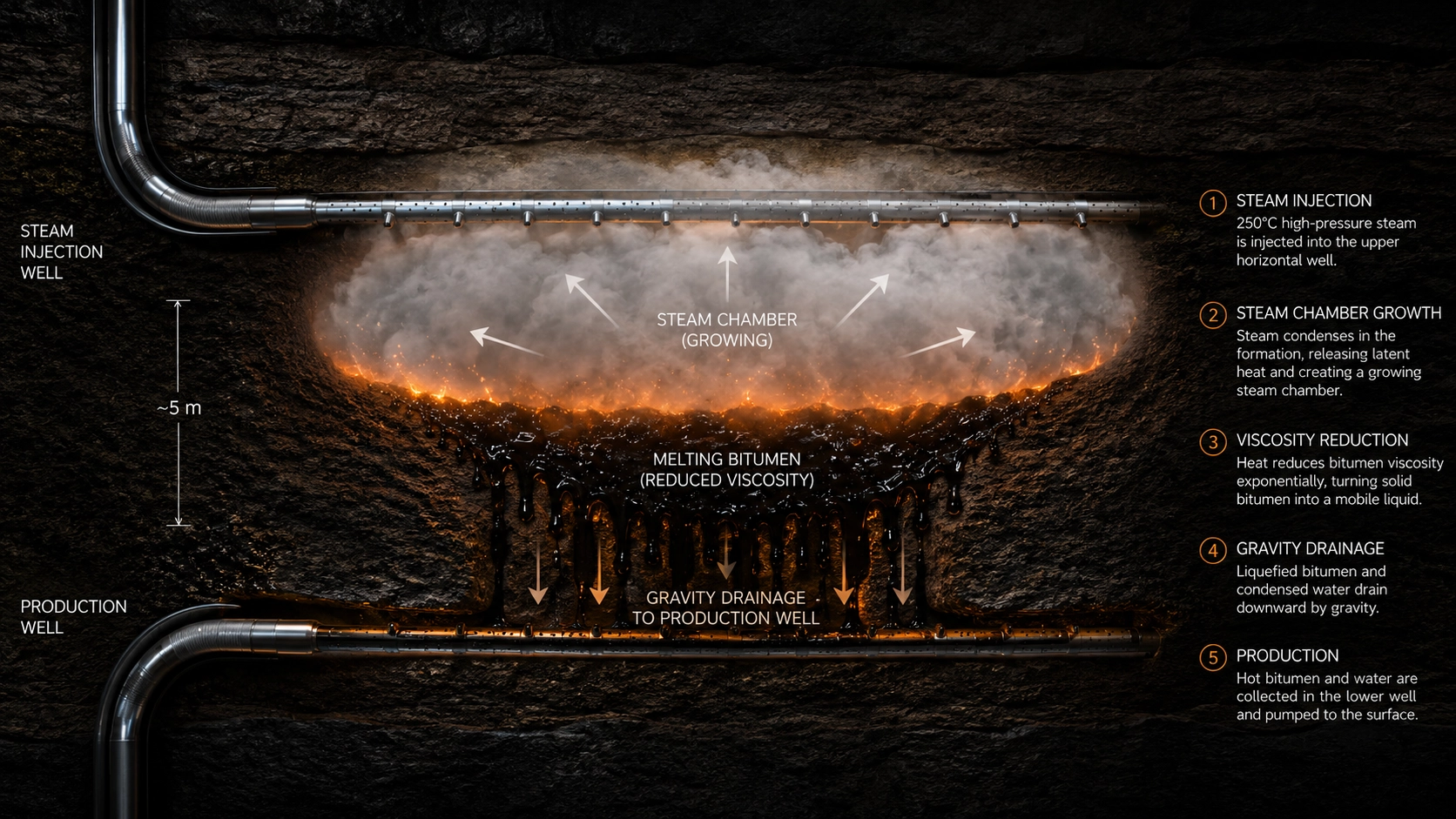
- Concept: Dual Wellbore Architecture: Operators drill two horizontal pipes directly on top of each other, separated by a specific five-meter vertical gap.
- Concept: Steam Chamber Growth: The top pipe injects 250°C steam, creating a growing thermal bubble that actively melts the surrounding rock formation.
- Concept: Gravity Drainage: The melted bitumen drops naturally into the lower production pipe, propelled entirely by gravity rather than mechanical pumping.
HOW IT WORKS
Conventional oil extraction relies on underground pressure. A drill punches a hole into a liquid reservoir, and natural geological pressure forces the light crude to the surface. Unconventional heavy oil, particularly the bitumen found in the Canadian oil sands, completely breaks this model. Bitumen possesses an extreme physical viscosity; at standard subterranean temperatures, it is functionally a solid block of tar mixed with sand.
To extract this resource, engineers must fundamentally alter its thermodynamic state. Steam-Assisted Gravity Drainage (SAGD) achieves this through a paired horizontal well architecture. Drillers navigate a highly precise path, placing an injection well roughly five meters directly above a parallel production well, often extending over a mile horizontally through the pay zone.
The surface facility utilizes massive boilers to generate 250°C, high-pressure steam. This steam pumps continuously into the upper injection well. As the steam escapes into the cold subterranean formation, it condenses back into water. This phase change violently releases latent heat, transferring massive thermal energy directly into the solid bitumen.
The core physical calculation of SAGD is the temperature-viscosity relationship. As the bitumen absorbs the latent heat, its viscosity drops exponentially. At native temperatures, bitumen viscosity registers around one million centipoise (comparable to peanut butter). At 200 degrees Celsius, the viscosity collapses to below ten centipoise (comparable to warm syrup).
Once melted, gravity dictates the rest of the physical process. The liquefied bitumen, mixed with the condensed steam water, simply falls downward through the sand matrix and pools in the lower production well. High-volume electrical submersible pumps then lift this hot fluid emulsion to the surface processing facility, where the oil is separated, and the water is boiled back into steam to restart the continuous thermal loop.
WHY IT MATTERS NOW
The global supply of easily accessible, light sweet crude is entering a period of terminal decline. To meet baseline global energy demand, industrial nations are forced to rely heavily on unconventional, low-quality heavy crude reserves.
This reliance exposes a severe thermodynamic paradox: extracting heavy oil requires burning massive amounts of energy first. The efficiency of a SAGD operation is defined strictly by the Steam-to-Oil Ratio (SOR)—the mathematical volume of steam required to produce one barrel of oil. An optimal SAGD pad operates at an SOR of 2.0. If geologic anomalies or poor thermal management push the SOR to 4.0, the operation burns twice as much natural gas to generate the steam, instantly wiping out the profit margin of the extracted barrel.
Companies like Suncor Energy and Cenovus essentially run massive natural gas arbitrage operations. The financial viability of Canadian heavy oil is completely tethered to the localized price of the natural gas required to fuel the steam boilers.
This heavy natural gas consumption also generates immense localized carbon dioxide emissions. The absolute necessity to melt the oil before extracting it makes SAGD one of the most carbon-intensive extraction methods on Earth. As global carbon pricing frameworks expand, operators are racing to physically alter the injection loop to lower the SOR, attempting to preserve the economic viability of trillions of dollars of stranded heavy crude reserves.
WHAT MOST PEOPLE MISS
Environmental and energy policy debates focus entirely on the physical characteristics of the extracted crude oil. They completely miss the subsurface geomechanical reality: a SAGD well is not a static pipe; it is an active, artificially engineered thermal cave.
The steam chamber grows aggressively upward and outward, physically altering the stress state of the rock. If operators inject steam too quickly to maximize short-term production, the extreme pressure can physically fracture the caprock seal above the reservoir. If this geological seal cracks, the 250-degree steam violently breaches to the surface, causing a catastrophic blowout that destroys the wellpad, ruins the underlying reservoir pressure, and forces the permanent abandonment of the multi-million dollar asset. SAGD operators must constantly balance maximum thermal delivery against the absolute fracture pressure of the overlying dirt.
THE TRAJECTORY
Next 12–36 Months: Operators will widely deploy solvent-assisted SAGD. By injecting light chemical solvents like butane directly alongside the steam, the solvents will dissolve the bitumen chemically while the steam melts it thermally. This dual-action approach drastically reduces the total volume of steam required, cutting the baseline natural gas consumption by up to thirty percent.
Next Five Years: Advanced electromagnetic downhole heaters will replace centralized surface steam boilers. Instead of pumping hot water a mile underground, high-voltage cables will utilize radio-frequency heating directly at the bitumen face, generating localized thermal energy with significantly higher thermodynamic efficiency and zero direct surface emissions.
Next Ten Years: The integration of small modular nuclear reactors (SMRs) will completely detach heavy oil extraction from the natural gas market. SMRs will provide firm, zero-carbon industrial process heat directly to the SAGD injection loops, transforming one of the world’s most carbon-intensive oil operations into a functionally zero-emission extraction process.
What Could Go Wrong: The entire SAGD process relies on continuous water recycling. The emulsion lifted to the surface is highly toxic, and water treatment facilities must strip the silica and oil before boiling the water again. If the specialized boiler tubes scale over with localized mineral deposits, the steam generation plant will suffer a catastrophic mechanical failure, instantly freezing the underground steam chamber and permanently locking the oil in place.
Most Likely Outcome: SAGD will remain the only mathematically viable technology for producing deep unconventional heavy oil. However, the sheer thermodynamic cost of boiling water will force operators to transition from pure steam injection to complex solvent-hybrid architectures, fundamentally altering the economics of the global heavy crude supply chain.
KEY TERMS
- Steam-Assisted Gravity Drainage (SAGD): A thermal recovery process using dual horizontal wells to inject steam into a heavy oil reservoir, melting the bitumen so it can flow to a production well.
- Steam-to-Oil Ratio (SOR): A strict thermodynamic efficiency metric calculating the exact volume of water boiled into steam required to extract one single barrel of heavy crude.
- Bitumen: An extremely heavy, highly viscous form of petroleum that exists as a near-solid state at normal subterranean temperatures.
- Viscosity: A physical measurement of a fluid’s resistance to flow; reducing viscosity is the primary engineering objective of thermal oil recovery.
- Steam Chamber: The expanding underground volume of hot, vaporized water that actively transfers latent heat into the surrounding cold oil sands formation.
SOURCES
- Society of Petroleum Engineers (SPE) — Thermal Recovery Methods and SAGD Chamber Growth Dynamics
- Alberta Energy Regulator (AER) — Steam-to-Oil Ratios and Caprock Integrity in In-Situ Operations
- Journal of Petroleum Science and Engineering — Solvent-Assisted SAGD Thermodynamics and Viscosity Reduction
- Suncor Energy — In-Situ Heavy Oil Production and Thermal Efficiency Optimization