Advertisement
)
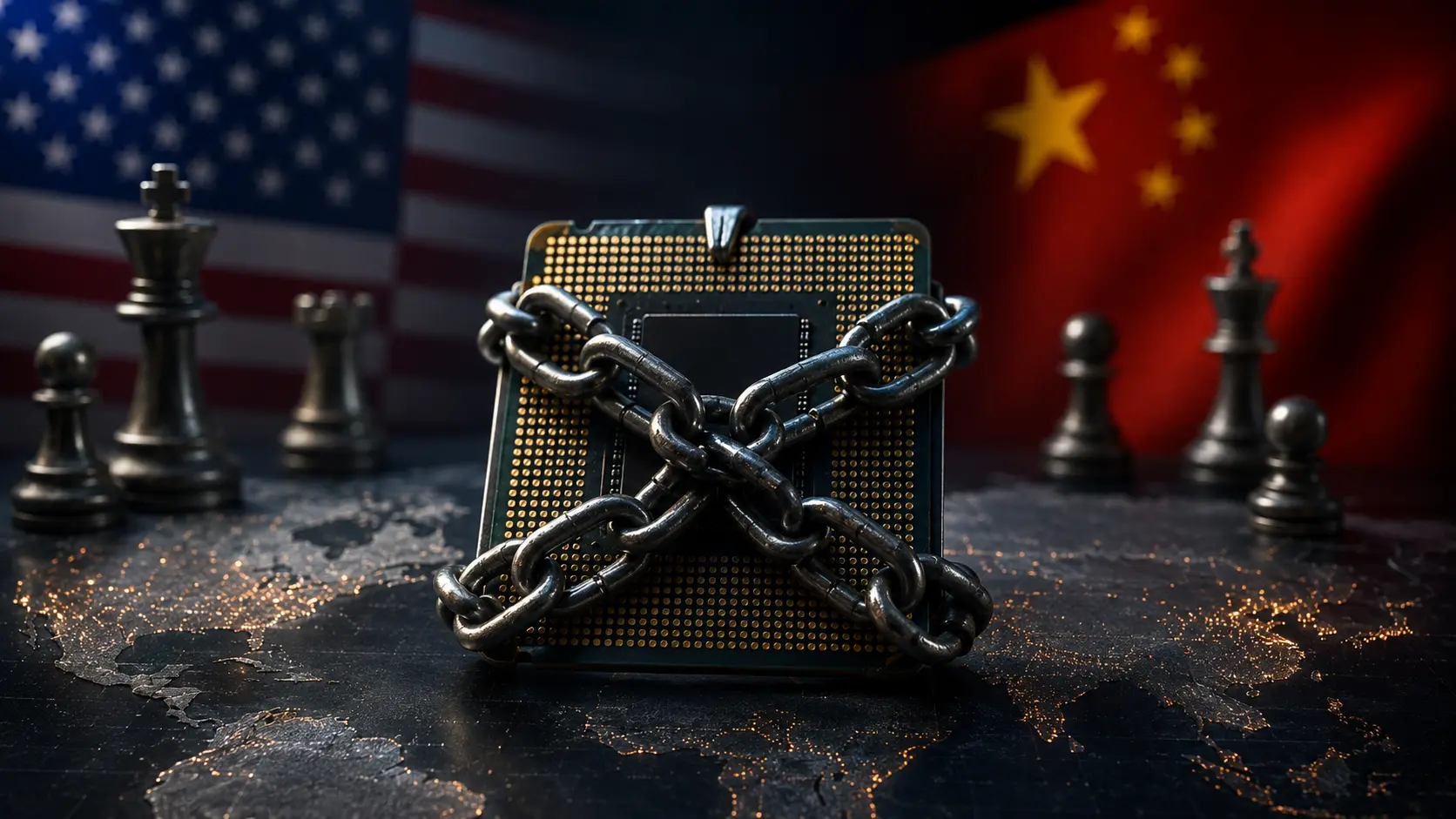

AT A GLANCE
- Concept: Bureau of Industry and Security: The US agency responsible for writing and enforcing international technology export laws.
- Concept: Foreign Direct Product Rule: A law extending American jurisdiction to chips manufactured entirely outside the United States.
- Concept: Entity List: A strict federal ledger of foreign corporations and universities prohibited from buying American technology.
- Concept: Compute Thresholds: Mathematical speed limits determining whether a specific microchip requires a government license to export.
IN SIMPLE WORDS
Imagine you invent a highly specialized wrench that builds the fastest race cars on Earth. You sell this wrench to factories worldwide. Eventually, you realize a rival nation is using your wrench to build military tanks.
Instead of fighting them on the battlefield, you weaponize the supply chain. You pass a law stating that anyone, anywhere in the world, using your specific wrench cannot sell their finished vehicles to your rival.
This is exactly how semiconductor export controls work. The United States dominates the design software and manufacturing equipment required to build advanced microchips. By threatening to revoke access to these foundational American tools, the US government forces foreign factories to comply with its political blockades. This strategy physically throttles the technological advancement of rival nations without firing a single shot.
HOW IT WORKS
The global semiconductor supply chain is completely interdependent but relies heavily on critical American intellectual property. To weaponize this reliance, the US Department of Commerce utilizes the Bureau of Industry and Security (BIS). The BIS establishes strict licensing requirements for the export of sensitive dual-use technologies.
The primary enforcement mechanism is the Foreign Direct Product Rule (FDPR). Historically, US export laws only applied to physical goods manufactured inside the United States. The FDPR radically expands this jurisdiction by dictating that if a foreign factory produces a microchip using American electronic design automation (EDA) software or American manufacturing equipment, that chip becomes subject to US law.
Because virtually every advanced semiconductor factory on Earth relies on American equipment, the FDPR grants Washington extraterritorial control over the entire global silicon market. If a Taiwanese foundry attempts to sell a restricted chip to a Chinese technology firm, the US government can instantly sanction the foundry and cut off its equipment maintenance contracts.
The BIS implements these restrictions using mathematical performance thresholds. Regulators calculate a chip’s Total Processing Performance (TPP) and its interconnect bandwidth. If a processor exceeds these specific speeds, the manufacturer must obtain a federal license before exporting the hardware to designated countries of concern.
To target specific corporate threats, the BIS maintains the Entity List. When the US government adds a foreign corporation or research institute to this ledger, American companies are legally prohibited from doing business with them. Recent updates utilize “Footnote 5” designations, which apply the maximum severity of the FDPR to specific companies attempting to build advanced-node logic chips for military-civil fusion programs.
REAL WORLD EXAMPLE
In late 2024 and early 2025, the US government aggressively expanded the Entity List to target Chinese semiconductor foundries attempting to manufacture sub-7nm microchips. The BIS added over 140 foreign entities to this restricted ledger to systematically degrade their manufacturing capacity.
Simultaneously, American regulators pressured the Dutch government to restrict ASML, the sole manufacturer of Extreme Ultraviolet (EUV) lithography scanners. By harmonizing export controls with the Netherlands and Japan, the United States successfully blocked Chinese access to both the American chemical etching tools and the European optical scanners required to manufacture modern artificial intelligence accelerators.
WHY IT MATTERS NOW
Microchips are the foundational resource of the modern global economy. Training advanced artificial intelligence, guiding hypersonic missiles, and managing sovereign financial grids all require leading-edge silicon. The nation that controls the physical hardware dictates the balance of global geopolitical power.
In January 2026, the Bureau of Industry and Security executed a major structural shift in how it regulates high-end AI chips like the Nvidia H200. Previously, the government reviewed all advanced exports to China under a strict presumption of denial. The new rules pivot to a highly conditional, case-by-case review system requiring extreme corporate transparency.
This shift directly ties geopolitics to domestic industrial capacity. To secure an export license, hardware companies must now prove their foreign sales will not deplete the domestic supply of chips available to US-based data centers. They must also submit independent third-party testing and grant the US government visibility into exactly who accesses the computing clusters remotely.
This regulatory evolution turns export controls from a blunt instrument into a precision economic weapon. It forces multinational technology conglomerates to build massive internal compliance divisions capable of tracking the end-use of every individual processor they sell. Failure to maintain this compliance results in devastating federal penalties and the total loss of export privileges.
COMMON MISCONCEPTIONS
Many people believe export controls completely ban the sale of all technology to restricted countries. In reality, the regulations only target the most advanced, high-performance logic and memory chips. Billions of dollars in legacy, mature-node semiconductors continue to flow across borders freely.
Observers often assume US controls only apply to American companies. Due to the Foreign Direct Product Rule, these laws apply to any company globally that relies on American technology anywhere within its supply chain.
Some executives think acquiring an export license is a quick administrative process. Submitting a license application to the BIS triggers an intense, multi-agency review involving the Department of Defense and the Department of State, frequently taking months and requiring exhaustive security audits.
WHAT MOST PEOPLE MISS
Geopolitical analysts focus heavily on the physical hardware blockades, but they completely overlook the restriction of human capital. The Export Administration Regulations (EAR) contain strict “U.S. persons” provisions.
These provisions make it a federal crime for American citizens, green card holders, or permanent residents to support the development or production of advanced-node integrated circuits at restricted foreign facilities.
This hidden mechanism forces a massive brain drain. When the US government enacts these specific controls, American executives and senior engineers working at foreign semiconductor foundries must resign immediately or face federal prosecution. This instantly strips adversarial nations of the highly specialized operational talent required to run complex fabrication plants.
THE ECONOMIC AND STRATEGIC IMPACT
The United States secures absolute strategic dominance over the global computing architecture. By dictating which nations receive advanced graphics processing units (GPUs), Washington strictly throttles the artificial intelligence development capabilities of rival superpowers.
Global semiconductor manufacturers face severe revenue compression. Companies like Nvidia, AMD, and Applied Materials lose billions of dollars in potential sales as entire regional markets are closed off. To compensate, they design highly specific, mathematically degraded chips that sit just below the BIS performance thresholds to maintain revenue.
Targeted nations respond by heavily subsidizing their domestic technology sectors to achieve silicon sovereignty. This initiates a massive, parallel supply chain decoupling. Governments pour hundreds of billions of dollars into domestic foundries to completely eradicate American technology from their manufacturing lines, attempting to permanently neutralize the threat of the Foreign Direct Product Rule.
THE TRAJECTORY
Next 12–36 Months: Multinational technology firms will deploy advanced cryptographic tracking software at the silicon level. These embedded security keys will allow manufacturers to remotely disable high-performance chips if they detect unauthorized diversion to restricted end-users or sovereign military programs.
Next Five Years: The expansion of multilateral semiconductor alliances. The United States will establish formalized, treaty-bound export control regimes with allied techno-democracies. This coordinating mechanism will harmonize restrictions across the entire semiconductor value chain, including raw chemical inputs and electronic design automation tools.
Next Ten Years: The strict regulation of artificial intelligence model weights. As the physical hardware controls mature, the BIS will expand its jurisdiction to restrict the digital export of fully trained, foundational AI models. Selling or transferring a massive neural network to a foreign adversary will carry the same legal penalty as smuggling a nuclear weapon component.
What Could Go Wrong: Total supply chain retaliation. If restricted nations control critical upstream resources, they can retaliate by embargoing the rare earth minerals, gallium, and germanium necessary to build microchips. This asymmetric response would instantly paralyze Western semiconductor fabrication plants and crash the global digital economy.
Most Likely Outcome: The global technology ecosystem will fracture into isolated, highly protected geographic blocs. The era of a unified, friction-free global supply chain is permanently over. Semiconductor trade will operate under the same strict security protocols historically reserved for advanced aerospace and nuclear materials.
KEY TERMS
- Bureau of Industry and Security (BIS): The agency within the US Department of Commerce that drafts, regulates, and enforces national security export controls.
- Foreign Direct Product Rule (FDPR): A regulation that extends US jurisdiction to foreign-made items produced using American software, technology, or manufacturing equipment.
- Entity List: A restricted trade ledger published by the US government; American companies cannot conduct business with listed organizations without a special license.
- Total Processing Performance (TPP): A specific mathematical metric used by regulators to measure the computing power of a microchip and determine its export status.
- Export Administration Regulations (EAR): The comprehensive set of federal rules that govern whether commercial and dual-use items can be exported from the United States.
- Semiconductor Manufacturing Equipment (SME): The highly complex industrial machinery, including lithography scanners and etching chambers, required to physically fabricate microchips.
- Dual-Use Technology: Products or software originally designed for commercial purposes that can be easily adapted for military or intelligence applications.
BEGINNER FAQ
What is an export control? It is a specific federal law that restricts the shipment of certain goods, software, or technology to foreign countries. The government uses these laws primarily to protect national security and foreign policy interests.
Why does the US restrict microchips? Advanced microchips power military weapons, cyber-warfare systems, and artificial intelligence. The US restricts them to prevent rival nations from modernizing their militaries and gaining a technological advantage.
What is the Foreign Direct Product Rule? It is a powerful legal tool that allows the US government to control products made entirely in other countries. The rule applies as long as the foreign factory used American tools or software to design or build the final product.
Can companies just ignore these rules? No. If a company violates these rules, the US government imposes massive financial fines, files criminal charges against executives, and bans the company from buying American technology, which usually bankrupts the business.
Does this mean no chips are sold to China? No. The rules only ban the sale of the absolute fastest and most advanced microchips. Basic chips used in cars, microwaves, and standard computers are still sold globally every day.
What is the Entity List? It is a highly restrictive government blacklist. If a foreign company is placed on the Entity List, it becomes illegal for anyone to sell American technology to that company without special government permission.
How do regulators measure chip speed? They use a metric called Total Processing Performance (TPP). The government calculates how many math operations the chip can perform per second. If the number exceeds the legal speed limit, the chip is restricted.
What happens to American engineers working in restricted factories? US export laws make it illegal for American citizens to help restricted foreign factories build advanced chips. Engineers must immediately quit their jobs or face severe criminal prosecution by the US government.
SOURCES
- Bureau of Industry and Security (BIS) — Revisions to the Export Administration Regulations and Advanced Computing Controls
- Center for Strategic and International Studies (CSIS) — Chokepoints in the Global Semiconductor Supply Chain
- Department of Commerce — The Foreign Direct Product Rule and Extraterritorial Jurisdiction
- Stanford University — The Geopolitics of Artificial Intelligence and Semiconductor Hardware Blockades