Advertisement
)

If the global transition to renewable energy relies entirely on lithium-ion batteries, it is mathematically and economically constrained. There is simply not enough easily mineable, cheap lithium on Earth to safely back up every municipal power grid, and packing thousands of highly flammable lithium cells into shipping containers near residential neighborhoods poses an unacceptable urban fire risk. For a decade, grid planners have been held hostage by the volatile price spikes and geopolitical chokepoints of the lithium supply chain.
To solve this, battery engineers have executed a radical pivot away from rare, expensive metals and turned toward the most abundant, cheapest mineral on the planet: salt. By swapping lithium for sodium, manufacturers are commercializing a new generation of utility-scale batteries that are entirely fireproof, perform flawlessly in freezing temperatures, and can be built using universally accessible supply chains without a single drop of cobalt or nickel. Why should you care right now? Because in 2026, Sodium-Ion Batteries (SIBs) have officially crossed the commercial threshold from laboratory prototypes into gigawatt-scale grid deployments. Understanding the underlying chemistry and brutal economics of this “post-lithium” architecture is essential for anyone navigating the multi-trillion-dollar future of energy infrastructure.
What are Sodium-Ion Batteries?
Sodium-ion batteries are rechargeable energy storage devices that use sodium ions ($Na^+$) to carry electrical charge between the anode and cathode. Because sodium is globally abundant and inexpensive, these batteries offer a highly scalable, non-flammable alternative to lithium-ion technology, specifically designed for massive, stationary grid-scale energy storage.
At a Glance
- Concept: Replacing the internal lithium ions of a battery with sodium ions, shifting the fundamental constraint from “energy density” to “economic scale.”
- Why it matters: SIBs use zero lithium, zero cobalt, zero nickel, and zero copper. This completely insulates the battery from the geopolitical supply chain shocks that frequently cripple the EV industry.
- Who uses it: Major battery manufacturers (CATL, HiNa Battery, Northvolt), municipal utility planners, and commercial microgrid developers.
- Biggest takeaway: SIBs can be safely discharged to exactly 0 volts. A lithium battery discharged to 0V is permanently destroyed and highly dangerous. SIBs can be shipped entirely dead, eliminating the risk of catastrophic thermal runaway (fires) during global transit.
In Simple Words
Think of a battery like a parking garage.
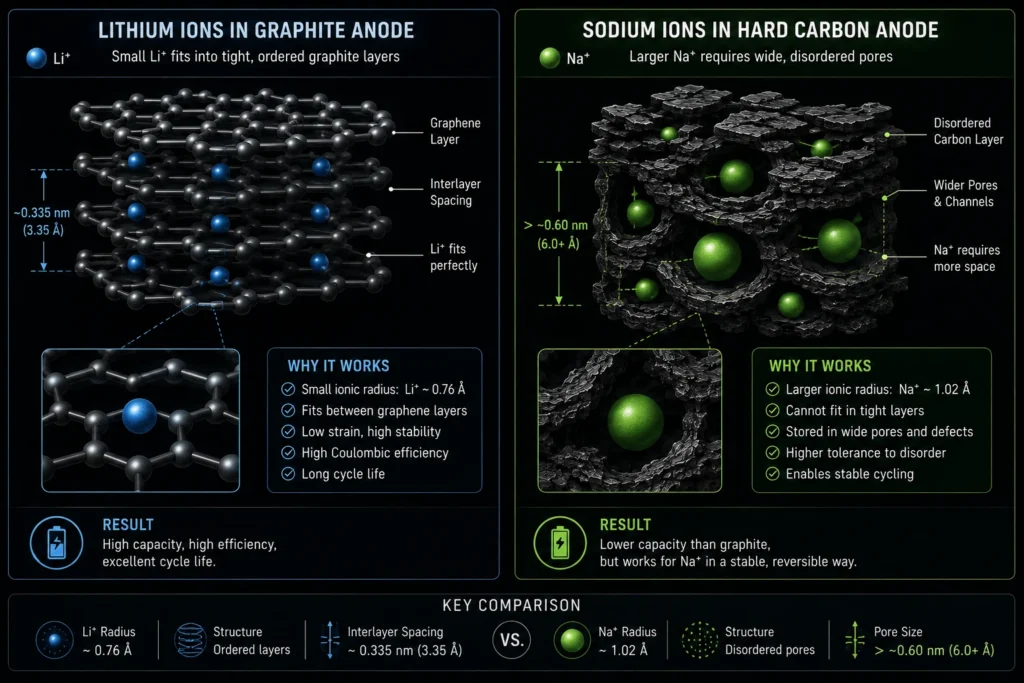
When you charge the battery, you are forcing cars (ions) to drive from one side of the garage to the other and park tightly into tiny spaces. In a traditional battery, those cars are Lithium ions. Lithium ions are very small, like motorcycles. Because they are small, they fit perfectly into a tightly packed, highly organized parking structure made of graphite.
However, lithium is rare and expensive. Scientists wanted to use Sodium instead because it is cheap and everywhere (it is literally salt).
The problem is that Sodium ions are physically 25% larger than lithium ions—they are like pickup trucks. If you try to force a pickup truck into the tiny motorcycle parking spaces of a standard graphite anode, the structure breaks. To fix this, scientists invented Hard Carbon. Hard carbon is like a chaotic, disorganized parking garage with massive, wide-open spaces. The large sodium “trucks” can easily drive in and park. By redesigning the garage to fit the larger vehicles, we can now store massive amounts of energy using the cheapest materials on Earth.
Why This Matters
For electric vehicles (EVs) and smartphones, “Energy Density” is the only metric that matters. You need the battery to be as light and small as possible so the car can drive 300 miles. Lithium wins that race flawlessly.
But for the power grid, energy density is irrelevant. If a utility company is building a 100-megawatt battery installation in an empty field in Texas, it does not matter if the batteries weigh 10,000 tons or 15,000 tons; they are never going to move. The only metric that matters for grid storage is the Levelized Cost of Storage (LCOS)—how cheap is it to buy, and how safe is it to operate?
Because SIBs utilize abundant materials (iron, manganese, aluminum, and sodium), their theoretical floor for Capital Expenditure (CapEx) is roughly 30% to 40% cheaper than Lithium Iron Phosphate (LFP) batteries. Driven by this aggressive cost advantage, the global SIB market is expanding at a staggering 24.4% Compound Annual Growth Rate (CAGR). For energy investors, SIBs represent the decoupling of the stationary grid storage market from the volatile supply constraints of the EV sector.
The Commercial Scaling of Sodium-Ion Batteries
The emergence of SIBs is not a total replacement of lithium; it is a market bifurcation.
While Western automakers continue to obsess over high-nickel lithium chemistries for premium EVs, China has rapidly mobilized its manufacturing base to dominate the SIB supply chain. Giants like CATL (Contemporary Amperex Technology Co. Limited) are actively scaling SIB production lines.
Crucially, this commercialization relies on Drop-In Manufacturing. SIBs do not require completely new, billion-dollar factory designs. The physical structure of a sodium-ion cell is nearly identical to a lithium-ion cell. Manufacturers can take an existing lithium-ion gigafactory, clean out the chemical vats, swap the lithium slurry for a sodium slurry, and instantly begin printing SIBs on the exact same roll-to-roll assembly lines. This compatibility allows the SIB market to scale at an unprecedented velocity compared to entirely novel architectures like solid-state batteries.
How Sodium-Ion Batteries Work: Hard Carbon Anodes
Accommodating the physical bulk of a sodium ion requires manipulating the chemical architecture of both the anode and the cathode. Here is the first-principles breakdown.
1. The Fundamental Problem: Ion Size and Intercalation
Batteries charge and discharge through a process called “intercalation”—ions sliding in and out of the molecular layers of the anode and cathode. Lithium ions ($Li^+$) have an ionic radius of 0.76 Ångströms (Å). Sodium ions ($Na^+$) have a radius of 1.02 Å. Because sodium is significantly larger, it physically cannot squeeze between the tightly spaced graphene layers of a standard graphite anode without shredding the crystal structure.
2. The Insufficiency of Copper Current Collectors
In a lithium-ion battery, the anode must be coated onto a copper foil. If aluminum were used, the lithium would chemically react (alloy) with the aluminum at low voltages, pulverizing the foil. Copper is heavy, expensive, and subject to intense geopolitical supply chain constraints.
3. The Core Mechanism: Hard Carbon Anodes
To solve the ion size problem, SIBs use Hard Carbon. Unlike the perfectly stacked, neat layers of graphite, hard carbon has a highly disordered, amorphous structure resembling a “house of cards.” This chaotic structure creates massive, microscopic voids and widened interlayer spacing, providing plenty of room for the bulky $Na^+$ ions to easily intercalate and extract without physically stressing the material.
4. Technical Depth: Prussian Blue Analogues and Layered Oxides
The cathode must also accommodate the large sodium ions. Engineers typically use one of three materials:
- Layered Transition Metal Oxides: Using cheap elements like Iron (Fe) and Manganese (Mn) arranged in sliding sheets.
- Prussian Blue Analogues (PBAs): These possess massive, open, 3D porous frameworks. The wide channels within the PBA crystal structure allow the large sodium ions to race in and out rapidly, giving these batteries excellent charge/discharge speeds.
- Polyanionic Compounds: Highly stable structures that sacrifice some capacity for extreme lifespan and safety.
5. Real-World Consequences: The Aluminum Advantage and 0V Discharge
Because sodium—unlike lithium—does not alloy with aluminum at low voltages, SIB manufacturers use cheap, lightweight aluminum foil for both the anode and the cathode current collectors. Even more critically, this chemical stability allows the battery to be safely drained to 0.0 Volts. A lithium battery drained to 0V degrades permanently and becomes a severe fire risk. A SIB can be completely short-circuited to 0V, thrown in a shipping container, sent across the ocean, and revived perfectly at its destination with zero risk of thermal runaway.
Real-World Applications of SIBs
Sodium-ion technology is actively carving out dominant market share in sectors where lithium is economically or physically misaligned.
Utility-Scale Grid Storage: The primary destiny of the SIB. Massive BESS (Battery Energy Storage Systems) installations backing up solar and wind farms operate continuously, absorbing and discharging power daily. Because these systems are stationary, the lower energy density of sodium is irrelevant. Utilities prioritize the drastic reduction in upfront capital expenditure and the absolute elimination of thermal runaway fire risks, allowing these massive facilities to be permitted and built much closer to dense urban substations.
Extreme Climate Deployments: Traditional lithium-ion batteries suffer severe performance degradation and battery-plating damage in sub-zero temperatures. SIBs exhibit remarkable temperature resilience. They retain over 90% of their total capacity even at -20°C (-4°F) and can operate safely up to 60°C (140°F). This makes them the undisputed choice for backing up remote wind farms in the freezing North Sea or solar arrays in the sweltering Middle Eastern deserts without requiring massive, energy-draining internal HVAC systems.
Micro-Mobility and Two-Wheelers: While SIBs are too heavy for a 300-mile Tesla, they are perfect for electric scooters, e-bikes, and low-speed urban delivery vehicles. These vehicles require cheap, robust batteries that can be fast-charged aggressively. The porous nature of hard carbon and Prussian blue analogues allows sodium ions to move exceptionally fast, enabling SIBs to reach 80% charge in less than 15 minutes, perfectly serving the high-turnover micro-mobility market.
Economic & Strategic Impact
The mass deployment of Sodium-Ion Batteries represents a total circumvention of the global critical minerals cartel.
The lithium-ion supply chain is an intense geopolitical chokepoint. Lithium mining is concentrated in Australia, South America, and China. Cobalt is overwhelmingly sourced from the Democratic Republic of Congo under heavy ethical scrutiny. Nickel supply shocks frequently break commodity exchanges.
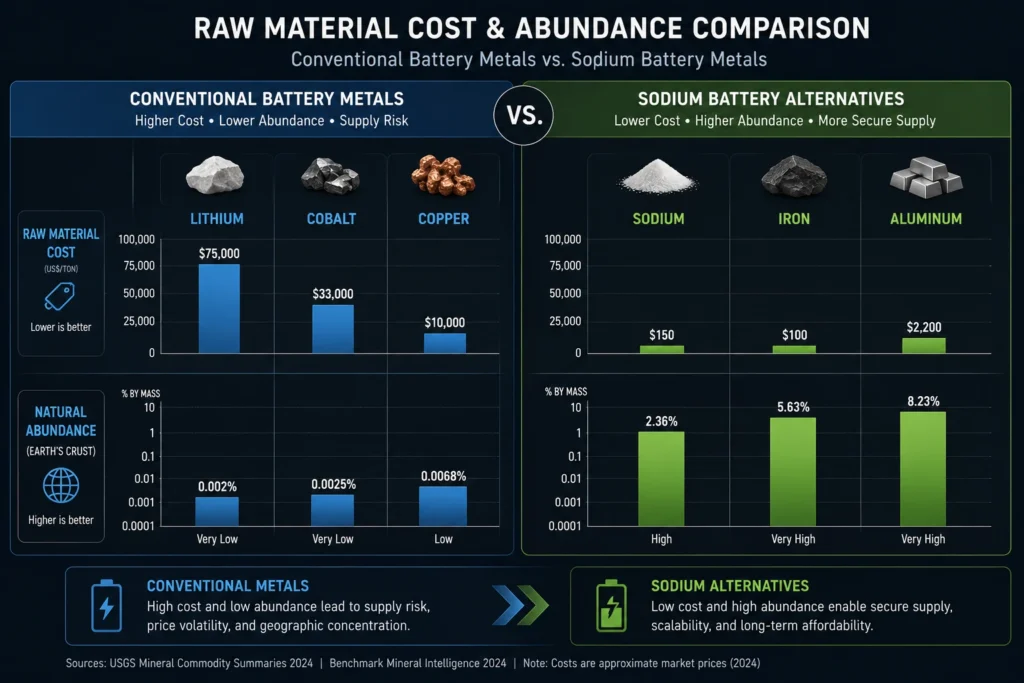
SIBs run on sodium (derived from soda ash or seawater), iron, manganese, and aluminum. These materials are universally abundant, completely decoupling energy storage from geopolitical leverage. Any nation on Earth with a coastline and basic metallurgy can theoretically source the raw materials for a sodium-ion gigafactory entirely within its own borders, enabling true domestic energy security and rendering resource embargos mathematically obsolete for grid storage.
Advantages
- Abundant, Cheap Materials: Uses zero lithium, cobalt, nickel, or copper, drastically lowering the raw material CapEx and insulating the manufacturer from commodity price spikes.
- Absolute Safety (0V Discharge): Can be physically discharged to 0.0V without damaging the battery, allowing for safe, non-hazardous global shipping and preventing thermal runaway.
- Extreme Temperature Resilience: Operates with near-flawless capacity in freezing environments (-20°C) where lithium-ion batteries freeze and fail.
- Drop-In Manufacturing: Can be manufactured on the exact same assembly lines currently used for lithium-ion batteries, requiring near-zero factory retooling costs.
Limitations
- Lower Energy Density: SIBs typically max out around 140–160 Wh/kg, whereas advanced lithium-ion cells exceed 250+ Wh/kg. This makes them heavier and bulkier, eliminating them from the premium EV, aerospace, or smartphone markets.
- Immature Cycle Life: While the raw materials are cheaper, early-generation SIBs typically hit 3,000 to 5,000 cycles. Standard Lithium Iron Phosphate (LFP) batteries can hit 6,000 to 10,000 cycles. If a SIB has to be replaced twice in 20 years while the LFP only has to be replaced once, the LFP wins on lifetime economics.
- Hard Carbon Supply Chain: While salt is cheap, the highly specialized “hard carbon” required for the anode is currently difficult to source at scale. The supply chain for synthetic hard carbon is still nascent and represents the primary manufacturing bottleneck.
Common Misconceptions
Misconception: Sodium batteries are filled with actual saltwater.
Reality: While they use the same element found in table salt (sodium), they are solid-state or use highly engineered liquid organic electrolytes, just like lithium-ion batteries. They are not swimming pools of seawater.
Misconception: Because they are cheaper, they charge slower.
Reality: The opposite is often true. The wide pores of the hard carbon anode and specific cathode structures actually allow the large sodium ions to travel surprisingly fast. Many SIBs can safely fast-charge to 80% in 15 minutes without suffering the destructive “dendrite plating” that destroys fast-charging lithium batteries.
Misconception: They will eventually replace lithium in all electric cars.
Reality: The physics of weight and space prevent this. To get a 300-mile range using SIBs, the car would have to be excessively heavy, hurting efficiency. Lithium will remain the king of mobility; sodium will become the king of stationary grids.
What Most People Miss
The strategic integration of A/B Hybrid Battery Packs.
As SIB technology scales, automotive manufacturers are not choosing strictly between lithium or sodium; they are using both simultaneously in the exact same vehicle.
What most observers miss is the emergence of the “A/B Hybrid Pack” engineered by companies like CATL. A vehicle battery pack will contain 70% cheap Sodium-Ion cells and 30% high-density Lithium-Ion cells. A central Battery Management System (BMS) intelligently routes power. When the car needs a burst of acceleration or is starting in freezing weather, the software draws from the high-power, cold-resistant sodium cells. For long-distance highway cruising, it leans on the energy-dense lithium cells. This hybrid architecture drastically lowers the overall cost of the EV while maximizing the unique physics of both elements.
Comparison Table
| Feature | Lithium-Ion (NMC) | Lithium Iron Phosphate (LFP) | Sodium-Ion (SIB) |
| Charge Carrier | Lithium ($Li^+$) | Lithium ($Li^+$) | Sodium ($Na^+$) |
| Energy Density | High (200-250+ Wh/kg) | Moderate (160-190 Wh/kg) | Low to Moderate (120-160 Wh/kg) |
| Anode Material | Graphite | Graphite | Hard Carbon |
| Current Collectors | Copper (Anode) / Aluminum (Cathode) | Copper (Anode) / Aluminum (Cathode) | Aluminum (Both Anode & Cathode) |
| Cold Weather Perf. | Poor (Freezes) | Poor | Excellent (Operates at -20°C) |
| Shipping Safety | Flammable (Cannot be 0V) | Flammable | Zero Fire Risk (Ships safely at 0V) |
Case Study
Situation: A major European utility needed to deploy a 500-megawatt battery storage facility in Northern Scandinavia to capture excess wind power generated by massive offshore turbines.
Challenge: The extreme sub-zero winter temperatures meant that a traditional Lithium Iron Phosphate (LFP) BESS would require installing massive, energy-draining HVAC heating systems just to keep the batteries warm enough to function. Furthermore, local municipalities fiercely protested the installation of lithium cells near population centers due to a recent string of highly publicized thermal runaway fires.
Solution (The SIB Deployment): The utility abandoned lithium entirely and contracted for a massive Sodium-Ion Battery installation utilizing Prussian blue analogue cathodes.
Outcome: The SIB facility booted up successfully. During the harsh winter, the batteries operated at 93% efficiency at -15°C without the need for auxiliary heating, massively improving the net energy yield of the facility. Additionally, because the batteries could be safely discharged to 0V, the insurance premiums and fire-suppression infrastructure costs for the site were slashed by 60%.
Lessons Learned: The case study proved that for grid-scale infrastructure, capital efficiency and environmental resilience are vastly more important than the physical weight of the battery. By utilizing a chemistry that inherently matches the harsh realities of municipal deployment, SIBs achieved a superior Levelized Cost of Storage (LCOS) despite having a lower raw energy density than lithium.
Future Outlook
Next 12–24 Months
The era of Hard Carbon Supply Chain Maturation. The primary bottleneck preventing SIBs from completely undercutting lithium on price is the cost of manufacturing hard carbon for the anodes. Over the next two years, massive chemical processing plants will come online in Asia and Europe, synthesizing hard carbon from cheap biomass precursors (like agricultural waste and coconut shells). As this localized supply chain scales, the per-kilowatt-hour cost of SIBs will decouple entirely from the global mining sector and plummet below the cost floor of LFP batteries.
Next 3–5 Years
The achievement of Cycle Life Parity. Currently, early commercial SIBs offer roughly 3,000 to 5,000 cycles. Through aggressive R&D focusing on advanced electrolyte additives and solid-electrolyte interphase (SEI) stabilization, manufacturers will push SIB longevity past the 8,000-cycle threshold by the late 2020s. Once SIBs can mathematically guarantee a 20-year operational lifespan on the grid without replacement, they will become the undisputed, unassailable default architecture for all global utility storage.
Next 10 Years
The transition to Solid-State Sodium. By the mid-2030s, the liquid electrolytes currently used in SIBs will be replaced by solid sodium-ion conductors (like NASICON-type solid electrolytes). Solid-state SIBs will push the energy density closer to 200 Wh/kg while maintaining absolute, undeniable fire safety. This will allow sodium to violently disrupt the entry-level EV market, providing the world with $15,000 electric vehicles that can be charged in ten minutes and driven safely in the Arctic Circle.
Most Likely Scenario
Lithium-ion will retain its absolute monopoly over premium electric vehicles, aviation, and consumer electronics where minimizing weight is paramount. However, Sodium-Ion Batteries will conquer the heavy industrial world. They will become the invisible, ultra-cheap, fireproof bedrock of the 21st-century power grid, finally providing the scalable storage capacity required to permanently retire fossil-fuel peaker plants.
Key Takeaways
- Sodium-Ion Batteries (SIBs) replace expensive lithium with cheap, globally abundant sodium (salt) to store electrical energy.
- Because sodium ions are physically larger than lithium ions, SIBs must use “hard carbon” anodes with wider pores instead of traditional tightly packed graphite.
- SIBs use cheap aluminum foil for both the anode and cathode, completely eliminating the need for expensive, geopolitically constrained copper.
- Unlike lithium, SIBs can be safely discharged to exactly 0.0 Volts, meaning they can be shipped completely dead with zero risk of thermal runaway (fires).
- They excel in freezing temperatures (-20°C), making them the perfect battery for backing up wind and solar farms in harsh climates without expensive heating systems.
- While they are heavier and bulkier than lithium (lower energy density), their massive cost advantage makes them the ultimate economic solution for stationary grid storage.
Glossary
CapEx (Capital Expenditure): The initial, upfront cost required to purchase and build a battery energy storage system.
Hard Carbon: A disorganized, non-crystalline form of carbon with large microscopic pores, used as the anode in sodium-ion batteries because it can easily accommodate bulky sodium ions.
Intercalation: The physical process of ions sliding into and out of the microscopic layers of a battery’s anode and cathode during charging and discharging.
Levelized Cost of Storage (LCOS): The ultimate financial metric for grid batteries, calculated by dividing the total lifetime cost of the battery (purchase, maintenance, disposal) by the total amount of energy it discharges over its life.
Prussian Blue Analogues (PBAs): A class of materials with a highly open, 3D porous crystal framework, used as cathodes in SIBs because they allow sodium ions to move in and out extremely fast.
Thermal Runaway: A catastrophic, uncontrollable chain reaction inside a battery where excess heat causes internal components to break down, releasing oxygen and toxic gases, leading to violent, unextinguishable fires.
Frequently Asked Questions
Are sodium batteries heavier than lithium batteries?
Yes. Because sodium is a heavier element and the cells have a lower energy density, a sodium-ion battery pack will weigh significantly more than a lithium-ion pack holding the exact same amount of energy. This is why they are perfect for the grid, but bad for sports cars.
Will sodium batteries explode if they get wet?
No. Pure elemental sodium metal explodes in water, but SIBs do not use pure sodium metal. They use sodium ions (salt compounds) dissolved in an electrolyte, exactly like how lithium-ion batteries use lithium salts. They are actually significantly safer than lithium-ion batteries.
Can you make sodium batteries in existing lithium factories?
Yes. This is their greatest manufacturing advantage. The physical architecture (anode, separator, cathode, liquid electrolyte) is identical. A factory that makes lithium-ion batteries today can switch to making sodium-ion batteries tomorrow with very minimal retooling.
Why did it take so long to invent them?
They were actually researched at the same time as lithium in the 1970s and 80s. However, because cell phones and laptops needed the lightest battery possible, all the global R&D money flowed into lithium. Now that we need massive, heavy grid batteries, scientists have dusted off the old sodium research and modernized it.
Do we have to mine the ocean to get the sodium?
You can, but it’s unnecessary. Sodium is most easily refined from Soda Ash (sodium carbonate), which is mined cheaply in massive quantities globally for making glass and baking soda, meaning the supply chain is virtually infinite.
Sources
[1] U.S. Department of Energy (DOE): Sodium-Ion Battery Technology: Economics and Grid Storage Scaling (2025/2026 Analysis)
[2] BloombergNEF: The Post-Lithium Transition: Hard Carbon and the Sodium Supply Chain
[3] Contemporary Amperex Technology Co. Limited (CATL): Commercialization of First-Generation Sodium-Ion and AB Hybrid Battery Systems
[4] Journal of The Electrochemical Society: Prussian Blue Analogues and Polyanionic Compounds for High-Performance SIB Cathodes
[5] Pacific Northwest National Laboratory (PNNL): Levelized Cost of Storage (LCOS) for Emerging Battery Architectures