Advertisement
)

AT A GLANCE
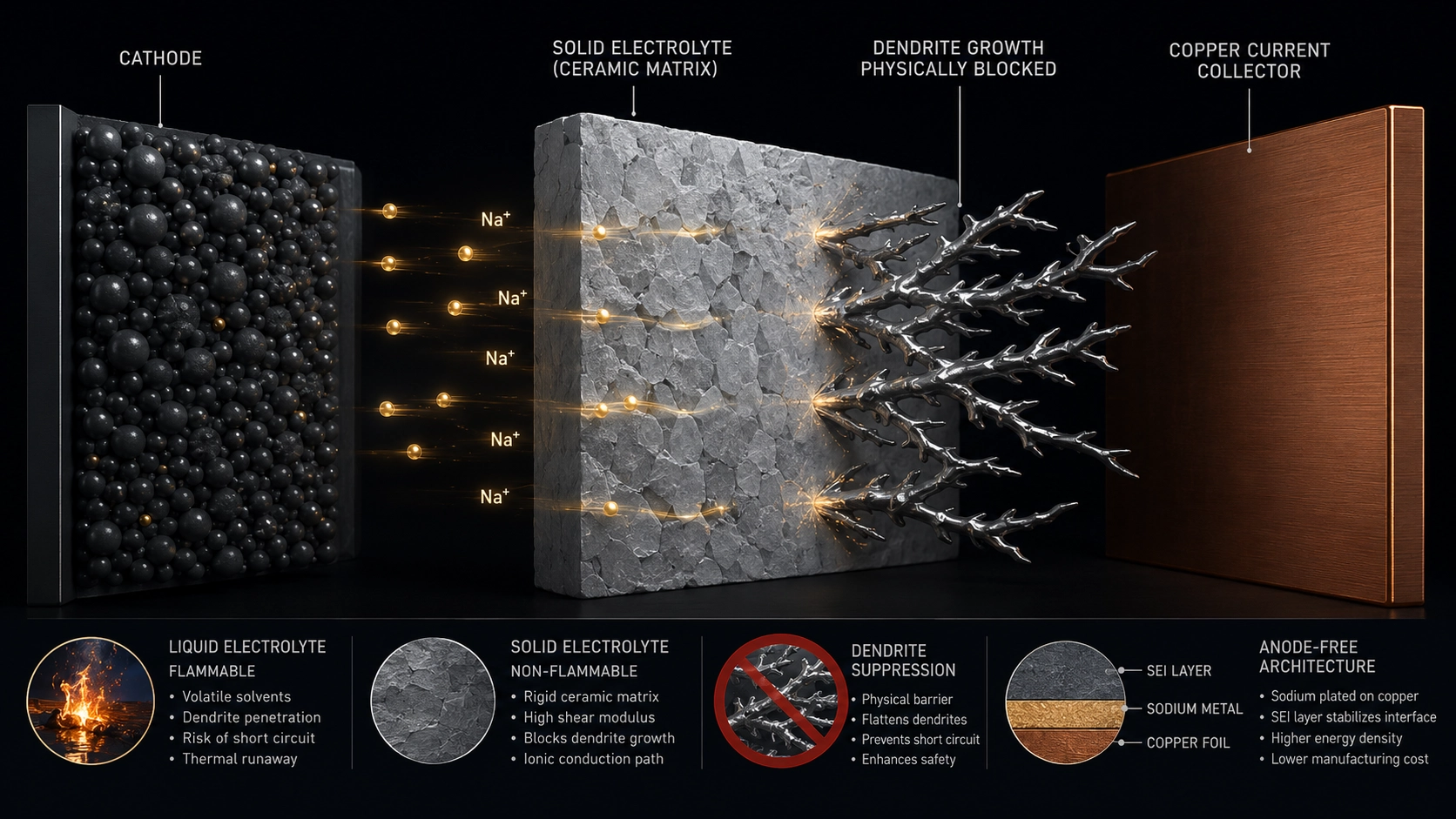
- Concept: Liquid Electrolyte Flammability: Traditional batteries use volatile liquid solvents that can boil and explode under thermal stress.
- Concept: Solid-State Matrix: Engineers replace the liquid with a solid ceramic or polymer layer that safely conducts ions without the fire risk.
- Concept: Dendrite Suppression: The physical rigidity of the solid electrolyte mathematically blocks microscopic metal spikes from short-circuiting the battery.
- Concept: Anode-Free Architecture: Stripping away the graphite anode completely allows factories to print pure, low-cost sodium batteries directly on copper foil.
HOW IT WORKS
All modern batteries operate on a simple principle: moving ions from a cathode to an anode to store energy, and moving them back to release it. In traditional lithium-ion architecture, these ions swim through a liquid electrolyte.
When a liquid battery charges rapidly, metal atoms can build up unevenly on the anode, forming microscopic, needle-like structures called dendrites. If a dendrite grows long enough, it punctures the internal separator, touches the cathode, and causes a catastrophic electrical short circuit that violently ignites the liquid electrolyte.
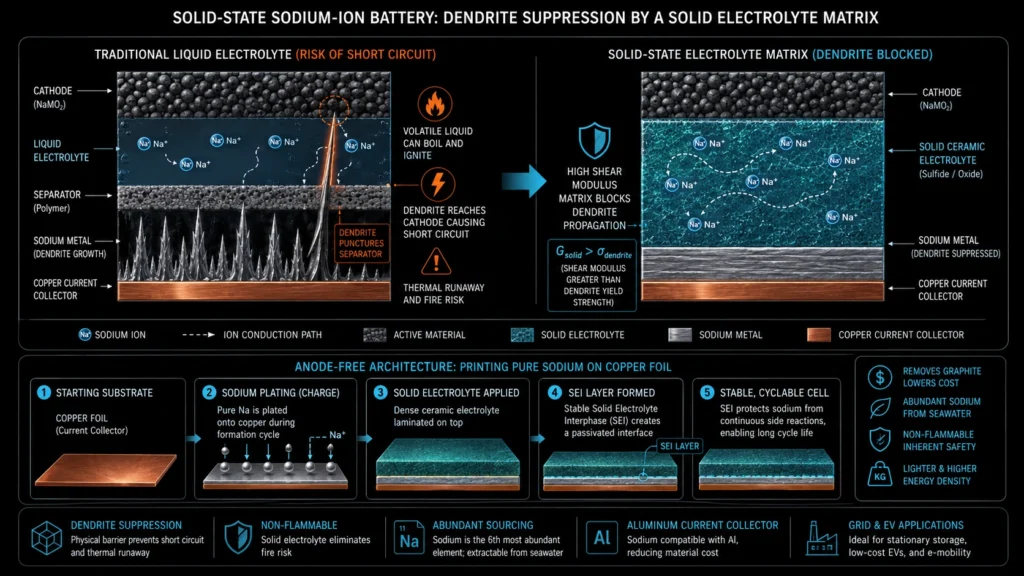
Solid-state batteries solve this by replacing the flammable liquid with a dense, non-combustible solid material, typically a sulfide or oxide-based ceramic glass. This solid matrix allows the positively charged sodium ions to pass through, but its shear modulus—its physical rigidity—is mathematically higher than the structural yield strength of the growing metal dendrites.
Because the solid electrolyte is physically harder than the metal spikes, it acts as an impenetrable physical wall. When a sodium dendrite attempts to grow, it hits the ceramic matrix and flattens out harmlessly, permanently eliminating the risk of an internal short circuit.
This physical suppression allows engineers to execute a radical manufacturing shift: the anode-free design. Instead of using expensive, heavy graphite to absorb the ions, manufacturers simply plate pure sodium metal directly onto a thin sheet of copper foil during the charging cycle. The solid electrolyte interface (SEI) that forms between the pure sodium and the ceramic matrix chemically stabilizes this highly reactive boundary, preventing the battery from degrading over thousands of charge cycles.
WHY IT MATTERS NOW
The entire global electrification mandate—from electric vehicles to hyperscale grid storage—is fundamentally held hostage by the geological distribution of lithium. The supply chain for battery-grade lithium carbonate is highly concentrated, chemically intensive to refine, and subject to extreme geopolitical price volatility.
Sodium-ion solid-state technology breaks this lithium monopoly completely. Sodium is the sixth most abundant element in the Earth’s crust; it can be extracted cheaply and indefinitely from global ocean seawater. By pairing abundant sodium with a non-flammable solid-state architecture, battery manufacturers remove both the material scarcity limit and the catastrophic fire risk of legacy lithium systems.
For the automotive sector, solid-state sodium acts as the ultimate cost-reduction mechanism. While lithium-ion dominates high-performance, long-range vehicles, sodium solid-state batteries are significantly cheaper to manufacture. Because sodium does not alloy with aluminum at low voltages, factories can replace heavy, expensive copper current collectors with cheap aluminum foil, drastically reducing the baseline material cost of the battery cell.
Corporate giants like CATL are aggressively scaling this exact chemistry to capture the entry-level electric vehicle and stationary grid storage markets. A utility company deploying a massive battery farm to store excess solar power does not care about the physical weight of the battery; they care exclusively about the Levelized Cost of Storage (LCOS) and absolute fire safety. Solid-state sodium mathematically optimizes both of these variables simultaneously.
WHAT MOST PEOPLE MISS
Financial analysts assume that transitioning from liquid lithium to solid-state sodium simply requires pouring a different chemical into the same manufacturing equipment. They entirely miss the brutal capital expenditure required to re-engineer the physical assembly line.
Solid-state sulfide electrolytes are highly reactive with ambient moisture. If the solid matrix is exposed to normal factory air for even a fraction of a second, it chemically reacts with the humidity to generate lethal hydrogen sulfide gas. Manufacturing these batteries requires specialized, hyper-dry cleanrooms (dry rooms) operating at extreme negative dew points, fundamentally altering the architectural requirements and upfront construction costs of next-generation gigafactories. The companies that master this anhydrous manufacturing environment will control the entire future supply curve of post-lithium energy storage.
THE TRAJECTORY
Next 12–36 Months: Global battery manufacturers will launch commercial, first-generation liquid sodium-ion cells for low-speed electric vehicles and e-bikes, validating the global supply chain for sodium cathode precursors and aluminum current collectors.
Next Five Years: Pilot production lines will successfully integrate solid polymer and ceramic electrolytes into the sodium architecture. These semi-solid hybrid batteries will eliminate the graphite anode completely, printing pure sodium metal directly during the initial formation cycle on the factory floor.
Next Ten Years: The stationary grid storage market will transition almost entirely to solid-state sodium-ion architectures. Massive, fireproof battery installations will be deployed directly within dense urban centers without the need for complex, expensive liquid cooling systems or heavy blast-containment concrete walls.
What Could Go Wrong: Solid electrolytes suffer from high interfacial resistance; the solid ceramic does not naturally maintain perfect physical contact with the expanding and contracting sodium metal during charge cycles. If the solid matrix develops microscopic physical gaps, the electrical resistance will spike, permanently killing the battery’s ability to hold a charge after only a few hundred cycles.
Most Likely Outcome: Solid-state sodium-ion batteries will permanently bifurcate the global energy storage market. Lithium will remain the premium, lightweight chemistry for aviation and high-end automotive applications, while solid-state sodium will become the dominant, hyper-cheap backbone for global industrial electrification and utility-scale renewable grid stabilization.
KEY TERMS
- Solid-State Battery: A battery architecture that replaces liquid chemical solvents with a rigid, non-flammable ceramic or polymer material to safely conduct ions.
- Dendrite: Microscopic, needle-like metallic structures that grow inside a battery during charging, capable of puncturing internal layers and causing catastrophic short circuits.
- Solid Electrolyte Interphase (SEI): A microscopic chemical layer that forms naturally at the boundary between the battery’s active materials and the electrolyte, dictating the long-term stability of the cell.
- Anode-Free Architecture: A battery design that completely removes the heavy graphite structure, instead plating pure metal directly onto a current collector to maximize energy density and reduce cost.
- Shear Modulus: A mathematical measurement of a material’s physical rigidity and resistance to structural deformation under stress.
SOURCES
- Nature Energy — Solid-State Sodium Batteries: Materials, Design, and Interfacial Dynamics
- Argonne National Laboratory — Dendrite Suppression Mechanisms in Solid Electrolyte Architectures
- Journal of the Electrochemical Society — Anode-Free Sodium Metal Batteries and Aluminum Current Collector Economics
- CATL (Contemporary Amperex Technology Co. Limited) — Sodium-Ion Commercialization and Next-Generation Cell Architecture