Advertisement
)

AT A GLANCE
- Concept: Salt Dome: Massive, naturally occurring underground pillars of solid salt that are perfectly waterproof and chemically stable.
- Concept: Solution Mining: Dissolving underground salt with fresh water to carve out giant, hollow caverns for oil storage.
- Concept: Drawdown: The mechanical process of pumping water into the caverns to force the oil up to the surface.
- Concept: IEA Mandate: The international treaty requiring member nations to hold at least 90 days of emergency oil imports in reserve.
IN SIMPLE WORDS
If a war or a massive hurricane suddenly shuts down the global oil supply, the modern economy would freeze in days. Trucks would stop delivering food, and airplanes would be grounded.
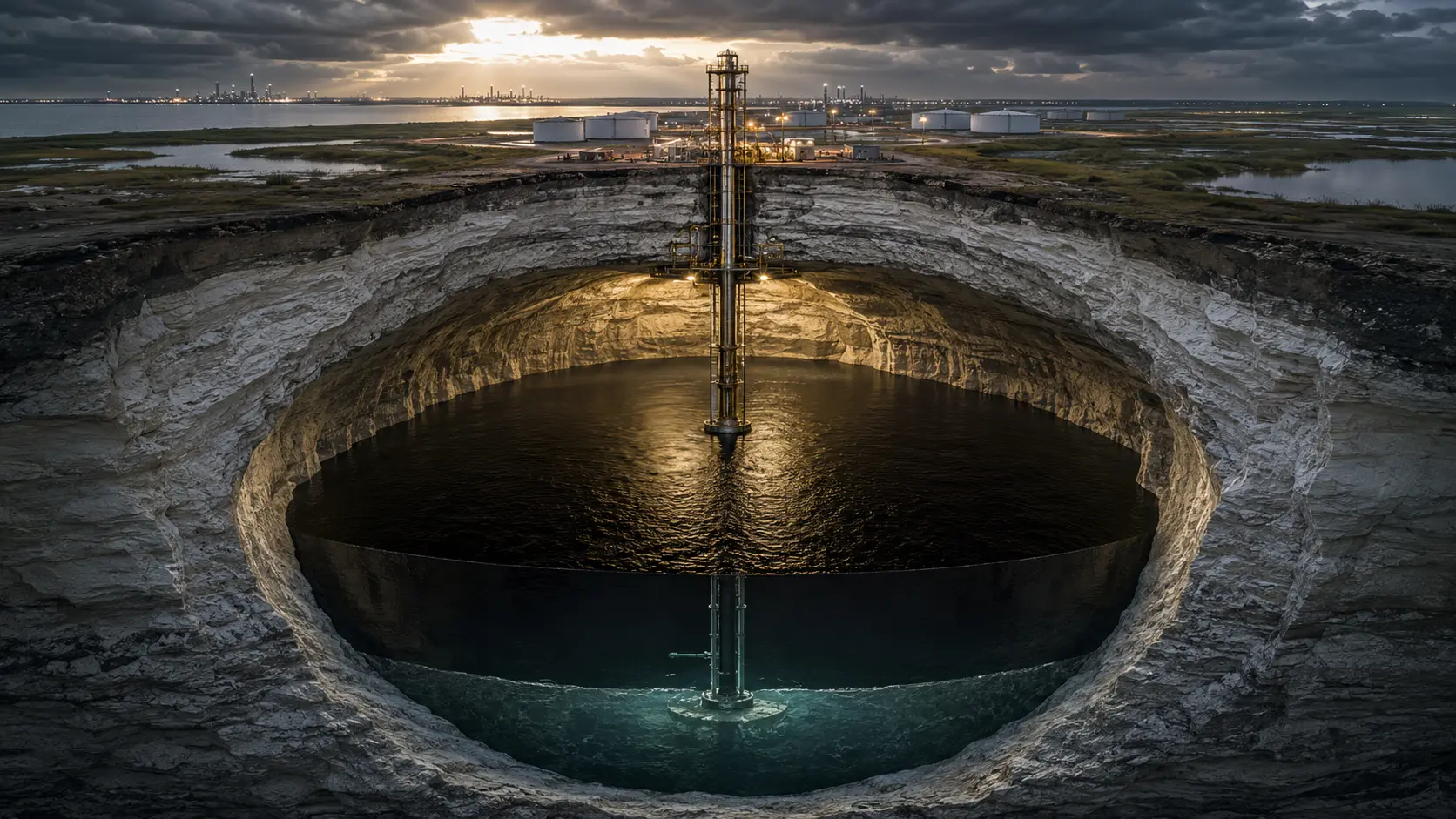
To prevent this, the United States built the ultimate backup generator. Hidden thousands of feet beneath the swamps of Texas and Louisiana are giant, hollow caves carved out of solid salt. These caves are so large you could fit the Empire State Building inside them. Together, they hold hundreds of millions of barrels of crude oil.
When global oil prices skyrocket, the President can order a “drawdown.” Engineers pump water down into the caves, which physically pushes the oil up to the surface and into national pipelines. This sudden flood of backup oil instantly lowers the price of gasoline for consumers and neutralizes the power of hostile nations trying to hold the world hostage through energy blockades.
HOW IT WORKS
The Strategic Petroleum Reserve (SPR) is a triumph of geotechnical engineering. It does not store oil in surface-level steel tanks, which are vulnerable to rust, lightning strikes, and sabotage. Instead, the Department of Energy utilizes natural geological formations called salt domes.
These domes are massive subterranean pillars of halite (rock salt) that pushed upward through sedimentary layers millions of years ago. To create a storage cavern, engineers use a process called solution mining. They drill a well into the salt dome and pump fresh water down the pipe. The water dissolves the salt, and the resulting heavy brine is pumped back to the surface. By carefully controlling the flow of water, engineers carve out a perfectly cylindrical, hollow cavern capable of holding 10 million barrels of crude oil.
Because oil and water do not mix, and because oil is lighter than water, the crude oil floats on top of any residual brine at the bottom of the cavern. Crucially, the rock salt is totally impermeable. It does not react chemically with the crude oil, and it self-heals any microscopic fractures through tectonic pressure, ensuring the oil never leaks into the surrounding groundwater.
When the President authorizes a drawdown, the extraction mechanics rely purely on hydraulic displacement. Operators do not use mechanical pumps to pull the oil up. Instead, they pump heavy brine down to the bottom of the cavern. Because the cavern is a sealed pressure vessel, injecting fluid at the bottom forces the lighter crude oil at the top up through the wellhead and directly into the commercial pipeline network.
The SPR can draw down at a maximum rate of 4.4 million barrels per day. The network is physically hardwired into the major commercial refineries along the Gulf Coast, allowing the government to inject emergency crude into the domestic supply chain within 13 days of a presidential order.
REAL WORLD EXAMPLE
In 2022, following the Russian invasion of Ukraine, global oil markets panicked. Russia is one of the world’s largest oil exporters, and the sudden threat of global sanctions caused crude prices to spike above $120 a barrel. This triggered massive inflation across the United States.
In response, the Biden administration authorized the largest drawdown in the history of the SPR, releasing 180 million barrels over six months. This massive influx of artificial supply immediately broke the speculative panic in the commodities market. By flooding the market with SPR crude, the US government artificially lowered global prices, depriving the Russian war machine of excess oil revenue while shielding American consumers from paying $6 a gallon for gasoline.
WHY IT MATTERS NOW
The SPR was originally created in 1975 following the Arab Oil Embargo, when the US was highly dependent on Middle Eastern imports. Today, thanks to the shale fracking revolution, the United States is the largest oil producer in the world.
This domestic abundance fundamentally shifts the strategic purpose of the SPR. It is no longer just an emergency survival stockpile; it is a proactive weapon of macroeconomic statecraft.
When the OPEC+ cartel (led by Saudi Arabia and Russia) intentionally cuts oil production to artificially raise prices and hurt Western economies, the US President can counter-strike by releasing SPR barrels. This creates a high-stakes geopolitical poker game. The SPR acts as the ultimate price ceiling on global crude, allowing Washington to mathematically neutralize adversarial energy cartels without firing a shot.
However, the SPR is a finite weapon. Because it was drained aggressively in 2022, the reserve fell to its lowest levels since the 1980s. Refilling the salt caverns is a slow, expensive process. If a second, simultaneous global crisis were to occur—such as a war in the Middle East closing the Strait of Hormuz—the United States currently has significantly less macroeconomic ammunition to absorb the shock.
COMMON MISCONCEPTIONS
- “The oil in the SPR goes bad over time.” Crude oil does not expire or degrade like refined gasoline. Sitting in a dark, chemically inert salt cavern, raw crude oil remains perfectly viable for decades.
- “The President sets the price of gas directly.” The President has no direct control over retail gasoline prices. The President can only alter the global supply of raw crude oil by releasing SPR barrels, which eventually trickles down to lower gas prices at the pump.
- “We use taxpayer money to buy the oil.” Currently, the Department of Energy funds the SPR’s maintenance and oil purchases by selling older batches of crude oil when market prices are exceptionally high, operating the reserve largely as a self-funding commodity trading desk.
WHAT MOST PEOPLE MISS
Political commentators focus heavily on the volume of oil released, but they completely ignore the physical degradation of the caverns.
Every time a drawdown occurs, fresh water or unsaturated brine must be pumped into the cavern to push the oil out. This fresh water dissolves a thin layer of salt from the cavern walls before it becomes fully saturated. Therefore, every single drawdown physically expands the size of the cavern. If a cavern is drawn down too many times, the structural integrity of the salt pillar weakens, risking a catastrophic subterranean collapse that would permanently destroy the storage capacity. The SPR is not infinitely reusable; its physical geology limits its lifespan.
THE ECONOMIC AND STRATEGIC IMPACT
The primary financial losers of an SPR release are hedge funds and commodity speculators heavily leveraged in long oil futures. An unexpected, massive release of government crude instantly crushes the spot price of oil, liquidating billions of dollars in speculative positions overnight.
For domestic oil producers in Texas and North Dakota, the SPR operates as a complex double-edged sword. When the government releases oil, it lowers prices, hurting the profit margins of private drillers. However, when the government commits to refilling the SPR—promising to buy millions of barrels at a fixed floor price, like $79 a barrel—it provides private drillers with a guaranteed future buyer, incentivizing them to invest billions in new drilling rigs.
Globally, China has studied the US SPR aggressively and is currently executing a massive, secretive buildout of its own strategic reserves. Beijing is filling massive underground caverns and surface tanks with discounted Russian and Iranian crude. If China achieves total energy independence through its own SPR, it removes the United States Navy’s primary strategic leverage—the ability to blockade Chinese oil imports during a conflict over Taiwan.
THE TRAJECTORY
Next 12–36 Months: The Department of Energy will execute a slow, highly calculated refill strategy. They will utilize advanced algorithmic trading to purchase domestic crude only during brief, unexpected dips in the global commodity market, acting exactly like a massive corporate hedge fund to protect taxpayer capital.
Next Five Years: The geological retirement of legacy caverns. The DOE will permanently decommission several of the oldest salt caverns that have been drawn down too many times, capping them with cement to prevent structural collapse. This will permanently reduce the maximum theoretical capacity of the SPR from 714 million barrels to closer to 600 million.
Next Ten Years: The pivot toward refined product reserves. As electric vehicles reduce the domestic demand for raw crude oil, the government will shift its strategic focus. It will build localized reserves of refined diesel and aviation fuel to guarantee emergency supply lines for military operations and disaster relief, rather than purely macroeconomic price manipulation.
What Could Go Wrong: A catastrophic hurricane strike on the Gulf Coast. The entire SPR infrastructure—the pumps, the wellheads, and the connecting pipelines—is heavily concentrated in the direct path of major Atlantic hurricanes. If a Category 5 storm destroys the surface facilities, the United States will be entirely locked out of its own emergency oil supply, regardless of how much oil sits safely underground.
Most Likely Outcome: The Strategic Petroleum Reserve will remain the ultimate arbiter of global oil prices. Even as the world transitions to renewable energy, the lingering reliance on heavy transportation fuels ensures that the sheer volume of the SPR will dictate geopolitical power dynamics for the next three decades.
KEY TERMS
- Strategic Petroleum Reserve (SPR): The world’s largest emergency supply of crude oil, owned by the US government and stored in underground salt caverns along the Gulf Coast.
- Salt Dome: A massive, natural column of solid salt deep underground that is perfectly sealed and ideal for carving out hollow storage tanks.
- Solution Mining: The process of pumping fresh water into a salt dome to dissolve the rock, creating a hollow, structural cavern.
- Drawdown: The act of releasing oil from the SPR into the commercial market to stabilize prices or combat a supply shortage.
- Hydraulic Displacement: Pumping heavy saltwater into the bottom of a cavern to force the lighter crude oil floating on top to the surface.
- Curtailment: When global oil producers intentionally reduce their drilling output to artificially raise the global price of oil.
BEGINNER FAQ
What is the Strategic Petroleum Reserve? It is a massive stockpile of emergency crude oil owned by the United States government, hidden underground in Texas and Louisiana.
Why does it exist? It was created in the 1970s so that if foreign countries ever cut off America’s oil supply again, the US would have enough backup fuel to survive without the economy collapsing.
How do they store the oil? They do not use metal tanks. They pump water into massive underground pillars of solid salt to dissolve giant caves. They pump the oil into these caves, where it is protected from weather, fire, and attacks.
How much oil is down there? When totally full, the SPR can hold over 700 million barrels of crude oil. That is enough to replace all the oil the US imports for many months.
Who decides when to use it? Only the President of the United States has the legal authority to order a massive emergency release of the oil.
How does releasing oil lower gas prices? Gasoline is made from crude oil. If the price of crude oil is high, gas is expensive. When the President floods the market with millions of backup barrels, the sudden massive supply forces the price of crude oil to drop.
Do we have to buy the oil back? Yes. When the crisis is over, the government eventually has to buy oil from the private market to refill the caves so the reserve is ready for the next emergency.
Can the caves break? Yes. Every time they pump water in to get the oil out, the water dissolves a little more salt, making the cave bigger. If they empty and refill a cave too many times, the walls get too thin and the cave can collapse.
SOURCES
- Department of Energy (DOE) — Strategic Petroleum Reserve Annual Report and Infrastructure Capabilities
- International Energy Agency (IEA) — Global Emergency Response Systems and Oil Stockholding
- Center for Strategic and International Studies (CSIS) — The Geopolitics of the Strategic Petroleum Reserve Release
- Society of Petroleum Engineers (SPE) — Geomechanics and Solution Mining of Salt Caverns for Hydrocarbon Storage