Advertisement
)

AT A GLANCE
- Concept: Diazotrophic Endophytes: Genetically altered bacteria that inhabit crop root tissues to manufacture essential ammonia.
- Concept: Synthetic Autoregulatory Override: Modifying genetic circuits to prevent microbes from shutting down nitrogen fixation.
- Concept: Cereal Non-Legumes: Rewiring corn and wheat root interactions to mimic natural legume symbiosis.
- Concept: Geopolitical Decoupling: Ending agricultural reliance on industrial, natural-gas-consuming ammonia manufacturing facilities.
HOW IT WORKS
Cereal crops like corn, wheat, and rice require massive amounts of nitrogen to build proteins and grow leaves. Unlike legumes, these grass crops lack the evolutionary machinery to form symbiotic relationships with natural nitrogen-fixing bacteria.
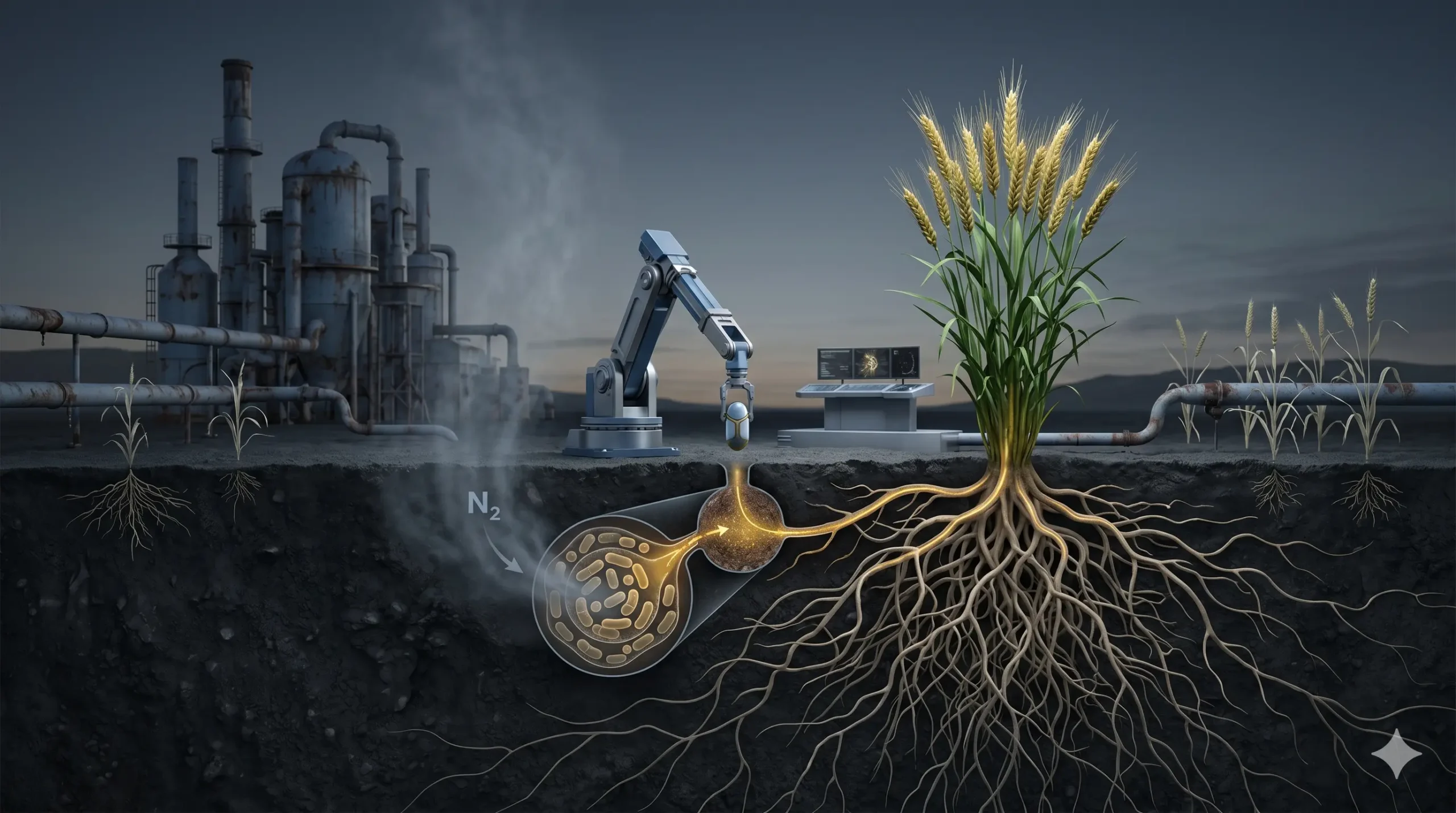
Industrial agriculture bridges this gap by dumping millions of tons of synthetic ammonia fertilizer onto soils every year. This brute-force chemical method bypasses natural biology entirely, consuming vast quantities of fossil fuels.
The synthetic rhizobiome vector replaces this chemical loop with engineered biology. Scientists isolate diazotrophic endophytes—bacteria that naturally live inside plant root tissues without causing disease.
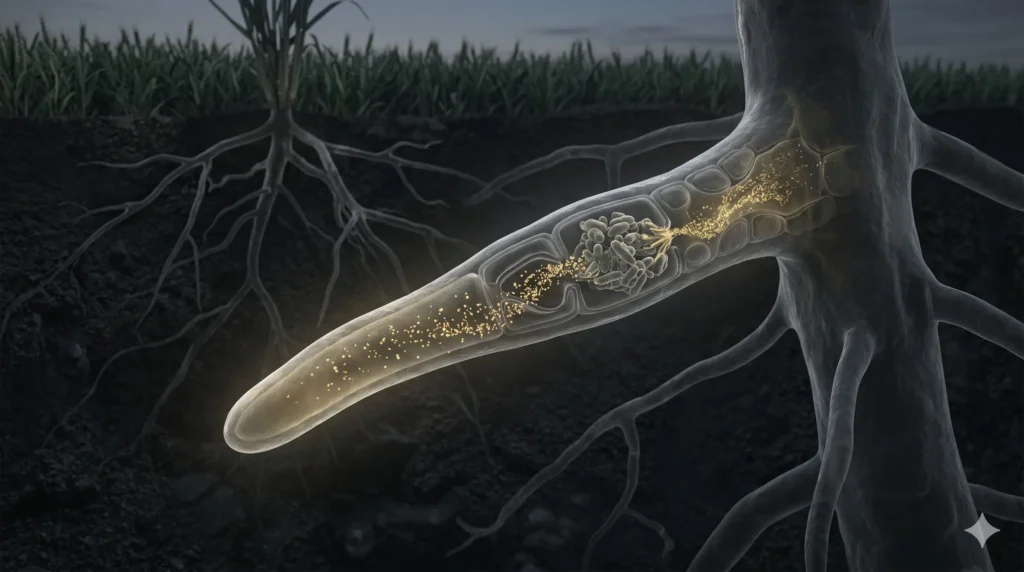
Natural bacteria possess genetic circuits called nif gene clusters that turn off nitrogen fixation the moment they detect any ambient nitrogen in the soil. Synthetic biologists use precise gene edits to permanently delete these feedback loops, forcing the bacteria to continuously produce ammonia.
These engineered microbes adhere to the seed coat before planting. As the roots expand, the bacteria colonize the intracellular spaces of the root system, feeding on plant sugars and pumping a steady stream of bio-synthesized nitrogen directly into the crop’s vascular network.
WHY IT MATTERS NOW
The global food supply rests on a highly volatile, energy-intensive chemical foundation. The production of synthetic fertilizer relies completely on the Haber-Bosch process, which consumes roughly two percent of global energy and three to five percent of worldwide natural gas production.
This reliance subjects global agricultural operating expenditures to the volatility of natural gas markets. When geopolitical tensions freeze gas pipelines, fertilizer prices spike instantly, causing immediate food security crises across developing nations.
Companies like Pivot Bio and Ginkgo Bioworks are pulling massive venture capital into biological alternatives as a hedge against this energy-food nexus. Deploying synthetic bio-inoculants allows farmers to stabilize their input costs by swapping fluctuating chemical commodities for fixed-price biological coatings.
Regulatory pressure from organizations like the USDA and environmental protection agencies accelerates this adoption. Excess chemical fertilizer runs off fields during heavy rains, poisoning freshwater aquifers and creating massive marine dead zones that cost coastal economies billions in lost revenue annually.
WHAT MOST PEOPLE MISS
Most environmental commentators look at bio-fertilizers and assume the primary hurdle is simple microbial survival in open dirt. They treat soil inoculation as a generic organic farming supplement.
The true engineering battle centers on antigen escape and sequence-specific chemical signaling. If the engineered bacteria do not actively read the specific root exudates of a specific hybrid corn variant, they fail to colonize the host. Synthetic biologists must design custom genetic keys for every major commercial seed line, transforming generic microbes into highly proprietary, software-like agricultural inputs.
THE TRAJECTORY
Next 12–36 Months: Agricultural tech firms will roll out multi-strain biological coatings that combine nitrogen fixation with phosphate solubilization. Early field deployments will focus on the North American corn belt, establishing real-world yield parity data against standard synthetic baselines.
Next Five Years: Synthetic biology platforms will deploy gene-drive systems to ensure the engineered trait persists through wild soil microbial generations. This development will trigger intense regulatory review from international biosecurity agencies regarding the uncontained spread of modified genetic circuits.
Next Ten Years: Engineered nitrogen fixation will expand to target staple crops across sub-Saharan Africa and Southeast Asia, breaking the geopolitical leverage of fertilizer-exporting nations. Global ammonia infrastructure will downsize, shifting permanently toward specialized industrial applications rather than mass agriculture.
What Could Go Wrong: Microscopic mutations within the soil matrix could cause the engineered endophytes to view the plant host as a competitor rather than a partner. If a mutation flips the metabolic circuit, the bacteria will consume plant sugars without delivering nitrogen, actively suppressing crop yields across entire geographic zones.
Most Likely Outcome: Synthetic bio-inoculants will capture a dominant share of the global agricultural input market, operating as an integrated component of premium commercial seed packages. Chemical fertilizers will transition into a secondary, emergency top-dressing tool used only during extreme weather anomalies.
KEY TERMS
- Diazotrophic Endophytes: Microscopic organisms capable of converting atmospheric nitrogen gas into bio-available ammonia while living inside plant tissues.
- nif Gene Cluster: A specific group of genes found in microbes that codes for the enzymes responsible for fixing atmospheric nitrogen.
- Root Exudates: Chemical compounds and sugars secreted by plant roots into the surrounding soil to communicate with and recruit specific microbes.
- Biological Inoculant: A formulation of beneficial microorganisms applied to seeds or soil to improve plant health and nutrient uptake.
- Haber-Bosch Process: An industrial chemical reaction that combines atmospheric nitrogen with hydrogen gas under high pressure to manufacture synthetic ammonia.
SOURCES
- United States Department of Agriculture (USDA) — Biotechnology and Agricultural Resource Optimization Reports
- Proceedings of the National Academy of Sciences (PNAS) — Engineering Nitrogen Fixation in Non-Legume Cereal Crops
- Ginkgo Bioworks Technical Repository — Synthetic Rhizobiome Circuit Design for Cereal Endophytes
- Pivot Bio Performance Assessments — Multi-Year Field Trials of Microbe-Driven Nitrogen Delivery