
AT A GLANCE
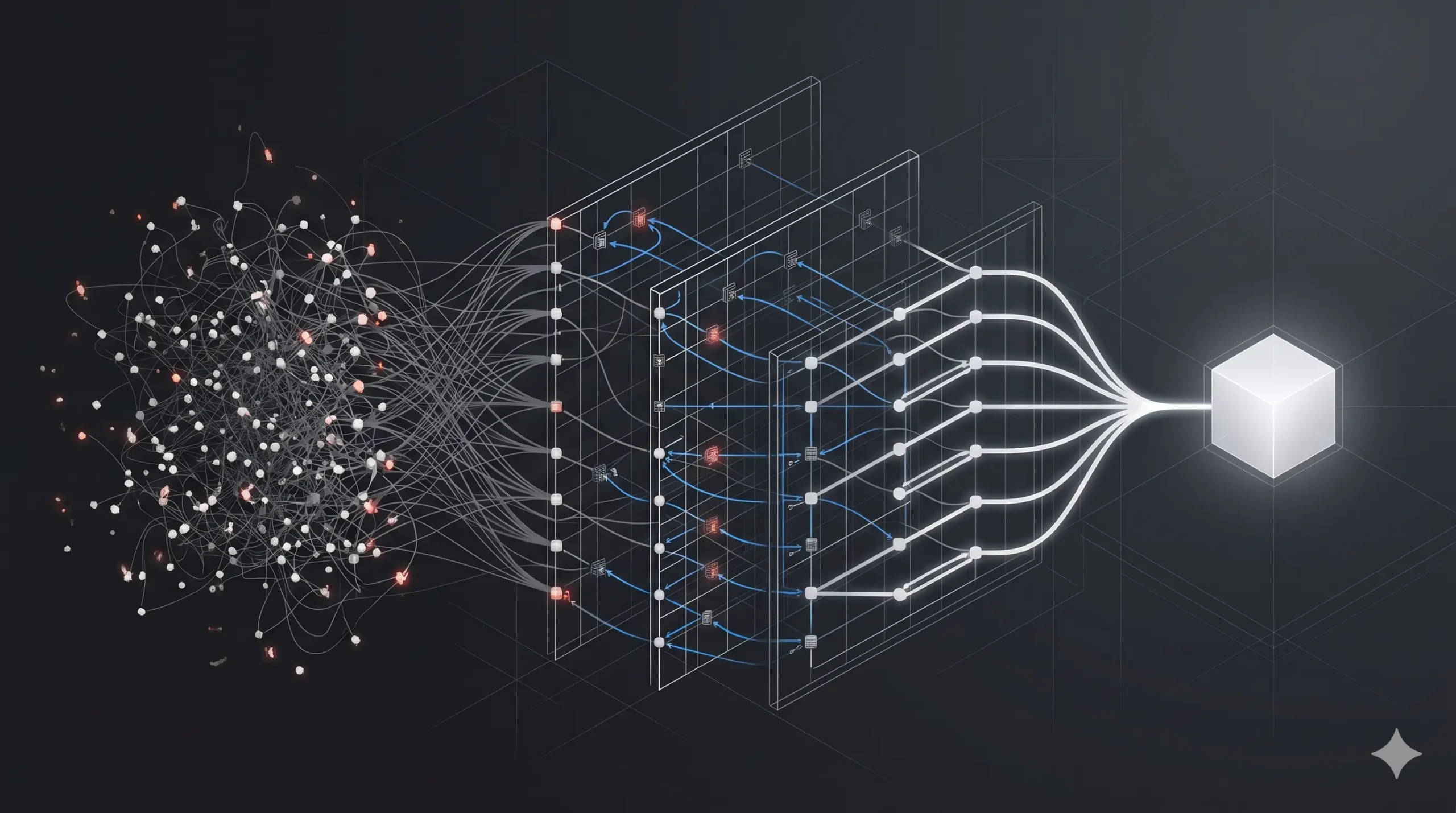
- Concept: Physical Qubits: The raw, highly unstable hardware components that process quantum information.
- Concept: Logical Qubits: A stable, software-defined entity created by bundling thousands of physical qubits together.
- Concept: Syndrome Measurement: Ancilla qubits constantly check neighboring data qubits for errors without destroying their state.
- Concept: Decoding Loops: Classical algorithms calculate and apply error corrections in fractions of a microsecond.
HOW IT WORKS
Quantum computers process information using subatomic properties. These states are incredibly fragile. A slight change in temperature, stray microwave radiation, or even cosmic rays will cause a qubit to flip its state or lose its phase entirely.
Traditional computers fix errors by keeping backup copies of data. Quantum physics strictly forbids copying an unknown quantum state. Engineers cannot simply back up a qubit to check if an error occurred.
The surface code solves this by spreading a single piece of quantum information across a massive two-dimensional grid of physical qubits. Engineers divide this grid into two categories: data qubits that hold the actual information, and measure qubits that act as supervisors.
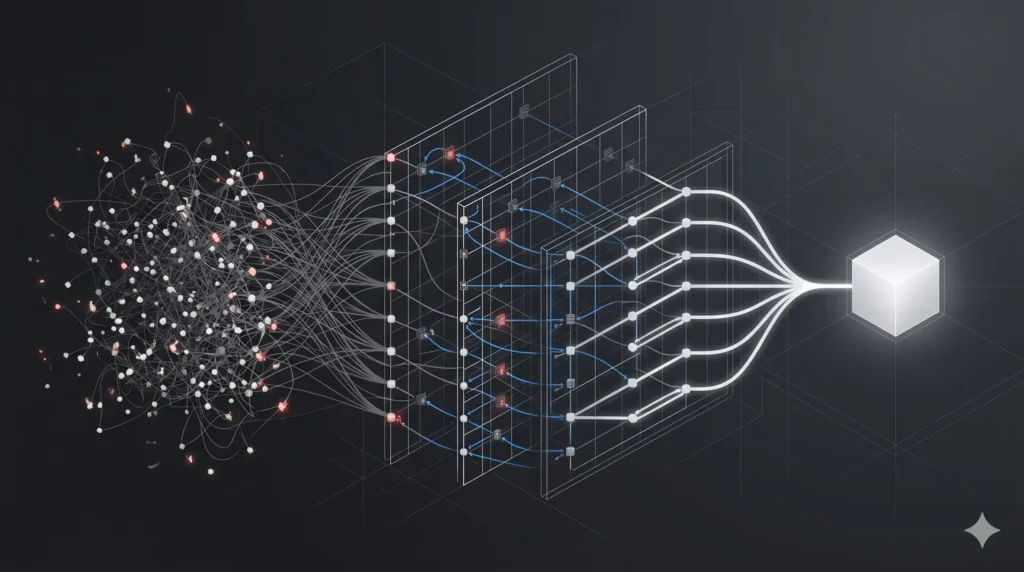
The system executes continuous syndrome measurement cycles. The measure qubits, often called ancillas, briefly interact with their neighboring data qubits to detect parity changes. They extract this error data without ever observing the actual hidden quantum information, preserving the fragile state.
This measurement generates a continuous flood of error data called a syndrome. A classical supercomputer sits adjacent to the quantum processor, running high-speed decoding algorithms to interpret this syndrome map.
The classical algorithm calculates exactly which physical qubit failed. It then applies a software correction to the system before the next computational step begins, isolating the error before it can corrupt the entire grid.
Surface Code Breakeven Simulator
Observe how the physical error rate dictates whether scaling physical hardware produces stable logical qubits or mathematically collapses the system.
WHY IT MATTERS NOW
Financial markets and national security agencies track quantum computing due to its theoretical ability to break standard RSA encryption. Running Shor's algorithm to crack modern cryptography requires millions of consecutive, error-free operations. Current raw quantum hardware fails after just a few dozen steps.
The industry currently operates in the Noisy Intermediate-Scale Quantum era. Machines feature hundreds of physical qubits, but they remain too unstable for complex commercial applications. Useful quantum computing requires fault tolerance.
The surface code dictates the actual economics of this fault tolerance. Because current hardware is so noisy, bundling a single stable logical qubit requires up to ten thousand physical qubits. A machine with one thousand physical qubits effectively yields zero computational value if it cannot form a single logical unit.
This mathematical reality shifts the bottleneck from quantum physics to classical engineering. IBM and Google Quantum AI currently spend massive capital not just on supercooling chips, but on building specialized classical microprocessors capable of running syndrome decoding loops in under a microsecond.
WHAT MOST PEOPLE MISS
Mainstream technology reporting fixates entirely on raw physical qubit counts. Headlines celebrate when a company announces a new thousand-qubit processor. They ignore the underlying hardware error rates entirely.
Adding more physical qubits actually makes the machine worse if the error rate remains too high. The hidden operational threshold is the surface code breakeven point. Until the physical hardware noise drops below a specific mathematical limit, adding more physical qubits simply generates errors faster than the classical decoding algorithm can track them.
THE TRAJECTORY
Next 12–36 Months: Hardware developers will demonstrate persistent logical qubits that mathematically outlive their underlying physical components. They will chain together two or three logical qubits to execute basic error-corrected algorithms, proving the physical viability of topological codes.
Next Five Years: Foundries will physically integrate the classical decoding logic directly into the cryogenic control electronics. This reduces the latency of sending error syndromes back to room-temperature servers, allowing the system to scale beyond a few dozen logical qubits without massive signal delay.
Next Ten Years: The ratio of physical to logical qubits will compress dramatically. Advanced error-correcting architectures, such as low-density parity-check codes, will replace the standard two-dimensional surface code. This allows engineers to build a single logical qubit using hundreds, rather than thousands, of physical components.
What Could Go Wrong: Cosmic radiation causes correlated errors, striking multiple physical qubits simultaneously. The surface code assumes errors happen independently. If a single radiation strike knocks out an entire localized grid, the syndrome decoder will fail to reconstruct the logical state, crashing the calculation entirely.
Most Likely Outcome: Quantum computing will evolve into a heavily hybrid architecture. Classical supercomputers will handle the massive computational load of continuous error decoding, serving as the inescapable physical infrastructure that keeps the fragile quantum processor mathematically stable.
KEY TERMS
- Surface Code: A topological error correction method that arranges physical qubits in a two-dimensional grid to collectively protect a single logical state.
- Logical Qubit: A stable unit of quantum information created by networking multiple physical qubits together with continuous error correction software.
- Syndrome Measurement: The process of extracting error information from a quantum system without destroying the underlying quantum data.
- Ancilla Qubit: A specialized physical qubit used strictly for measuring errors and interacting with data qubits, rather than storing information.
- Fault Tolerance: The architectural ability of a quantum computer to continue operating accurately even when individual physical components fail.
SOURCES
- Google Quantum AI — Suppressing quantum errors by scaling a surface code logical qubit
- National Institute of Standards and Technology (NIST) — Quantum Error Correction and Fault Tolerance
- IBM Quantum — Quantum Error Mitigation and Error Correction
- Physical Review X — Surface codes: Towards practical large-scale quantum computation