
AT A GLANCE
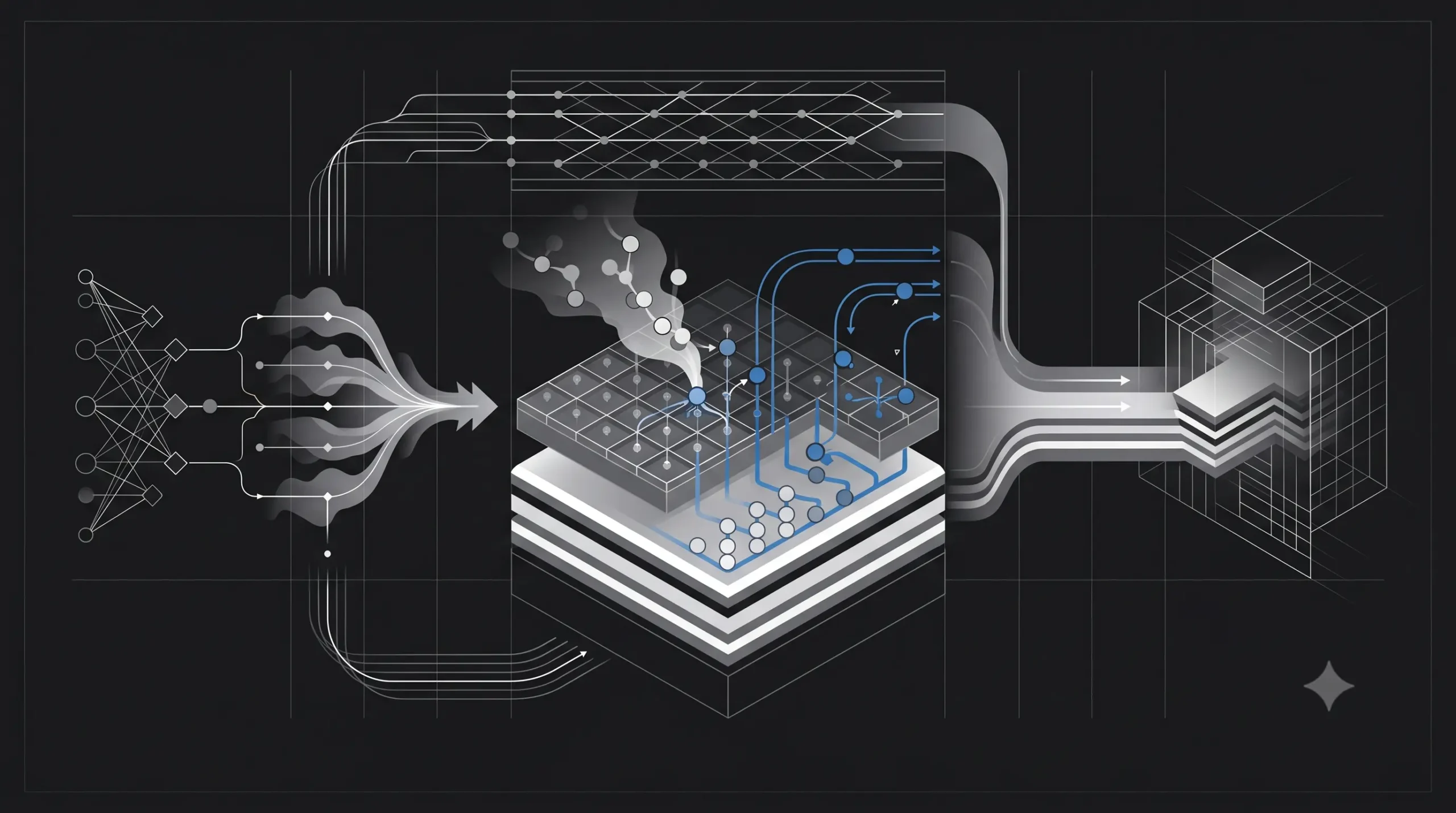
- Concept: Organometallics: Volatile chemical compounds containing metal atoms bound to protective organic carbon ligands.
- Concept: Self-Limiting Reactions: Vapors chemically bond to a surface until exactly one molecular monolayer forms.
- Concept: Step Coverage: ALD chemically coats the deep, vertical trenches of modern 3D transistors perfectly.
- Concept: Supply Concentration: A fraction of chemical foundries globally control these ultra-high purity specialty gases.
HOW IT WORKS
Transistors at the 3nm node no longer sit flat on the silicon. They form complex vertical architectures like gate-all-around structures. Coating these deep trenches with insulation requires absolute atomic precision.
Traditional deposition techniques spray material like paint. This approach clogs the top of the trench while leaving the bottom entirely empty. Atomic layer deposition (ALD) solves this geometric challenge using chemical vapor physics.
The ALD process relies entirely on organometallic precursors. These highly reactive gases consist of a central metal atom, such as titanium or aluminum, bonded to protective organic carbon ligands.
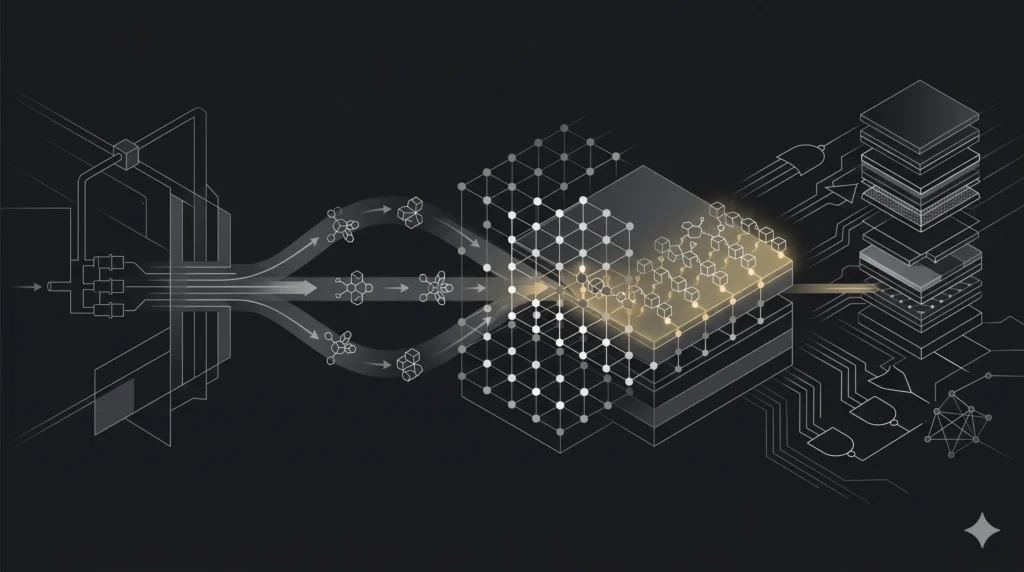
Engineers pump the first precursor gas into the vacuum chamber. The molecules naturally bond to the exposed silicon surface. The organic ligands physically block the precursor molecules from reacting with each other.
Once the vapor completely coats the surface in a layer one atom thick, the chemical reaction physically halts. The system then purges the remaining gas and introduces a second precursor.
This second chemical strips away the organic ligands, leaving behind a perfectly flat, solid layer of pure metal or metal oxide. Foundries repeat this binary cycle thousands of times to build complex semiconductor films one atomic layer at a time.
WHY IT MATTERS NOW
The economics of artificial intelligence rely entirely on the continuation of Moore’s Law. Foundries construct 3nm logic chips using billions of microscopic transistors packed onto a single die.
If the gate dielectric layer inside a single transistor varies by even one atom, the entire chip fails. ALD precursors dictate this physical scaling limit.
Without these specific organometallic molecules, extreme ultraviolet lithography becomes useless. You can draw a 3nm transistor pattern with light, but you cannot physically build the electrical walls of that transistor without self-limiting chemical vapors.
This dynamic creates extreme economic gravity for the chemical manufacturing sector. Foundries purchase billions of dollars of deposition equipment from Applied Materials and Tokyo Electron.
Those massive machines require a continuous feed of highly volatile, ultra-pure precursor gases to function. Foundries use Trimethylaluminum (TMA) as the standard precursor to deposit insulating layers.
Synthesizing TMA requires extreme chemical engineering. It ignites violently upon contact with ambient air. Securing a steady supply of these hyper-pure, highly dangerous chemicals dictates the actual production volume of the global AI hardware market.
WHAT MOST PEOPLE MISS
General tech analysis treats semiconductor manufacturing as a purely mechanical and optical discipline. Analysts focus entirely on the physical machines stamping out the chips. They ignore the severe geopolitical vulnerability of the consumable chemical supply chain.
The true bottleneck is parts-per-trillion purity. Only a handful of specialized chemical companies globally possess the engineering capability to synthesize organometallic precursors without trace metal contamination.
If a single atom of iron contaminates a batch of cobalt precursor, it ruins the electrical conductivity of an entire silicon wafer. Consequently, the global computing backbone relies entirely on the uninterrupted output of a few highly obscure chemical refineries.
THE TRAJECTORY
Next 12–36 Months: Tool manufacturers will aggressively deploy spatial ALD systems. These machines will continuously rotate wafers through different gas zones to accelerate deposition speeds without sacrificing atomic precision.
Next Five Years: Foundries will shift toward exotic precursor molecules. Molybdenum and ruthenium precursors will replace traditional copper to prevent electromigration in ultra-dense sub-2nm interconnects.
Next Ten Years: Area-selective ALD will eliminate the need for several lithography steps. Chemical engineers will design precursors to grow exclusively on metallic surfaces while ignoring adjacent dielectric materials, forcing chips to self-assemble.
What Could Go Wrong: Precursors exhibit extreme chemical instability. Prolonged shipping delays or slight temperature variations during transit can cause the chemicals to decompose inside their steel canisters, instantly crippling regional semiconductor production.
Most Likely Outcome: The ALD precursor market will face intense nationalization. Semiconductor superpowers will subsidize domestic chemical synthesis plants to secure direct, sovereign control over these volatile organometallic vapors.
KEY TERMS
- Atomic Layer Deposition (ALD): A thin-film deposition technique that uses sequential, self-limiting chemical reactions to build materials one atomic layer at a time.
- Organometallic Precursor: A highly volatile chemical compound featuring a metal atom bonded to organic ligands used to deliver raw materials in vapor form.
- Step Coverage: The mathematical measure of how uniformly a deposition process coats the vertical walls and flat bottoms of deep, microscopic trenches.
- Ligand: An organic molecule attached to the central metal atom in a precursor that prevents the metal atoms from reacting with each other prematurely.
- Pyrophoric: A chemical property describing a substance that ignites spontaneously and violently upon exposure to ambient air or moisture.
SOURCES
- Sigma-Aldrich — Solution & Vapor Deposition Precursors
- Harvard University — Overview of ALD Precursors and Reaction Mechanisms
- Applied Materials — Advancing ALD for 3D Device Architectures
- Semiconductor Research Corporation — Organometallic Chemistry for Atomic Layer Deposition