
AT A GLANCE
- Transient Transfection: Engineers temporarily insert synthetic DNA into host cells to produce viral vectors.
- HEK293T Cells: These immortalized human kidney cells act as the biological factories for virus assembly.
- Suspension Bioreactors: Host cells float freely in liquid media to maximize spatial density and yield.
- Single-Use Plastics: Sterile, disposable bioreactor bags eliminate cross-contamination but create severe supply chain dependencies.
HOW IT WORKS (THE MECHANISM)
Gene therapy requires a delivery vehicle. Scientists use lentiviruses to penetrate patient cells. They strip the virus of its ability to replicate and replace its core with a therapeutic gene.
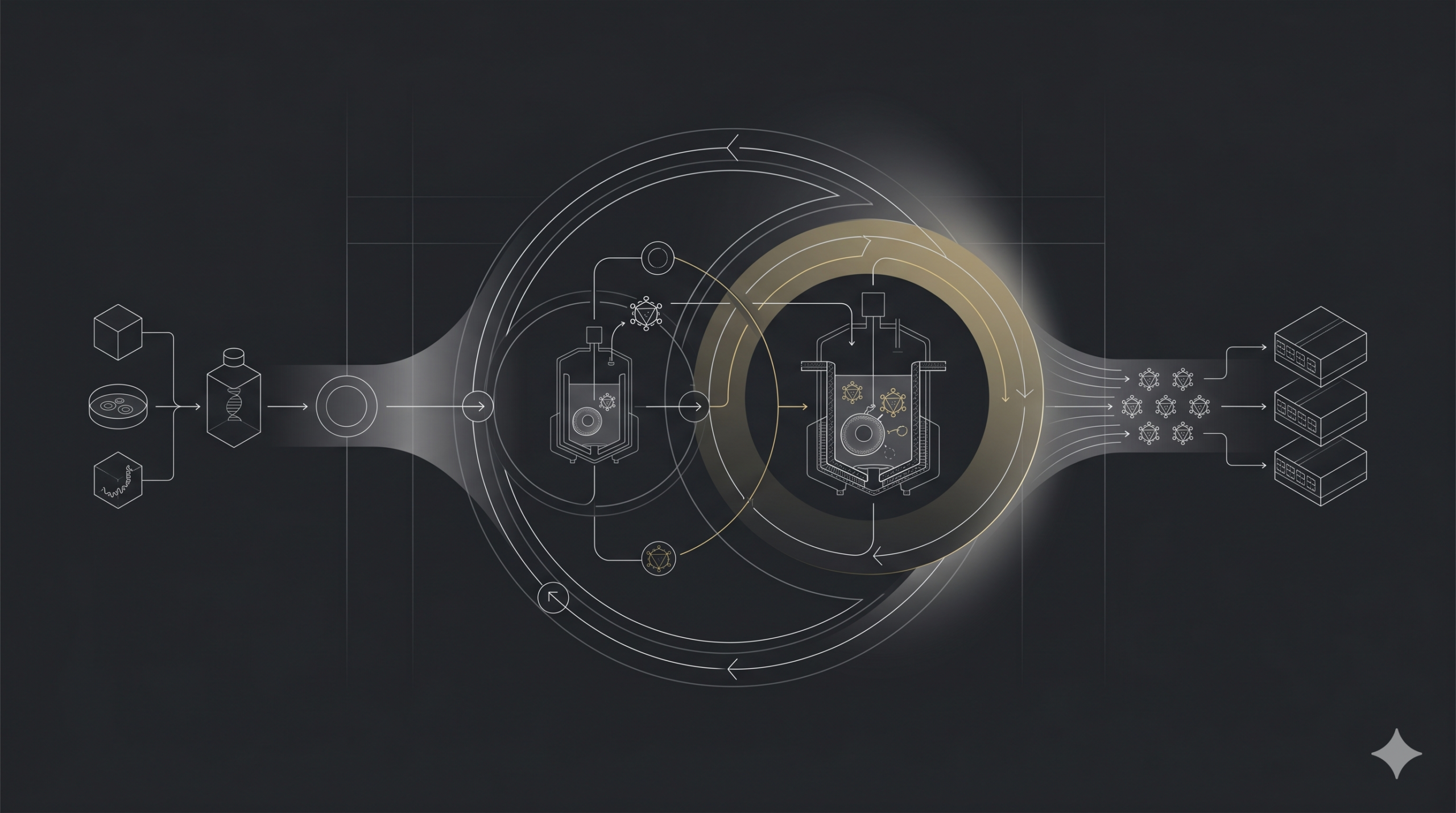
To build these vectors at scale, engineers use transient transfection. They mix four separate circular DNA molecules, called plasmids, with a chemical reagent like polyethylenimine. This mixture forms microscopic complexes.
Engineers pump this mixture into a suspension bioreactor. Inside, billions of host cells float freely in a specialized nutrient broth. The chemical complexes trick the host cells into absorbing the DNA.

Once inside, the host cell misreads the synthetic DNA as its own. Its internal machinery begins printing viral proteins and assembling functional lentiviral vectors. The cells shed these finished vectors into the surrounding liquid, where they await physical harvesting.
WHY IT MATTERS NOW (THE HUMAN IMPACT)
This biological manufacturing loop dictates the commercial viability of modern medicine. Advanced cell therapies cure terminal blood cancers. They rely entirely on this physical process to exist.
However, the math behind the manufacturing currently fails. A single dose of a commercial gene therapy like Zynteglo or Kymriah costs between half a million and nearly three million dollars.
The extreme cost stems directly from the inefficiency of the transfection loop. Typical suspension bioreactors yield extremely low concentrations of functional viruses. It often takes an entire fifty-liter bioreactor run just to produce enough vectors for a single patient dose.
This low yield forces pharmaceutical companies into a raw materials war. They must hoard specialized medical-grade plastics, microfluidic tubing, and custom growth media to maintain production. When a manufacturer experiences a slight delay in sourcing single-use bioreactor bags, patient wait times double.
WHAT MOST PEOPLE MISS
Public markets treat gene therapy companies like software startups, assuming biological code scales infinitely. It does not. The true limit to genetic medicine is not the science, but the industrial plumbing.
You cannot scale vector production by simply building larger vats. Viruses are highly sensitive to physical shear stress. If the mechanical impellers inside a massive bioreactor stir the liquid too fast, the turbulence tears the fragile viral envelopes apart.
The global supply chain relies entirely on specialized single-use plastics and chromatography resins. A shortage of sterile polymer bags instantly halts billion-dollar production pipelines.
THE TRAJECTORY (12–36 MONTHS)
Over the next thirty-six months, biomanufacturing will aggressively pivot toward stable producer cell lines. This transition embeds the viral instructions permanently into the host cell’s genome. It completely eliminates the need for expensive, daily plasmid injections.
Simultaneously, continuous perfusion systems will replace batch manufacturing. These systems will constantly siphon off newly assembled viruses while feeding fresh nutrients to the cells. This prevents the viral degradation caused by prolonged exposure to human body heat inside the reactor.
To bypass the severe bottleneck in medical plastics, venture capital will fund advanced downstream purification hardware. Acoustic wave separation and dense nanofiber filters will emerge as standard tools. They will physically separate intact viruses from cellular debris without relying on backlogged chemical resins.
KEY TERMS
- Lentiviral Vector: A modified, non-replicating virus used as a biological vehicle to deliver therapeutic genes directly into a patient’s DNA.
- Transient Transfection: The temporary introduction of foreign nucleic acids into a cell to force the short-term production of a specific protein or virus.
- Plasmid: A small, circular DNA molecule physically separate from chromosomal DNA that carries the genetic instructions for the viral vector.
- HEK293T: An immortalized human embryonic kidney cell line heavily utilized as the primary biological factory for assembling viral vectors.
- Perfusion Bioreactor: A continuous manufacturing system that constantly circulates fresh media and removes waste products to sustain extreme cell densities.
SOURCES
- National Center for Biotechnology Information — Scalable production of lentiviral vectors for CAR-T cell therapy
- BioProcess International — Overcoming Bottlenecks in Viral Vector Manufacturing
- Frontiers in Bioengineering and Biotechnology — Advances in Lentiviral Vector Manufacturing
- Cell and Gene Therapy Insights — Upstream processing of lentiviral vectors using suspension cell cultures