Advertisement
)

AT A GLANCE
- Concept: Micro-Containment: Instead of building massive concrete domes, engineers trap radioactive fission products directly inside microscopic ceramic spheres.
- Concept: The Kernel: At the center of each sphere sits a tiny bead of enriched uranium oxycarbide fuel.
- Concept: Silicon Carbide Armor: A continuous layer of advanced ceramic physically halts the escape of radioactive gases up to 1,600 degrees Celsius.
- Concept: Meltdown Immunity: The fuel’s melting point is mathematically higher than the maximum temperature the reactor can physically generate if all cooling systems fail.
HOW IT WORKS
Traditional nuclear reactors use long, metallic rods packed with uranium pellets. These metal rods are highly vulnerable to heat. If the water cooling pumps fail—as they did in Fukushima—the intense thermal decay heat melts the metal casing, releasing highly radioactive fission gases directly into the environment.
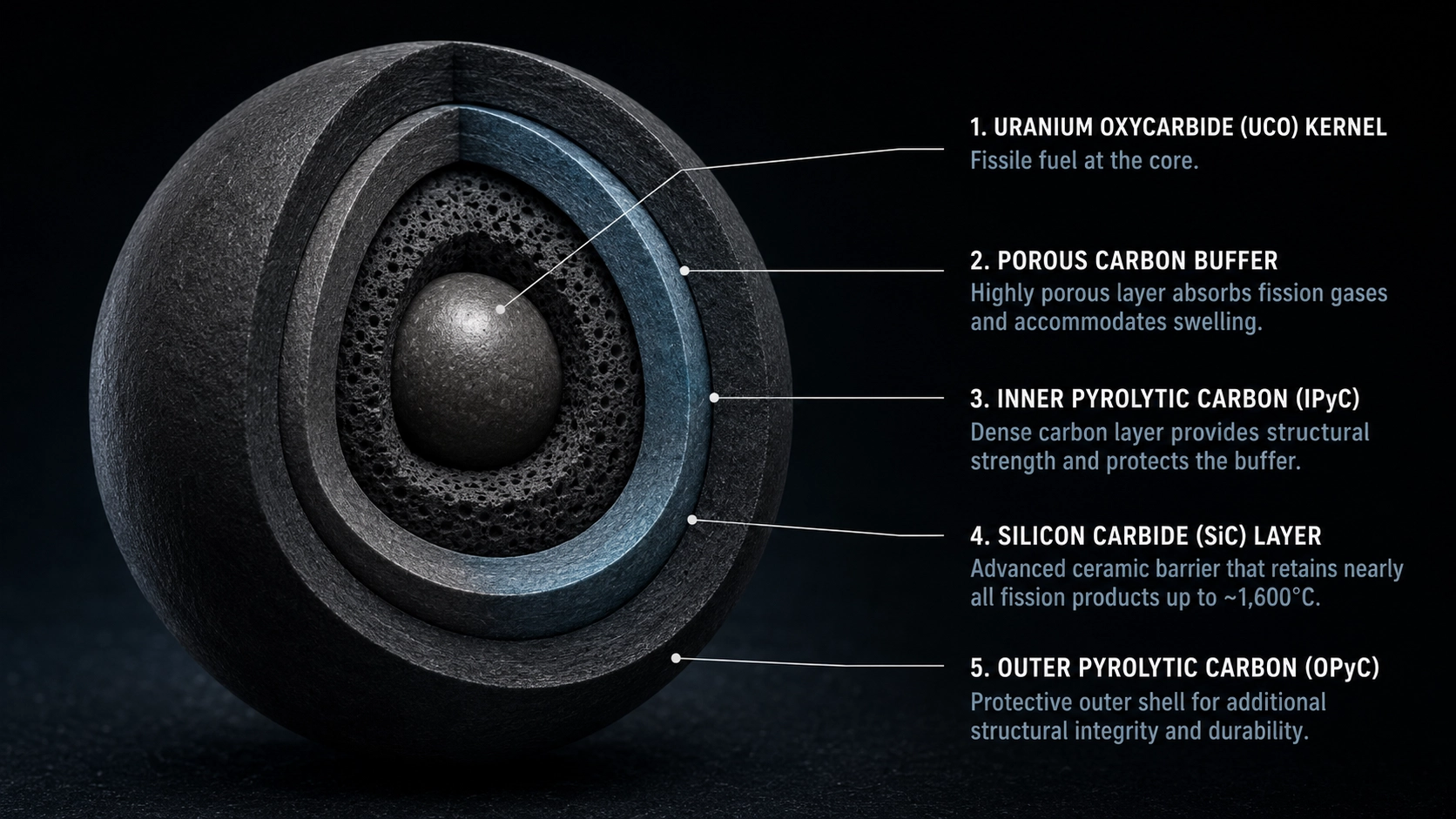
TRistructural ISOtropic (TRISO) fuel entirely discards the metal rod architecture. Instead, it places the physical containment vessel at the microscopic level. The process begins with a core kernel of uranium oxycarbide (UCO), measuring roughly half a millimeter in diameter.
Manufacturing facilities then utilize chemical vapor deposition in a fluidized bed reactor to coat this uranium kernel with three distinct, highly engineered layers.
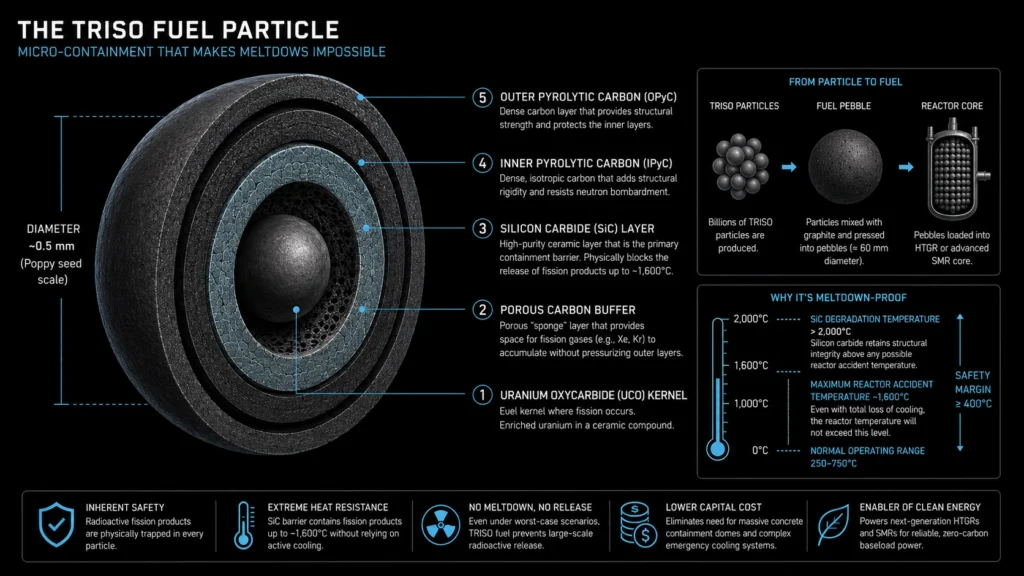
The first layer is a porous carbon buffer. As the uranium undergoes nuclear fission, it releases volatile radioactive gases like xenon and krypton. The porous carbon acts like a microscopic sponge, providing physical empty space for these gases to expand without exerting pressure on the outer walls.
The second and fourth layers consist of dense pyrolytic carbon, providing extreme structural rigidity to survive the physical bombardment of high-energy neutrons.
The critical third layer is a shell of pure silicon carbide (SiC). This advanced ceramic layer acts as the absolute, impenetrable pressure vessel. Silicon carbide remains structurally solid and chemically inert at extreme temperatures, physically trapping all radioactive byproducts inside the microscopic sphere. These TRISO particles are then mixed with graphite and pressed into billiard-ball-sized fuel pebbles or cylindrical compacts, which are loaded directly into the reactor core.
WHY IT MATTERS NOW
The global energy grid requires massive amounts of firm, zero-carbon baseload power to support the explosive growth of artificial intelligence data centers and industrial electrification. However, the financial cost of building traditional, massive light-water nuclear reactors is economically paralyzing due to the extreme regulatory requirements for redundant safety cooling systems.
TRISO fuel breaks this financial bottleneck by enabling the commercialization of High-Temperature Gas-Cooled Reactors (HTGRs) and advanced Small Modular Reactors (SMRs). Companies like X-energy and BWXT are heavily scaling the production of this fuel because it offers inherent, physics-based safety.
If a modern TRISO-fueled reactor suffers a catastrophic station blackout and loses all active cooling capability, the core will heat up. However, the reactor’s maximum theoretical accident temperature will plateau around 1,600 degrees Celsius. The silicon carbide shell of a TRISO particle does not structurally degrade until it exceeds 2,000 degrees Celsius.
This thermodynamic gap mathematically prevents a meltdown. The reactor naturally radiates its excess heat into the surrounding earth without human intervention, electrical power, or emergency water pumps. Because the fuel physically cannot breach its own containment, utility companies no longer need to construct multi-billion-dollar emergency cooling infrastructure or massive concrete containment domes, drastically dropping the capital expenditure required to build a new nuclear plant.
WHAT MOST PEOPLE MISS
Public policy assumes that nuclear safety relies entirely on operator training and backup diesel generators. They miss the paradigm shift of moving safety from active mechanical systems to passive material science.
However, the commercial hurdle is not the reactor physics; it is the extreme precision required in fuel fabrication. If the chemical vapor deposition process fluctuates by just a few microns, the silicon carbide layer may develop microscopic stress fractures. Out of the billions of individual TRISO particles loaded into a commercial reactor, the U.S. Nuclear Regulatory Commission (NRC) requires a defect rate strictly lower than one in a hundred thousand. Achieving this near-perfect chemical uniformity at industrial mass-production scales is the actual heavy-industry moat delaying the immediate global rollout of advanced microreactors.
THE TRAJECTORY
Next 12–36 Months: The Department of Defense will finalize the deployment of Project Pele, utilizing TRISO fuel to power a fully mobile, transportable microreactor. This military validation will instantly de-risk the civilian regulatory pathway for commercial TRISO applications.
Next Five Years: Heavy industrial sectors, such as steel and chemical manufacturing, will co-locate TRISO-fueled microreactors directly on-site. The reactors will output not only electricity but also 700-degree-Celsius industrial process heat, completely displacing the fossil fuel boilers currently powering global heavy industry.
Next Ten Years: Space agencies will standardize TRISO fuel for interplanetary logistics. NASA will integrate these meltdown-proof particles into nuclear thermal propulsion rockets and lunar surface power grids, utilizing the fuel’s extreme thermal resilience to survive the harsh temperature swings of deep space operations.
What Could Go Wrong: The commercial viability of TRISO fuel requires High-Assay Low-Enriched Uranium (HALEU). Currently, the global supply chain for HALEU is heavily concentrated outside the West. If a geopolitical embargo chokes off the raw enriched uranium feed material, the multi-billion-dollar domestic TRISO fabrication facilities will sit empty, stalling the entire advanced reactor pipeline.
Most Likely Outcome: TRISO particles will become the undisputed, standard fuel architecture for all next-generation advanced nuclear reactors. The ability to guarantee meltdown immunity purely through ceramic material science will permanently dismantle the financial and regulatory barriers that have suppressed the nuclear energy sector for forty years.
KEY TERMS
- TRISO (TRistructural ISOtropic): A microscopic nuclear fuel particle composed of a uranium kernel surrounded by multiple layers of carbon and ceramic to prevent radioactive leakage.
- Silicon Carbide (SiC): An advanced, high-temperature ceramic compound used as the primary containment layer in TRISO fuel due to its extreme thermal and structural stability.
- Pyrolytic Carbon: A highly dense, engineered form of carbon deposited as a gas onto the fuel particle, providing structural strength against neutron bombardment.
- Fission Products: The radioactive isotopes and volatile gases created when a uranium atom splits during a nuclear reaction.
- High-Assay Low-Enriched Uranium (HALEU): Nuclear fuel enriched between 5% and 20% Uranium-235, providing the higher energy density required by advanced microreactors.
SOURCES
- U.S. Department of Energy (DOE) — TRISO Fuel: The Most Robust Nuclear Fuel on Earth
- Idaho National Laboratory (INL) — Advanced Gas Reactor (AGR) Fuel Development and Qualification Program
- Nuclear Regulatory Commission (NRC) — Safety Evaluation Report for TRISO-X Fuel Fabrication Facility
- Journal of Nuclear Materials — Thermomechanical Performance of Silicon Carbide in TRISO Fuel Particles