Advertisement
)

AT A GLANCE
- Concept: Unmanned Surface Vehicle: A robotic boat that navigates without a human crew onboard.
- Concept: Asymmetric Warfare: A conflict where a weaker force uses cheap, unconventional weapons to defeat a vastly superior military.
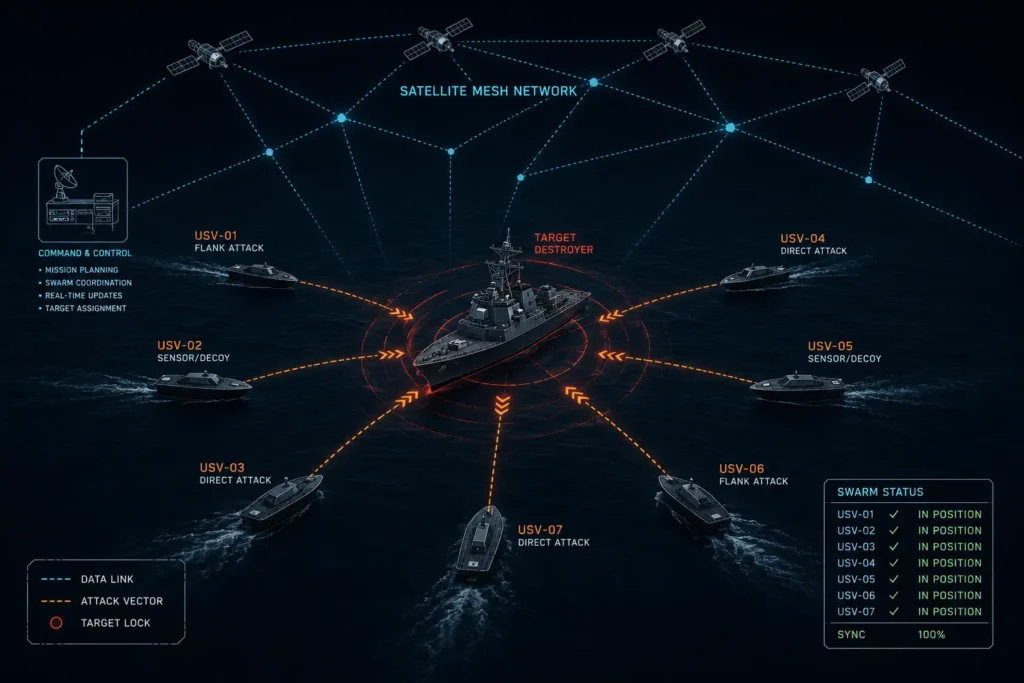
- Concept: Autonomous Swarm: Multiple drones communicating with each other to attack a target simultaneously from different angles.
- Concept: Cost-Exchange Ratio: The financial math of destroying a $500 million warship using a $250,000 drone.
IN SIMPLE WORDS
For the last century, naval warfare was dominated by massive steel warships. Superpowers built billion-dollar aircraft carriers and destroyers, assuming that the only thing that could sink a giant ship was another giant ship.
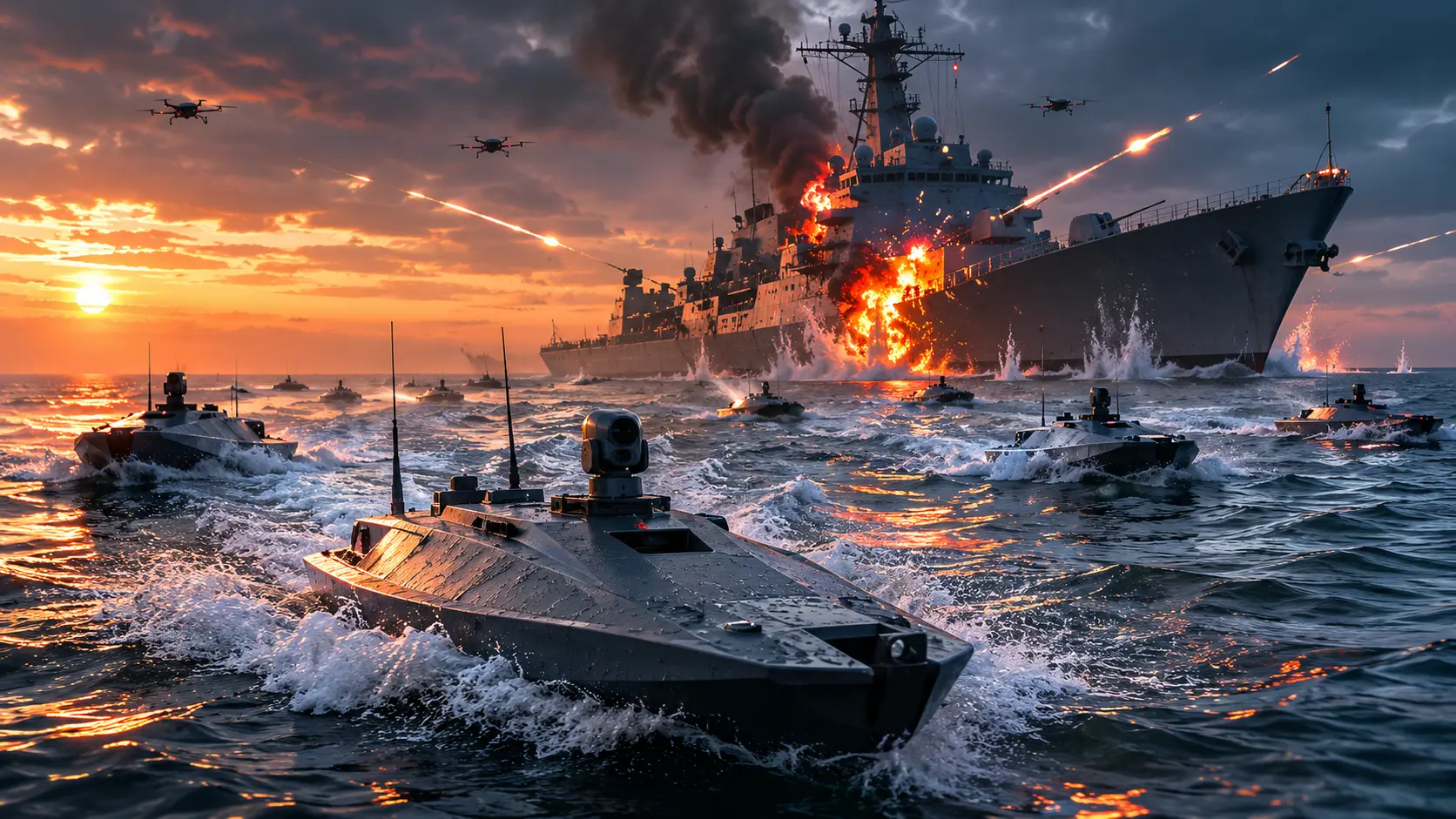
That era is over. Today, a country without a traditional navy can build a fleet of small, remote-controlled robot boats for the cost of a single fighter jet. These Unmanned Surface Vehicles (USVs) are packed with explosives and sit so low in the water that enemy radar cannot see them.
Instead of fighting fair, these robot boats attack in massive, coordinated swarms. Even if a warship manages to shoot down five of them, the sixth boat slips through and blows a hole in the hull. This completely breaks the financial math of war, allowing small nations to devastate superpowers at sea.
HOW UNMANNED SURFACE VEHICLES WORK
The engineering behind an Unmanned Surface Vehicle prioritizes stealth, speed, and terminal guidance over traditional armor. A standard combat USV, like the Ukrainian MAGURA V5, is roughly 5.5 meters long. It is constructed from carbon fabric reinforced with epoxy resin, similar to a high-performance surfboard. This composite material drastically reduces the vessel’s radar cross-section.
Furthermore, the drone features a semi-submersible profile. By sitting barely 0.5 meters above the waterline, it is visually camouflaged by ocean waves, making it incredibly difficult for traditional warship radar to detect until it is within a few hundred meters.
Propulsion is achieved through commercial high-output outboard motors or waterjets, allowing the drone to reach burst speeds of up to 42 knots (78 km/h). This speed is critical during the final attack run, forcing the defending warship’s automated machine guns to track a rapidly moving, erratic target.
Navigation and targeting rely on a redundant, multi-layered architecture. For the majority of its 800-kilometer transit, the USV operates autonomously using GNSS (GPS) and internal inertial navigation systems. If electronic warfare jammers block the GPS signal, the drone falls back to inertial dead reckoning.
During the terminal attack phase, the drone utilizes low-latency satellite internet (like Starlink) and dual electro-optical/thermal cameras. This allows a human operator sitting hundreds of miles away to manually steer the drone directly into the most vulnerable section of an enemy ship’s hull, detonating a 300-kilogram explosive payload.
REAL WORLD EXAMPLE
The most profound demonstration of USV combat occurred in the Black Sea. Following the 2022 invasion, Ukraine possessed virtually no traditional navy. Yet, by deploying swarms of domestically built MAGURA V5 and Sea Baby USVs, they systematically dismantled the Russian Black Sea Fleet.
In early 2024, Ukrainian intelligence used a coordinated swarm of MAGURA V5 drones to hunt down and sink the Russian missile corvette Ivanovets. The drones attacked at night, utilizing thermal cameras and attacking from multiple vectors simultaneously. Video footage confirmed that while the Russian ship successfully fired heavy machine guns at the incoming drones, the sheer number of autonomous boats overwhelmed the defenses, resulting in multiple catastrophic hull breaches that sank the multi-million dollar vessel.
WHY IT MATTERS NOW
For the past eighty years, global maritime security has been underwritten by carrier strike groups. The United States protects global shipping lanes by projecting power through massive, heavily armed naval flotillas.
Unmanned Surface Vehicles introduce a devastating asymmetric threat to this established order. A modern naval destroyer relies on highly expensive interceptor missiles to defend itself. If a non-state actor or a small nation launches a swarm of twenty USVs costing roughly $250,000 each, the defending destroyer must fire twenty missiles costing $2 million each to survive.
This cost-exchange ratio is completely unsustainable. Even if the superpower intercepts every single drone, they go bankrupt firing their own weapons. If they run out of interceptor missiles, the ship sinks.
Furthermore, USVs provide an immediate coastal defense umbrella. Nations like India no longer need to spend a decade building traditional frigates to secure their maritime borders. By purchasing thousands of cheap, autonomous boats that can idle silently at sea for weeks, a defending nation can create an impassable explosive minefield for any invading amphibious fleet.
This technology effectively democratizes sea denial. The ocean is no longer the exclusive playground of nations that can afford nuclear submarines and aircraft carriers.
COMMON MISCONCEPTIONS
- “Robot boats are easy to shoot down.” Traditional naval cannons and missiles are designed to track high-flying jets or massive, slow-moving ships. They struggle to lock onto a tiny, erratic fiberglass boat bouncing over ocean waves at 40 knots.
- “You can just jam their radio signals.” While electronic warfare is a threat, modern USVs are increasingly autonomous. If jammed, they do not simply stop; they use onboard artificial intelligence and optical cameras to visually identify the target and execute the attack without human input.
- “They are only used as suicide bombs.” While kamikaze variants are famous, modern USVs are highly modular. They are increasingly used for persistent anti-submarine surveillance, acoustic monitoring, and electronic intelligence gathering.
WHAT MOST PEOPLE MISS
Military analysts focus heavily on the explosive payload, but they frequently overlook the logistics of mothership deployment.
A small USV only has a fuel range of roughly 800 kilometers. To project power globally, navies are developing disguised motherships—standard commercial cargo freighters heavily modified to carry and launch hundreds of USVs from their internal cargo bays. This allows a nation to quietly sail a seemingly harmless merchant ship into a foreign port, only to suddenly release a massive, autonomous attack swarm from its hull.
THE ECONOMIC AND STRATEGIC IMPACT
The primary financial beneficiaries are the agile, mid-tier defense startups specializing in autonomy software, commercial marine propulsion, and satellite mesh networking. Unlike traditional aerospace prime contractors who require decades to build a single destroyer, these startups can iterate and mass-produce USVs using standard commercial supply chains in a matter of months.
Strategically, the era of power projection via massive surface ships is facing an existential crisis. If multi-billion dollar aircraft carriers cannot safely operate within 1,000 miles of a hostile coast due to the threat of autonomous drone swarms, superpowers lose their ability to intimidate regional rivals.
The economic losers are the traditional shipbuilders and the legacy defense primes reliant on massive, monolithic shipbuilding contracts. Navies are rapidly realizing they must reallocate billions of dollars away from building one giant ship, and instead buy ten thousand small, expendable robotic vessels.
THE TRAJECTORY
Next 12–36 Months: The integration of surface-to-air missiles on USVs. Drones like the Ukrainian MAGURA V7 are already being equipped with modified R-73 anti-aircraft missiles. This allows the drone boat to shoot down the defending enemy helicopters that are currently the best defense against USV swarms.
Next Five Years: The rise of fully autonomous, decentralized swarms. Currently, many USVs require a human operator for the final attack phase. Within five years, swarms will operate using decentralized mesh logic. If one drone is destroyed, the remaining drones will instantly communicate and re-evaluate their attack vectors autonomously, attacking from 360 degrees without human input.
Next Ten Years: The deployment of hybrid submersible USVs. To defeat advanced radar, the next generation of USVs will transit on the surface to save fuel, but immediately submerge just below the water’s surface during the final ten miles of the attack, making them entirely immune to traditional surface gunfire.
What Could Go Wrong: A catastrophic autonomous targeting error. As USVs are granted full “fire-and-forget” autonomy, the risk of misidentification rises exponentially. In a congested waterway like the Strait of Hormuz, an autonomous USV swarm could incorrectly identify a massive commercial oil tanker as a hostile aircraft carrier, triggering a devastating international environmental and economic crisis.
Most Likely Outcome: The surface of the ocean will become a “no man’s land.” Traditional, manned warships will be forced to operate far out in the deep ocean, relying entirely on their own fleets of deployed USVs and uncrewed submarines to project power and fight proxy battles in contested coastal waters.
KEY TERMS
- Unmanned Surface Vehicle (USV): A robotic boat that operates on the surface of the water without any human crew onboard.
- Asymmetric Warfare: Conflict where two sides have vastly unequal military power, forcing the weaker side to use unconventional, cheap tactics to win.
- Swarm Tactics: The coordinated deployment of dozens of autonomous drones designed to overwhelm a target’s defensive systems simultaneously.
- Cost-Exchange Ratio: The financial calculation of how much money it costs to launch an attack versus how much money it costs the enemy to defend against it.
- Terminal Guidance: The final phase of a weapon’s flight or transit where it actively steers itself to guarantee a direct hit on the target.
- Mesh Network: A decentralized communication system where each drone in a swarm relays data to the others, ensuring the network survives even if several drones are destroyed.
BEGINNER FAQ
What is a USV? It stands for Unmanned Surface Vehicle. It is simply a highly advanced, remote-controlled or autonomous boat that operates without a human crew.
Why are they changing naval warfare? Because they are incredibly cheap. A country can build thousands of explosive robot boats for the price of one traditional warship, making it financially impossible for large navies to defend themselves effectively.
How do they sink massive steel ships? They attack in swarms. A warship can shoot down three or four boats, but if twenty boats attack at the same time, one will get through and detonate hundreds of pounds of explosives directly against the ship’s hull.
Why can’t radar see them coming? They are very small, built out of non-reflective materials, and sit extremely low in the water. To a radar screen, they often just look like normal ocean waves until they are too close to stop.
Who is driving the boat? For most of the journey, the boat drives itself using GPS. During the final attack, a human operator hundreds of miles away steers it using a satellite internet connection and a camera on the front of the boat.
Can’t the defending ship just jam the internet signal? They try. But modern USVs are being programmed with artificial intelligence. If they lose their internet connection, their onboard computers take over and finish the attack automatically.
Are they only used as explosive drones? No. Navies are building larger USVs to quietly patrol the oceans for months at a time, looking for enemy submarines, clearing sea mines, and carrying cargo.
Which country is leading this technology? Due to the necessities of war, Ukraine has advanced USV technology faster than anyone else, using them to successfully destroy a large portion of the Russian Black Sea Fleet.
SOURCES
- United States Naval Institute (USNI) — The Evolution of Unmanned Surface Vehicles and Distributed Maritime Operations
- Center for Strategic and International Studies (CSIS) — Asymmetric Naval Warfare: The Impact of Kamikaze USVs in the Black Sea
- RAND Corporation — Autonomous Swarm Tactics and the Future of Sea Denial
- International Institute for Strategic Studies (IISS) — Cost-Exchange Ratios in Modern Naval Missile Defense