Advertisement
)

AT A GLANCE
- Concept: Decoupled Scaling: Unlike lithium-ion, you increase a flow battery’s energy capacity simply by building larger liquid storage tanks, not by buying more expensive battery cells.
- Concept: The Vanadium Advantage: Using the exact same elemental metal in both the positive and negative tanks eliminates irreversible chemical cross-contamination.
- Concept: Proton-Exchange Membranes: The central cell physically separates the liquids but allows microscopic hydrogen protons to cross, completing the electrical circuit.
- Concept: Parasitic Pumping Loss: The system requires constant mechanical energy to pump the heavy acidic fluids, directly reducing the total round-trip electrical efficiency.
HOW IT WORKS
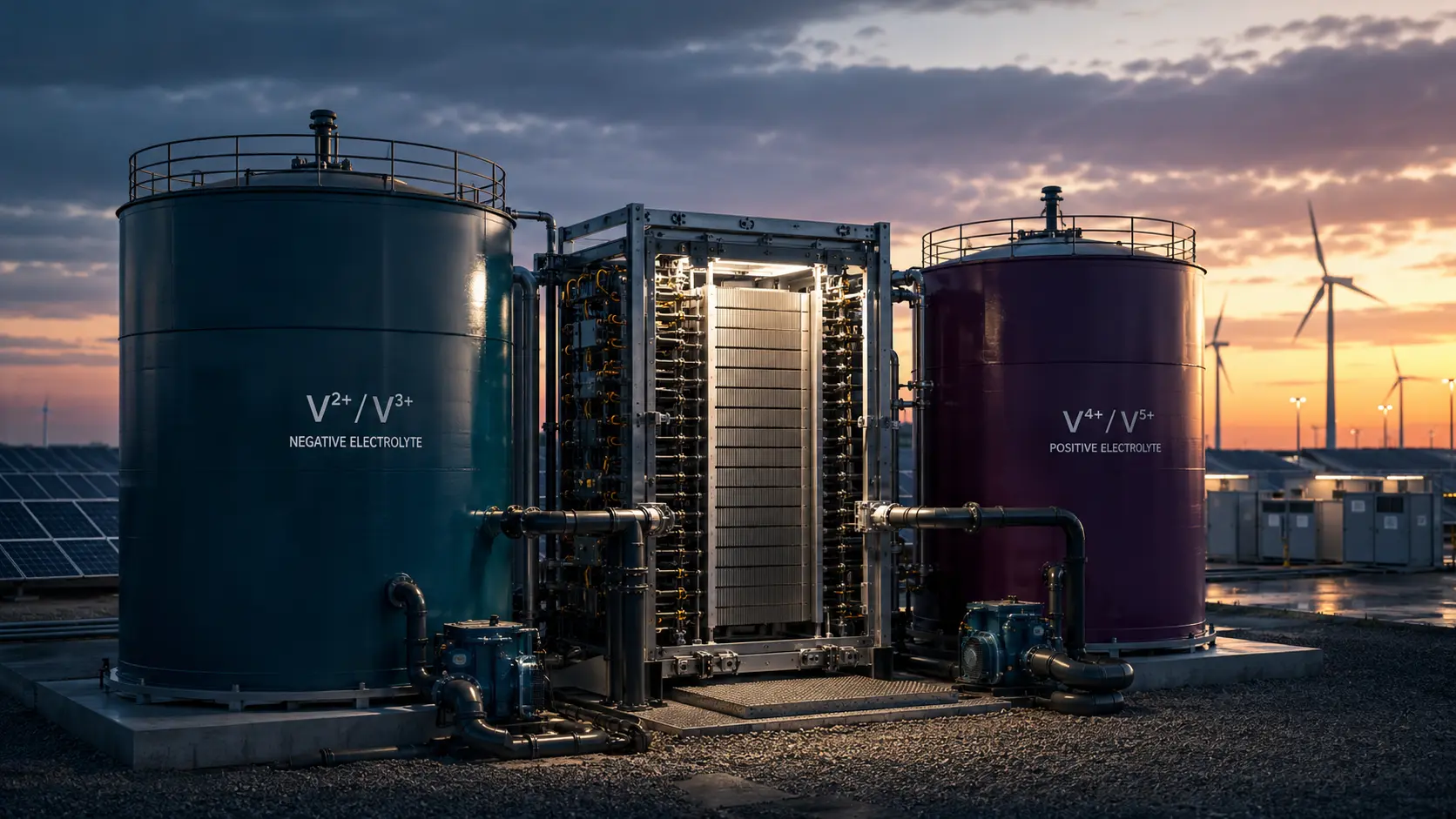
Traditional lithium-ion batteries are solid-state devices. The energy storage and the power generation occur within the exact same confined physical package. A vanadium redox flow battery (VRFB) physically separates these two functions. The energy is stored chemically in two massive external tanks containing a liquid electrolyte—specifically, vanadium salts dissolved in a highly corrosive sulfuric acid solution.
To generate electricity, heavy-duty mechanical pumps push the liquid from both tanks into a central unit called the power stack. Inside this stack, the two fluids never physically mix. They are separated by an ultra-thin, highly engineered proton-exchange membrane (typically Nafion).
The magic of vanadium relies on its ability to exist in four distinct oxidation states in a liquid solution (\(\text{V}^{2+}\), \(\text{V}^{3+}\), \(\text{V}^{4+}\), and \(\text{V}^{5+}\)). As the fluids flow past the membrane, an electrochemical reaction occurs. The vanadium ions in the negative fluid give up electrons, which travel through an external wire to power the grid. Simultaneously, hydrogen protons physically squeeze through the membrane to the positive fluid, balancing the electrical charge.
To recharge the battery, grid operators simply reverse the electrical current, forcing the electrons and protons back across the membrane and returning the liquid in the tanks to its fully charged oxidation state. Because the only physical mechanism changing is the oxidation state of the fluid, the battery can be charged and discharged tens of thousands of times with almost zero physical degradation to the storage medium.
WHY IT MATTERS NOW
Global power grids are currently failing to manage the massive, sudden influx of intermittent renewable energy. Solar farms overproduce at noon, crashing wholesale electricity prices, and instantly stop producing at sunset, causing dangerous pricing spikes. Grid operators urgently require long-duration energy storage (LDES)—batteries capable of discharging power continuously for ten to twelve hours to bridge this gap.
Lithium-ion completely fails the economic math of LDES. To get twelve hours of storage from lithium, a developer must buy twelve times the number of expensive, fire-prone battery cells. With a VRFB, the developer buys one power stack and simply constructs larger, cheap plastic tanks to hold more liquid vanadium. This decoupled scaling makes flow batteries the absolute mathematical baseline for future grid-scale energy arbitrage.
However, the commercial deployment of VRFBs is bottlenecked by the extreme physical stress placed on the central membrane. The sulfuric acid electrolyte is brutally corrosive. Over time, the proton-exchange membrane degrades. More critically, the mechanical pumps required to move the heavy liquid consume a massive amount of the battery’s own power. This parasitic loss drags the round-trip efficiency of a VRFB down to roughly 70 percent, compared to 95 percent for lithium-ion.
This efficiency penalty dictates the financial modeling of grid stabilization. Developers must mathematically calculate if the massive, multi-decade lifespan of the liquid vanadium offsets the 30 percent energy lost to physical pumping friction. Companies like UniEnergy Technologies are aggressively redesigning the micro-fluidic channels inside the power stack to reduce this fluid resistance, attempting to squeeze out a few extra percentage points of efficiency to secure multi-million dollar utility contracts.
WHAT MOST PEOPLE MISS
Mainstream coverage of clean tech assumes all battery chemistries degrade and eventually die. They miss the fundamental chemical immortality of a single-element flow system.
In a hybrid flow battery (like iron-chromium), if a microscopic tear develops in the membrane, the iron and chromium fluids permanently mix. The battery is instantly and irreversibly destroyed. In a VRFB, the exact same element—vanadium—is used on both sides. If the membrane leaks and the fluids mix (cross-contamination), the battery simply loses its immediate state of charge. A technician can literally pump all the liquid into a single tank, apply an electrical current to chemically re-separate the oxidation states, and restore the battery to 100 percent health. The vanadium electrolyte outlasts the physical lifespan of the concrete pad the battery sits on.
THE TRAJECTORY
Next 12–36 Months: Utility commissions will mandate specific LDES procurement targets. This regulatory shift will immediately unfreeze institutional capital, allowing infrastructure funds to finance gigawatt-hour scale VRFB installations adjacent to massive, isolated solar arrays in Texas and California.
Next Five Years: The industry will standardize the leasing of liquid electrolyte. Because vanadium does not degrade, financial institutions will purchase the liquid asset directly and lease it to grid operators. This eliminates the massive upfront capital expenditure for the battery developer, shifting the vanadium from a depreciating capital expense to a perpetual operational expense.
Next Ten Years: Material scientists will replace expensive, fluorinated Nafion membranes with highly advanced, cheap hydrocarbon-based alternatives. This will physically halve the manufacturing cost of the central power stack, allowing VRFBs to economically displace natural gas peaker plants for all grid balancing operations lasting longer than six hours.
What Could Go Wrong: Vanadium is a relatively rare industrial metal, historically mined as a minor additive for strengthening steel. If global steel production surges or major producing nations (like China and Russia) implement strict export controls, the physical price of vanadium pentoxide will skyrocket, instantly destroying the economic viability of new flow battery deployments.
Most Likely Outcome: The Vanadium Redox Flow Battery will become the undisputed heavy-industrial workhorse of the global power grid. While lithium-ion will continue to dominate electric vehicles and short-duration frequency regulation, VRFBs will provide the massive, multi-day chemical reservoirs required to physically backstop the intermittent physics of wind and solar.
KEY TERMS
- Flow Battery: A rechargeable fuel cell where the energy is stored chemically in liquid electrolytes contained in external tanks, rather than within the power cell itself.
- Vanadium: A transition metal capable of existing in four distinct, stable oxidation states, making it the perfect single-element liquid electrolyte.
- Proton-Exchange Membrane (PEM): A highly engineered, semi-permeable material that strictly separates two liquids but allows hydrogen protons to pass through to complete an electrical circuit.
- Oxidation State: The degree of loss of electrons in an atom; shifting this state in the liquid vanadium physically stores or releases the electrical charge.
- Parasitic Loss: The electrical power generated by a system that is immediately consumed by the system’s own mechanical components, such as the fluid pumps in a flow battery.
SOURCES
- Department of Energy (DOE) — Long-Duration Energy Storage Earthshot and Flow Battery Architectures
- Pacific Northwest National Laboratory (PNNL) — Advanced Vanadium Redox Flow Battery Electrolyte Development
- IEEE Transactions on Energy Conversion — Modeling of Parasitic Pumping Losses in Large-Scale Flow Batteries
- Federal Energy Regulatory Commission (FERC) — Energy Storage Integration and Wholesale Market Participation