Advertisement
)

At a Glance
- Concept: Massive, uncrewed submersibles operating autonomously in the deep ocean for extended deployments.
- Why it matters: The increasing vulnerability of expensive surface fleets to drone swarms and hypersonic missiles is driving a strategic pivot to the subsea domain, where XLUUVs provide asymmetric, deniable naval power.
- Who uses it: Defense contractors (Anduril, Boeing), and major naval forces globally (U.S. Navy, Royal Australian Navy, UK Royal Navy, China’s PLAN).
- Biggest takeaway: The true breakthrough is not just making submarines autonomous; it is removing the pressure hull. Because they do not need to keep humans alive, XLUUVs can use flooded-hull designs, shrinking costs by over 90% and unlocking mass production of deep-sea naval assets.
In Simple Words
Building a traditional submarine is incredibly difficult because you have to keep humans alive underwater. You need thick steel pressure hulls to prevent the crew from being crushed, life support systems for oxygen, and massive galleys for food. This makes nuclear and diesel-electric submarines cost billions of dollars and take decades to build.
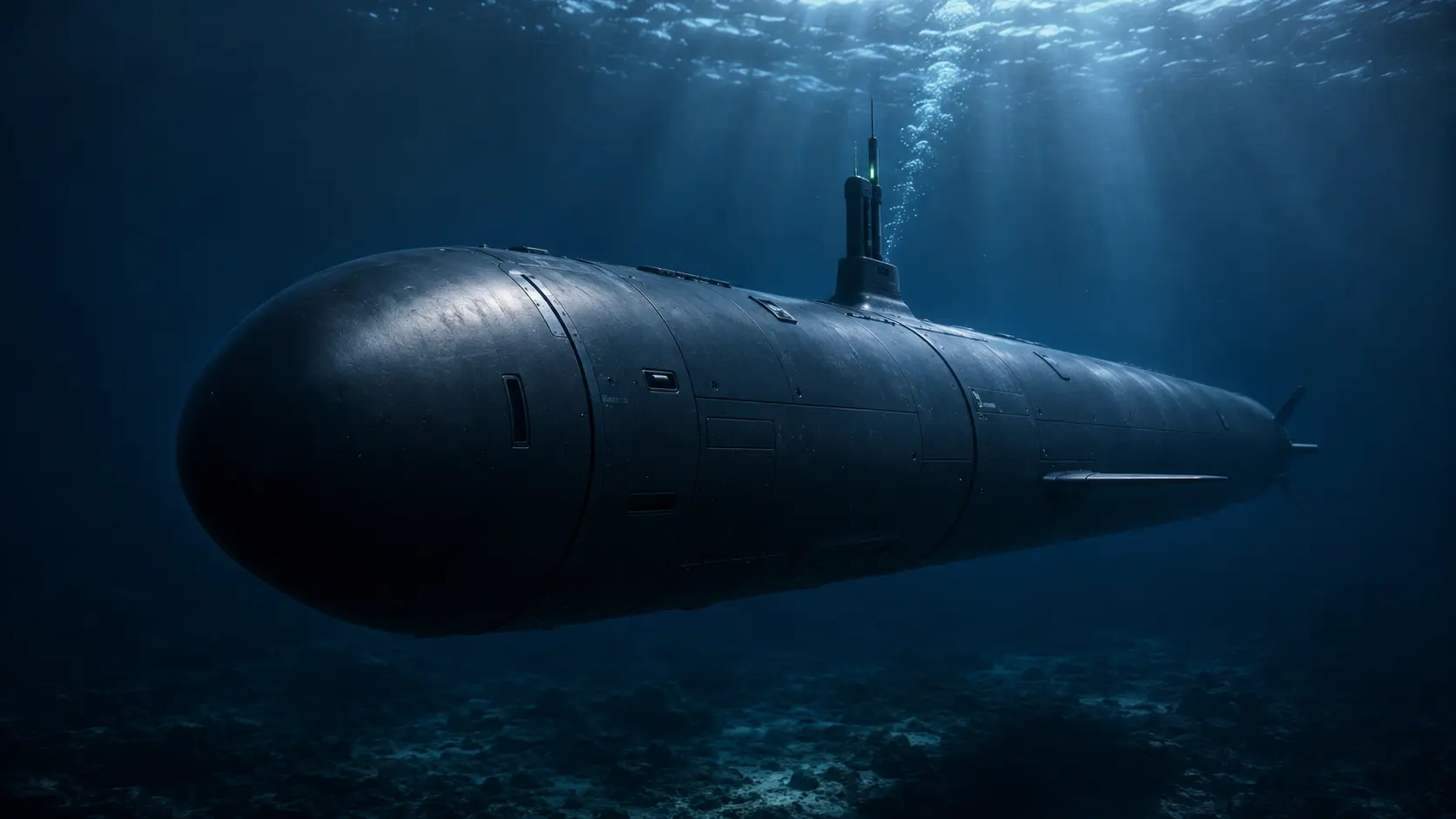
An Extra-Large Unmanned Underwater Vehicle (XLUUV) removes the humans. These are giant, robotic submarines—often the size of a school bus—that swim entirely on their own. Because there are no humans inside, the submarine does not need a heavy, pressurized tube filled with air. The ocean water is allowed to flood freely around the internal electronics, which are individually sealed.
Without human constraints, these robotic subs can be mass-produced in civilian factories for a fraction of the cost. They are programmed with artificial intelligence to leave port, navigate thousands of miles across the ocean, drop sea mines or listen for enemy submarines, and return home months later—all in complete silence.
Why This Matters
The geopolitical balance of naval power is shifting toward asymmetric warfare. Surface ships, such as multi-billion-dollar aircraft carriers, are becoming increasingly vulnerable to cheap drone swarms and anti-ship ballistic missiles. To maintain deterrence, the U.S. and its allies (specifically the AUKUS partnership) are moving their strategic operations underwater.
However, Western navies are facing a severe shipbuilding bottleneck. Producing traditional crewed attack submarines (SSNs) is slow, and shipyards are backlogged for years. XLUUVs solve the mass problem. In 2025 and 2026, programs like Australia’s “Ghost Shark” (Anduril) and the U.S. Navy’s “Orca” (Boeing) moved from experimental prototypes into full-rate production. For just USD 1.13 billion, the U.S. Navy is acquiring an entire fleet of 16 Orca XLUUVs through 2031—roughly a third of the cost of a single crewed Virginia-class submarine. This allows navies to cheaply flood strategic chokepoints with intelligent sensors and weapons, effectively establishing an invisible, autonomous blockade that adversaries cannot afford to track.
The Big Picture
XLUUVs represent a completely new tier in the naval order of battle.
Small and medium Unmanned Underwater Vehicles (UUVs) have existed for decades. They are shaped like torpedoes, run on small batteries, and have to be launched and recovered by a “mother ship.” Their range is limited to a few days.
XLUUVs are classified differently. Generally measuring over 10 meters (33 feet) in length and displacing upwards of 10 to 50 tons, they are “pier-launched.” They do not need a mother ship. They drive themselves out of the harbor and operate independently for months, utilizing hybrid propulsion and massive modular payload bays to execute missions spanning thousands of miles.
HOW AN XLUUV WORKS
Deploying a multi-ton robotic asset across the Pacific Ocean requires overcoming immense physics and engineering barriers.
1. The Fundamental Problem: Subsea Endurance
Deploying a robotic asset across an ocean requires immense energy. Solar power is useless underwater, and running a standard diesel engine requires oxygen. Traditional UUVs use lithium-ion batteries, but water drag severely limits their range. A subsea drone cannot loiter for months if its battery dies in 48 hours.
2. The Insufficiency of Traditional Air-Independent Propulsion (AIP)
Crewed non-nuclear submarines use complex Air-Independent Propulsion (AIP) systems (like Stirling engines or hydrogen fuel cells) to stay submerged. However, these systems are volatile, incredibly expensive, and require constant human maintenance and safety oversight—making them largely unsuitable for a cheap, uncrewed, expendable drone.
3. The Core Mechanism: Hybrid Diesel-Electric and Flooded Hulls
Modern XLUUVs rely on a hybrid architecture combined with a “flooded hull” design. The submarine is not a hollow, air-filled tube; water flows freely through the outer casing. Key components (like batteries and navigation computers) are encased in localized, pressure-tolerant, oil-filled pods.
For propulsion, the XLUUV operates identically to a hybrid car. It uses a massive bank of lithium-ion batteries to cruise silently deep underwater at roughly 3 knots. When the battery runs low, it autonomously rises near the surface, raises a small snorkel mast, and starts a commercial-grade marine diesel generator. The generator inhales atmospheric oxygen, rapidly recharges the batteries, and the drone dives back into the abyss. This gives XLUUVs like the Orca a staggering range of up to 6,500 nautical miles.
4. Technical Depth: Autonomous Acoustic Navigation
GPS radio waves cannot penetrate seawater. Once submerged, the XLUUV is completely cut off from satellite navigation. Instead, it relies on an Inertial Navigation System (INS) paired with a Doppler Velocity Log (DVL). The DVL fires acoustic sound waves at the ocean floor to measure the exact speed and direction of the drone relative to the seabed. To correct the inevitable mathematical drift of the INS, the drone periodically matches its downward-facing sonar readings against pre-loaded bathymetric maps of the ocean floor—a process known as Terrain Relative Navigation (TRN)—allowing it to navigate blindly across oceans with pinpoint accuracy.
5. Real-World Consequences: Modular Payload Bays
Because the XLUUV is simply a delivery truck, the middle of the vehicle is essentially an empty, unpressurized cargo bay. Navies can swap out modules based on the mission. Before deploying, operators can bolt in a 34-foot payload module carrying encapsulated sea mines, towed sonar arrays for anti-submarine warfare (ASW), or electronic warfare (EW) masts that can be raised to spy on enemy radar while the bulk of the submarine remains safely hidden underwater.
Real-World Applications
XLUUVs are transitioning from experimental prototypes to active participants in multi-domain combat operations.
Strategic Mine-Laying: The most immediate operational use for XLUUVs is offensive mining. Sneaking a crewed submarine into a hostile, shallow harbor to drop mines puts human lives at immense risk. An XLUUV can autonomously infiltrate an adversary’s coastal waters, quietly deposit smart mines to blockade a naval base, and slip away entirely undetected.
Anti-Submarine Warfare (ASW) Pickets: To track enemy nuclear submarines, navies deploy XLUUVs as silent listeners. A fleet of autonomous subs can loiter in critical strategic chokepoints (such as the GIUK gap or the Taiwan Strait). Trailing passive sonar arrays, they sit silently on the battery for weeks, listening for the distinct acoustic signature of an adversary’s submarine, and only surfacing to broadcast the coordinates via satellite burst-transmission once a target is detected.
AUKUS Pillar 2 Interoperability: In late 2025, the UK’s Submarine Delivery Agency handed over the 19-tonne XV Excalibur (Project Cetus) to the Royal Navy. In a landmark demonstration of joint operations, British operators successfully commanded the Excalibur in UK waters from a control center in Australia, 16,000 kilometers away. This capability allows allied nations to seamlessly share control of uncrewed subsea fleets across the globe.
Economic & Strategic Impact
The financial arbitrage of the XLUUV is permanently disrupting naval procurement.
In 2026, the Australian government fast-tracked the Ghost Shark program, committing AUD 1.7 billion (USD 1.1 billion) to acquire a fleet of “dozens” of these extra-large AUVs, entering service from early 2026. Simultaneously, the U.S. Navy committed to purchasing 16 Orca XLUUVs from Boeing for roughly the same price (USD 1.13 billion).
Strategically, this allows Western navies to rapidly scale their subsea mass without waiting for nuclear shipyards to expand capacity. The cost of a single traditional attack submarine can exceed USD 3.5 billion. For that same budget, a navy can purchase a swarm of over 50 XLUUVs. This flips the economic equation against adversaries; forcing an enemy to expend a multi-million dollar heavy-weight torpedo or depth charge to destroy a relatively cheap, uncrewed robotic drone is a massive victory in the economics of attrition warfare.
Advantages
- Zero Human Risk: Operators can deploy these vessels into highly contested, hostile “anti-access/area denial” (A2/AD) zones without risking a crew of 130 sailors.
- Asymmetric Cost: Flooded-hull designs bypass the need for human life support and pressure-hull metallurgy, allowing for rapid, cheap mass-production in standard commercial facilities.
- Extreme Endurance: Combining high-density lithium-ion batteries with snorkel-driven marine diesel generators allows XLUUVs to operate independently for months over thousands of nautical miles.
Limitations
- Communication Blackouts: Because radio waves do not travel through water, an XLUUV cannot be remote-controlled by a human pilot while deep underwater. If it encounters an unexpected threat, its onboard AI must make split-second decisions without human input.
- Vulnerability at the Surface: To recharge its batteries using the diesel engine, the XLUUV must ascend and raise its snorkel. The thermal heat of the diesel exhaust and the physical mast make it momentarily vulnerable to detection by enemy maritime patrol aircraft and satellites.
- Slow Sprint Speeds: While XLUUVs excel at slow, silent loitering (typically around 3 knots), they lack the massive nuclear propulsion required to sprint at 30 knots to chase down fast-moving crewed submarines.
Common Misconceptions
Misconception: XLUUVs will replace nuclear attack submarines.
Reality: XLUUVs are complementary. They are too slow and lack the computing power and human intuition to execute complex, multi-domain combat operations. They serve as the “scouts” and “minelayers” of the fleet, freeing up the expensive, crewed nuclear submarines to focus on high-value strikes.
Misconception: Submarines use GPS underwater.
Reality: GPS signals bounce off the surface of the ocean. Submarines are entirely blind to GPS once they dive. They must rely on internal gyroscopes, accelerometers, and acoustic bottom-tracking to guess their location until they surface to catch a satellite signal.
Misconception: XLUUVs are built exactly like mini-submarines.
Reality: Traditional submarines are dry on the inside. XLUUVs use a “flooded architecture.” The water is completely allowed to flow into the hull framework, which significantly reduces the structural pressure load and lowers manufacturing costs.
What Most People Miss
The software framework is vastly more valuable than the submarine’s metal hull.
The true breakthrough in the subsea arms race is not making a submarine bigger; it is making it smarter. Programs like the Australian Ghost Shark are fundamentally built around advanced AI and machine learning architectures (such as Anduril’s “Lattice” software). This AI must manage complex subsea navigation, autonomous obstacle avoidance, acoustic target classification, and mission decision-making entirely disconnected from the cloud. The hardware is just a delivery system; the autonomous software is the actual weapon.
Comparison Table
| Feature | Unmanned Surface Vessel (USV) | Standard Unmanned Underwater Vehicle (UUV) | Extra-Large Unmanned Underwater Vehicle (XLUUV) | Nuclear Attack Submarine (SSN) |
| Domain | Surface Ocean | Shallow / Deep Ocean | Deep Ocean | Deep Ocean |
| Launch Method | Pier / Davit | Mother Ship (Torpedo tube / crane) | Pier-launched | Pier-launched |
| Endurance | Months | Days | Months (Hybrid Diesel/Electric) | Decades (Nuclear) |
| Human Risk | Zero | Zero | Zero | High (130+ Crew) |
| Stealth | Low (Visible to radar/satellites) | High | Extremely High | Ultimate |
| Cost | Low | Very Low | Moderate (~$70M – $100M) | Astronomically High (~$3.5B+) |
Case Study
Situation: For decades, deploying offensive sea mines required sending expensive, crewed submarines into highly dangerous, heavily defended enemy shallow waters.
Challenge: The U.S. Navy needed a way to lay vast fields of smart mines across contested chokepoints without risking human lives, but traditional drone submarines lacked the battery life to reach the target, and lacked the physical size to carry heavy mines.
Solution: In 2019, the Navy awarded Boeing a contract to develop the Orca XLUUV, based on their Echo Voyager prototype. The Orca was explicitly designed around a massive 34-foot modular payload bay capable of holding multiple encapsulated torpedo mines.
Outcome: After significant developmental delays and budget overruns during the prototype phase, the program stabilized. In its May 2026 shipbuilding plan, the Navy transitioned the Orca from a prototype into a formal acquisition program. The Navy committed USD 1.13 billion to acquire 16 Orcas through 2031, effectively establishing a dedicated, uncrewed minelaying fleet.
Lessons Learned: The Orca program proved that scaling up subsea drone technology is difficult due to supply chain and integration hurdles, but the strategic payoff—the ability to autonomously blockade an enemy port from thousands of miles away—justifies the upfront hardware investment.
Future Outlook
Next 12–24 Months
The AUKUS alliance (Australia, UK, US) will aggressively test subsea interoperability. As the U.S. Navy prepares for its fiscal 2027 Orca funding and Australia spins up full-rate production of the Ghost Shark in Sydney, allied navies will focus on standardizing communication protocols. We will see increased joint exercises demonstrating how a U.S. commander can seamlessly receive acoustic intelligence from an allied drone patrolling the Pacific.
Next 3–5 Years
The payload modules will shift from passive sensors to active kinetics. While early XLUUVs are prioritized for intelligence, surveillance, and reconnaissance (ISR) and mine-laying, defense contractors will successfully integrate lightweight torpedoes and anti-ship missiles directly into the flooded payload bays. This will turn the autonomous vehicles into lethal “loitering munitions” capable of engaging targets without a human in the immediate firing loop.
Next 10 Years
Subsea swarming will become the standard doctrine. XLUUVs will act as underwater “motherships” themselves, carrying smaller, specialized micro-drones. An XLUUV will travel 3,000 miles, park on the seabed, and release a swarm of small acoustic sensor nodes that scatter across the ocean floor. If an enemy submarine passes overhead, the nodes will communicate via acoustic modems back to the XLUUV, which will surface its mast to alert military command, creating an inescapable, intelligent subsea tripwire.
Most Likely Scenario
The subsea domain will experience the same drone revolution that recently transformed aerial warfare. However, the extreme hostility and physics of the deep ocean mean the barrier to entry remains incredibly high. The nations that master the complex blend of flooded-hull metallurgy, autonomous acoustic navigation, and machine-learning decision engines—principally the AUKUS nations and China—will permanently control the invisible layers of global maritime trade routes.
Key Takeaways
- Extra-Large Unmanned Underwater Vehicles (XLUUVs) are pier-launched robotic submarines that can patrol oceans autonomously for months without human intervention.
- Removing the human crew allows the use of “flooded hulls,” eliminating the need for expensive pressurized steel and reducing production costs by over 90% compared to traditional submarines.
- Because radio waves cannot penetrate water, XLUUVs navigate using an Inertial Navigation System (INS), Doppler Velocity Logs (DVL), and Terrain Relative Navigation instead of GPS.
- They utilize hybrid diesel-electric propulsion: cruising silently on lithium-ion batteries and surfacing a small snorkel to run a diesel generator for recharging.
- By 2026, programs like the U.S. Navy’s Orca and Australia’s Ghost Shark transitioned into massive acquisition plans, prioritizing missions like covert mine-laying and anti-submarine listening pickets.
- The true weapon is the software; onboard AI must make complex, life-or-death tactical decisions entirely disconnected from the cloud or human operators.
Glossary
Acoustic Modem: A communication device that transmits data underwater by converting digital information into sound waves, used because radio waves are blocked by seawater.
Air-Independent Propulsion (AIP): Technologies (like fuel cells) that allow a non-nuclear submarine to operate without access to atmospheric oxygen, though XLUUVs often prefer simpler hybrid diesel-electric snorkel systems.
Doppler Velocity Log (DVL): An acoustic sensor that fires sound waves at the sea floor to measure the vehicle’s exact speed and direction over the ground.
Flooded Hull: A submarine design where the outer casing is not watertight; ocean water freely fills the empty spaces, while sensitive electronics are individually sealed in pressure-tolerant pods.
Inertial Navigation System (INS): A navigation device that uses internal computers, motion sensors (accelerometers), and rotation sensors (gyroscopes) to continuously calculate the vehicle’s position without needing external references like GPS.
Terrain Relative Navigation (TRN): A technique where a submarine uses its sonar to scan the topography of the ocean floor and matches it to a pre-loaded 3D map to correct navigation drift.
XLUUV: Extra-Large Unmanned Underwater Vehicle. A classification of uncrewed submersibles generally over 10 meters in length that do not require a mother ship to launch.
Frequently Asked Questions
Are XLUUVs nuclear powered?
No. Nuclear reactors require massive shielding, complex cooling systems, and specialized infrastructure that defeats the purpose of building cheap, expendable drones. They use hybrid diesel-electric generators and large battery banks to achieve endurance.
How do they communicate if they are underwater?
When deeply submerged, they communicate via very low-bandwidth acoustic modems (using sound waves). To send high-bandwidth data (like pictures or large intelligence files), they must ascend near the surface and raise a satellite antenna mast into the air.
Can they fire torpedoes?
While current early-generation models (like the Orca) are primarily designed to drop stationary sea mines, future payload modules are explicitly being designed to carry and launch lightweight torpedoes and anti-ship missiles.
Why not just use regular submarines?
A regular Virginia-class nuclear submarine costs over USD 3.5 billion, takes years to build, and puts 130 sailors’ lives at risk. XLUUVs cost a fraction of that (the Orca program averages under USD 100 million per unit). Navies can mass-produce them to perform boring, dangerous tasks, freeing up the expensive crewed submarines to hunt high-value targets.
Who is building these drones?
Major defense contractors and agile tech startups. Boeing builds the Orca for the U.S. Navy, Anduril Industries builds the Ghost Shark for Australia, and MSubs builds the Cetus/Excalibur for the UK Royal Navy. State-owned defense firms in China, Russia, and Europe are heavily investing in similar technology.
Sources
- U.S. Navy / Naval Sea Systems Command (NAVSEA): Orca XLUUV Program Updates and Shipbuilding Plans (May 2026)
- Australian Department of Defence: Ghost Shark XL-AUV Production and Capability Announcements (2025/2026)
- UK Ministry of Defence / Submarine Delivery Agency: Project Cetus / XV Excalibur HMNB Devonport Handover (December 2025)
- Government Accountability Office (GAO): Reports on Uncrewed Maritime Systems and Acquisition Costs