Advertisement
)

AT A GLANCE
- Concept: Thin-Film Composites: Active polyamide layers selectively reject ions while allowing water molecules to pass.
- Concept: Concentration Polarization: Highly concentrated salt boundaries accumulate at the membrane surface, degrading performance.
- Concept: Chemical Scaling: Dissolved minerals precipitate onto the polymer matrix, physically choking the purification channels.
- Concept: Sovereign OPEX: High operating pressures and constant membrane replacement directly tie water survival to energy budgets.
HOW IT WORKS
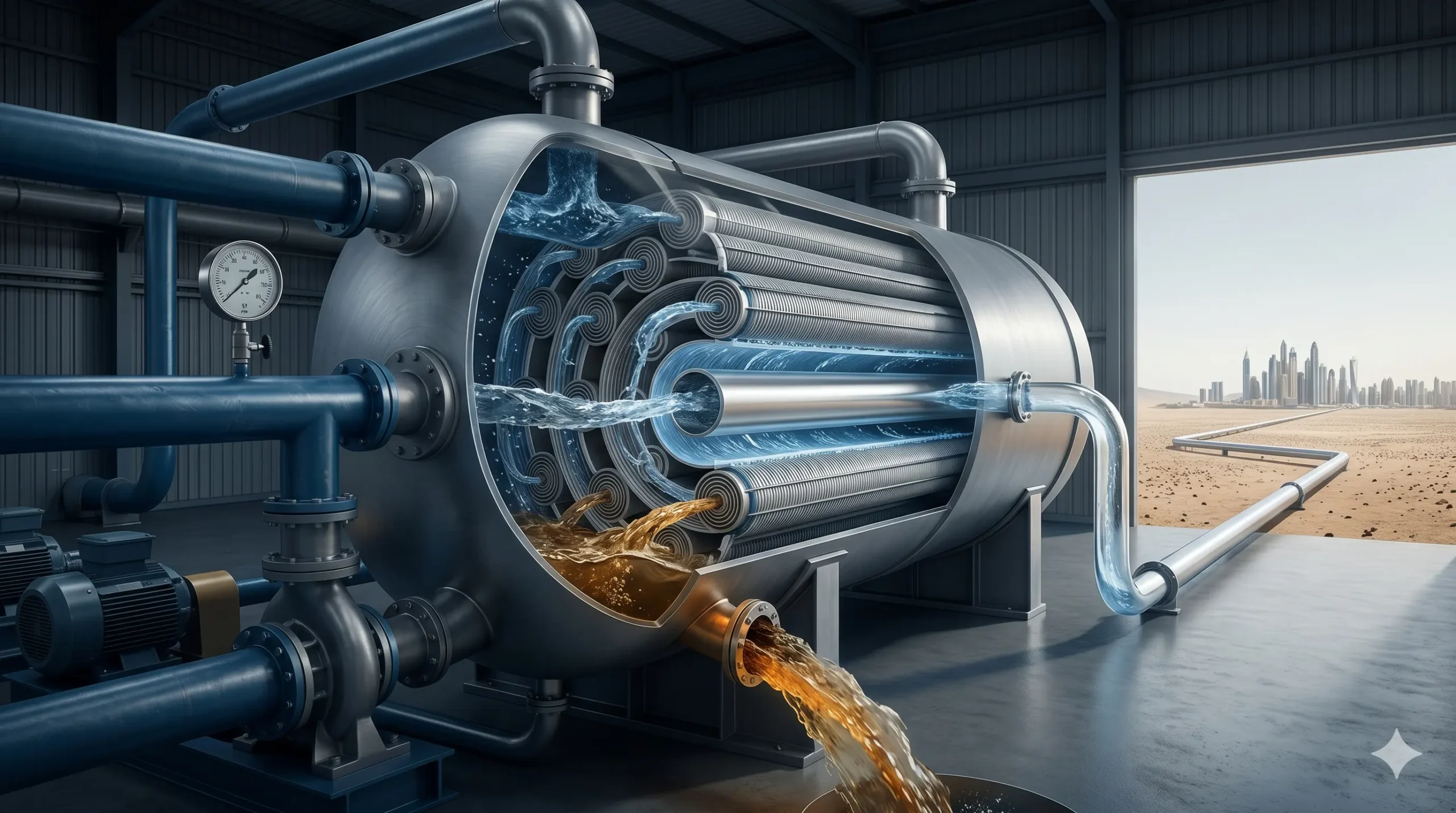
Desalination plants push seawater through spiral-wound pressure vessels. These vessels contain thin-film composite membranes, dominated by an ultra-thin polyamide barrier resting on a porous polysulfone support. The polyamide layer acts as a molecular sieve, allowing water molecules to slide through its intermolecular spaces while rejecting dissolved sodium and chloride ions.
This separation requires overcoming natural osmotic pressure. To force water molecules to flow against their natural thermodynamic gradient, massive high-pressure pumps must apply mechanical pressures exceeding 70 bar.
The baseline osmotic pressure of seawater follows the van ‘t Hoff equation:
Where $\Pi$ represents the osmotic pressure, $i$ is the dimensionless van ‘t Hoff factor, $M$ is the molar solute concentration, $R$ is the ideal gas constant, and $T$ is the absolute temperature. Pressurizing seawater beyond this limit forces pure water to flow into the collection tube, leaving concentrated brine behind.

As clean water passes through the barrier, rejected ions accumulate directly against the feed side of the membrane. This localized boundary layer is concentration polarization. The salt concentration at this boundary exceeds that of the bulk seawater stream, dramatically increasing the localized osmotic pressure.
This polarization degrades system performance. It forces pumps to expend more mechanical energy to maintain baseline flow rates. More dangerously, the elevated salt concentration triggers chemical scaling, where minerals like calcium sulfate precipitate directly onto the polyamide matrix, permanently clogging the nanoscopic pores.
WHY IT MATTERS NOW
Climate shifts and groundwater depletion threaten regional stability across the globe. Arid nations, particularly in the Middle East and North Africa, rely on seawater reverse osmosis for up to 90 percent of their municipal drinking water.
Saudi Arabia’s massive infrastructure expansion, exemplified by the Jubail 3A plant, highlights this absolute structural dependence. These gigawatt-scale projects require continuous energy inputs to sustain high operating pressures.
Consequently, water security is directly tethered to the domestic energy grid. If energy prices spike or grid infrastructure fails, municipal water reservoirs deplete within days, turning thermodynamic separation limits into an existential survival bottleneck.
As global population growth outpaces natural aquifers, the demand for high-efficiency membranes is surging. Companies like DuPont and Toray Industries dominate this specialized polymer supply chain, turning membrane fabrication into a highly concentrated geopolitical resource node.
WHAT MOST PEOPLE MISS
Pop science platforms praise desalination as an endless environmental cure-all. They ignore the brutal physical reality that reverse osmosis plants operate on a razor-thin margin dictated entirely by membrane degradation.
The actual operational bottleneck is not building larger intakes, but managing the thermodynamic boundary layer. When concentration polarization runs unchecked, it accelerates chemical scaling, requiring aggressive chemical washes with harsh acids.
This clean-in-place cycle physically degrades the polyamide chains, forcing operators to execute expensive, premature membrane replacements that destroy the facility’s economic viability.
THE TRAJECTORY
Next 12–36 Months: Desalination operators will widely deploy automated antiscalant dosing systems integrated with real-time pressure sensors. These systems dynamically adjust chemical feeds to mitigate localized polarization before scaling layers can crystallize.
Next Five Years: Material scientists will scale the manufacturing of graphene oxide and carbon nanotube composite membranes. These nanomaterials offer up to double the water permeability of standard polyamide, drastically reducing the baseline energy requirements of reverse osmosis.
Next Ten Years: Arid nations will integrate co-located nuclear reactors to power massive desalination complexes directly. This baseline energy integration isolates municipal water production from volatile global fossil fuel markets, securing thermodynamic sovereign survival.
What Could Go Wrong: A sudden surge in marine algal blooms or plastic microparticles can overwhelm pre-filtration systems. This debris directly coats the polyamide active layer, causing rapid, irreversible physical fouling that forces a complete shutdown of regional municipal water supplies.
Most Likely Outcome: Seawater reverse osmosis will remain the un-substitutable anchor of Middle Eastern and North African civilization. High-efficiency membrane replacements will transition into a strategic sovereign asset class, heavily stockpiled by governments to defend against supply chain disruptions.
KEY TERMS
- Concentration Polarization: The accumulation of rejected salt ions at the membrane-solution interface, which increases local osmotic pressure and accelerates scaling.
- Thin-Film Composite: A multi-layered membrane structure combining an ultra-thin active polyamide barrier with a porous backing material to handle high operating pressures.
- Desalination: The industrial process of extracting mineral components and dissolved salts from saline water to produce potable municipal water.
- Chemical Scaling: The precipitation and crystallization of dissolved mineral salts onto a membrane surface, permanently restricting the flow of purified water.
- Osmotic Pressure: The minimum pressure required to prevent the inward flow of pure solvent across a semi-permeable membrane.
SOURCES
- DuPont Water Solutions — FilmTec Seawater Reverse Osmosis Element Design Manual
- Toray Industries — Advanced Membrane Technologies for Seawater Desalination
- Environmental Protection Agency (EPA) — Seawater Desalination Technology and Regulatory Assessment
- Journal of Membrane Science — Thermodynamics of Concentration Polarization in Thin-Film Composite Membranes