Advertisement
)


When a human reads a dense academic textbook, they do not read every single word with the exact same level of mental exertion. The brain naturally skips over prepositions, conjunctions, and simple connecting phrases, saving its cognitive energy for the complex nouns, formulas, and core arguments. For the first decade of the deep learning revolution, artificial intelligence was entirely incapable of this basic efficiency. When you prompt a traditional Large Language Model (LLM) with a paragraph of text, the system blindly forces every single token—from a simple comma to a dense line of Python code—through every single layer of its massive neural network. The model spends billions of mathematical operations “thinking” about a period at the end of a sentence.
This uniform distribution of compute is thermodynamically insane, and it is the primary reason AI data centers are rapidly exhausting the power grids of entire cities. Why should you care right now? Because AI researchers have fundamentally solved this inefficiency. By implementing an architecture known as “Mixture of Depths” (MoD), scientists have taught neural networks how to dynamically route their own computing power, processing difficult concepts while instantly bypassing the easy ones. This breakthrough is slashing the cost of AI inference, accelerating generation speeds, and completely redefining the physical limits of hyperscale cloud computing.
What is Mixture of Depths (MoD)?
Mixture of Depths (MoD) is a neural network architecture that dynamically allocates computational resources during inference. It utilizes a routing algorithm to evaluate each token in a sequence, sending complex tokens through a transformer layer for processing while forcing simpler tokens to bypass the layer via a residual connection, significantly reducing total FLOPs.
At a Glance
- Concept: Teaching a language model to identify “easy” words and “hard” words, and then skipping the mathematical processing for the easy ones.
- Why it matters: Standard models waste immense electricity treating every word equally. MoD can cut the computational math required for a prompt by up to 50% without making the AI any less intelligent.
- Who uses it: DeepMind (Google), leading MLOps engineers, and open-source AI researchers attempting to run frontier-level models on highly constrained hardware.
- Biggest takeaway: Earlier attempts to do this crashed GPUs because GPUs hate unpredictability. MoD succeeds because it enforces a strict budget: it forces the AI to pick exactly the top 50% most important tokens to process, keeping the math perfectly aligned for GPU hardware.
In Simple Words
Imagine a high-security airport screening checkpoint with 10 different security gates (the layers of an AI model).
In a Standard AI Model, every single passenger—from a suspicious individual carrying wires to a 90-year-old grandmother carrying a knitting needle—is forced to go through all 10 security gates. It takes an agonizing amount of time, the lines are miles long, and the security guards are exhausted.
In a Mixture of Depths (MoD) Model, there is a smart sorting agent standing in front of every gate. The agent looks at the passengers. The 90-year-old grandmother is routed to an express lane that completely bypasses the gate. The suspicious individual is pulled into the gate for a full, heavy-duty scan.
By the end of the airport, the grandmother might have only gone through 2 gates, while the suspicious passenger went through all 10. The airport remains highly secure, but the overall speed of the line is doubled, and the security guards only work when it actually matters.
Why This Matters
For Cloud Architects and MLOps Engineers, AI inference costs dictate the survival of software-as-a-service (SaaS) businesses.
If an enterprise AI application processes millions of documents daily, the cost of renting NVIDIA H100 GPUs becomes the primary threat to the company’s gross margins. MoD is a margin-expansion mechanism. Because an MoD model requires vastly fewer floating-point operations (FLOPs) per token, it allows a smaller, cheaper cluster of GPUs to generate text at the same speed and quality as a massively expensive supercomputer. It physically decouples the size of the language model from the cost to run it, allowing 100-billion-parameter models to operate with the agility of 10-billion-parameter models.
Conditional Computation: MoD vs. Mixture of Experts (MoE)
MoD is the logical evolution of “Conditional Computation.”
For years, the industry optimized the width of neural networks using Mixture of Experts (MoE), an architecture where tokens are routed to different specialized sub-networks (experts) within a layer. However, MoE models still force every token to do some work in every layer.
MoD attacks the depth of the network. It asks a more profound question: does this token need to be in this layer at all? By proving that language models over-compute heavily on structural syntax and under-compute on dense facts, MoD establishes that deep learning does not require uniform depth. The future of AI relies on extreme sparsity—activating only the precise neurons necessary for the specific millisecond of thought.
How Mixture of Depths (MoD) Top-k Routing Works
Routing tokens dynamically without breaking the rigid matrix multiplication required by modern GPUs is an intense algorithmic balancing act. Here is the first-principles breakdown of the architecture.
1. The Fundamental Problem: Isochronous Compute
A standard Transformer executes isochronous compute: the processing time is constant and identical for every input. If a sequence has N tokens and the model has L layers, the total computational cost is rigidly fixed. This creates a mathematically inefficient “compute bloat.”
2. The Insufficiency of Early Dynamic Routing
Previous researchers attempted to solve this by letting tokens “vote” on whether they wanted to be processed. The problem is that GPUs operate on dense, rectangular matrices. If 10 tokens want to be processed in Layer 1, but 90 tokens want to be processed in Layer 2, the shape of the data matrix constantly changes. This causes extreme memory fragmentation and pipeline stalling, ultimately making the “efficient” model run slower on the hardware than the bloated model.
3. The Core Mechanism: The Top-k Router
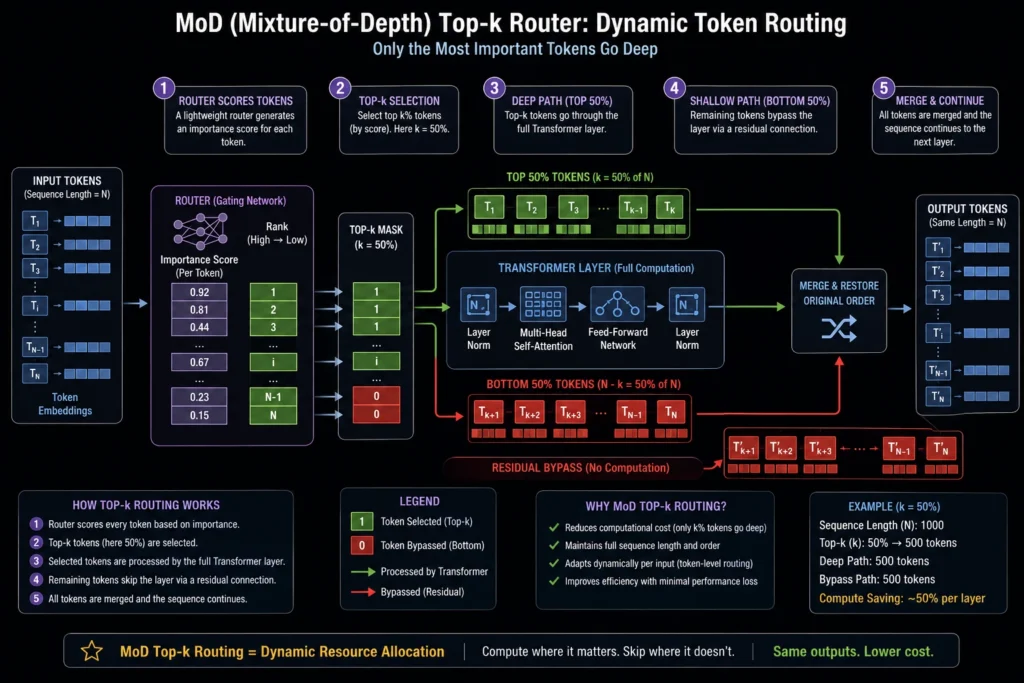
MoD solves the hardware problem by enforcing a strict capacity limit. At the beginning of a layer, a small linear router examines the tokens and assigns each a weight (a score of importance).
The network designer sets a hard limit: for example, a capacity (C) of 50%. The router then sorts the tokens and selects the top-k tokens that have the highest scores (where k = 50% of N).
4. Technical Depth: The Residual Bypass
The top-k tokens are multiplied by the layer’s weights, undergoing full self-attention and feed-forward processing.
The bottom 50% of the tokens do not disappear; they are routed through a residual connection. They simply carry their exact mathematical state from the previous layer directly into the next layer without any mathematical transformation.
x_(i+1) = Layer(x_i) [for top-k tokens]
x_(i+1) = x_i [for bypassed tokens]
5. Real-World Consequences: Static Graphs, Dynamic Compute
Because the capacity C is mathematically fixed before the model runs, the size of the matrix sent to the GPU never changes. The GPU always processes exactly 50% of the tokens. The compute is dynamic (different tokens skip different layers), but the computational graph remains perfectly static and rectangular. This allows the model to fully utilize Tensor Core speeds while artificially halving the total FLOPs executed per forward pass.
Real-World LLM Inference Applications for MoD
The deployment of MoD allows advanced AI to function in highly constrained environments.
On-Device Edge AI: Running a powerful LLM natively on a smartphone or a smart vehicle is heavily bottlenecked by battery drain and thermal throttling. Because MoD significantly reduces the active FLOPs required to process a prompt, it minimizes heat generation and power consumption, allowing flagship-tier reasoning models to be deployed directly onto mobile neural processing units (NPUs) without relying on cloud connectivity.
Massive Context Window Summarization: When an enterprise user uploads a 500-page PDF for the AI to summarize, standard attention mechanisms crash due to memory limits. Because MoD models can be trained to aggressively route background text (like page numbers, boilerplate legal text, and simple prepositions) into the residual bypass, the model can ingest vastly larger context windows while isolating its heavy computational power exclusively for the core arguments of the text.
Real-Time Multimodal Processing: In video or audio streaming, many frames or milliseconds of sound contain almost zero new information (e.g., a static background or a pause in speaking). MoD architectures deployed in multimodal systems can dynamically bypass the processing of these static frames, allocating compute only when the visual or auditory scene drastically shifts, ensuring zero-latency real-time AI generation.
Economic & Strategic Impact
The transition to MoD permanently shifts the economics of Training vs. Inference Compute.
Implementing MoD actually makes training the model slightly more difficult. The model must learn how to predict the next word, but it must simultaneously learn a second task: learning which tokens are important enough to route to the experts. This dual-optimization requires specialized training regimens and slightly more initial compute time.
However, a foundation model is only trained once, but it performs inference billions of times. For tech hyperscalers (Google, Microsoft, Meta), sacrificing a 10% increase in upfront training costs to secure a permanent 50% reduction in daily inference costs is an ultimate economic arbitrage. The strategic dominance of an AI firm will no longer be dictated purely by who has the most GPUs, but by who possesses the most aggressive, hardware-friendly conditional routing algorithms.
Advantages
- Substantial Inference Cost Reduction: Reduces the total FLOPs per forward pass by up to 50% compared to a baseline model, drastically lowering cloud hosting expenses.
- Hardware-Friendly Sparsity: By enforcing a strict top-k capacity limit, the architecture guarantees a static computation graph, avoiding the GPU memory fragmentation that plagued older dynamic models.
- Decoupled Parameter Weight: Allows developers to deploy models with massive parameter counts (high latent knowledge) that operate with the speed and latency of a much smaller model.
Limitations
- KV Cache Complexity: In traditional models, every token creates a Key-Value (KV) cache entry in every layer. If an MoD model skips a layer, there is no updated KV entry for that token, forcing engineers to develop complex memory-retrieval workarounds for autoregressive generation.
- Training Instability: Training the router to correctly identify which tokens to skip is inherently unstable. If the router mistakenly bypasses a critical negation word (like “not”), the model’s entire output is mathematically ruined.
- Predictability: Because the latency of the model depends on how many tokens are bypassed versus processed, predicting the exact millisecond response time for a specific prompt becomes difficult, complicating strict Service Level Agreement (SLA) guarantees for enterprise APIs.
Common Misconceptions
Misconception: MoD makes the AI less intelligent because it skips data.
Reality: Empirical tests by DeepMind show that an MoD model trained with a specific FLOP budget achieves lower loss (higher accuracy) than an isochronous baseline model trained with the exact same budget. The model actually gets smarter because it can spend its limited budget entirely on the difficult parts of the problem.
Misconception: Mixture of Depths (MoD) is the same as Mixture of Experts (MoE).
Reality: They manipulate different dimensions. MoE is about width—a token is processed, but the router decides which specialized sub-network processes it. MoD is about depth—the router decides if the token should be processed at all, or if it should skip the layer entirely.
Misconception: Bypassed tokens are deleted.
Reality: The tokens are not deleted from the sequence. They are simply pushed through a residual connection (a mathematical bypass lane). Their previous mathematical state is preserved and carried forward to the next layer untouched.
What Most People Miss
The inevitable synthesis of MoE and MoD (Sparse Architectures).
Most analysts debate whether MoD or MoE is the superior architecture. What they miss is that the technologies are mathematically orthogonal and perfectly complementary.
The ultimate end-state of the LLM architecture is the integration of both. A router will first look at a token. MoD logic will dictate: Does this token need processing? If no, it skips the layer. If yes, MoE logic will take over: Which expert should process this? By stacking depth sparsity (MoD) on top of width sparsity (MoE), researchers can theoretical create models with trillions of parameters that utilize fewer active FLOPs than a standard 7-billion parameter model, achieving artificial general intelligence (AGI) scale without requiring the energy output of a nuclear reactor.
Comparison Table
| Feature | Standard Transformer | Mixture of Experts (MoE) | Mixture of Depths (MoD) |
| Compute Allocation | Uniform (100% of tokens) | Selective (Specific experts) | Selective (Skip layers entirely) |
| Sparsity Type | None (Dense) | Width Sparsity | Depth Sparsity |
| Total FLOPs per Token | Very High | Moderate | Very Low |
| Hardware Efficiency | Perfect | Moderate (Load balancing issues) | High (Due to capacity limits) |
| Model Size vs Speed | Linearly coupled | Decoupled | Heavily Decoupled |
Case Study
Situation: As Google DeepMind scaled its language models, the computational waste of isochronous compute became undeniable. Training and deploying models where every token utilized the same FLOP budget inherently restricted the scale of context windows and bottlenecked inference throughput.
Challenge: Develop a conditional computation architecture that allowed the model to dynamically skip layers without breaking the static, predictable matrix multiplications required to run efficiently on Google’s Tensor Processing Units (TPUs).
Solution (The MoD Paper, 2024): DeepMind researchers published the foundational MoD methodology. They implemented a top-k routing mechanism within the transformer blocks. They strictly capped the capacity of each layer (e.g., allowing only 12.5% to 50% of the sequence to participate in self-attention and MLP blocks).
Outcome: The results proved that MoD models could match the baseline performance of standard dense models while requiring significantly fewer FLOPs per forward pass. Furthermore, for a given training compute budget, the MoD models demonstrated superior performance to their dense counterparts. The researchers successfully proved that depth sparsity could be trained reliably without causing hardware fragmentation.
Lessons Learned: The breakthrough validated that neural networks possess immense, untapped latency optimization. By treating compute as a routing problem rather than a pure scaling problem, DeepMind established that the future of efficiency lies in forcing models to consciously budget their own cognitive energy on a token-by-token basis.
Future Outlook
Next 12–24 Months
The era of Open-Source Integration and Hardware Kernels. In the short term, open-source communities (like HuggingFace and Mistral) will aggressively integrate MoD architectures into smaller 7B to 13B parameter models. Simultaneously, NVIDIA and AMD will release specialized CUDA kernels optimized specifically for residual bypass routing. This will smooth out the memory-retrieval complexities of the KV cache, making MoD the default architectural choice for any developer attempting to deploy an LLM on consumer-grade hardware.
Next 3–5 Years
The scaling of MoD/MoE Hybrid Megamodels. By the late 2020s, hyperscalers (OpenAI, Anthropic, Google) will exclusively train hybrid models combining Mixture of Depths and Mixture of Experts. These models will boast parameter counts in the tens of trillions but will only activate a microscopic fraction of their network per token. This extreme, dual-axis sparsity will finally arrest the exponential growth curve of AI data center energy consumption, allowing cloud providers to scale their user bases without constantly triggering localized power grid failures.
Next 10 Years
The Continuous Asymmetric Thought Process. By the mid-2030s, the concept of sequential layers will dissolve into a fully continuous, asymmetric processing graph. Future architectures will not just route tokens through pre-defined layers; they will utilize recurring, dynamic loops. A highly complex mathematical prompt might be routed through the exact same logic “expert” fifty times in a row, while a simple greeting bypasses the entire network instantly. The AI will functionally possess a “System 1” (fast, instinctual) and “System 2” (slow, deliberative) thinking apparatus, mirroring human cognitive psychology and achieving unprecedented thermodynamic efficiency.
Most Likely Scenario
Mixture of Depths is a mandatory structural evolution. The sheer physical limits of silicon manufacturing and data center power transmission demand it. Standard dense transformers will be viewed historically as brute-force, inefficient prototypes. The ability to dynamically route compute based on context difficulty will become the foundational law of all future neural network designs.
Key Takeaways
- Mixture of Depths (MoD) allows a neural network to dynamically skip mathematical processing for simple tokens (like “the”) while focusing heavy compute on complex tokens.
- Standard Transformers waste massive amounts of electricity because they force every single token through every single layer of the network (isochronous compute).
- MoD uses a “router” to score the importance of each token. The most important tokens go into the layer for processing; the rest bypass the layer via a residual connection.
- To prevent GPU crashes, MoD uses a strict “capacity limit” (e.g., exactly 50% of tokens are processed). This keeps the mathematical matrices perfectly rectangular and hardware-friendly.
- The architecture reduces the computational load (FLOPs) of an AI model by up to 50%, massively lowering cloud hosting costs and speeding up generation without sacrificing intelligence.
- While Mixture of Experts (MoE) optimizes the width of a network (routing to different sub-networks), MoD optimizes the depth (routing around the network entirely).
Glossary
Capacity Limit: A hard mathematical ceiling in MoD (e.g., 50%) that dictates exactly how many tokens are allowed into a layer. This ensures the GPU doesn’t crash from unpredictable matrix sizes.
Conditional Computation: The broader concept in deep learning where a neural network dynamically chooses which parts of its architecture to activate based on the input it receives.
FLOPs (Floating Point Operations): The basic unit of mathematical computation in an AI model. More FLOPs mean more time, money, and electricity consumed.
Isochronous Compute: The inefficient baseline of traditional AI models, where the exact same amount of compute is applied universally to every input, regardless of complexity.
Mixture of Experts (MoE): An architecture where a token is processed, but it is routed to a specialized sub-network (an “expert”) rather than the whole network.
Residual Connection: A mathematical shortcut or “bypass lane.” In MoD, skipped tokens are sent down this lane, carrying their data to the next layer entirely untouched.
Sources
DeepMind / arXiv: Mixture-of-Depths: Dynamically allocating compute in transformer-based language models (Raposo et al., April 2024)
Hugging Face Papers: Mixture of Depths Explained
AI Engineering / Medium: DeepMind’s New Mixture of Depths (MoD) Architecture
Towards Data Science: Understanding Mixture of Depths in LLMs
Analytics Vidhya: Conditional Computation and the Future of Sparse Transformers