Advertisement
)
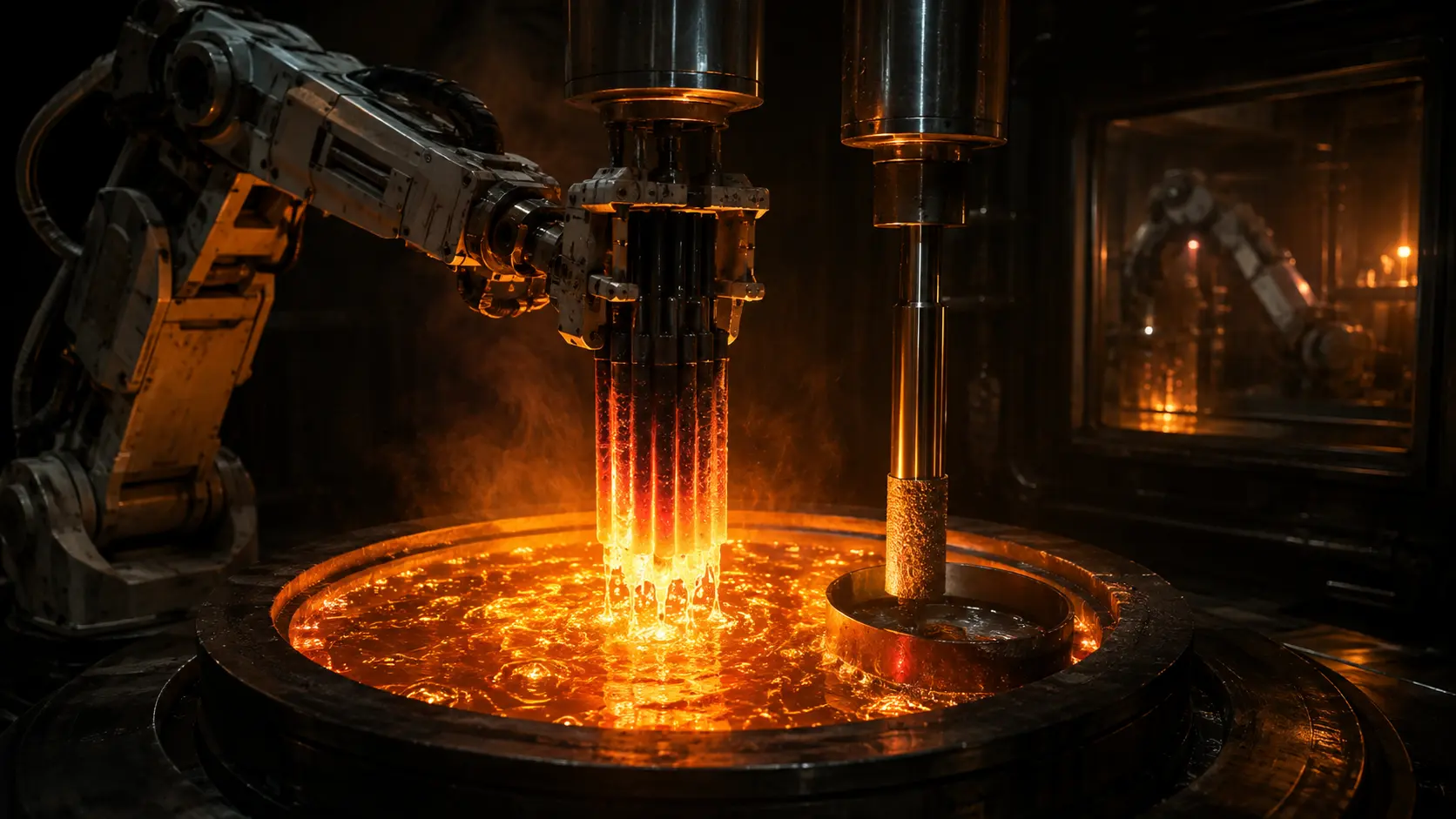

The global nuclear energy industry is paralyzed by a 300,000-ton problem. Decades of operating traditional nuclear power plants have resulted in mountains of spent nuclear fuel, currently sitting in concrete dry casks at power plants around the world. Because this waste remains dangerously radioactive for hundreds of millennia, governments have spent billions trying—and largely failing—to build deep geological repositories to bury it. But branding this material as “waste” is a profound thermodynamic tragedy. A standard nuclear reactor only burns about 5% of the energy inside a fuel rod before it is discarded. The remaining 95% of the energy is still locked inside the cask.
Why should you care right now? Because advanced energy planners are realizing that we do not need to bury this material; we need to recycle it. To do so without risking global nuclear weapons proliferation, scientists are commercializing a technology known as Nuclear Pyroprocessing. By dunking spent fuel into an electrified bath of 500°C molten salt, engineers can separate the usable fuel from the true waste. It is a revolutionary chemical architecture that promises to power the Earth for centuries using the “garbage” we already have, permanently closing the loop on the radioactive fuel cycle.
What is Nuclear Pyroprocessing?
Nuclear pyroprocessing is a high-temperature electrometallurgical technology used to recycle spent nuclear fuel. By applying an electrical current through a molten salt bath (typically LiCl-KCl), it separates reusable uranium and transuranic elements from fission products. The process co-recovers plutonium with highly radioactive isotopes, providing inherent resistance to nuclear weapons proliferation.
At a Glance
- Concept: Melting down radioactive nuclear waste in a scorching hot salt bath and using electricity to pull out the usable fuel, exactly like electroplating jewelry.
- Why it matters: It reduces the volume of high-level nuclear waste by up to 90%, and reduces the time it stays dangerously radioactive from 300,000 years down to just a few hundred years.
- Who uses it: Idaho National Laboratory (INL), the Korea Atomic Energy Research Institute (KAERI), and advanced fast-reactor startups evaluating closed-fuel-cycle economics.
- Biggest takeaway: Unlike old recycling methods that created pure, bomb-grade plutonium, pyroprocessing purposely extracts plutonium mixed with highly radioactive, lethal isotopes. This “dirty” mix works perfectly as fuel for advanced reactors, but is physically impossible to steal and turn into a weapon.
In Simple Words
Imagine you have a giant bucket of dirty, mixed-up Lego bricks (spent nuclear fuel). You want to pull out all the useful bricks (Uranium and Plutonium) to build a new spaceship, and throw away the broken, useless bricks (fission products).
The old way of doing this (Aqueous Reprocessing) involved pouring strong acid over the Legos to dissolve them, and carefully filtering out only the Plutonium bricks. The problem? If someone steals a bucket of pure Plutonium bricks, they can build a nuclear bomb.
Nuclear Pyroprocessing is a different approach. You dump the Legos into a vat of 500°C liquid salt and turn on an electromagnet. The magnet is specifically tuned to pull the Plutonium bricks, but it also grabs a bunch of glowing, highly radioactive, dangerous bricks at the exact same time. The resulting clump of bricks is impossible to hold, hide, or use for a bomb because it is too dangerously radioactive. However, if you drop that clump directly into a specialized, heavily shielded “Fast Reactor,” the reactor can burn those glowing bricks to generate massive amounts of clean electricity.
Why This Matters
For ESG Funds, Energy Policy Makers, and Nuclear Engineers, the lack of a permanent waste disposal solution is the primary political bottleneck preventing the construction of new nuclear power plants.
The political failure of deep geological repositories (like Yucca Mountain in the U.S.) has handed ammunition to anti-nuclear lobbyists. Pyroprocessing shifts the narrative from “waste disposal” to “resource harvesting.” By integrating pyroprocessing facilities directly with next-generation Sodium-Cooled Fast Reactors (SFRs), the industry transforms a geopolitical liability into a closed-loop, sustainable energy matrix. The fast reactor burns the recycled fuel, the pyroprocessing plant recycles the waste, and the cycle continues until the long-lived actinides are completely destroyed, leaving behind only a fraction of short-lived waste that is vastly cheaper and safer to manage.
PUREX vs. Nuclear Pyroprocessing: The Proliferation Barrier
To understand pyroprocessing, you must understand what it replaces: The PUREX Process.
Invented during the Cold War, PUREX (Plutonium Uranium Redox EXtraction) uses nitric acid to separate incredibly pure plutonium from spent fuel. The explicit goal of PUREX was to build nuclear weapons. While countries like France and Japan use modified PUREX to recycle commercial fuel, the U.S. banned commercial reprocessing in the 1970s precisely because it feared that expanding PUREX technology globally would lead to massive weapons proliferation.
Pyroprocessing was developed specifically to solve this geopolitical deadlock. Because the high-temperature molten salt chemistry makes it physically and thermodynamically impossible to isolate pure plutonium, pyroprocessing allows a nation to recycle its nuclear waste aggressively without violating non-proliferation treaties or raising the suspicions of the international intelligence community.
How Molten Salt Electrorefining Works
Separating elements based on their electrochemical potential in a 500°C corrosive liquid requires masterful manipulation of redox chemistry. Here is the first-principles breakdown of the architecture.
1. The Fundamental Problem: The Actinide Hazard
Spent nuclear fuel is highly radioactive because it contains Transuranic elements (Actinides like Plutonium, Neptunium, Americium, and Curium). These elements have half-lives extending tens of thousands of years. The goal is to extract these actinides so they can be fissioned (split) in a fast reactor, destroying them permanently.
2. The Core Mechanism: The Molten Salt Electrorefiner
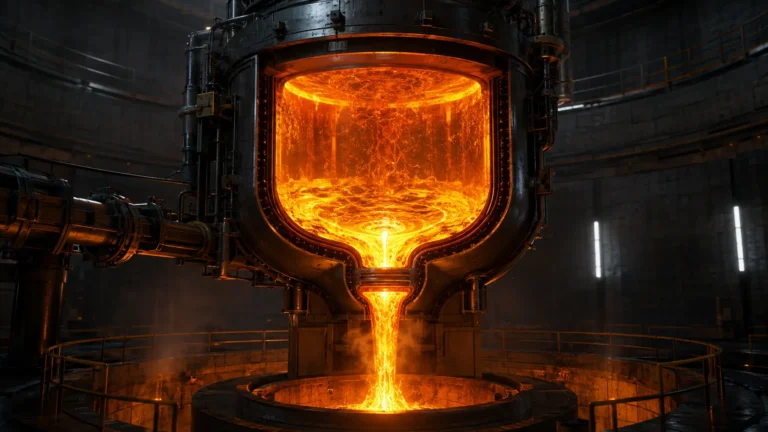
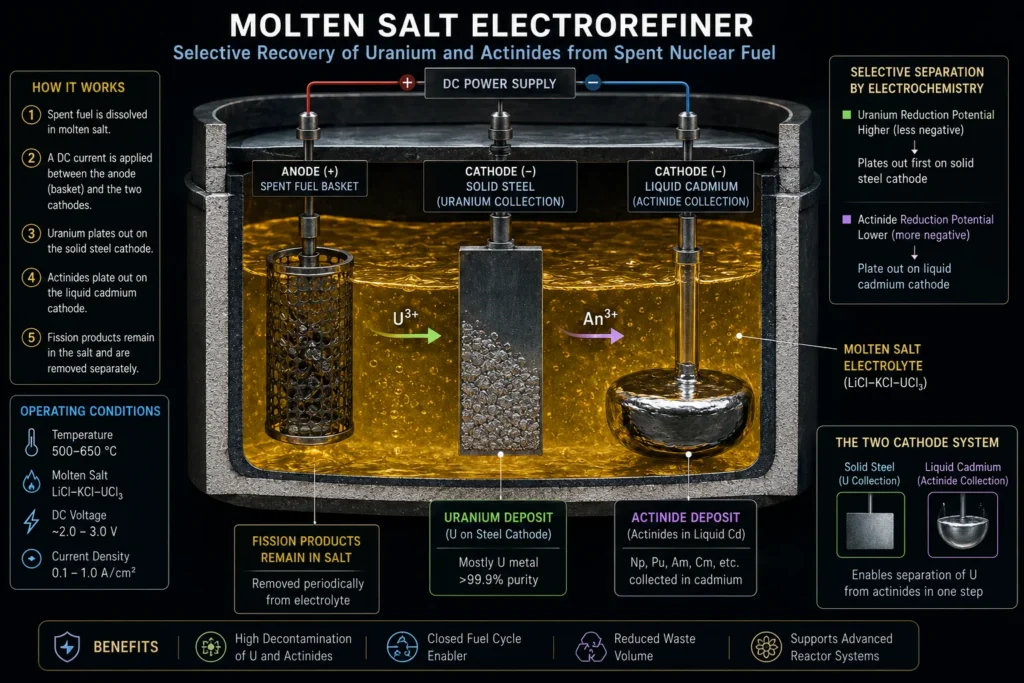
The heart of pyroprocessing is the electrorefiner. The spent fuel is chopped into pieces and placed in an anode basket. The basket is submerged in an electrolyte bath of molten lithium chloride-potassium chloride (LiCl-KCl) eutectic, heated to 500°C.
When an electrical potential is applied, the elements in the spent fuel oxidize (lose electrons) and dissolve into the liquid salt as positive ions (cations).
3. Technical Depth: Separation via Nernst Potential
Different elements require different amounts of voltage to be reduced (gain electrons) back into solid metals at the cathode. This is dictated by their standard reduction potentials (E°), governed by the Nernst equation:
E = E° + (RT/zF) * ln(a_oxidized / a_reduced)
Because Uranium has a specific reduction potential, engineers insert a solid steel cathode into the salt. The voltage is tuned precisely so that only pure Uranium (U³⁺) reduces onto the steel rod, forming beautiful, crystalline uranium metal.
4. Co-Recovery on the Liquid Cathode
To recover the plutonium and minor actinides, a solid steel cathode cannot be used, because their reduction potentials are too close to that of the rare-earth fission products. Instead, engineers use a Liquid Cadmium (or Bismuth) Cathode.
The liquid metal drastically alters the thermodynamic activity coefficients of the actinides. When voltage is applied, Plutonium, Americium, Neptunium, and Curium drop out of the salt and dissolve directly into the liquid cadmium pool simultaneously.
5. Real-World Consequences: The Proliferation Barrier
Because the liquid cathode chemistry cannot differentiate between Plutonium and the highly radioactive minor actinides (like Curium), they are recovered as one inseparable, extremely radioactive metallic lump. This material is lethal to handle without massive robotic hot-cells. A rogue state or terrorist organization cannot use this lump for a weapon; but an advanced Sodium-Cooled Fast Reactor (SFR) will happily consume it to generate power.
Commercial and Pilot Pyroprocessing Facilities
While not yet operating at commercial gigawatt scale, pyroprocessing is the foundational technology of several advanced nuclear programs.
The Integral Fast Reactor (IFR) Legacy: Between 1984 and 1994, Argonne National Laboratory operated the EBR-II (Experimental Breeder Reactor II) in Idaho. This was the ultimate proof-of-concept for the closed fuel cycle. The facility generated electricity, took its own spent metallic fuel, pyroprocessed it in an attached facility, and put the recycled fuel right back into the reactor. Although the program was prematurely cancelled for political reasons, the Fuel Conditioning Facility at Idaho National Laboratory (INL) continues to pyroprocess the legacy EBR-II fuel today to neutralize its hazards.
South Korea’s KAERI Program: South Korea relies heavily on nuclear power but has extremely limited landmass for geological repositories. The Korea Atomic Energy Research Institute (KAERI) has partnered extensively with the U.S. to develop pilot-scale pyroprocessing facilities. By transitioning from oxide fuel (standard in commercial reactors) to metallic fuel via electrolytic reduction, KAERI aims to dramatically shrink its high-level waste footprint and feed future fast-reactor fleets.
Advanced Micro-Reactors (Oklo / TerraPower): Next-generation nuclear startups recognize the value of the 300,000 tons of existing spent fuel. Companies developing liquid metal-cooled fast reactors are designing their core physics specifically to burn the High-Assay Low-Enriched Uranium (HALEU) and transuranic metallic alloys that are the direct outputs of the pyroprocessing cycle, establishing a market demand for recycled fuel.
Economic & Strategic Impact
The implementation of pyroprocessing fundamentally alters the Economics of the Nuclear Fuel Supply Chain.
Currently, the nuclear industry operates on a “Once-Through” cycle. Uranium is mined, enriched, burned once, and buried. This requires continuous geopolitical reliance on uranium mining (heavily concentrated in Kazakhstan, Canada, and Russia) and enrichment facilities (dominated by Rosatom).
Pyroprocessing creates an internal, domestic fuel loop. By recovering the transuranic elements and unfissioned uranium, a nation can fuel its fast reactors for centuries using only the spent fuel it already has sitting in dry casks. This severs the nation’s reliance on imported uranium ore and foreign enrichment services, transforming historical nuclear waste from an environmental liability into the ultimate strategic asset for sovereign energy independence.
Advantages
- Proliferation Resistance: The process inherently co-recovers plutonium with highly radioactive minor actinides, making the theft and weaponization of the material virtually impossible without dying of radiation sickness.
- Waste Volume Reduction: By removing the long-lived actinides to be burned in a reactor, the remaining true waste (fission products) is drastically smaller in volume and only requires geological storage for roughly 300 years, compared to 300,000 years for untreated fuel.
- Compact Facility Footprint: Unlike aqueous PUREX plants, which require massive footprints to house thousands of miles of piping for liquid solvents, pyroprocessing relies on dense, high-temperature electrometallurgy. The entire electrorefining process can occur inside compact, heavily shielded hot-cells, vastly reducing capital expenditure (CapEx).
Limitations
- Highly Corrosive Environment: Molten chloride salts at 500°C are incredibly aggressive. The metal alloys used to build the crucibles, pipes, and electrodes degrade rapidly over time, leading to high maintenance costs and frequent replacement of highly radioactive hardware.
- Batch Processing Inefficiency: Pyroprocessing is fundamentally a “batch” process (loading a basket, running the current, emptying the basket). It lacks the continuous, flowing throughput efficiency of aqueous chemical plants, creating bottlenecks when attempting to scale to thousands of tons per year.
- Front-End Oxide Reduction: 99% of the world’s spent nuclear fuel is Oxide fuel (UO₂), not metal fuel. Pyroprocessing works best on metals. Therefore, commercial LWR waste must first undergo a highly complex, energy-intensive “electrolytic reduction” step to strip the oxygen away before it can enter the electrorefiner, adding massive costs to the workflow.
Common Misconceptions
Misconception: Pyroprocessing produces clean, safe material that you can hold in your hand.
Reality: The entire point of pyroprocessing is that the output is highly, lethally radioactive. It is safe from a proliferation standpoint (terrorists can’t steal it), but it is incredibly dangerous from a biological standpoint. All operations, manufacturing, and refueling must be done remotely by robots inside thick concrete “hot cells.”
Misconception: We can pyroprocess waste and put it back into standard nuclear plants.
Reality: Standard Light Water Reactors (LWRs) operate on “thermal” slow neutrons. They choke on the transuranic mix produced by pyroprocessing. The recycled fuel must be used in a “Fast Reactor” (where fast-moving neutrons can easily split the heavy, complex actinides).
Misconception: Pyroprocessing solves the waste problem immediately.
Reality: Even with a perfect pyroprocessing facility, you still produce true waste—fission products (like Cesium and Strontium) and contaminated chloride salts. While the volume and lifespan are drastically reduced, a deep geological repository is still required for the final, neutralized byproducts.
What Most People Miss
The integration of Zeolite Salt-Waste Immobilization.
One of the great criticisms of pyroprocessing is: What do you do with the highly radioactive, corrosive chloride salt bath once it gets too dirty to use?
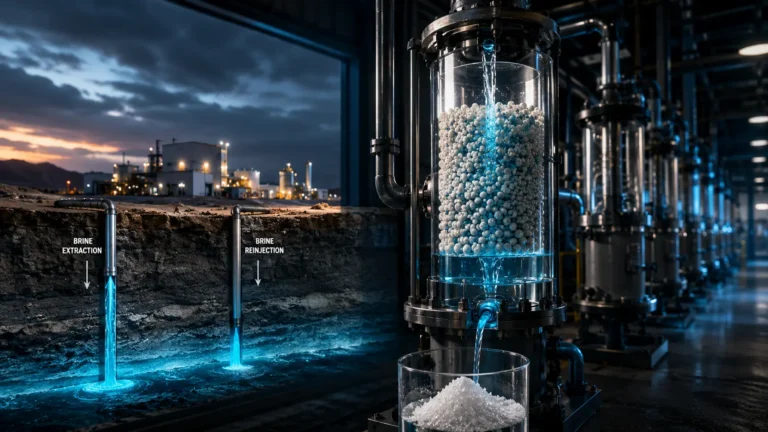
What most analysts miss is the elegant material science of Zeolites. Engineers have developed processes to take the spent, highly radioactive LiCl-KCl salt and blend it with zeolite (a highly porous, volcanic mineral). The zeolite structure acts like a microscopic cage, trapping the radioactive salt molecules inside its lattice. When heated, the zeolite turns into a dense, solid, glass-like ceramic block (sodalite). This chemically locks away the fission products in an incredibly stable, waterproof form that is perfectly suited for long-term geological burial, solving the secondary waste stream problem.
Comparison Table
| Feature | Once-Through (Direct Disposal) | Aqueous Reprocessing (PUREX) | Pyroprocessing |
| Separation Medium | None | Liquid Nitric Acid & Solvents | Molten Salt (LiCl-KCl) |
| Operating Temp | Ambient | Room Temperature | High (~500°C) |
| Pure Plutonium Isolated? | No (Stays in rod) | Yes (High Proliferation Risk) | No (Co-recovered with Actinides) |
| Compatible Reactor | LWRs | LWRs (as MOX fuel) | Fast Reactors (SFRs) |
| Facility Footprint | Massive (Geological mine) | Massive (Chemical plant) | Compact (Robotic Hot-Cells) |
Case Study
Situation: The United States government officially abandoned the commercial reprocessing of spent nuclear fuel via the PUREX method in the late 1970s due to the severe risks of global plutonium proliferation. However, to advance nuclear energy sustainably, the U.S. still needed a way to close the fuel cycle without creating a pathway to weapons manufacturing.
Challenge: Prove that a non-aqueous, proliferation-resistant recycling method could successfully separate fissile material from fission products, manufacture new fuel rods, and generate power in a continuous, closed-loop ecosystem.
Solution (The Integral Fast Reactor at INL): Argonne National Laboratory developed the Integral Fast Reactor (IFR) concept, physically realized at the Experimental Breeder Reactor II (EBR-II) site in Idaho. They built a localized Fuel Conditioning Facility (FCF) directly adjacent to the reactor dome. The FCF utilized remote-controlled robotic manipulators inside heavy hot-cells to execute high-temperature electrorefining on the spent metallic fuel pulled directly from the reactor core.
Outcome: The facility successfully demonstrated the complete pyroprocessing loop. It routinely took highly radioactive spent fuel, dissolved it in molten salt, electrochemically separated the actinides, cast new metallic fuel pins, and returned them to the reactor to generate electricity. It proved that pure plutonium was never isolated at any point in the cycle, flawlessly addressing the proliferation concerns of the U.S. government.
Lessons Learned: The EBR-II/FCF demonstration proved that pyroprocessing works exceptionally well for metallic fuels and that co-locating the recycling facility with the reactor eliminates the dangerous transportation of radioactive material. Despite the program’s political cancellation in 1994, the data generated established the undeniable baseline for all modern fast-reactor startups attempting to revive the closed fuel cycle in the 21st century.
Future Outlook
Next 12–24 Months
The era of HALEU Security and Oxide Reduction Scaling. The immediate bottleneck for advanced reactors is securing High-Assay Low-Enriched Uranium (HALEU). As geopolitical tensions restrict Russian enrichment supply, the U.S. Department of Energy (DOE) is accelerating funding to extract HALEU from existing domestic spent fuel stockpiles. Over the next two years, significant capital will flow into optimizing “electrolytic reduction”—the difficult preliminary step required to turn standard oxide fuel (UO₂) into metallic fuel so it can enter a pyroprocessing electrorefiner, bridging the gap between legacy LWR waste and future fast-reactor fuel.
Next 3–5 Years
The scaling of Commercial Fast Reactor Integration. By the late 2020s, advanced reactor developers (like TerraPower’s Natrium reactor) will transition from paper designs to physical construction. Because these Sodium-Cooled Fast Reactors are designed to burn the exact metallic transuranic alloys produced by pyroprocessing, the market demand for electrometallurgical recycling will officially materialize. We will see the first commercial partnerships between private nuclear startups and national laboratories to license and construct small, modular pyroprocessing hot-cells directly adjacent to these new reactor sites.
Next 10 Years
The Closure of the Global Fuel Cycle. By the mid-2030s, the paradigm of the “nuclear waste dump” will be obsolete. Advanced nuclear nations will view dry cask storage sites not as toxic burdens, but as strategic energy reserves. Standardized, commercial-scale pyroprocessing facilities will operate as automated, robotic foundries. They will consume the 300,000 tons of legacy LWR waste, feeding a global fleet of fast reactors that produce zero-carbon baseload electricity for centuries, permanently neutralizing the long-lived actinide hazard and fulfilling the original, limitless promise of the atomic age.
Most Likely Scenario
Pyroprocessing will not replace the traditional uranium enrichment supply chain overnight; it will serve as the necessary back-end solution for the next generation of nuclear power. Because it inherently solves the dual political nightmares of the nuclear industry—weapons proliferation and 300,000-year waste burial—pyroprocessing is the inevitable, mandatory chemical architecture required to sustain a global nuclear renaissance.
Key Takeaways
- Nuclear pyroprocessing uses a 500°C molten salt bath and electricity to separate usable fuel (actinides) from useless waste (fission products) in spent nuclear fuel.
- Unlike traditional PUREX recycling, pyroprocessing is “proliferation-resistant.” It is chemically incapable of isolating pure plutonium, meaning terrorists or rogue states cannot use the output to build a nuclear bomb.
- The resulting mix of plutonium and highly radioactive minor actinides serves as the perfect fuel for advanced Sodium-Cooled Fast Reactors (SFRs).
- By extracting and burning the long-lived actinides, pyroprocessing reduces the time nuclear waste remains dangerously radioactive from 300,000 years down to just 300 years.
- Because the entire process uses intensely radioactive materials, it must be performed inside heavily shielded “hot cells” entirely by robotic manipulators.
- The technology was successfully proven at the pilot scale during the Integral Fast Reactor (IFR) program at Idaho National Laboratory, and is currently the primary focus for managing future fast-reactor fuel cycles.
Glossary
Actinides: A series of heavy, radioactive elements on the periodic table (including Uranium, Plutonium, Americium). They are the primary source of long-term radioactivity in nuclear waste and the prime targets for recycling.
Electrorefining: The core step of pyroprocessing where an electrical current drives elements from an impure metal anode through a molten salt electrolyte, depositing pure elements onto a cathode based on their specific voltage potentials.
Fast Reactor: An advanced nuclear reactor that uses high-speed (“fast”) neutrons to sustain the chain reaction. Unlike standard reactors, they can easily split (fission) the complex, dirty actinide mix produced by pyroprocessing.
LiCl-KCl Eutectic: A specific mixture of Lithium Chloride and Potassium Chloride salts that has a lower melting point than either salt individually. It becomes a highly conductive liquid at ~500°C, serving as the bath for pyroprocessing.
PUREX (Plutonium Uranium Redox EXtraction): The traditional, aqueous method of recycling nuclear fuel using nitric acid. It isolates pure plutonium, making it a severe weapons proliferation risk.
Transuranic Elements: Elements with an atomic number greater than Uranium (92), such as Plutonium (94) and Americium (95). They are man-made inside the reactor during operation.
Sources
PapersFlow: Pyroprocessing Technology for Nuclear Fuel: Research Guide
INIS-IAEA: Pyrometallurgical processing of Integral Fast Reactor metal fuels
Idaho National Laboratory (INL): Analysis of Nuclear Proliferation Resistance Reprocessing and Recycling Technologies
University of Manchester / Research Explorer: Molten salt spectroscopy and electrochemistry for spent nuclear fuel treatment
Wikipedia: Nuclear reprocessing