
AT A GLANCE
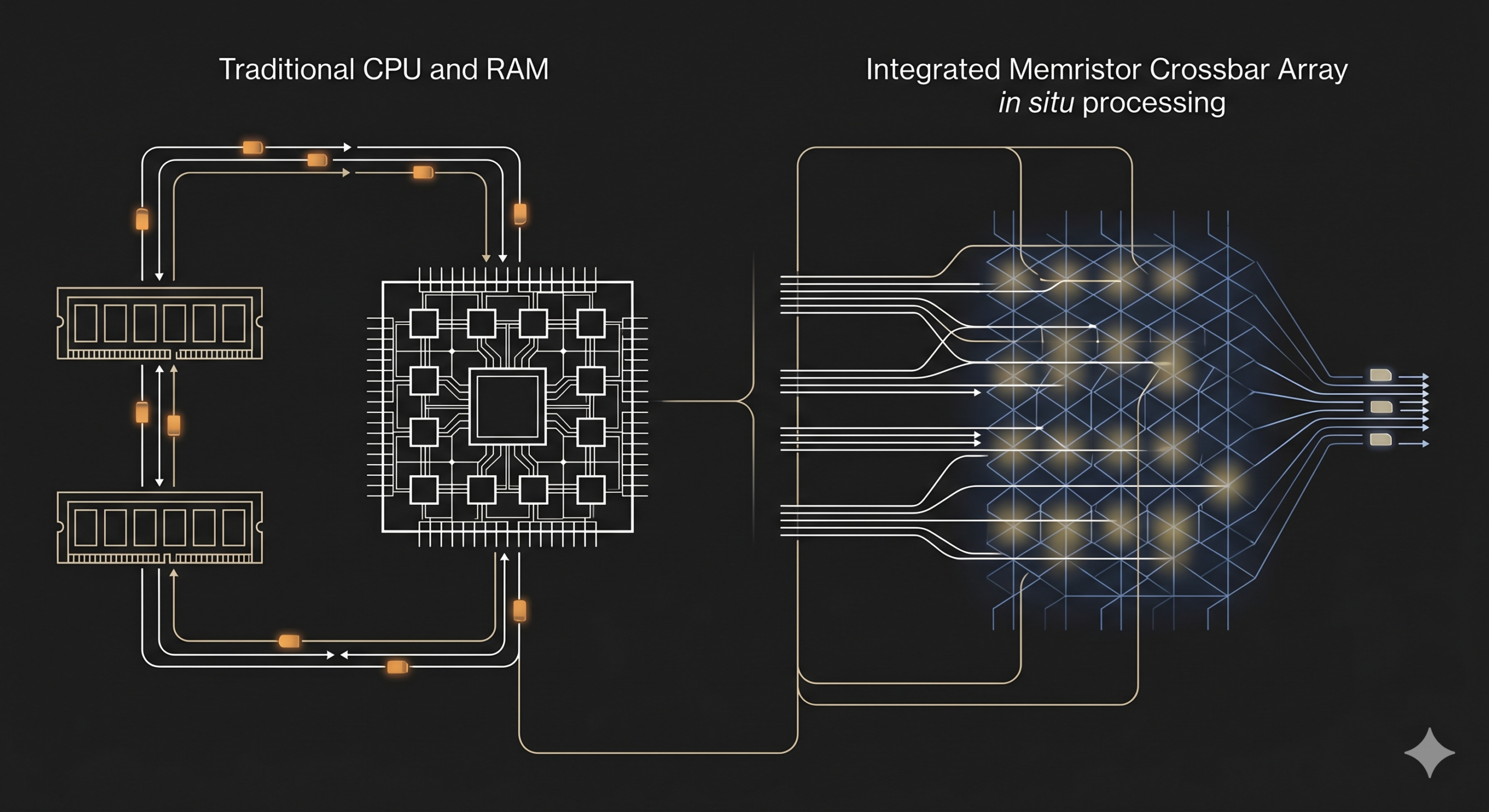
- The Bottleneck: Traditional Von Neumann architectures waste up to 90% of system energy simply moving data between memory and processors.
- Energy Efficiency: Memristor-based Compute-In-Memory (CIM) systems execute operations at fractions of a femtojoule, consuming magnitudes less power than traditional GPUs.
- Analog Math: Operations occur physically via Ohm’s and Kirchhoff’s circuit laws, entirely eliminating the need for binary logic gates during matrix multiplications.
- Edge AI Acceleration: These arrays allow massive neural networks to run locally on low-power, battery-operated edge devices without cloud latency.
HOW IT WORKS (The Mechanism)
Digital chips separate memory from the processor. Data constantly shuttles back and forth. This creates a traffic jam. Engineers call this the Von Neumann bottleneck.
A memristor operates differently. It acts exactly like a biological synapse. It remembers the electrical voltage that previously passed through it by altering its physical resistance. Engineers arrange these components into a dense grid. They call this a crossbar array. Firing an electrical voltage through this grid forces the intersecting wires to calculate matrix multiplications instantly via pure physics. The memory itself becomes the processor.
WHY IT MATTERS NOW (The Human Impact)
Current Large Language Models hit a hard physical wall. Data centers consume gigawatts of power just moving data from memory chips to GPU cores. Neuromorphic silicon shatters this limitation. Memristor arrays execute AI models using nearly zero power. This unlocks pure edge computing. A military drone or bio-integrated medical implant can now execute complex neural networks locally on a standard watch battery. The system requires zero cloud connectivity. For investors and hardware architects, this marks the end of absolute GPU dominance. It shifts the entire economic paradigm of artificial intelligence hardware from brute-force digital scaling to extreme analog efficiency.
WHAT MOST PEOPLE MISS
Mainstream analysts treat memristors as a simple plug-and-play upgrade. They ignore the brutal reality of analog physics. Memristors generate noise. They suffer from temperature drift and non-linear resistance. The core matrix multiplication uses almost zero power. However, translating those analog voltages back into binary code requires massive Analog-to-Digital Converters (ADCs). If architects fail to optimize these peripheral converters, the power overhead entirely erases the crossbar’s energy efficiency. The true engineering war does not involve building the memristor. It demands mastering the mixed-signal border.
THE TRAJECTORY (What Happens Next)
Over the next 12 to 36 months, foundries will rapidly commercialize 3D-heterogeneous integration. They will stack analog memristor layers directly on top of traditional CMOS logic to bypass the GPU supply chain entirely and dominate the ultra-low-power edge computing market.
KEY TERMS
- Von Neumann Architecture: The standard computer design model that physically separates the central processing unit from the memory storage.
- Memristor: A two-terminal electrical component that regulates current flow and remembers its last resistance state even when powered off.
- Compute-In-Memory (CIM): A hardware paradigm where mathematical operations execute directly inside the memory array to eliminate data transfer latency.
- Crossbar Array: A high-density grid of perpendicular wires that executes massively parallel operations via intersecting memristors.
- Analog-to-Digital Converter (ADC): A critical peripheral circuit that translates the continuous analog voltages of the crossbar into discrete digital binary code.
SOURCES
- ACS Nano – “High-Performance Neuromorphic Computing Based on a Self-Assembled Vertically Aligned Nanocomposite Memristor” (2024).
- National Center for Biotechnology Information (PMC) – “In-Sensor-Memory Computing for Post-Von Neumann Intelligence” (2026).
- IEEE INFOCOM – “Analog In-Network Computing through Memristor-based Match-Compute Processing” (2024).
- MDPI – “Energy-Efficient Training of Memristor Crossbar-Based Multi-Layer Neural Networks” (2024).
RELATED TOPICS
- Read Next: The CRISPR Off-Target Dynamics: The Unmapped Chaos of Cellular Repair
- Read Next: The Predatory Speed of Light: Latency Arbitrage in Market Microstructure
- Read Next: The Grid Frequency Decay: The Physics of Renewable Intermittency
- Read Next: The Federal Reserve Swap Lines: The Invisible Piping of Dollar Hegemony