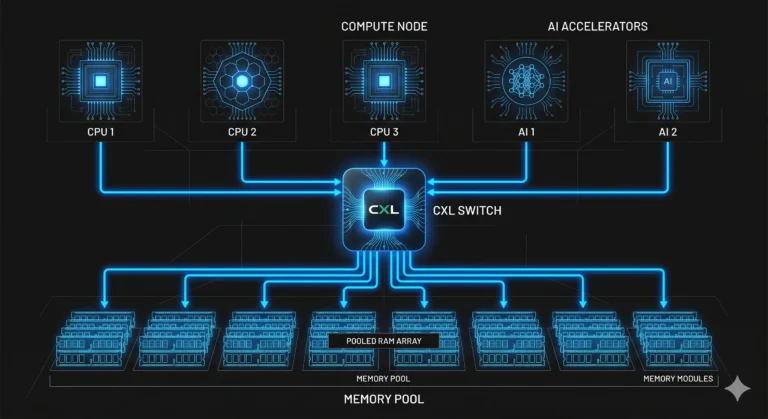
How the Data Center Becomes One Computer
Compute Express Link is a high-speed, cache-coherent interconnect standard that physically decouples memory from individual processors, allowing an entire data center to share a massive, dynamic pool of RAM.

Compute Express Link is a high-speed, cache-coherent interconnect standard that physically decouples memory from individual processors, allowing an entire data center to share a massive, dynamic pool of RAM.

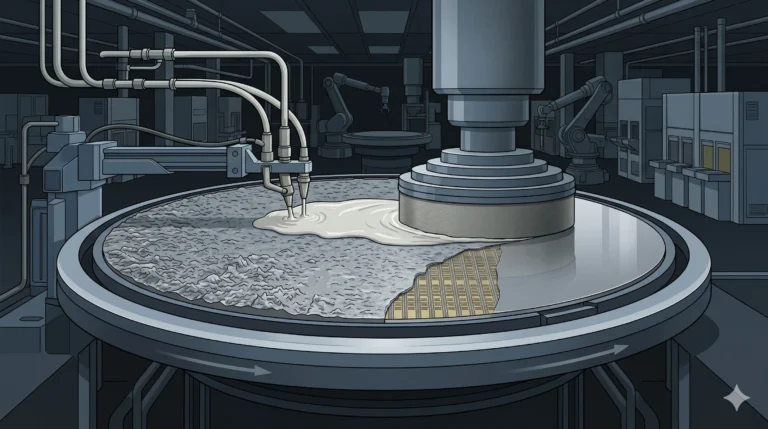
Chemical mechanical planarization slurry is a highly engineered liquid compound of reactive chemicals and microscopic abrasives used to physically grind and chemically dissolve uneven topography on silicon wafers, enabling the stacking of billions of transistors.

The Key-Value cache temporarily stores mathematical representations of previous text tokens in high-speed memory to prevent large language models from wastefully recalculating past context during real-time sentence generation.

The Peripheral Component Interconnect Express bus is the foundational high-speed communication pathway that links processing units, storage architectures, and custom accelerators to maintain synchronized data movement across modern computing systems.

Spiking neural network processors utilize asynchronous, event-driven circuits that mimic human brain biology to process information only when specific data thresholds trip, minimizing power use for isolated remote systems.

PAM4 optical transceivers convert electronic data from AI processors into four-level laser light pulses, doubling network throughput across fiber-optic strands to sustain high-speed distributed computing fabrics.

The Flash Translation Layer is an embedded firmware engine that translates virtual software file requests into physical coordinate writes on silicon while continuously reclaiming dead space to keep write speeds from collapsing.