Advertisement
)


Five years ago, elite Silicon Valley venture capitalists refused to fund weapons, famously writing “do no evil” clauses into their term sheets and staging employee walkouts over military contracts. In the first quarter of 2026, those exact same Sand Hill Road firms poured a record-breaking $19.8 billion into startups building autonomous drones, electronic warfare systems, and AI targeting software. Why the sudden, violent pivot? Because the nature of global warfare has fundamentally shifted from heavy metal to intelligent software, and the Pentagon is panicking
In recent global conflicts, $10 million legacy tanks are being consistently destroyed by $10,000 algorithmic drones built from commercial parts. The US Department of Defense realized that its reliance on five massive, legacy “Prime” contractors—who take a decade to build a single exquisite weapons system—is a fatal structural vulnerability. To survive an era of rapid technological warfare, the Pentagon has opened its checkbook to the only entities capable of innovating at the speed of software: agile, venture-backed startups. This $19.8 billion influx isn’t just an investment trend; it is the financial re-armament of the Western world.
What is Defense Tech Venture Capital?
Defense tech venture capital is the targeted financial investment by private equity and venture firms into early-stage startups building advanced military technologies. This capital funds the rapid development of artificial intelligence, autonomous drones, and cybersecurity systems, allowing agile startups to compete directly with legacy defense prime contractors for government procurement contracts.
At a Glance
- Concept: Private tech investors funding weapons and military software instead of consumer apps and enterprise SaaS.
- Why it matters: It forces the military to buy fast, cheap, smart technology instead of slow, expensive, dumb hardware.
- Who uses it: Vanguard defense tech “unicorns” like Anduril, Palantir, and Shield AI, backed by funds like Founders Fund and Andreessen Horowitz.
- Biggest takeaway: A legacy defense contractor makes money by dragging out a hardware project for 15 years. A venture-backed startup makes money by deploying working software in 6 months. VCs are betting the Pentagon will be forced to choose speed over tradition.
In Simple Words
Imagine a city is being attacked by a swarm of angry bees.
The traditional defense contractors (the “Primes”) tell the mayor: “We can build you a giant, heavily armored, laser-guided bee-swatter. It will cost $10 billion, and it will be ready in 12 years.” By the time it is built, the bees have already taken over the city, or they have mutated and the giant swatter no longer works against them.
Defense Tech Startups take a different approach. They tell the mayor: “Give us $10 million. In six months, we will build 10,000 cheap, disposable robotic spiders that hunt bees autonomously using artificial intelligence.”
The military has realized that in modern conflicts, having 10,000 cheap, smart robotic spiders today is infinitely better than having one perfect, giant bee-swatter in a decade. Venture capitalists are simply providing the startup money to build the spiders.
Why This Matters
For Defense VCs, Military Strategists, and Aerospace Founders, this influx of capital attempts to bridge the infamous Valley of Death.
The “Valley of Death” is the graveyard where brilliant military technologies go to die. It occurs because the DoD budget cycle takes roughly two years to approve. If a startup invents a breakthrough AI drone, the Pentagon might say, “We love this! We will buy $100 million worth of them in two years when the budget clears.”
But startups cannot survive for two years with zero revenue; they burn through their cash and go bankrupt while waiting for the government check. The legacy Primes (like Lockheed Martin or Raytheon) survive this wait because they have billions in cash reserves.
The $19.8 billion in Q1 VC funding is explicitly designed to bridge this valley. By giving defense startups massive war chests of private capital, VCs are keeping these companies alive long enough to survive the Pentagon’s glacial bureaucracy, ensuring that disruptive tech actually makes it to the battlefield.
The Shift to Attritable Mass in Defense Tech
We are witnessing the death of Exquisite Hardware and the rise of Attritable Mass.
For 50 years, the US military pursued “exquisite” systems—weapons like the F-35 fighter jet or the Ford-class aircraft carrier. These systems are physical marvels, but they cost astronomical amounts of money and exist in very small numbers. They are “too big to fail,” meaning commanders are terrified to risk losing them in combat.
The defense tech VC boom is funding the exact opposite: Attritable Mass. “Attritable” means cheap enough that you don’t care if it gets destroyed. Startups are building thousands of autonomous, software-driven systems (like $5,000 loitering munitions). If you lose 500 of them in a battle, it doesn’t break the national budget. We are moving from a military defined by a few untouchable titans, to a military defined by overwhelming, disposable robotic swarms.
How Defense Tech Startups Bypass the PPBE Process
Disrupting a multi-trillion-dollar military-industrial complex requires bypassing entrenched lobbying and altering how the government writes checks. Here is the first-principles breakdown of the mechanics.
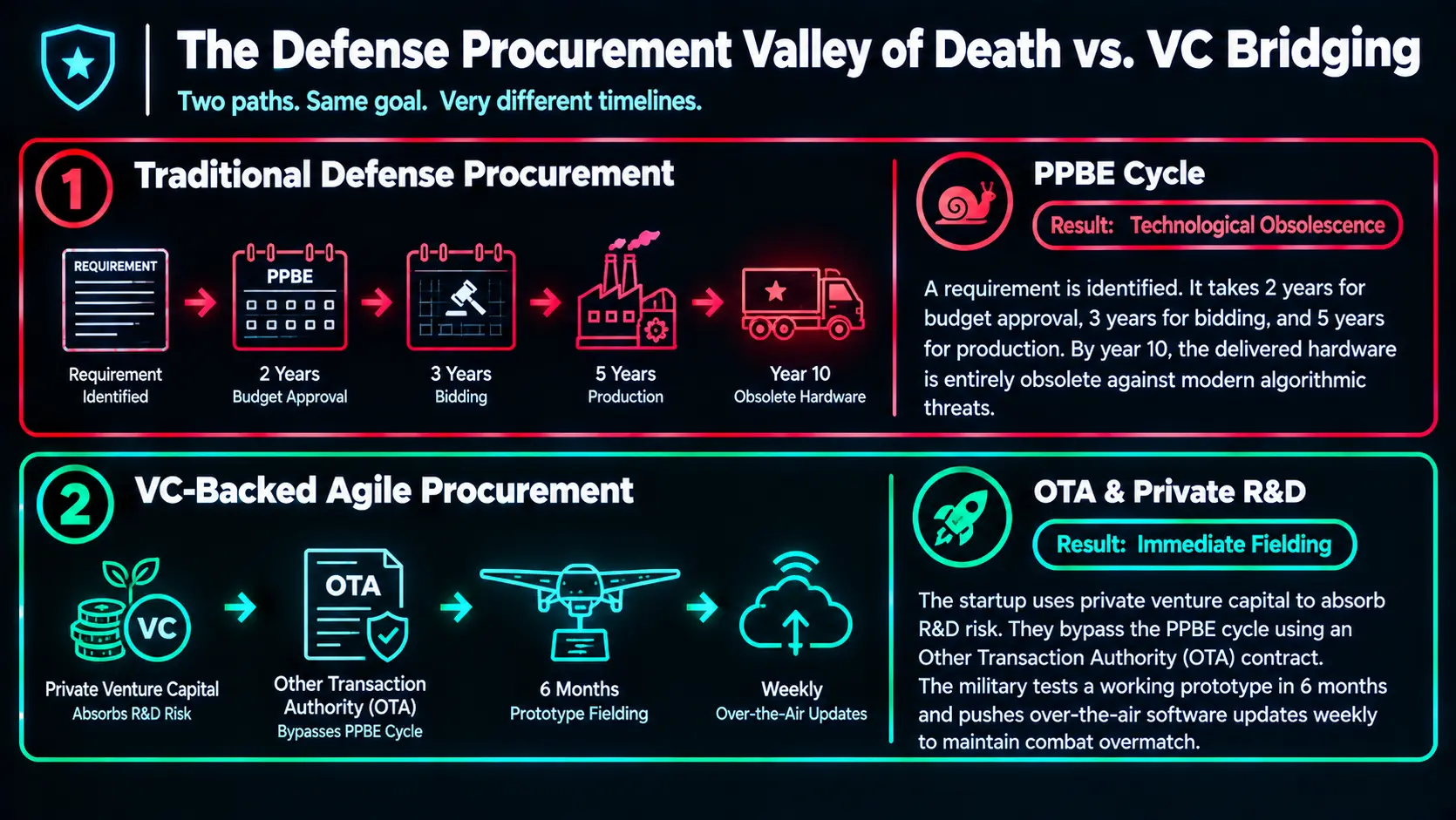
1. The Fundamental Problem: The PPBE Process
The Pentagon buys things using the Planning, Programming, Budgeting, and Execution (PPBE) process, designed in the 1960s to buy tanks and ships. It requires defining the exact specifications of a weapon a decade before it is built. This works for steel; it is catastrophic for software. If you define an AI algorithm’s specs in 2026 and deploy it in 2036, it is obsolete the moment it boots up.
2. The Core Mechanism: Other Transaction Authority (OTA)
To bypass this, defense startups leverage OTAs. An OTA is a special contracting vehicle that allows the military to bypass the rigid, decades-long Federal Acquisition Regulation (FAR). It allows the Pentagon to act like a private company—testing a prototype, cutting a check in 60 days, and iterating on the design continuously.
3. Technical Depth: Software-Defined Hardware
Legacy defense contractors build hardware-first. They design a missile, and the software is an afterthought written to fly that specific missile.
Venture-backed defense startups build software-first. They build a powerful AI operating system (like Anduril’s Lattice), and the hardware (the drone, the submarine) is just a cheap, swappable plastic shell that carries the software. If the hardware is destroyed, the software instantly routes the mission to the next drone in the mesh network.
Micro-Insight: In the old model, the intelligence lived in the pilot, and the hardware was expensive. In the new model, the intelligence lives in the cloud, and the hardware is expendable.
4. Technical Depth: Dual-Use Architecture
VCs hate businesses with only one customer (monopsonies), and the DoD is exactly that. To mitigate this risk, VCs fund “Dual-Use” technology. A startup builds advanced computer vision software to inspect commercial oil pipelines (commercial use). Once the tech is proven and generating civilian revenue, the startup flips the exact same software to the Pentagon to identify enemy supply convoys (defense use). This derisks the investment.
5. Real-World Consequences: The Replicator Initiative
This software-first, attritable model terrified the Pentagon into action. The DoD launched the Replicator initiative, explicitly aimed at fielding thousands of autonomous systems across multiple domains (air, sea, land) within 18 to 24 months. The DoD publicly signaled they would not rely on the legacy Primes for this; they turned directly to the agile, VC-backed defense tech ecosystem to supply the swarm.
Defense Procurement Simulator
Legacy Prime Exquisite System vs. Agile Startup Attritable Swarm
Threat Influx Velocity
30 Drones/Wave
Procurement Architecture
Legacy Prime (Exquisite)
Agile Startup (Attritable)
Unit / Fleet Replacement Cost
$850.0M
Procurement & Update Cycle
120 Months
Fleet Survivability / Intercept
100.0%
Tactical Engagement Vector: Interceptor Defense vs Inbound Swarm
STANDBY
Financial Spend & Asymmetric Cost Ratio Over Time
Commercial and Military Defense Tech Applications
The $19.8B in VC funding is already materializing into deployed combat systems.
AI-Targeting and Sensor Fusion: Programs like Project Maven (originally famously protested by Google employees, now heavily backed by Palantir and new startups) use computer vision to digest millions of hours of drone footage. Instead of a human analyst staring at a screen for 12 hours looking for a camouflaged tank, the AI instantly highlights the tank and sends the GPS coordinates directly to an artillery battery in seconds.
Autonomous Unmanned Surface Vessels (USVs): The Navy is heavily investing in VC-backed startups building robotic boats. Instead of risking a $2 billion destroyer and 300 sailors to patrol a hostile strait, the Navy deploys a fleet of cheap, solar-powered, AI-driven drone boats. They network together, share radar data, and can autonomously execute defensive maneuvers without a single human on board.
Commercial Space ISR (Intelligence, Surveillance, Reconnaissance): The war in Ukraine proved the lethality of commercial space tech. Startups building synthetic aperture radar (SAR) satellites provide the military with real-time, weather-penetrating imagery of enemy troop movements. Because the satellites are built cheaply and launched frequently via SpaceX, if an adversary shoots one down, a startup can launch a replacement the following week.
Economic & Strategic Impact
The core strategic consequence of the defense VC boom is the Disruption of the Prime Monopoly.
For decades, companies like Lockheed Martin, Boeing, and General Dynamics operated essentially as protected government utilities. Their business model relied on "cost-plus" contracting—meaning the longer a project took and the more expensive it got, the more profit the Prime made. There was zero financial incentive to deliver weapons quickly or cheaply.
The VC influx funds "fixed-price" commercial startups. A company like Anduril uses its own venture capital to do the R&D, builds a working weapon, and tells the Pentagon: "Here is a working drone. It costs exactly $500,000. Buy it or don't." This shifts the risk of failure from the taxpayer back to the private investor, completely upending the economics of defense contracting and forcing legacy Primes to either acquire the startups or face obsolescence.
Advantages
- Speed of Innovation: Startups push software updates to military hardware over-the-air in hours, countering new enemy tactics almost instantly, compared to the years required for legacy hardware upgrades.
- Cost Asymmetry: Forces adversaries to spend $2 million interceptor missiles to shoot down a $20,000 3D-printed startup drone, bankrupting the enemy economically.
- Reduces Human Risk: Autonomous robotics physically remove human soldiers from the most dangerous, highly contested environments (dull, dirty, and dangerous missions).
- Talent Migration: The massive influx of capital is pulling the world's best AI engineers away from optimizing ad-clicks at Meta/Google and redirecting their brains toward hard national security problems.
Limitations
- The SCIF Barrier: Defense work requires Top Secret security clearances and Sensitive Compartmented Information Facilities (SCIFs). Building these secure rooms and getting 25-year-old software engineers cleared takes up to 18 months, violently stalling startup momentum.
- Hardware Manufacturing at Scale: Building ten amazing prototype drones in a San Francisco warehouse is easy. Setting up an industrialized supply chain to mass-produce 50,000 flawless drones a month without buying cheap parts from China is incredibly difficult and capital-intensive.
- The Compliance Labyrinth: To sell to the DoD, a company's software must pass grueling cybersecurity audits (like FedRAMP and IL5/IL6). Many startups run out of money paying compliance consultants before they ever write a line of combat code.
Takeaway: Defense VCs are not just funding technology; they are funding a lobbying and compliance war. The best weapon doesn't win the contract; the best navigation of the Pentagon's bureaucracy wins the contract.
Common Misconceptions
Misconception: Defense tech startups are building Terminator-style killer robots.
Reality: While lethal autonomous weapons are being developed, roughly 80% of defense tech funding goes to "boring" back-office logistics. VCs are funding software to optimize supply chains, predict when a helicopter engine will break (predictive maintenance), and protect communication networks from hacking.
Misconception: VCs are relying entirely on government handouts.
Reality: The new model demands that startups use their own VC money for Research & Development. They only ask the government to pay for the final, working product. This protects taxpayer dollars from being wasted on failed science experiments.
Misconception: The Legacy Primes will just go bankrupt.
Reality: The Primes still build the aircraft carriers and nuclear submarines. You cannot build a nuclear sub in a startup garage. The most likely outcome is a symbiotic relationship: the Primes build the heavy metal platforms, and the VC-backed startups provide the AI "brains" that control them.
What Most People Miss
The disruptive capability of The Defense-Tech Talent Pivot.
When analysts look at the $19.8B number, they see cash. What they miss is the cultural shift.
For the last twenty years, working for a defense contractor was considered a career dead-end for top-tier software engineers. It was slow, bureaucratic, and morally frowned upon in Silicon Valley. The new wave of defense startups has completely rebranded the industry. By framing defense tech as the ultimate defense of democratic values against authoritarian regimes, companies have made working on military AI cool. This cultural permission structure has unlocked an absolute flood of tier-1 engineering talent into the national security apparatus.
Comparison Table
| Metric | Legacy Defense Primes | VC-Backed Defense Startups |
| Business Model | Cost-Plus (Gov assumes risk) | Fixed-Price Commercial (VC assumes risk) |
| Development Speed | 7 to 15 Years | 6 to 18 Months |
| Product Focus | Exquisite, Heavy Hardware | Attritable, Software-Defined Robotics |
| Revenue Stream | Monopsony (DoD Only) | Dual-Use (Commercial + Defense) |
| Update Cadence | Multi-Year Block Upgrades | Over-the-Air Weekly Software Patches |
Future Outlook
Next 12–24 Months
The era of The Replicator Deliverables. Through 2026 and 2027, the Pentagon will be forced to show its hand. The industry will watch closely to see if the DoD actually cuts multi-hundred-million-dollar production contracts to the new wave of startups, or if they simply award "pilot programs" that lead nowhere. If the DoD fails to convert this VC momentum into real, massive contracts, venture capital will abandon the sector entirely, leading to a catastrophic collapse of the defense tech ecosystem.
Next 3–5 Years
The scaling of The M&A Consolidation Wave. There are currently too many defense startups building the exact same drone software. As the capital markets tighten, a massive wave of Mergers and Acquisitions (M&A) will occur. Mid-tier startups will merge to form "Neo-Primes," while legacy Primes (desperate for modern AI software) will acquire successful startups at massive premiums. The defense industrial base will transition from five massive monopolies to a highly competitive, dynamic oligopoly.
Next 10 Years
The Software-First Military Transformation. By the mid-2030s, the US military will operate like a massive tech company. Hardware will be viewed as cheap, disposable, and largely irrelevant. The true power of the military will reside in an omnipotent, cloud-based AI operating system that orchestrates millions of disposable sensors and weapons globally. Procurement will shift entirely from buying jets to licensing software, forever altering how global superpowers project force.
Most Likely Scenario
The $19.8B influx into defense tech is not a bubble; it is a permanent realignment of the military-industrial complex. The glacial pace of legacy procurement has proven structurally incapable of keeping pace with the exponential curve of artificial intelligence. By outsourcing R&D risk to Silicon Valley venture capitalists, the Pentagon will successfully modernize its arsenal with attritable, software-defined swarms, ensuring the United States maintains technological overmatch in an increasingly volatile geopolitical landscape.
Key Takeaways
- Silicon Valley venture capitalists are pouring billions into defense tech to build cheap, AI-driven weapons, abandoning their historical reluctance to fund military contracts.
- The DoD’s traditional buying process takes a decade, creating a "Valley of Death" where startups go bankrupt waiting for contracts. VC money keeps them alive long enough to win.
- Modern warfare favors "Attritable Mass"—thousands of cheap, disposable robotic drones—over "Exquisite Hardware"—a single, $100 million fighter jet that is too expensive to risk losing.
- Defense startups build weapons "software-first." They design a brilliant AI brain and put it in a cheap plastic drone body, allowing them to push fast, weekly software updates to troops in combat.
- Startups derisk their business by building "Dual-Use" technology—software that can inspect a commercial oil pipeline on Monday and identify enemy tanks for the Pentagon on Tuesday.
Glossary
Attritable: Military hardware that is cheap enough to be lost or destroyed in combat without causing a major financial or strategic blow to the military.
Defense Innovation Unit (DIU): A specialized DoD organization tasked with accelerating the adoption of commercial technology into the US military and bypassing slow traditional procurement.
Dual-Use Technology: Software or hardware that has legitimate, profitable commercial applications as well as distinct military applications.
Other Transaction Authority (OTA): A fast-track government contracting method that allows the military to buy prototypes from startups without following the agonizingly slow rules of traditional federal acquisition.
PPBE Process: Planning, Programming, Budgeting, and Execution. The decades-old, incredibly slow process the Pentagon uses to allocate money and buy heavy weapons.
Valley of Death: The 18-to-24-month gap between a startup successfully demonstrating a prototype to the military and actually receiving a production contract, during which most startups run out of money and die.
Sources
Department of Defense (DoD): The Replicator Initiative and Autonomous Systems Scaling
PitchBook / Silicon Valley Bank: Defense Technology Venture Capital Investment Trends Q1 2026
Defense Innovation Unit (DIU): Commercial Technology Transition and OTA Utilization Reports
Center for a New American Security (CNAS): Software-Defined Warfare and the End of Exquisite Hardware
National Defense Industrial Association (NDIA): Navigating the Valley of Death in Defense Acquisition