Advertisement
)

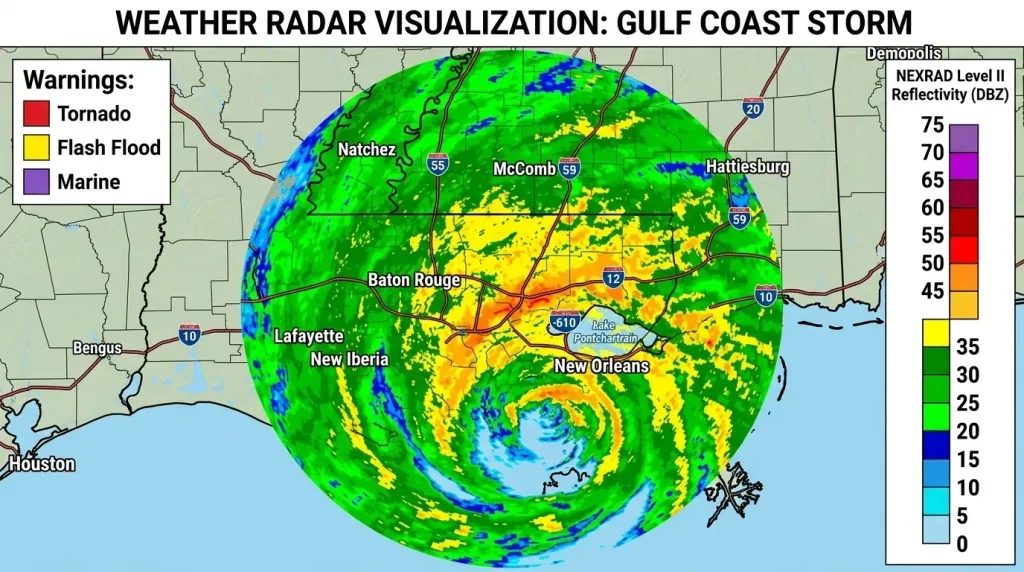
Imagine a Category 4 hurricane makes a direct hit on your primary semiconductor manufacturing hub in Taiwan. Under traditional insurance, you will spend the next 18 months fighting a platoon of claims adjusters over the depreciated value of a ruined roof. Meanwhile, your factory sits idle, your supply chain freezes, and your competitors ruthlessly steal your market share. The storm didn’t bankrupt your company; the 18-month wait for the insurance check did.
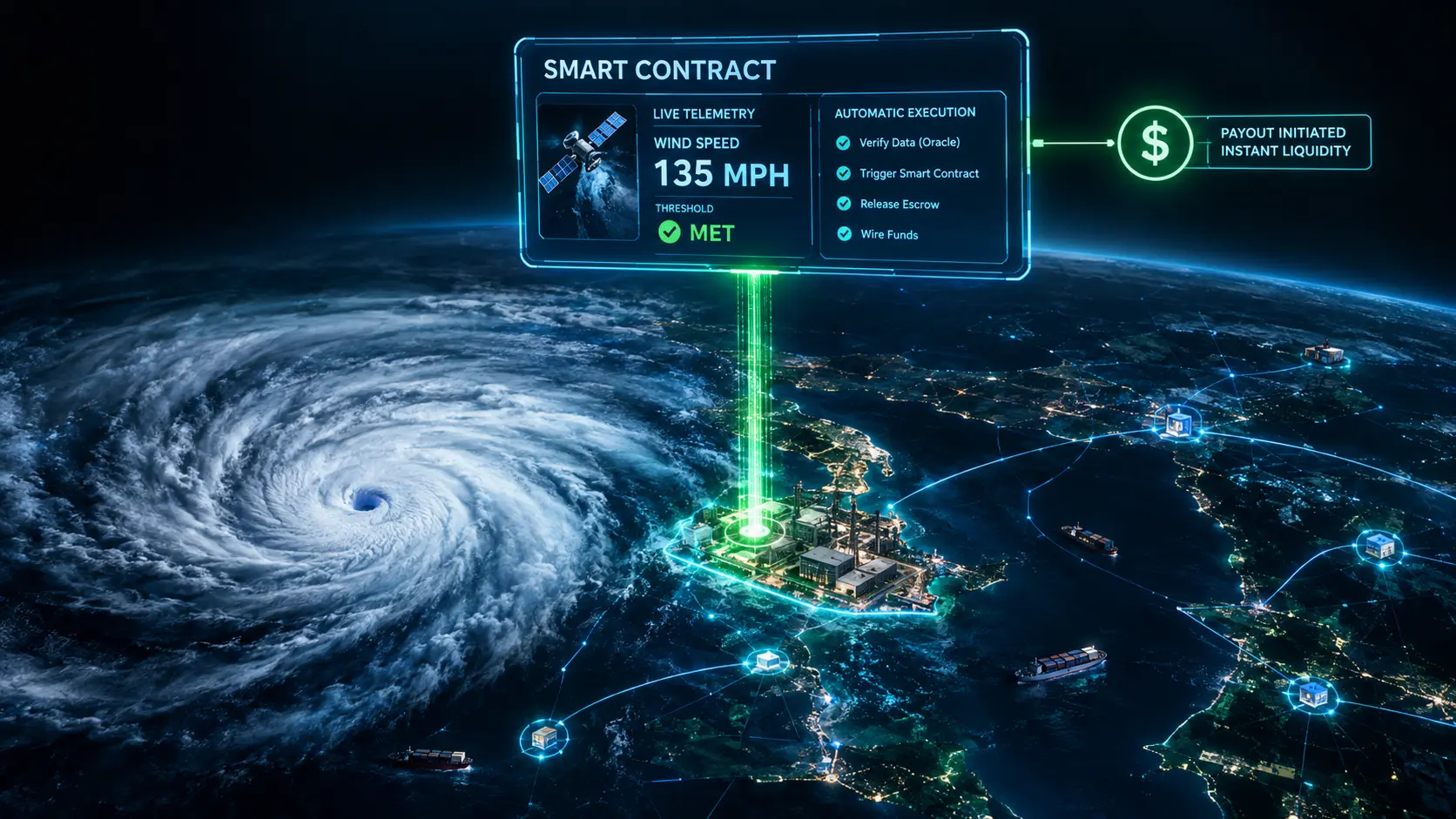
Why should you care right now? Because global supply chains are facing an era of compounding climate volatility, and relying on humans to manually assess disaster damage is a corporate death sentence. The financial sector has quietly engineered a solution: instead of insuring the damage, you insure the weather itself. By utilizing parametric insurance—algorithmic smart contracts tied directly to live satellite telemetry—multinational corporations are securing policies that wire tens of millions of dollars into their bank accounts the exact second a hurricane crosses a specific GPS coordinate. No adjusters. No disputes. No delays. Just instant, algorithmic liquidity when your survival depends on it.
What is Parametric Climate Insurance?
Parametric climate insurance is an algorithmic financial contract that guarantees an immediate payout when a specific, objective environmental threshold is crossed. Instead of reimbursing physical damage assessed by a human inspector, it automatically releases funds based on verified meteorological data, such as wind speed, earthquake magnitude, or flood depth.
At a Glance
- Concept: “If/Then” coding applied to massive corporate insurance policies. If the wind hits 150 mph, then pay $10 million.
- Why it matters: Traditional insurance only covers physical damage (a broken building). Parametric covers economic loss. If a river dries up and ships can’t move, your building is fine, but you lose millions. Parametric pays for that lost revenue.
- Who uses it: Supply chain executives, national governments, and agricultural mega-corporations.
- Biggest takeaway: The payout speed transforms insurance from a slow recovery tool into immediate emergency capital, allowing companies to outbid competitors for backup supplies the day after a disaster.
In Simple Words
If you get into a car crash, standard insurance works like a mechanic. The mechanic has to look at the dent, figure out how much the bumper costs, argue with you about how old the car is, and eventually write you a check months later. That is indemnity insurance.
Parametric insurance works like a speeding camera. There is no mechanic, and nobody looks at your car. You sign a contract that says: “If a sensor detects a car crash at exactly 50 mph, you get $10,000 instantly.” The moment the sensor reads 50 mph, the money drops into your bank account. It doesn’t matter if your car is completely totaled or if it doesn’t have a single scratch on it. The payout is tied entirely to the speed of the crash, not the damage.
By applying this logic to hurricanes, earthquakes, and droughts, companies guarantee they have cash in hand the minute the storm hits.
Why This Matters
For Corporate Risk Officers, Supply Chain Execs, and ESG Analysts, parametric insurance solves the Non-Damage Business Interruption (NDBI) Void.
In 2022, the Rhine River in Europe experienced a severe drought. Water levels dropped so low that cargo barges could not physically pass. For massive chemical conglomerates like BASF, their factories were perfectly intact—there was zero physical damage. However, because they couldn’t receive raw materials, production halted, costing them hundreds of millions of dollars.
Traditional insurance refused to pay. Traditional policies require a physical asset to be broken (a fire, a collapsed roof) to trigger a payout.
Parametric insurance fills this void. A chemical company can buy a parametric policy based on a river gauge. The contract dictates: If the Kaub gauge drops below 40 centimeters for 10 consecutive days, pay out €50 million. When the river dries up, the smart contract executes. The company receives the cash and immediately uses it to charter emergency freight trains and trucks, keeping their supply chain alive while competitors halt production.
The Datafication of Risk Transfer
We are witnessing the Datafication of Risk Transfer.
Historically, the insurance industry was built on subjective human trust and legal arbitration. A contract was a promise written on paper, subject to interpretation by lawyers in a courtroom.
Parametric insurance shifts risk transfer from the legal department to the IT department. The contract is no longer a piece of paper; it is an executable piece of code living on a server or a blockchain. This eliminates the frictional costs of lawyers, adjusters, and courts. By turning weather into a digital derivative, insurance transforms into a hyper-efficient, liquid financial instrument.
How Parametric Smart Contracts Execute
Replacing human judgment with deterministic math requires an entirely new technological architecture. Here is the first-principles breakdown of the system.
1. The Fundamental Problem: The Human Bottleneck
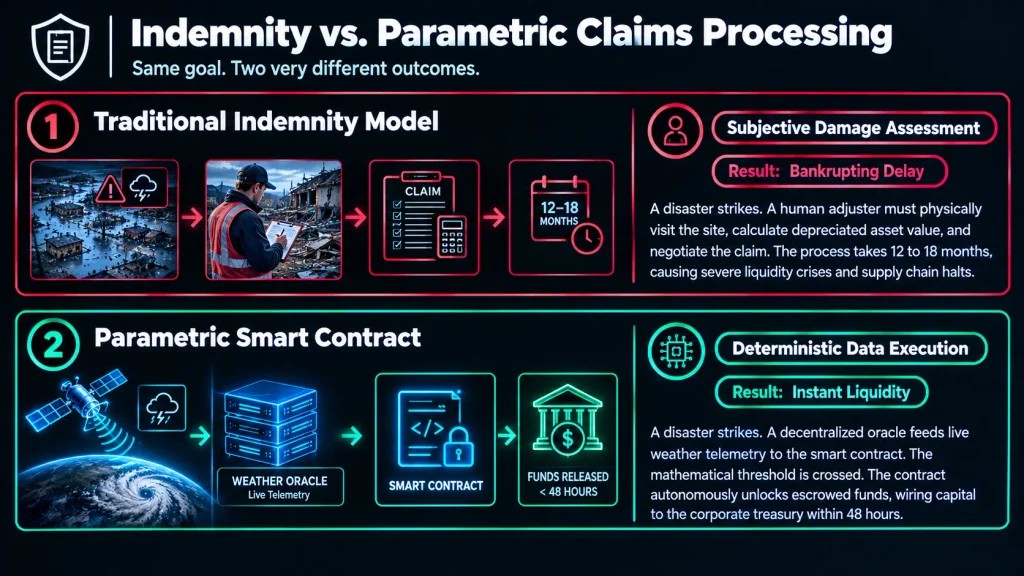
After a massive disaster like a Category 5 hurricane, thousands of businesses file insurance claims simultaneously. There simply aren’t enough human adjusters to visit every factory. The system clogs. Companies go bankrupt simply because they run out of operating cash while waiting for the adjuster to arrive.
2. The Core Mechanism: The Parameter Threshold
To remove the human, the insurer and the corporation agree on a measurable, objective parameter. For example, a global logistics company wants to protect its Miami distribution center. They structure a contract: If a hurricane passes within a 30-mile radius (the “box”) and registers sustained wind speeds over 130 mph, the payout is 100%. If wind speeds are 110 mph, the payout is 50%.
3. Technical Depth: The Oracle Integration
Who decides if the wind hit 130 mph? You cannot rely on the corporation (they have an incentive to lie) or the insurance company (they have an incentive to deny). The smart contract must plug into an “Oracle”—an independent, trusted, third-party data feed. This is usually a government agency like the National Hurricane Center, or specialized IoT sensors installed directly on the factory roof.
Micro-Insight: The Oracle is the single point of failure in parametric insurance. If the wind sensor breaks during the storm and records 0 mph, the smart contract will refuse to pay, even if the building is destroyed.
4. Technical Depth: Blockchain Smart Contracts
To guarantee that the insurance company cannot delay or freeze the payout, the policy is often written as a blockchain smart contract. The funds (or credit lines) are locked in escrow. The exact millisecond the Oracle feeds the 130 mph data point into the blockchain, the code executes autonomously. The escrow unlocks, and the funds are wired to the corporation’s treasury without a single human authorizing the release.
5. Real-World Consequences: Immediate Liquidity
The logistics company receives $20 million on Day 2 of the disaster. While their competitors are laying off workers and waiting for claims adjusters, the logistics company uses the instant cash to lease alternative warehouses in Atlanta, outbid rivals for emergency diesel generators, and route cargo to different ports, completely saving their fiscal quarter.
Insurance Payout Simulator
Parametric Smart Contracts vs. Traditional Indemnity Claims Delay
Hurricane Severity
Category 4
Insurance Policy Type
Traditional Indemnity
Parametric Smart Contract
Operating Cash Reserves
$15.0M
Time Since Landfall
0 Months
Claims Payout Status
STANDBY
Satellite Telemetry & Supply Chain Node
WAITING FOR EVENT
Corporate Financial Survival (12-Month Outlook)
Commercial Use Cases for Parametric Policies
Parametric architecture is quietly securing the world's most vulnerable infrastructure.
National Disaster Relief (CCRIF): The Caribbean Catastrophe Risk Insurance Facility (CCRIF) provides parametric coverage for entire nations. In 2010, when the devastating earthquake hit Haiti, the government's infrastructure was completely destroyed. They could not process aid. Because Haiti had a parametric policy based on seismic magnitude, CCRIF wired $8 million to the Haitian government within 14 days, providing the immediate, unconditional cash required to pay first responders before international aid could mobilize.
Renewable Energy Hedging: Wind and solar farms face "volume risk." If the wind doesn't blow, the turbines don't spin, and the farm defaults on its bank loans. Energy developers buy parametric "Lack of Wind" policies. If anemometers (wind sensors) record that average wind speeds drop below a certain threshold for the quarter, the smart contract pays the developer, ensuring they have the cash to service their debt regardless of the weather.
Agricultural Mega-Corps: Global food conglomerates face immense crop yield risks due to climate change. Traditional crop insurance requires inspectors to walk through thousands of acres of ruined corn. Parametric policies now use satellite soil-moisture telemetry. If a satellite detects that soil moisture in a specific grid drops below a critical threshold for 20 days, the payout executes automatically, allowing the conglomerate to immediately secure alternative grain shipments from South America.
Economic & Strategic Impact
The core strategic consequence of parametric insurance is the Unlocking of Alternative Capital Markets.
Traditional insurance is constrained by the balance sheets of insurance companies. There isn't enough capital in the traditional insurance market to cover the trillions of dollars of global climate risk.
Parametric insurance fixes this by transforming weather risk into a mathematically predictable bond (a Catastrophe Bond, or "Cat Bond"). Because the payout is based on a pure, objective formula (e.g., Wind > 130 mph = Payout), hedge funds, pension funds, and institutional investors can easily model the risk using historical weather data. They don't need to know anything about roofing materials or claims adjusting; they just run the math. This allows Wall Street to act as the ultimate reinsurer, flooding the climate resilience market with trillions in deep institutional liquidity.
Advantages
- Instantaneous Liquidity: Payouts settle in days or weeks, completely bypassing the months-long forensic accounting and legal arbitration required by traditional claims.
- Covers Non-Damage Interruption: Pays out for pure economic losses (like a dried-up river or a blocked port) even if the policyholder's physical building is completely untouched.
- Total Transparency: Because the trigger is an objective data point published by a government agency (like NOAA), there is zero ambiguity or room for an insurance company to deny the claim in bad faith.
- Unrestricted Capital Use: Unlike traditional insurance that legally forces you to spend the money repairing the specific broken building, parametric cash is unrestricted. The CEO can use it to build a new factory in a different country, hire temporary workers, or pay off debt.
Limitations
- Basis Risk (The Fatal Flaw): This is the ultimate risk. If you buy a policy that pays out when wind hits 130 mph, and a hurricane hits your factory at 128 mph and destroys it, you get nothing. Your factory is gone, and the smart contract refuses to pay because the mathematical threshold was not crossed.
- Oracle Tampering: The entire system relies on the accuracy of the data sensor. If a sensor is destroyed by flying debris before it registers the peak wind speed, the data is lost, and the payout may fail.
- High Premium Costs: Because parametric insurance is heavily utilized by corporations in high-risk, uninsurable zones (like coastal Florida or wildfire zones in California), the premiums are exceptionally high, requiring significant upfront corporate capital.
Takeaway: Parametric insurance is a scalpel, not a blanket. You are mathematically guaranteed a fast payout, but if you design the trigger threshold poorly, you can lose your factory and walk away with zero dollars.
Common Misconceptions
Misconception: Parametric insurance will completely replace traditional insurance.
Reality: They are complementary. A corporation uses parametric insurance as an emergency cash injection to survive the first 6 months after a disaster. They use traditional indemnity insurance to fund the 3-year process of physically rebuilding the factory.
Misconception: You can only use it for hurricanes and earthquakes.
Reality: If you can measure it, you can parameterize it. There are policies based on foot traffic (using mobile phone data), cloud cover (for solar farms), flight cancellations, and even cyber-attack downtime.
Misconception: It requires blockchain to work.
Reality: While blockchain smart contracts make the execution mathematically guaranteed and trustless, traditional insurance companies write massive parametric policies using standard fiat banking wires. The "smart contract" can just be a Python script running on an underwriter's server.
What Most People Miss
The disruptive capability of Micro-Parametrics for the Gig Economy.
When analysts discuss parametric risk, they focus on $50 million corporate policies. What they miss is the consumer-level scalability unlocked by automated data feeds.
In developing nations, small-hold farmers cannot afford traditional crop adjusters. Startups are deploying micro-parametric policies via SMS text messages. A farmer pays a $10 premium from their phone. If a satellite detects that their specific 1-acre square of land received less than 5 inches of rain during the monsoon season, a $100 payout is instantly wired to their mobile wallet. By removing the human adjuster, the administrative cost drops to zero, allowing the insurance industry to profitably protect the poorest, most climate-vulnerable populations on Earth.
Comparison Table
| Feature | Traditional Indemnity Insurance | Parametric Smart Contract |
| Trigger Mechanism | Actual physical damage incurred | Pre-agreed environmental data threshold |
| Payout Speed | Months to Years (Subjective review) | Seconds to Days (Algorithmic execution) |
| Claims Adjuster Required? | Yes (Mandatory site visits) | No (Relies on data Oracles) |
| Basis Risk | Very Low (Pays exact damage) | High (May trigger without damage, or vice versa) |
| Capital Restrictions | Must be used to repair the insured asset | Unrestricted corporate liquidity |
Future Outlook
Next 12–24 Months
The era of Multi-Variable Sensor Fusion. Through 2026, simple single-trigger policies (e.g., "Wind > 130 mph") will evolve. To reduce Basis Risk, underwriters will deploy multi-variable contracts using sensor fusion. A payout will execute dynamically based on a weighted matrix of wind speed, storm surge depth, power grid downtime, and supply chain port closures, creating a highly customized, hyper-accurate risk profile that perfectly mirrors actual corporate revenue loss.
Next 3–5 Years
The scaling of Decentralized Oracle Networks (DONs). Trusting a single government sensor is a single point of failure. The industry will rapidly adopt blockchain networks like Chainlink to aggregate thousands of independent IoT weather sensors. The smart contract will require a cryptographic consensus from 50 different data sources before executing the payout. This guarantees that no single entity (neither the insurer nor the policyholder) can hack or manipulate the weather data to force a fraudulent payout.
Next 10 Years
The Embedded Parametric Supply Chain. By the 2030s, parametric insurance will not be something a company buys separately; it will be natively embedded into B2B software. When a logistics algorithm routes a cargo ship through a high-risk typhoon zone, the software will automatically spin up a micro-parametric hedge for the exact 72-hour transit window. If the storm delays the ship, the contract automatically reimburses the late-delivery penalties, creating an autonomously self-hedging global supply chain.
Most Likely Scenario
Parametric climate insurance is the inevitable financial response to a volatile planet. As the severity of climate events accelerates beyond the capacity of human claims adjusters to process them, corporate survival will depend entirely on the speed of capital recovery. By merging meteorological data, IoT hardware, and algorithmic execution, parametric contracts transform climate risk from an unpredictable existential threat into a deterministic, manageable line item.
Key Takeaways
- Traditional insurance is slow because human inspectors must verify physical damage, causing bankrupting delays for businesses whose supply chains are frozen.
- Parametric insurance bypasses humans entirely. It is a digital contract that triggers an automatic payout the moment a trusted data source (like a satellite) verifies an extreme weather event hit a specific location.
- It covers pure economic loss. If a river dries up and halts shipping, a company can receive millions in payouts even if their physical factory wasn't touched.
- The greatest danger is "Basis Risk"—the mathematical possibility that a storm destroys your factory, but the wind speed was 1 mph below the contract threshold, resulting in a payout of zero.
- By turning weather into pure math, parametric insurance allows massive institutional investors (pension funds) to confidently back these policies, unlocking trillions in climate resilience capital.
Glossary
Basis Risk: The fatal flaw in parametric insurance; the risk that the mathematical parameter doesn't perfectly match the actual damage (e.g., the policy triggers but you suffered no damage, or you are destroyed but the policy doesn't trigger).
Catastrophe Bond (Cat Bond): A financial instrument that allows Wall Street investors to back insurance policies. If a disaster happens, the investors lose their money to pay the claim. If it doesn't, they earn high interest.
Indemnity Insurance: Traditional insurance that requires an adjuster to calculate the exact monetary value of the physical damage before reimbursing the policyholder.
Non-Damage Business Interruption (NDBI): A massive financial loss caused by an external event (like a blocked shipping canal or a dry river) where the company's own physical property is not actually damaged.
Oracle: A trusted, independent data feed (like a NOAA satellite or a decentralized blockchain sensor network) that feeds real-world weather data into a smart contract.
Smart Contract: A piece of software code that automatically executes an action (like wiring $10 million) when specific conditions are met, without requiring human approval.
Sources
Swiss Re Institute: Parametric Insurance and the Future of Corporate Risk Transfer
World Bank / CCRIF: Sovereign Parametric Climate Risk Pooling Facilities
Chainlink Labs: Decentralized Oracle Networks for Parametric Weather Insurance
Munich Re: Bridging the Non-Damage Business Interruption Gap
Journal of Financial Perspectives: Catastrophe Bonds and Alternative Capital in Climate Hedging