Advertisement
)


Imagine lending a distressed corporation $500 million, perfectly secured by the company’s crown jewel intellectual property. You sleep soundly, knowing if the company defaults, you have the legal right to seize the brand. But over the weekend, the private equity sponsor legally transfers that intellectual property to a newly formed shell company in the Cayman Islands, borrows fresh cash against it from a rival hedge fund, and leaves your $500 million loan backed by absolutely nothing. You weren’t robbed by a hacker; you were legally expropriated by your fellow lenders.
Why should you care right now? Because as interest rates remain elevated, a massive wave of distress is hitting the $1.7 trillion private credit market. Rather than cooperating in traditional bankruptcies, aggressive Wall Street sponsors are exploiting contractual loopholes to pit lenders against each other in a zero-sum game of survival. This is the era of “creditor-on-creditor violence,” where Liability Management Exercises (LMEs) are weaponized to systematically strip minority creditors of their collateral, turning what was once a collaborative restructuring process into a ruthless legal knife fight.
What are Liability Management Exercises (LMEs)?
Liability Management Exercises (LMEs) are aggressive corporate debt restructuring maneuvers where distressed companies exploit loopholes in credit agreements to raise fresh capital or reduce debt burdens. In modern finance, LMEs often involve “creditor-on-creditor violence,” where a majority group of lenders colludes with the private equity sponsor to legally strip collateral or subordinate the debt of minority lenders.
At a Glance
- Concept: Legally rewriting a loan contract to push competing investors to the back of the bankruptcy line.
- Why it matters: It destroys the fundamental premise of “first-lien” secured debt. If collateral can be teleported away, the debt is effectively unsecured.
- Who uses it: Private equity sponsors (Apollo, Ares) and ad hoc groups of distressed debt hedge funds.
- Biggest takeaway: A Dropdown moves the collateral away from the lenders. An Uptier moves other lenders ahead of you in the repayment line. Both result in devastating losses for the minority group.
In Simple Words
When a company runs out of money, standard practice dictates they file for bankruptcy. A judge sells the assets, and the lenders get paid back in a strict, orderly line based on who has “first-lien” seniority.
Liability Management Exercises (LMEs) are designed to skip the judge.
Because modern loan contracts are notoriously loose, a clever private equity sponsor can find loopholes. The sponsor approaches a few of the biggest lenders and offers them a secret deal: “If you lend me a little more cash to keep the lights on, I will use a contractual loophole to push the other lenders to the back of the line, and I will give you their collateral.”
The big lenders agree to cannibalize the small lenders to save themselves. The company avoids bankruptcy, the majority lenders get better security, and the minority lenders are left holding worthless paper.
Why This Matters
For Private Credit Analysts, Institutional LPs, and Corporate Lawyers, LMEs destroy the Sanctity of the Capital Stack.
For decades, the syndicated loan and private credit markets operated on a gentleman’s agreement. “First-lien senior secured” meant exactly what it said. It was the safest corporate debt available, yielding a modest premium over Treasuries, anchored by the absolute certainty that the lender had the first legal claim on the company’s assets.
The proliferation of “covenant-lite” (cov-lite) loans—which now make up the vast majority of the leveraged loan market—stripped away the financial maintenance tests that historically protected lenders. Sponsors forced these loose documents onto lenders during periods of extreme capital overhang, when lenders were desperate to deploy cash.
Now that the default cycle has turned, sponsors are weaponizing those loose documents. The structural integrity of the $1.7 trillion market is fracturing. LPs are realizing that the “seniority” they paid for is an illusion, entirely dependent on whether they are invited to the sponsor’s secret restructuring table or excluded from it.
Micro-Insight: In an LME, the greatest threat to a lender is no longer the borrower defaulting; the greatest threat is the other lenders in the syndicate.
The Evolution of Private Credit Restructuring
We are witnessing the transition from Restructuring to Expropriation.
Traditional Chapter 11 bankruptcies are collective proceedings designed to maximize the value of the estate for all creditors equitably. LMEs are the exact opposite. They are private, exclusionary, zero-sum transactions designed to maximize the value for a specific sub-group of creditors at the explicit expense of another. It is the financial equivalent of a lifeboat where half the passengers mutually agree to throw the other half overboard to stay afloat.
LME Mechanics: Dropdowns and Uptiers
Executing creditor-on-creditor violence requires exploiting the specific definitions of “Restricted Subsidiaries” and “Required Lenders” buried deep within 500-page credit agreements. Here is the first-principles breakdown of the two primary mechanisms.
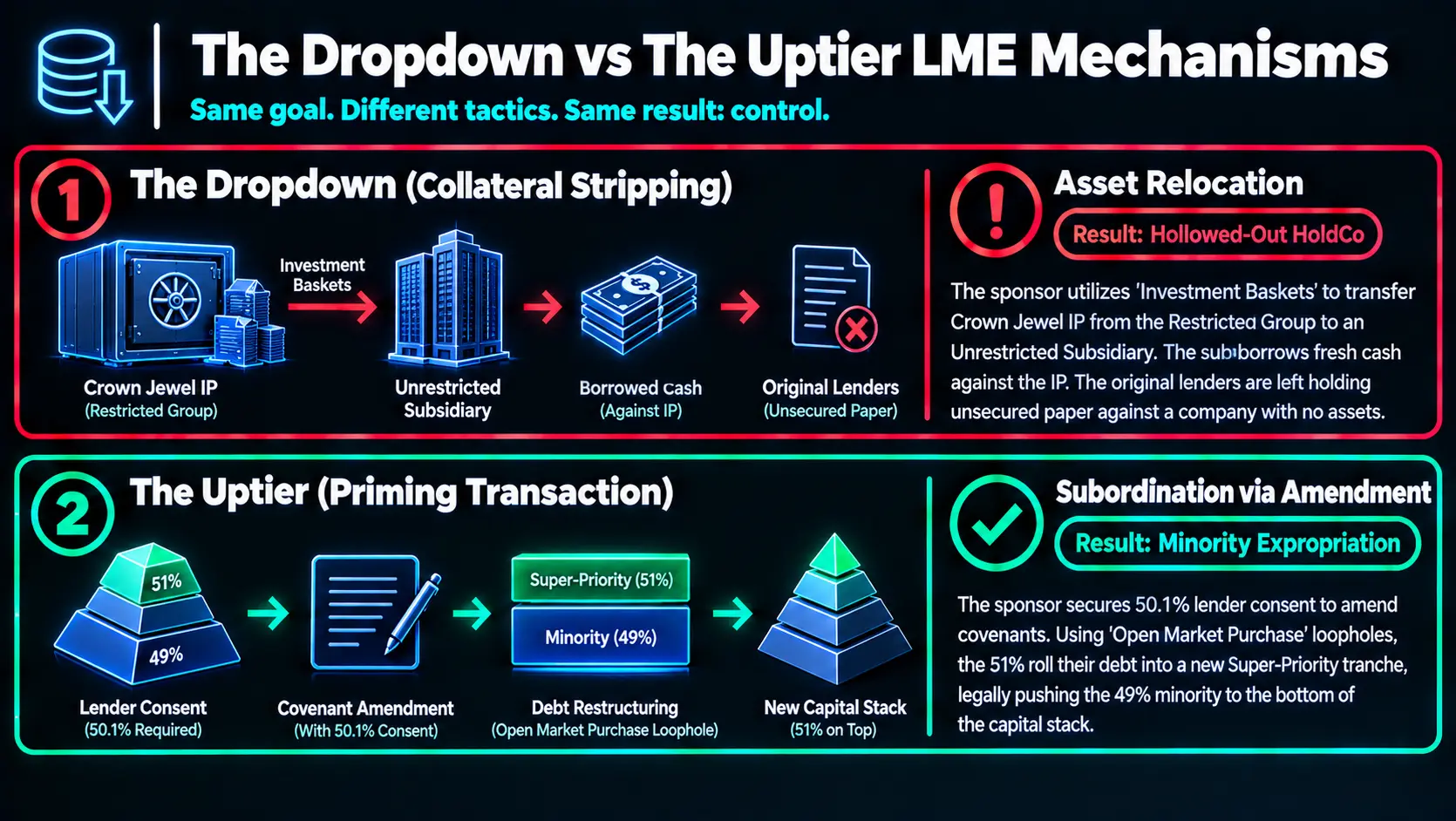
1. The Fundamental Problem: The Liquidity Trap
A private equity-backed company is bleeding cash. They have maxed out their first-lien revolving credit facility. Under traditional rules, they cannot borrow another dime without the permission of 100% of their existing lenders, because all the company’s assets are already pledged as collateral. They are facing imminent bankruptcy.
2. Mechanism 1: The Dropdown (The J.Crew Maneuver)
To raise cash, the sponsor executes a Dropdown. They scour the credit agreement for “Investment Baskets.” These are carve-outs originally intended to let the company make small, routine joint ventures.
The sponsor exploits this capacity to legally transfer the company’s most valuable asset (e.g., the intellectual property and brand trademarks) out of the main company and into a newly created “Unrestricted Subsidiary.”
Plain-English Takeaway: A dropdown does not steal money; it teleports the collateral out of your reach.
Because the Unrestricted Subsidiary is technically not bound by the original credit agreement, it is completely unencumbered. The sponsor then takes that Unrestricted Subsidiary to a new hedge fund, borrows fresh cash using the trademarks as collateral, and leaves the original lenders with a hollowed-out operating company that owns nothing.
3. Mechanism 2: The Uptier (The Serta / Boardriders Maneuver)
If a Dropdown moves the collateral away, an Uptier moves other lenders ahead of you.
Credit agreements require 100% lender consent to alter the sharing of collateral, but they only require a simple majority (50.1%) to amend other non-core covenants.
The sponsor approaches 51% of the lenders. This “Ad Hoc Majority Group” votes to amend the credit agreement, allowing the company to incur a massive new tranche of “Super-Priority” debt.
4. Technical Depth: The Roll-Up
The 51% group lends the company a small amount of new cash (New Money) but demands that their old debt be “rolled up” into the new Super-Priority tranche. The 49% minority group is intentionally excluded from the deal. Suddenly, the 51% group is sitting at the absolute top of the capital stack, while the 49% group is structurally subordinated to the bottom. When the company inevitably files for bankruptcy a year later, the Super-Priority group recovers 100 cents on the dollar, and the minority group recovers zero.
5. Real-World Consequences: Open Market Purchases
To achieve the Uptier without violating the rule that debt must be paid pro-rata (equally), sponsors exploit “Open Market Purchase” provisions. They disguise the restructuring by having the company “buy back” the debt of the 51% group in exchange for the new Super-Priority paper. Because it is classified as an open-market trade rather than a formal debt exchange, the minority lenders have no legal right to participate.
Liability Management Flow Simulator
Visualizing Creditor-on-Creditor Violence: Dropdowns vs. Uptiers
LME Transaction Type
Dropdown (Asset Shift)
Uptier (Priming)
Majority Group Participation
51%
Minority Debt Recovery
100¢ on the $
Majority Lender Status
Pari Passu (1st Lien)
Fresh Sponsor Liquidity
$0 M
Capital Stack & Collateral Transfer Map
PRE-RESTRUCTURING
Creditor Recovery Value Trajectory (¢/$)
Landmark Corporate LME Cases
The deployment of LMEs has moved from isolated legal anomalies to the standard operating procedure for distressed corporate sponsors.
J.Crew (The Original Dropdown): In 2016, J.Crew’s sponsors faced a massive debt wall. Utilizing a complex combination of investment baskets, they transferred the J.Crew brand name and intellectual property (valued at $250 million) to a newly formed Cayman Islands subsidiary. They then issued new notes secured by the brand. The original term loan lenders sued, but the courts ruled the transfer strictly adhered to the literal wording of the credit agreement. This birthed the modern era of the Dropdown.
Serta Simmons Bedding (The Open-Market Uptier): Facing severe distress during the COVID-19 pandemic, Serta Simmons orchestrated an Uptier transaction. A majority group of lenders provided $200 million in new cash and rolled $875 million of their existing first-lien debt into a new "super-priority" tranche. Apollo and other minority lenders were completely excluded. The minority sued, claiming it violated the pro-rata sharing clauses, but federal judges ultimately ruled that the "open market purchase" loophole made the maneuver completely legal.
Incora (The Phantom Guarantee Release): The aerospace parts supplier executed one of the most aggressive uptiers in history. To get around the 100% consent requirement for releasing collateral, the majority lenders utilized a loophole that allowed a 50.1% majority to release collateral only if the subsidiary was being sold. The company technically "sold" the subsidiary to an affiliate, triggered the release of the minority's collateral, and immediately reinstated it for the majority group. It was a masterclass in exploiting the exact letter of the law to defeat the spirit of the law.
Economic & Strategic Impact
The core strategic consequence of LMEs is the Fracturing of the Syndicated Loan Market.
Historically, syndicated loans were illiquid but relatively safe. LPs (pension funds, endowments) trusted CLO managers to buy first-lien debt, assuming the documentation provided structural safety.
The normalization of creditor-on-creditor violence has injected massive ex-ante pricing uncertainty into the market. A CLO manager evaluating a new loan must now price in the probability that they might be excluded from a future uptier. This requires highly sophisticated legal analysis of every single covenant basket before making a trade. While the market is attempting to introduce "J.Crew Blockers" and "Serta Blockers" (contractual clauses specifically banning these maneuvers), the massive overhang of un-deployed private credit capital often forces lenders to cave to private equity sponsors and accept loose documents just to get the deal done.
Advantages (For the Sponsor & Majority)
- Bankruptcy Avoidance: Provides distressed companies with desperately needed runway, injecting fresh cash to survive a macro-downturn without the exorbitant legal costs and operational destruction of a formal Chapter 11 filing.
- Enhanced Returns for the Majority: The hedge funds that orchestrate an Uptier not only earn massive interest rates on the new money they lend, but they instantly rescue their existing debt from certain default by elevating it to super-priority status.
- Sponsor Leverage: By threatening a Dropdown, a private equity sponsor can force recalcitrant lenders to the negotiating table, using the legal threat of collateral-stripping to extract concessions.
Limitations & Risks
- Reputational Destruction: Sponsors and hedge funds that routinely execute aggressive LMEs are blacklisted by certain CLOs and institutional lenders, limiting their ability to syndicate future debt for other portfolio companies.
- The Litigation Premium: Excluded minority lenders do not go quietly. They immediately launch scorched-earth litigation. The company must spend tens of millions of dollars defending the LME in state and bankruptcy courts, often neutralizing the fresh liquidity they just raised.
- The "Double-Dip" Blowback: In response to LMEs, aggressive minority lenders are inventing counter-maneuvers. If they suspect an Uptier is coming, a minority group will quickly form a "cooperation agreement," legally binding themselves together to block the 50.1% threshold and hold the sponsor hostage.
Takeaway: LMEs are financial trench warfare. They do not magically fix a broken business model; they simply rearrange who takes the loss when the business model inevitably fails.
Common Misconceptions
Misconception: Dropdowns and Uptiers are illegal fraud.
Reality: They are highly controversial, but they are generally perfectly legal. Federal judges have repeatedly ruled that if sophisticated Wall Street lenders agreed to a 500-page contract with a loophole in it, the courts will not rewrite the contract to save them from their own bad drafting.
Misconception: LMEs only happen in public junk bonds.
Reality: They are happening aggressively in the massive, opaque Private Credit and Broadly Syndicated Loan (BSL) markets.
Misconception: LMEs save companies.
Reality: Data shows that the vast majority of companies that execute a coercive LME end up filing for Chapter 11 bankruptcy anyway within 18 to 24 months. The LME doesn't save the company; it just ensures the majority lenders get paid out first when the company finally dies.
What Most People Miss
The disruptive capability of The Ex-Ante Cost of Capital.
When analysts discuss LMEs, they focus on the specific court cases. What they miss is the macro impact on corporate borrowing costs.
Because LMEs have destroyed the certainty of first-lien collateral, lenders are demanding higher yields to compensate for "loophole risk." If a private equity sponsor refuses to include a J.Crew blocker in the credit agreement, the syndicate desk will automatically widen the interest rate by 25 to 50 basis points. The normalization of LMEs is structurally raising the cost of capital for all speculative-grade borrowers across the global economy.
Comparison Table
| Feature | Traditional Chapter 11 Bankruptcy | The Dropdown (LME) | The Uptier (LME) |
| Primary Goal | Maximize value for all creditors equitably | Move collateral out of lender reach to borrow fresh cash | Subordinate existing lenders to raise fresh cash |
| Key Mechanism | Judicial restructuring plan | Exploiting "Unrestricted Subsidiary" investment baskets | Exploiting 50.1% majority "Open Market Purchase" rules |
| Impact on Minority | Take pro-rata haircut with all lenders | Left with hollowed-out company | Pushed to the back of the repayment line |
| Legal Venue | Federal Bankruptcy Court | Private contract enforcement / State Court | Private contract enforcement / State Court |
Future Outlook
Next 12–24 Months
The era of The Cooperation Agreement. Through 2026, as the default cycle peaks, the market will witness a massive surge in defensive posturing. The moment a company's bonds drop below 80 cents on the dollar, lenders will frantically race to sign "cooperation agreements" to lock up 50.1% of the voting block before the sponsor can divide them. The restructuring game will be won or lost within 48 hours of the first sign of distress.
Next 3–5 Years
The scaling of The Blocker Standardization. By 2029, the wild west of cov-lite exploitation will begin to recede. Institutional LPs will mandate strict compliance matrices for CLO managers, expressly forbidding them from buying loans that lack ironclad Serta and J.Crew blockers. The documentation pendulum will swing back violently, heavily restricting the ability of sponsors to use unrestricted subsidiaries or non-pro-rata open market purchases.
Next 10 Years
The Bifurcation of Private Credit. By the 2030s, the $1.7 trillion private credit market will split into two distinct tiers. "Premium" private credit will feature tight covenants, absolute collateral certainty, and lower yields, catering to risk-averse pensions. "Aggressive" private credit will operate more like distressed private equity, featuring loose docs, constant LME warfare, and massive yields. The illusion that all first-lien debt is created equal will be permanently erased from modern finance.
Most Likely Scenario
Liability Management Exercises are the inevitable consequence of a decade of zero interest rates and borrower-friendly documentation. While the courts will slowly begin to reign in the most egregious "bad faith" transfers, the fundamental mechanism of creditor-on-creditor violence is here to stay. Private equity sponsors will continuously employ brilliant corporate lawyers to invent new loopholes faster than the market can close them, ensuring that distressed investing remains the most legally hostile environment in global finance.
Key Takeaways
- The $1.7 trillion private credit market is suffering from "creditor-on-creditor violence," where lenders exploit contract loopholes to steal collateral from rival investors.
- A "Dropdown" (like J.Crew) involves a private equity sponsor transferring crown jewel assets into a shell company to borrow fresh cash, leaving original lenders with nothing.
- An "Uptier" (like Serta) involves 51% of lenders colluding with the company to create a new "super-priority" debt tier, pushing the remaining 49% to the back of the bankruptcy line.
- These Liability Management Exercises (LMEs) skip traditional bankruptcy court and are usually perfectly legal because they rely on the exact wording of loose "cov-lite" loan agreements.
- To fight back, minority lenders are increasingly forming rapid-response "cooperation agreements" to block the 51% vote, while demanding strict "blocker" clauses in new loan contracts.
Glossary
Covenant-Lite (Cov-Lite): A type of loan that lacks traditional financial maintenance covenants (rules requiring the company to maintain specific debt-to-income ratios), giving the borrower immense freedom.
Creditor-on-Creditor Violence: The slang term for Liability Management Exercises where one group of lenders aggressively subordinates or strips collateral from another group of lenders in the same syndicate.
Dropdown: An LME where a company transfers valuable assets (like intellectual property) into an Unrestricted Subsidiary, removing it from the collateral pool of the original lenders.
Liability Management Exercise (LME): A broad term for transactions designed to restructure a company's debt or raise fresh capital outside of a formal bankruptcy proceeding.
Open Market Purchase Provision: A loophole in credit agreements originally designed to let a company buy back its own debt quietly, but now weaponized to execute non-pro-rata Uptier exchanges.
Uptier / Priming: An LME where a majority group of lenders amends the credit agreement to create a new, senior tier of debt (Super-Priority), legally subordinating the original first-lien lenders.
Sources
LSTA (Loan Syndications and Trading Association): The Rise of Liability Management Exercises and Documentation Trends
S&P Global Market Intelligence: Creditor-on-Creditor Violence and the Ex-Ante Cost of Capital
Harvard Law School Forum on Corporate Governance: The Serta Simmons Ruling and the Legality of Uptiers
Moody’s Investors Service: The Impact of Unrestricted Subsidiaries on First-Lien Recovery Rates
Journal of Restructuring Finance: Defensive Cooperation Agreements in the Syndicated Loan Market