Advertisement
)


To rewire the global power grid and eliminate fossil fuels, humanity needs to spend roughly $4 trillion annually. Governments do not have the capital. The average homeowner certainly does not have $30,000 in cash lying around to bolt solar panels and a lithium-ion battery onto their roof. For over a decade, this upfront capital expenditure was the fatal bottleneck of the distributed energy transition. If people couldn’t afford the hardware, the solar panels stayed in the warehouse.
Why should you care right now? Because Wall Street solved the bottleneck using structural financial alchemy. By taking the boring, $150-a-month solar loan payments from thousands of suburban homeowners and bundling them together, bankers have created a multi-billion-dollar financial instrument known as a Residential Solar Asset-Backed Security (ABS). This mechanism connects the deepest pools of institutional capital on Earth—pension funds and insurance companies—directly to the roofs of everyday houses. It completely shifts the financial burden of the green transition from the consumer’s checking account to the global bond market, dropping the cost of clean energy and unleashing a pipeline of infinite liquidity.
What is Residential Solar ABS?
Residential Solar ABS (Asset-Backed Securities) are financial instruments created by pooling thousands of individual consumer solar loans, leases, or Power Purchase Agreements (PPAs) into a single, tradeable bond. Institutional investors purchase tranches of this bond, receiving regular fixed-income payouts funded directly by the monthly utility savings of the underlying homeowners.
At a Glance
- Concept: Taking 10,000 individual homeowner debts for solar panels and turning them into one giant, highly secure bond for institutional investors.
- Why it matters: It recycles capital. Without ABS, a solar installer would run out of money after building a few hundred roofs. By selling the debt to Wall Street, the installer gets cash instantly to build a thousand more.
- Who uses it: Solar originators (GoodLeap, Sunrun, Sunnova) to raise capital, and ESG institutional investors (pension funds, asset managers) looking for reliable, green fixed-income yields.
- Biggest takeaway: Solar ABS defaults are incredibly rare because of “Utility Bill Priority.” People pay for their solar panels before their credit cards because if they don’t, their lights turn off.
In Simple Words
Imagine you lend a friend $10. It takes them a year to pay you back. If you want to lend money to a second friend, you have to wait a whole year to get your cash back from the first friend.
But what if you sold the IOU for that $10 to a giant bank for $9 today? The bank waits a year to collect the $10, making a small profit, and you instantly have $9 in your pocket to go lend to someone else tomorrow.
Solar installers do this on a massive scale. They lend homeowners money to build solar panels. Instead of waiting 20 years for the homeowners to pay them back monthly, the installer bundles 10,000 of these IOUs together and sells them to Wall Street. Wall Street gets a safe, 20-year return, and the installer gets instant cash to build 10,000 more solar roofs immediately.
Why This Matters
For Institutional LPs, Fixed Income Analysts, and Cleantech Execs, Solar ABS solves the Cost of Capital Death Spiral.
In the solar industry, hardware (the panels themselves) is cheap. The true cost of solar is the cost of financing. If an installer has to borrow money at an 8% interest rate to build a roof, they have to charge the homeowner a massive premium to cover that debt. This makes solar energy more expensive than dirty grid energy, killing consumer demand.
Securitization violently crushes the cost of capital. By pooling thousands of loans together and applying mathematical credit enhancements, bankers can achieve a AAA credit rating for the solar bond. Because AAA bonds are considered virtually risk-free, pension funds will buy them at very low interest rates (e.g., 4% to 5%). The installer passes these ultra-low rates down to the consumer, making the monthly solar payment cheaper than the local utility bill. Securitization is the financial gravity that makes residential solar economically viable.
The Financialization of Distributed Energy Resources (DERs)
We are witnessing the Financialization of Distributed Energy Resources (DERs).
Historically, utility bonds were backed by massive, centralized assets: a $5 billion nuclear plant or a massive natural gas facility. If a bondholder wanted exposure to energy infrastructure, they bought the debt of a regulated monopoly like PG&E or Duke Energy.
Solar ABS represents a radical decentralization of energy finance. The “power plant” backing the bond is no longer a single concrete facility; it is a decentralized, digital swarm of 50,000 suburban rooftops across 14 different states. This geographical and demographic diversification makes the security fundamentally more resilient to localized economic shocks or natural disasters than a legacy, centralized power plant.
How the Residential Solar ABS Waterfall Works
Transforming thousands of disparate consumer credit checks into a monolithic, institutional-grade fixed-income security requires flawless financial engineering. Here is the first-principles breakdown of the architecture.
1. The Fundamental Problem: Trapped Capital
A solar originator (like GoodLeap) signs a 20-year, $30,000 loan with a homeowner. GoodLeap pays the installer upfront to put the panels on the roof. If GoodLeap holds that loan on its own balance sheet, its capital is trapped for 20 years. To grow a multi-billion-dollar national business, they must liquidate those 20-year receivables immediately.
2. The Core Mechanism: The Special Purpose Vehicle (SPV)
GoodLeap takes 15,000 of these homeowner loans and transfers them into a completely separate, legally isolated shell company called a Special Purpose Vehicle (SPV). If GoodLeap goes bankrupt tomorrow, the SPV remains untouched, and the homeowners’ payments keep flowing to the SPV. This “bankruptcy remoteness” protects the investors from corporate risk.
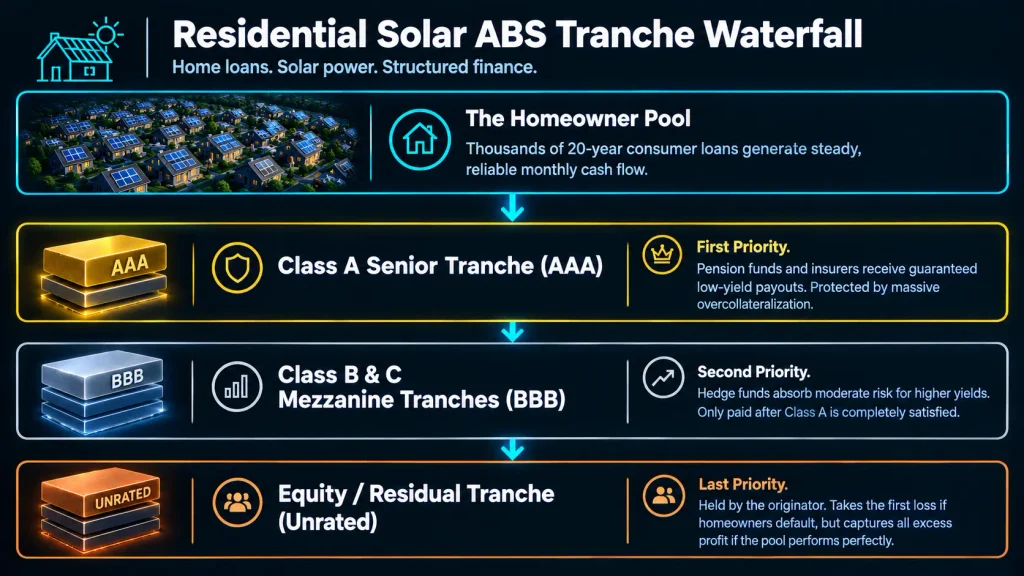
3. Technical Depth: The Tranche Waterfall
The SPV issues bonds backed by the $450 million worth of loans. To attract different types of investors, the bond is sliced horizontally into “tranches.”
- Class A (Senior): Gets paid first. Rated AAA. Lowest risk, lowest interest rate. (Bought by pension funds).
- Class B & C (Mezzanine): Gets paid second. Rated BBB. Medium risk, higher yield. (Bought by hedge funds).
- Equity (Residual): Gets paid last. Unrated. Takes the first loss if people stop paying. (Usually held by the originator to prove they have “skin in the game”).
Micro-Insight: Cash flowing from the homeowners acts like gravity, falling through a waterfall. The Senior bucket must be filled to the brim before a single drop of cash spills over into the Mezzanine bucket.
4. Technical Depth: Overcollateralization
How does consumer debt get a AAA rating? Through structural padding. If the SPV issues $100 million in Senior bonds, it puts $125 million worth of high-FICO homeowner loans into the pool. This 25% “Overcollateralization” acts as a massive shock absorber. Even if 10% of the homeowners default and stop paying their bills, the $100 million Senior bond is mathematically guaranteed to be paid in full.
5. Real-World Consequences: FICO Filtering
Because the entire security rests on the reliability of the American consumer, the underlying credit metrics are intensely scrutinized. Solar ABS pools historically mandate prime or super-prime borrowers. The weighted average FICO score in a top-tier Solar ABS pool is typically above 740, filtering out subprime risk before the pool is even constructed.
Commercial Solar ABS Issuers: GoodLeap and Sunrun
The Solar ABS market has grown from a niche experiment in 2013 into a critical pillar of global green finance.
GoodLeap and Sunrun ABS Issuance: GoodLeap (a point-of-sale financing platform) and Sunrun (a massive physical installer) dominate the securitization market. By standardizing their loan documentation and underwriting criteria, these companies routinely issue $400 million to $500 million ABS tranches multiple times a year. This massive, reliable issuance schedule has established Solar ABS as a deep, highly liquid asset class for Wall Street bond traders.
ESG Mandate Fulfillment: Institutional investors (like sovereign wealth funds and university endowments) are under extreme political and regulatory pressure to deploy capital into Environmental, Social, and Governance (ESG) assets. However, they are legally barred from taking high risks. Solar ABS allows them to deploy billions of dollars directly into green infrastructure (solar panels) while maintaining strict fiduciary duty by purchasing low-risk, AAA-rated fixed income.
Battery Storage Integration (Solar + Storage): Early Solar ABS pools only contained loans for basic solar panels. The 2025/2026 vintages now heavily feature “Solar + Storage” loans, bundling Tesla Powerwalls and Enphase batteries into the security. While this increases the average loan size to over $40,000, it also drastically decreases the default risk, as homeowners with batteries are insulated from local grid blackouts, increasing the perceived value of the system to the consumer.
Economic & Strategic Impact
The core strategic consequence of Solar ABS is the Immunity to Regulatory Net Energy Metering (NEM) Shocks.
In states like California (under the NEM 3.0 ruling), the amount of money a utility pays a homeowner for exporting excess solar power has been slashed. This damages the economic payback period for the homeowner.
However, from an ABS perspective, this regulatory risk is largely neutralized. The ABS bondholders are not paid by the local utility; they are paid a fixed monthly loan amount directly from the homeowner’s bank account. As long as the homeowner continues to make their $150 fixed loan payment, the ABS performs flawlessly, completely detaching institutional bond yields from volatile state-level utility politics.
Advantages
- Utility Bill Priority: In consumer credit, homeowners generally default on credit cards first, auto loans second, and mortgages third. Solar loans rank exceptionally high (often equal to mortgages) because defaulting risks the removal of the panels, which forces the consumer back onto highly expensive, inflating utility grid rates.
- Geographic Diversification: A single $500 million pool contains loans from sunny California, freezing Massachusetts, and humid Florida. A localized economic shock or natural disaster in one state cannot structurally impair the entire bond.
- Predictable Prepayments: Unlike mortgage-backed securities (RMBS) where users refinance wildly based on interest rates, solar loan prepayments are highly predictable. They usually spike in Month 18 when the homeowner receives their 30% Federal Investment Tax Credit (ITC) check and applies it directly to the loan principal.
Limitations
- Technological Obsolescence Risk: A solar loan lasts 20 years. Ten years from now, current solar panels may be severely outdated. If a homeowner feels they are paying $150 a month for obsolete, degrading technology, their willingness to pay (the psychological attachment to the debt) may drop, threatening the unrated Equity tranches.
- Interest Rate Sensitivity: The entire model relies on the spread between the homeowner’s interest rate and the bond market’s yield. If macro interest rates spike (as they did in 2023), originators must charge homeowners much higher rates (killing demand) or sell the ABS at a massive discount (destroying their own profit margins).
- Installer Bankruptcy Risk: While the SPV protects the loans from corporate bankruptcy, the physical solar panels still require ongoing maintenance. If the original installer goes bankrupt, homeowners left with broken panels and voided warranties are highly likely to stop paying their loans in protest, directly threatening the cash flow to the SPV.
Takeaway: The math of the ABS waterfall is indestructible, but the psychology of the consumer is not. You are ultimately betting that a homeowner will value a piece of glass on their roof for 20 continuous years.
Common Misconceptions
Misconception: Solar ABS is exactly like the Subprime Mortgage Crisis of 2008.
Reality: The 2008 crisis was driven by “NINJA” loans (No Income, No Job, No Assets) given to subprime borrowers, bundled into fraudulent AAA bonds. Solar ABS requires prime or super-prime borrowers (FICO 740+), rigid income verification, and is backed by equipment that actually reduces the borrower’s monthly expenses.
Misconception: If the solar company goes bankrupt, the bondholders lose their money.
Reality: The loans are held in a legally isolated “bankruptcy-remote” Special Purpose Vehicle. The bankruptcy of the parent company has zero legal impact on the SPV, and a backup servicer simply steps in to collect the monthly checks from the homeowners.
Misconception: Solar ABS relies entirely on government subsidies.
Reality: While the 30% Federal ITC drives consumer demand, the mechanics of the bond rely exclusively on the contractual obligation of the homeowner to pay their monthly loan bill.
What Most People Miss
The disruptive capability of The Uniform Commercial Code (UCC-1) Fixture Filing.
When analysts look at solar debt, they often assume it is an unsecured personal loan (like a credit card). What they miss is the aggressive legal collateralization.
When an installer originates a solar loan, they file a UCC-1 fixture filing on the property. This legally attaches the solar equipment to the title of the house. If the homeowner attempts to sell or refinance the house five years later, the title company will flag the UCC-1. The homeowner is legally blocked from closing the real estate transaction until they completely pay off the remainder of the solar loan. This invisible legal hook guarantees massive, unexpected lump-sum payouts (prepayments) to the ABS bondholders whenever the housing market turns over.
Comparison Table
| Metric | Mortgage-Backed Security (RMBS) | Auto Loan ABS | Residential Solar ABS |
| Underlying Asset | Residential Real Estate | Vehicles | Solar Panels & Batteries |
| Average FICO Requirement | Variable (620 – 750+) | Broad (Subprime to Prime) | Super-Prime (740+) |
| Prepayment Risk | High (Driven by rate cuts) | Low | Moderate (Driven by housing turnover & ITC) |
| Depreciation Profile | Asset Appreciates (Usually) | High Depreciation | Moderate Depreciation |
| Primary Incentive to Pay | Keep the house | Keep the car to get to work | Keep the lights on / Avoid grid inflation |
Future Outlook
Next 12–24 Months
The era of Virtual Power Plant (VPP) Securitization. Through 2026, the underlying assets inside the ABS will evolve. Rather than just collecting fixed loan payments, originators will aggregate the thousands of batteries attached to these homes into Virtual Power Plants. They will sell the combined battery power to the macro grid during peak hours. The revenue generated by the VPP will be funneled directly into the ABS SPV, creating a highly lucrative, dynamic secondary cash flow that accelerates the payoff of the Senior tranches.
Next 3–5 Years
The scaling of European and Global ABS Markets. Historically, the Solar ABS market has been heavily concentrated in the United States due to the highly developed tax equity and consumer credit structures. As European utility costs remain structurally elevated, consumer demand for residential solar across the EU is surging. We will see the rapid deployment of Euro-denominated Solar ABS pools, heavily anchored by institutional capital seeking compliance with the EU’s aggressive green taxonomy regulations.
Next 10 Years
The Home Electrification Mega-Tranche. By the 2030s, the concept of a “Solar ABS” will be too narrow. The bonds will evolve into holistic “Home Electrification ABS.” The 20-year consumer loan inside the SPV will cover the solar panels, the bidirectional EV charger, the electric heat pump, and the smart electrical panel. The entire energy infrastructure of the residential sector will be continuously financed, upgraded, and securitized through a relentless, efficient conduit to the global fixed-income markets.
Most Likely Scenario
Residential Solar ABS is the unsung financial hero of the green transition. By recognizing that average consumers cannot fund infrastructure megaprojects, Wall Street successfully bridged the gap between institutional wealth and suburban rooftops. While highly sensitive to macroeconomic interest rate environments, the structural protections of overcollateralization and prime FICO filtering guarantee the resilience of the asset class. Securitization will remain the absolute baseline requirement for scaling decentralized energy globally.
Key Takeaways
- To put solar panels on a house costs $30,000. Because consumers don’t have the cash, companies offer them 20-year loans.
- To get cash to build more roofs, these companies bundle thousands of these loans together and sell them to Wall Street as Asset-Backed Securities (ABS).
- The bonds are sliced into risk levels (tranches). The safest slices get AAA ratings, allowing massive pension funds to invest in green energy safely.
- To guarantee the AAA rating, the pools use “overcollateralization”—putting $120 million of loans into a bucket to back up $100 million of debt, creating a massive shock absorber against defaults.
- Solar ABS defaults are incredibly rare because consumers prioritize paying their solar bill over other debts to keep their electricity running and avoid expensive utility rates.
Glossary
Asset-Backed Security (ABS): A financial bond created by bundling thousands of smaller, illiquid loans (like auto loans or solar loans) into a single tradeable instrument.
FICO Score: A numerical representation of a consumer’s creditworthiness. Solar ABS pools demand highly reliable borrowers, usually targeting FICO scores of 740 or above.
Overcollateralization: A structural safety net where the total value of the loans in the pool is greater than the total value of the bonds issued, ensuring bondholders are protected if some homeowners default.
Special Purpose Vehicle (SPV): A legally separate “shell company” created entirely to hold the consumer loans. It protects investors from losing their money if the original solar installer goes bankrupt.
Tranche: French for “slice.” In securitization, it refers to cutting the bond into different risk levels (Senior, Mezzanine, Equity) to appeal to different types of investors.
UCC-1 Fixture Filing: A legal document that officially attaches the solar equipment to the title of the house, forcing the homeowner to pay off the solar loan if they ever want to sell their home.
Sources
Kroll Bond Rating Agency (KBRA): Residential Solar ABS Global Rating Methodology
BloombergNEF: Clean Energy Securitization and the Distributed Asset Market
National Renewable Energy Laboratory (NREL): Financing Residential Solar via Asset-Backed Securities
S&P Global Ratings: Performance Metrics of U.S. Solar Loan ABS Vintages
Solar Energy Industries Association (SEIA): Third-Party Ownership and Residential Financing Trends