Advertisement
)


Imagine a mid-sized Indian manufacturing conglomerate urgently needs $100 million to acquire a rival facility. Ten years ago, the CEO had two terrible options: beg a rigid, state-owned bank that would take nine months to approve the loan, or accept extortionate terms from a foreign shadow bank. The transaction would likely die in committee. Today, that same CEO closes the deal in three weeks, funded entirely by a localized pool of Indian capital.
Why should you care right now? Because the architecture of emerging market debt has fundamentally fractured. In the first half of 2026 alone, domestic Indian funds injected a staggering $3.5 billion into private corporate credit, aggressively pricing out massive Wall Street and European asset managers. India is no longer reliant on foreign dollar inflows to fund its corporate growth. By pooling the exploding wealth of domestic family offices into agile Alternative Investment Funds (AIFs), India has constructed a sovereign, un-hedged shadow banking system that operates faster, cheaper, and more aggressively than the legacy institutions it is rapidly replacing.
What is India’s Private Credit Boom?
India’s private credit boom is the rapid expansion of non-bank corporate lending, driven by domestic Alternative Investment Funds (AIFs). As traditional banks face strict regulatory constraints, these private funds pool local capital to provide bespoke, high-yield financing for corporate acquisitions, real estate, and infrastructure projects.
At a Glance
- Concept: Wealthy Indians pooling their money to act as private, agile banks for corporations that need fast, flexible cash.
- Why it matters: It breaks the monopoly of strict traditional banks and eliminates the currency risk of borrowing from foreign investors.
- Who uses it: Mid-market corporations, real estate developers, and infrastructure firms requiring M&A or bridge financing.
- Biggest takeaway: Foreign credit funds are losing their grip on India. Because local funds lend in Rupees and don’t have to pay massive fees to convert dollars, they can offer cheaper loans to companies while still generating double-digit returns for their investors.
In Simple Words
A traditional bank is like a public bus. It is cheap, heavily regulated by the government, follows a very strict route, and won’t change its schedule just because you are in a hurry. If a company needs a standard loan to buy a standard machine, the bank is perfect.
But what if a company needs money to buy out a competitor in 14 days before someone else does? The bank bus won’t help.
Private Credit is like chartering a private jet. It is more expensive, but the pilot (the fund manager) will fly exactly where you want, exactly when you want, and structure the flight around your specific needs. Previously, Indian companies had to charter these jets from foreign investors. Now, due to an explosion of local wealth, Indians have built their own fleet of private jets (AIFs), cutting out the foreign middlemen entirely.
Why This Matters
For Institutional LPs, Credit Analysts, and Macro Economists, this boom solves the Currency Hedging Friction.
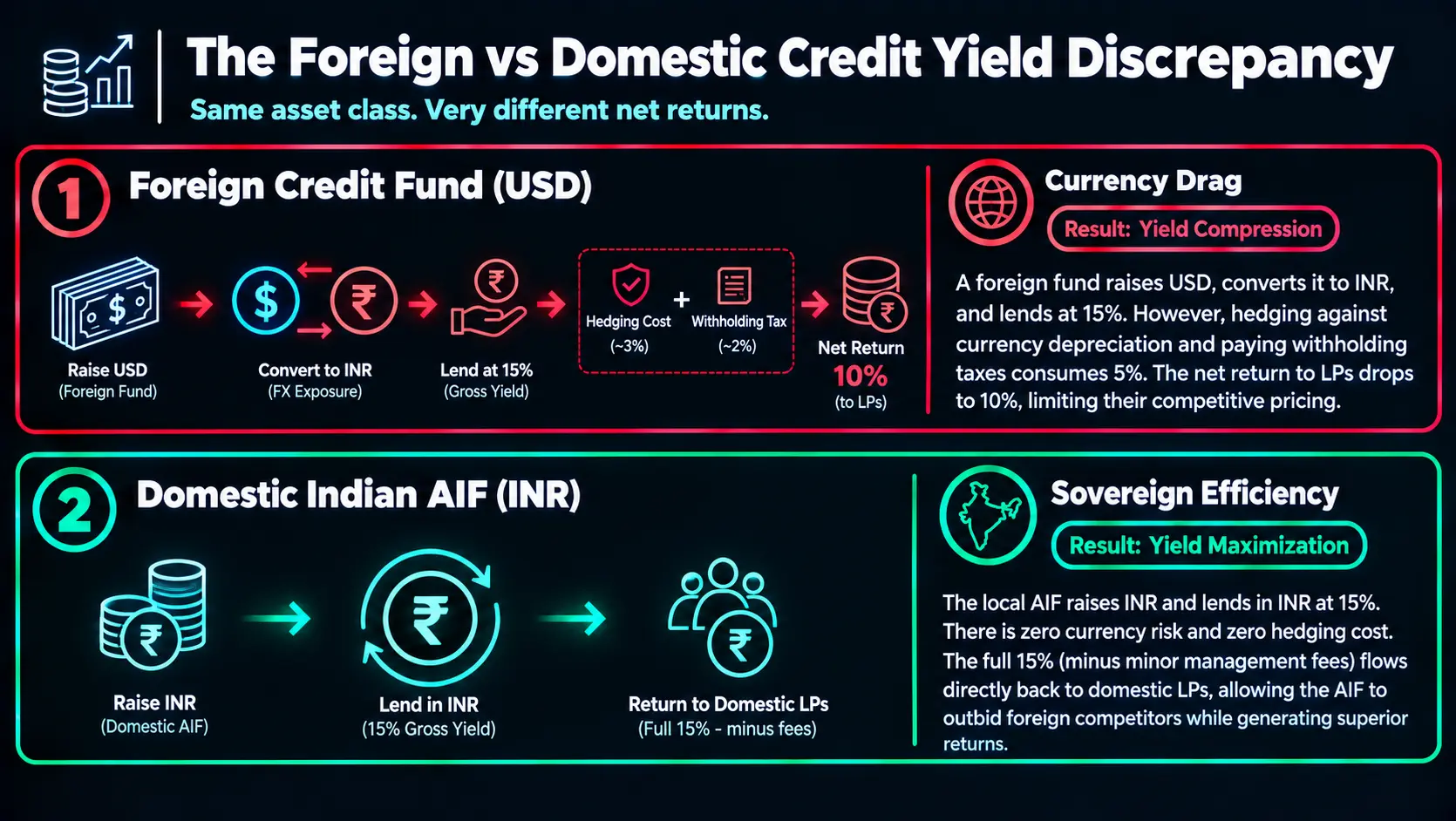
Historically, private credit in India was dominated by massive global players like Apollo, Oaktree, or KKR. These funds raise money in US Dollars (USD). When they lend to an Indian company in Indian Rupees (INR), they face currency risk. If the Rupee loses value against the Dollar, the fund’s returns are wiped out.
To prevent this, foreign funds buy “currency hedges”—essentially an insurance policy against exchange rate fluctuations. In India, this insurance is incredibly expensive, typically costing 4% to 5% of the investment’s total yield. If a foreign fund charges an Indian company 15% interest, they immediately lose 5% to the hedge, leaving a net return of 10%.
Domestic AIFs raise their money in Rupees from Indian investors and lend in Rupees. There is zero currency mismatch. The hedging cost is effectively 0%. This structural asymmetry allows Indian funds to underbid foreign funds on interest rates, while simultaneously delivering higher net returns to their local investors.
The Financialization of Indian Private Credit
We are witnessing the Financialization of Indian Wealth.
Historically, if an Indian family office or Ultra-High-Net-Worth Individual (UHNWI) wanted to generate yield, they bought physical real estate or gold. It was tangible, safe, and culturally ingrained.
Today, that capital is moving up the risk curve into structured financial products. Wealthy domestic investors realize that instead of buying a commercial building and dealing with tenants for a 6% yield, they can invest that same capital into a regulated Category II AIF. The AIF lends that money to the developer building the commercial building, securing the loan against the hard asset, and generates a 15% yield. The Indian LP has matured, transitioning from asset owners to sophisticated capital allocators.
How Alternative Investment Funds (AIFs) Replace Banks
Replacing banks with agile private capital requires precise legal and financial structuring. Here is the first-principles breakdown of the mechanism.
1. The Fundamental Problem: RBI Risk Weights
Traditional banks in India are heavily governed by the Reserve Bank of India (RBI). If a bank wants to lend money for a risky corporate acquisition, the RBI forces the bank to hold massive amounts of reserve capital against that loan to prevent systemic failure. This makes the loan unprofitable for the bank. Consequently, banks simply refuse to finance complex corporate maneuvering.
2. The Core Mechanism: The Category II AIF
To fill this void, domestic asset managers launch Category II Alternative Investment Funds (AIFs) governed by the Securities and Exchange Board of India (SEBI). An AIF is simply a legal pool of money. Unlike banks, AIFs do not take deposits from average retail citizens; they only take money from sophisticated institutional investors and UHNWIs. Because no “mom-and-pop” money is at risk, SEBI allows AIFs to take on significantly higher credit risks.
3. Technical Depth: Mezzanine and Structured Credit
The AIF approaches a corporation that needs money fast. Instead of a standard, rigid bank loan, the AIF offers “structured credit.” This might take the form of Mezzanine Debt (a hybrid of debt and equity) or Non-Convertible Debentures (NCDs). The AIF structures the loan perfectly to match the company’s cash flow, perhaps allowing them to pay zero interest for the first two years (payment-in-kind) while the business scales.
Micro-Insight: Banks lend based on historical balance sheets. Private credit funds lend based on future cash flows and enterprise value, allowing them to underwrite high-growth companies that banks view as “un-bankable.”
4. Technical Depth: Bespoke Covenants
In exchange for this extreme flexibility, the AIF demands strict covenants (financial rules). If the company’s revenue drops below a certain threshold, the AIF might instantly gain board seats, secure the rights to seize specific corporate assets, or force a sale of the company.
5. Real-World Consequences: Execution Velocity
A manufacturing firm wants to buy out a distressed competitor. A traditional bank requires board approvals, risk committee sign-offs, and external audits, taking six months. The domestic AIF deploys a lean team of credit analysts, completes the diligence in three weeks, and wires $50 million, securing the acquisition and earning an 18% premium for the speed of execution.
India Private Credit: Capital Flow Shift
Visualizing the $3.5B Domestic Pivot and the Elimination of Currency Hedging Frictions
Corporate Borrowing Rate
15.0%
Capital Source Architecture
Foreign Fund (USD)
Domestic AIF (INR)
Gross Corporate Yield
15.0%
Hedging & Tax Friction
-5.0%
Net Investor IRR
10.0%
Capital Flow & Leakage Map
FOREIGN CURRENCY DRAG ACTIVE
Net Yield Trajectory Over Time
Real-World Corporate M&A and Last-Mile Funding
The $3.5B domestic influx is reshaping India's tangible economy.
Real Estate Last-Mile Funding: During recent liquidity crunches, many mid-tier real estate developers had half-finished residential towers but ran out of cash. Banks are legally restricted from funding developers who are technically in default. Domestic AIFs step in as "rescue capital." They provide the last-mile funding required to finish the building, allowing the developer to sell the apartments, clear the debt, and generate a massive exit yield for the fund.
Promoter Financing: In India, business founders are called "promoters." Often, a promoter wants to expand their business or buy out an early investor without selling their own shares and losing control of the company. AIFs offer "promoter funding," lending money directly to the founder while holding the founder's shares as collateral. This allows aggressive corporate expansion without equity dilution.
Infrastructure Refinancing: India is undergoing a historic infrastructure boom (highways, ports, data centers). Building infrastructure is incredibly expensive and carries high construction risk. Once a toll road is finished and generating stable toll revenue, domestic credit funds step in to refinance the expensive construction debt, providing a stable, long-term yield for their LPs backed by hard, cash-generating assets.
Economic & Strategic Impact
The core strategic consequence of the private credit boom is the De-risking of the Systemic Banking Sector.
Historically, when Indian corporations defaulted on massive loans, the blow was absorbed by state-owned banks. This created a chronic "Non-Performing Asset" (NPA) crisis, requiring the government to bail out the banks using taxpayer money.
Private credit fundamentally shifts corporate risk away from the public banking system and onto the balance sheets of private, ultra-wealthy individuals. If a real estate developer defaults on a $100 million AIF loan today, no taxpayer money is lost, and the broader economy doesn't flinch. The wealthy LPs in the fund absorb the loss. By acting as a shock absorber for high-risk corporate debt, private credit actively stabilizes India's macroeconomic baseline.
Advantages
- Execution Speed: Private funds can underwrite and disburse capital in weeks, enabling corporations to capitalize on fleeting M&A opportunities.
- Bespoke Structuring: Cash flows can be precisely mapped to the borrower's business cycle, unlike the rigid monthly EMIs demanded by commercial banks.
- Domestic Rupee Insulation: Borrowing from local AIFs protects Indian corporations from global FX volatility and Federal Reserve rate hikes, stabilizing their balance sheets.
- No Dilution: Allows founders to raise massive amounts of growth capital without giving up equity or voting control to private equity firms.
Limitations
- Illiquidity for LPs: Money committed to an AIF is locked up for 5 to 7 years. Unlike a stock portfolio, an investor cannot panic and withdraw their capital if they need cash immediately.
- Resolution Friction: While India's Insolvency and Bankruptcy Code (IBC) is functional, taking a defaulting company to court and actually recovering the underlying assets is still a painfully slow, politically complex process that can drag on for years.
- Yield Compression: As more domestic family offices pour billions into the asset class, there is "too much money chasing too few good deals." This competition is driving interest rates down, slowly compressing the lucrative 18% yields down toward 13%.
Takeaway: The domestic pivot is highly lucrative today, but it is unseasoned. The true test of India's domestic credit funds will not be how fast they deploy the $3.5 billion, but how efficiently they recover it during the next major macroeconomic recession.
Common Misconceptions
Misconception: Private credit is just "distressed debt" or loan sharking.
Reality: While distressed debt exists, the vast majority of the $3.5B H1 2026 deployment is "performing credit." AIFs are lending to healthy, highly profitable companies that simply need specialized capital faster than a bank can provide it.
Misconception: AIFs are unregulated.
Reality: SEBI highly regulates AIFs. They must file detailed placement memorandums, adhere to strict concentration limits (they cannot lend all their money to one company), and face rigorous auditing and reporting requirements to protect investors.
Misconception: This replaces traditional banking.
Reality: Private credit complements banking. A healthy company uses a cheap bank loan to pay for its day-to-day operations and payroll. It uses expensive private credit to execute a rapid, complex buyout of a competitor.
What Most People Miss
The disruptive capability of Co-Lending Ecosystems.
When analysts look at private credit, they view AIFs and banks as enemies. What they miss is the emerging synergy between them.
Because banks are highly regulated, they cannot take the riskiest slice of a loan. Today, domestic AIFs are actively partnering with traditional banks to do "co-lending." If a company needs $100 million, the bank will provide $70 million as "senior debt" at 9% (very safe, first to get paid back), while the AIF provides $30 million as "junior debt" at 16% (higher risk, absorbs the first loss). This allows the company to secure massive capital, allows the bank to stay safe, and allows the AIF to hit its yield targets, creating a perfectly synthesized capital stack.
Comparison Table
| Metric | Traditional Commercial Bank | Foreign Private Credit Fund | Domestic Indian AIF |
| Capital Source | Retail Deposits | Global Endowments (USD) | Domestic Wealth (INR) |
| Hedging Cost | Zero | High (4-5% yield drag) | Zero |
| Execution Speed | 3 to 6 Months | 1 to 2 Months | 3 to 4 Weeks |
| Risk Tolerance | Very Low (Heavily regulated) | High | High |
| Loan Structuring | Rigid, Standardized | Highly Bespoke | Highly Bespoke |
Future Outlook
Next 12–24 Months
The era of Regulatory Tightening and Transparency. Through 2026 and 2027, SEBI will enforce stricter valuation norms on AIFs to prevent funds from artificially inflating the value of non-performing loans ("evergreening"). We will see a slight consolidation as smaller, poorly managed funds are pushed out by stringent compliance costs, leaving the market to institutionalized, institutional-grade domestic asset managers.
Next 3–5 Years
The scaling of Secondary Market Liquidity. Currently, if an LP wants out of an AIF on year three, they are stuck. By the late 2020s, India will develop a robust "secondary market" for private credit. Specialized funds will emerge solely to buy out the stakes of LPs who want early exits, finally introducing a layer of liquidity to an inherently illiquid asset class and attracting even more domestic capital.
Next 10 Years
The Export of the Rupee Credit Model. By the mid-2030s, the Indian domestic credit market will be so deep and sophisticated that Indian AIFs will begin lending outside their borders. Indian capital pools will finance infrastructure and corporate expansion across Southeast Asia and the Middle East, entirely in Rupee-denominated structured products, positioning Mumbai as the undisputed private capital hub of the Eastern Hemisphere.
Most Likely Scenario
The $3.5B pivot in H1 2026 is not a temporary anomaly; it is a permanent structural correction. As India’s ultra-high-net-worth population continues its exponential growth, the demand for sophisticated, high-yield alternative assets will only intensify. By structurally bypassing the currency hedging penalties that cripple foreign funds, domestic AIFs possess an insurmountable mathematical advantage. The era of foreign dominance in Indian corporate debt is over; the future of Indian growth will be underwritten entirely by Indian capital.
Key Takeaways
- Strict bank regulations and a booming economy have created a massive demand for fast, flexible corporate loans in India.
- Historically, foreign investors filled this gap, but their returns were severely eaten away by the cost of converting Dollars to Rupees and back (currency hedging).
- In H1 2026, wealthy Indians and local family offices injected $3.5 billion into domestic Alternative Investment Funds (AIFs), cutting out the foreign middlemen.
- Because domestic AIFs lend in Rupees, they pay zero currency hedging costs, allowing them to offer cheaper loans to companies while giving higher returns to local investors.
- This private credit boom shifts high-risk corporate loans off the books of public, taxpayer-backed banks and onto the balance sheets of ultra-wealthy private citizens, making the broader economy safer.
Glossary
Alternative Investment Fund (AIF): A privately pooled investment vehicle in India, regulated by SEBI, that collects funds from sophisticated investors to invest in asset classes beyond traditional stocks and bonds.
Covenant: A strict financial rule written into a loan contract. If the borrowing company breaks the rule (e.g., profits drop too low), the lender can take control of the company's assets.
Currency Hedging: A financial strategy used by foreign investors to protect themselves against changes in exchange rates. In India, buying this protection is famously expensive.
Internal Rate of Return (IRR): The standard metric used by private funds to measure the profitability of an investment over time, taking into account when the money was deployed and returned.
Mezzanine Debt: A hybrid type of financing that sits between safe bank debt and high-risk equity. It offers high returns but usually absorbs losses before the bank does if the company goes bankrupt.
Promoter: In the Indian corporate ecosystem, this term refers to the founder or controlling shareholder of a company.
Sources
Ernst & Young (EY) India: Private Credit in India: H1 2026 Investment Trends
Reserve Bank of India (RBI): Financial Stability Report and Risk Weights on Corporate Lending
Securities and Exchange Board of India (SEBI): Alternative Investment Funds (AIF) Regulatory Framework Updates
CRISIL Ratings: The Shift Toward Domestic Capital in Structured Credit Markets
Indian Venture and Alternate Capital Association (IVCA): The Evolution of the Indian LP and Family Office Allocation