Advertisement
)

AT A GLANCE
- Concept: Chemical Adsorption: Amine-functionalized porous structures bind weakly with low-concentration carbon dioxide molecules.
- Concept: Thermal Desorption: Low-pressure steam breaks chemical bonds to release pure carbon dioxide gas.
- Concept: Concentration Penalty: Capturing carbon at 420 parts per million requires massive volumetric airflow.
- Concept: Nuclear Integration: High thermal demands require dedicated, co-located small modular nuclear reactors for scaling.
HOW IT WORKS
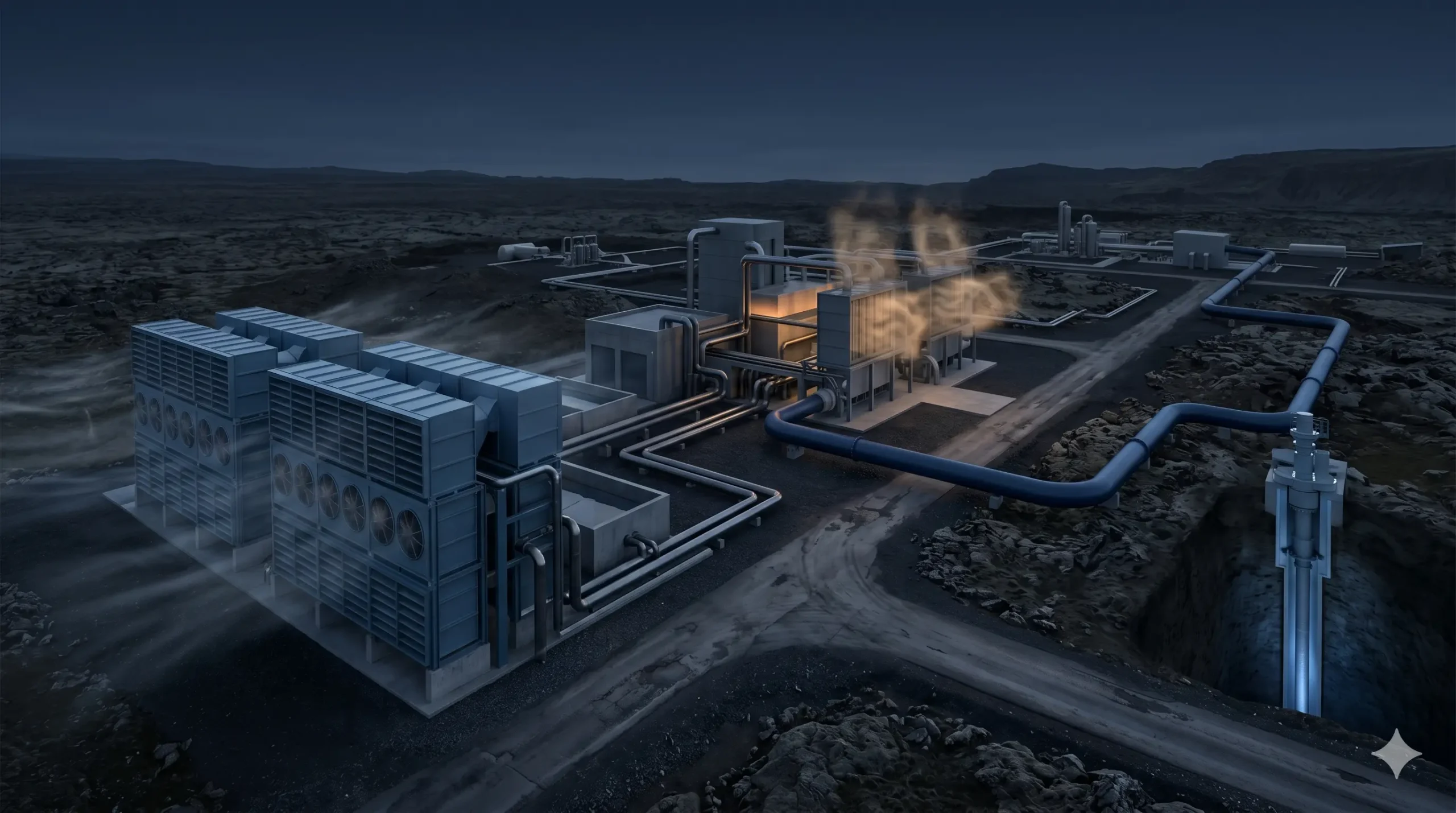
Giant fan arrays pull raw atmospheric air through highly porous solid matrix structures. These solid matrices feature an expanded surface area coated with basic amine chemical compounds that attract acidic carbon dioxide molecules.
The low baseline concentration of atmospheric carbon dioxide—roughly 420 parts per million—demands massive volumetric movement. As the air passes through the filter, the carbon dioxide binds chemically to the amine sites through a low-energy adsorption mechanism.
Once the chemical sites fill up completely, operators seal the air contactor chamber to isolate the filters from the outside atmosphere. Releasing the captured gas requires altering the local thermodynamic equilibrium.
Operators inject low-pressure steam into the closed chamber to raise the internal temperature to approximately 100°C. This specific thermal influx breaks the weak covalent bonds between the amine molecules and the carbon dioxide.
The desorption rate follows the Arrhenius kinetics model for chemical reaction rates:
Where $k$ represents the kinetic rate constant, $A$ is the pre-exponential factor, $E_a$ is the activation energy of the amine-carbon dioxide bond, $R$ is the universal gas constant, and $T$ is the absolute regeneration temperature.
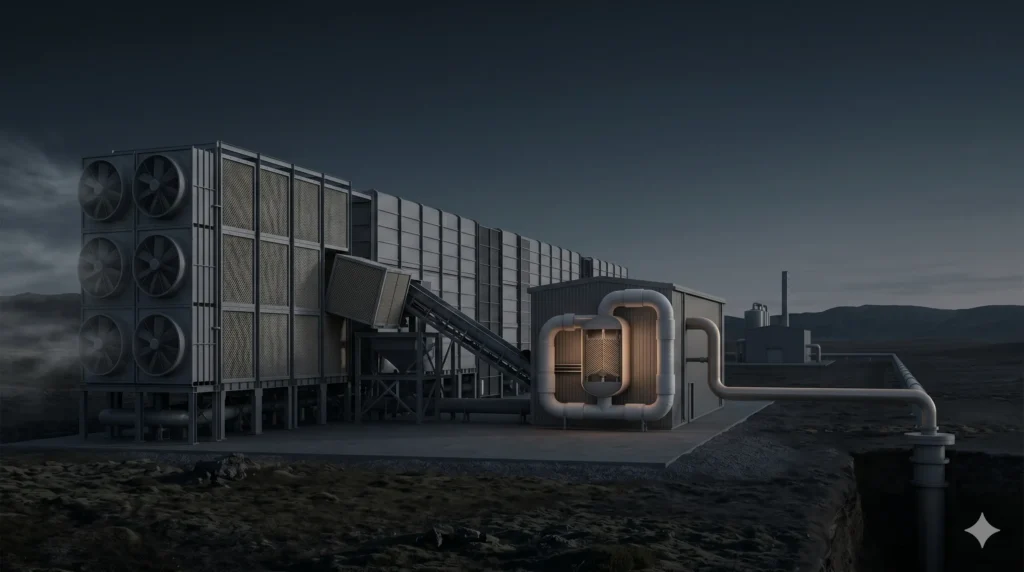
The pure, desorbed carbon dioxide gas is then pumped out of the chamber, compressed to a supercritical state, and channeled into deep basalt formations for permanent mineralization. The cooled filter resets, opening its gates to resume the atmospheric collection cycle.
WHY IT MATTERS NOW
Global corporate carbon offset markets are shifting from speculative forestry credits toward permanent, verifiable technical removals. Major technology firms buy massive multi-year contracts from direct air capture operators to satisfy stringent net-zero mandates.
This corporate demand has triggered a capital race funded by Department of Energy subsidies and private equity. The United States government has allocated billions to build regional direct air capture hubs, turning carbon management into an institutional infrastructure asset class.
Climeworks and its competitors are scaling up massive industrial installations like the Mammoth facility in Iceland. These projects represent the initial phase of a global infrastructure asset class that requires dedicated supply chains for chemical sorbents and heavy industrial machinery.
However, the physical scale required to remove a gigaton of carbon dioxide from the atmosphere clashes directly with global energy availability. Running thousands of these facilities requires massive amounts of continuous baseload thermal and electrical energy.
WHAT MOST PEOPLE MISS
Public marketing campaigns portray direct air capture as a straightforward environmental fix. They focus on the number of fans deployed rather than the immense thermodynamic penalty of the desorption loop.
The true limitation is the low-pressure steam requirement. Extracting carbon dioxide from solid amine filters consumes up to eighty percent of the facility’s total operating budget purely as thermal energy.
To scale effectively without cannibalizing the local electrical grid, these facilities cannot rely on intermittent wind or solar power. They require direct, co-located thermal integration with dedicated small modular nuclear reactors that supply continuous, high-temperature steam directly to the chemical contactors.
THE TRAJECTORY
Next 12–36 Months: Direct air capture companies will secure direct partnerships with nuclear energy providers to co-locate initial commercial testing facilities. These deployments will validate the performance of specialized heat exchangers using direct reactor thermal bleed.
Next Five Years: Sorbent chemistry will transition to advanced metal-organic frameworks that lower the necessary desorption temperature to under 80°C. This reduction will allow facilities to utilize low-grade industrial waste heat, reducing baseline operating expenditures.
Next Ten Years: Sovereign states will assume direct ownership of carbon sequestration infrastructure, classifying carbon capture as a mandatory national security utility. Massive automated facilities will operate along desert coastlines, powered by dedicated nuclear fleets.
What Could Go Wrong: Airborne particulate matter and industrial pollutants like sulfur dioxide can permanently poison amine sorbent sites. If pre-filtration systems fail to neutralize these contaminants, the expensive chemical filters will degrade within weeks, rendering the facility economically unviable.
Most Likely Outcome: Direct air capture will scale slowly as a premium, highly restricted carbon removal utility. The speed of deployment will align perfectly with the regulatory approval timelines of small modular nuclear reactors, acting as a structural constraint on corporate net-zero targets.
KEY TERMS
- Direct Air Capture (DAC): An industrial system that removes carbon dioxide directly from ambient air using chemical solutions or solid sorbents.
- Thermal Desorption: The use of heat to break chemical bonds between a sorbent material and a captured gas molecule.
- Concentration Penalty: The thermodynamic energy requirement increase associated with extracting a highly diluted solute from a solvent matrix.
- Amine Sorbent: A chemical compound derived from ammonia that binds selectively with carbon dioxide molecules in dilute gas streams.
- Supercritical Compression: The process of pressurizing carbon dioxide gas past its critical point into a dense, fluid-like state optimized for pipeline transport and deep geological injection.
SOURCES
- National Academies of Sciences, Engineering, and Medicine — Negative Emissions Technologies and Reliable Sequestration: A Research Agenda
- Climeworks AG — Mammoth Facility Operational Profile and Performance Verification Documentation
- International Energy Agency (IEA) — Direct Air Capture: A Key Technology for Net-Zero Targets
- Department of Energy (DOE) — Regional Direct Air Capture Hubs Program Framework