Advertisement
)
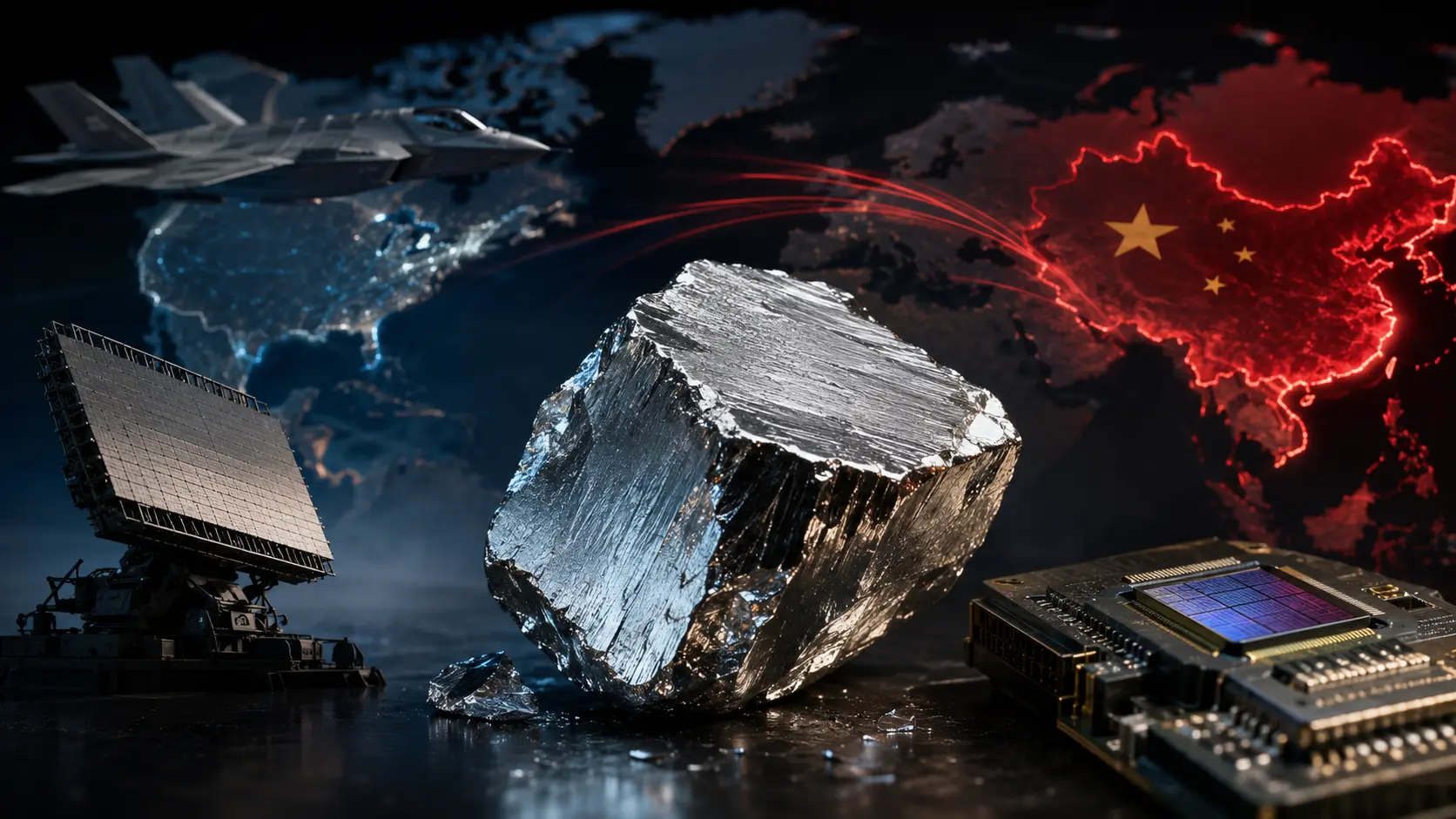

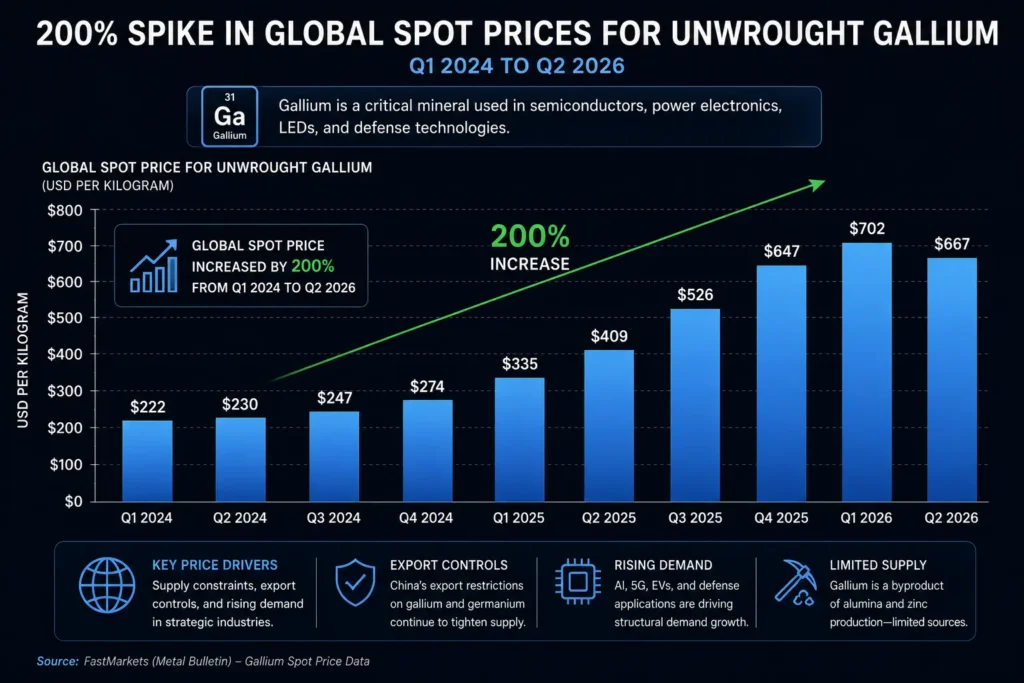
In early 2026, a single kilogram of a soft, silvery metal reached $1,850 on the global spot market—a staggering 200 percent price spike in just over a year. This metal is not traded on the COMEX, nor is it stored in central bank vaults. Yet, without it, the United States military is mathematically incapable of manufacturing its most advanced weapons. The metal is gallium. When engineered into Gallium Nitride (GaN) microchips, it acts as the pulsing heart of modern Active Electronically Scanned Array (AESA) radar systems, allowing fighter jets and missile interceptors to “see” further and resist enemy jamming.
For a decade, the West relied on China for over 90 percent of the world’s raw gallium supply. That dependency has now been weaponized. Through a labyrinth of export controls, outright bans, and temporary administrative suspensions extending through late 2026, Beijing has established a hard chokehold over the foundational material of the 21st-century power grid and defense apparatus. Why should you care right now? Because whoever controls the physical flow of gallium directly dictates the manufacturing timeline of commercial AI data centers, ultra-fast EV chargers, and the balance of global military aerospace supremacy.
What is The Gallium Export Embargo?
The gallium export embargo is a geopolitical supply chain constraint initiated by China to restrict the global sale of unwrought gallium and germanium. By manipulating export licenses and implementing targeted bans, Beijing controls the flow of the critical raw materials required to manufacture advanced semiconductors, military radar, and power electronics.
At a Glance
- Concept: The strategic throttling of a highly specialized minor metal (gallium) by the dominant global producer (China) to exact geopolitical leverage over Western technology and defense manufacturing.
- Why it matters: Advanced military hardware cannot run on standard silicon. AESA radars, electronic warfare (EW) pods, and missile seekers absolutely require Gallium Nitride (GaN) to handle extreme voltages and frequencies without melting.
- Who uses it: Top-tier defense primes (Lockheed Martin, Raytheon), telecommunications giants rolling out 5G/6G infrastructure, and EV manufacturers.
- Biggest takeaway: Despite a highly publicized diplomatic “truce” in late 2025 that supposedly suspended the export ban until November 2026, physical shipments of Chinese gallium to the United States have practically vanished, proving that legal suspensions do not guarantee physical supply.
In Simple Words
If you want to build a computer chip for a laptop, you use silicon. Silicon is cheap, abundant, and works perfectly for processing data.
But if you want to build a computer chip for a fighter jet radar that blasts massive amounts of invisible energy through the sky, silicon will literally melt. To handle that much raw, high-frequency power, engineers use a completely different material: Gallium Nitride (GaN).
The problem is that gallium doesn’t exist in convenient mines. It is a byproduct of mining aluminum (bauxite). Over the last 20 years, China built a monopoly on refining this metal, controlling over 90 percent of the global supply. Because the United States military and tech companies desperately need GaN chips to build modern weapons and power grids, China realized it held a “kill switch” over Western manufacturing. By simply refusing to sign the export paperwork, China can starve Western factories of the metal, driving up prices and delaying the deployment of critical national security infrastructure.
Why This Matters
The gallium bottleneck exposes the fragility of the “fabless” semiconductor model and the myth of immediate reshoring.
While the United States and Europe are spending billions via the CHIPS Act to build semiconductor fabrication plants (fabs) on domestic soil, a fab is useless without the raw chemical precursors to feed it. You cannot simply open a new gallium mine to solve the crisis. Gallium is found in microscopic concentrations alongside aluminum and zinc. Extracting and refining it to the “six-nines” purity (99.9999%) required for semiconductor wafers is a highly toxic, energy-intensive metallurgical process that the West outsourced to China decades ago.
For supply chain executives and defense hardware buyers, the current pricing bifurcation is a massive red flag. By April 2026, spot prices for gallium outside of China spiked to $1,850 per kilogram, while domestic Chinese prices remained artificially low and stable. This guarantees that Chinese defense and EV manufacturers have a massive, subsidized cost advantage, while Western firms bleed capital just to secure the raw materials required to keep their assembly lines running.
The Timeline of China’s Gallium Export Embargo
The export embargo is not a static policy; it is a dynamic, calculated geopolitical weapon.
The timeline of escalation is critical. In August 2023, China first introduced export licensing requirements for gallium and germanium. Then, in December 2024, China’s Ministry of Commerce (MOFCOM) escalated drastically by issuing Document No. 46, an outright ban explicitly naming the United States and creating a “presumption of denial” for all dual-use gallium exports.
Facing broad economic friction, Presidents Biden and Xi brokered a tentative truce at the APEC summit in late 2025. Shortly after, MOFCOM issued Document No. 72, officially suspending the U.S. export ban from November 7, 2025, until November 27, 2026. However, this “truce” is merely administrative theater. Chinese customs data reveals that unwrought gallium exports to the U.S. fell by 94 percent year-over-year in 2025 and have failed to recover in 2026, forcing a structural panic in the Western power electronics sector.
Why GaN Semiconductors are Irreplaceable
Understanding why gallium is irreplaceable requires diving into the physics of “Wide-Bandgap” (WBG) semiconductors. Here is the first-principles breakdown.
1. The Fundamental Problem: Silicon’s Voltage Limit
Standard silicon is a semiconductor, meaning it can switch electrical currents on and off. However, the “bandgap”—the amount of energy required to kick an electron into a conductive state—in silicon is relatively narrow (1.1 electron volts). If you push too much high-voltage power or high-frequency radio waves through silicon, the electrons flood the material uncontrollably, causing the chip to short-circuit and melt.
2. The Insufficiency of Gallium Arsenide (GaAs)
For decades, military radars used a compound called Gallium Arsenide (GaAs). While GaAs handles high frequencies better than silicon, it is highly inefficient at dissipating heat (thermal conductivity of 0.46 W/cm·K). To prevent GaAs radar arrays from overheating, fighter jets had to carry massive, heavy liquid-cooling systems, adding dead weight and limiting the aircraft’s performance.
3. The Core Mechanism: Gallium Nitride (GaN)
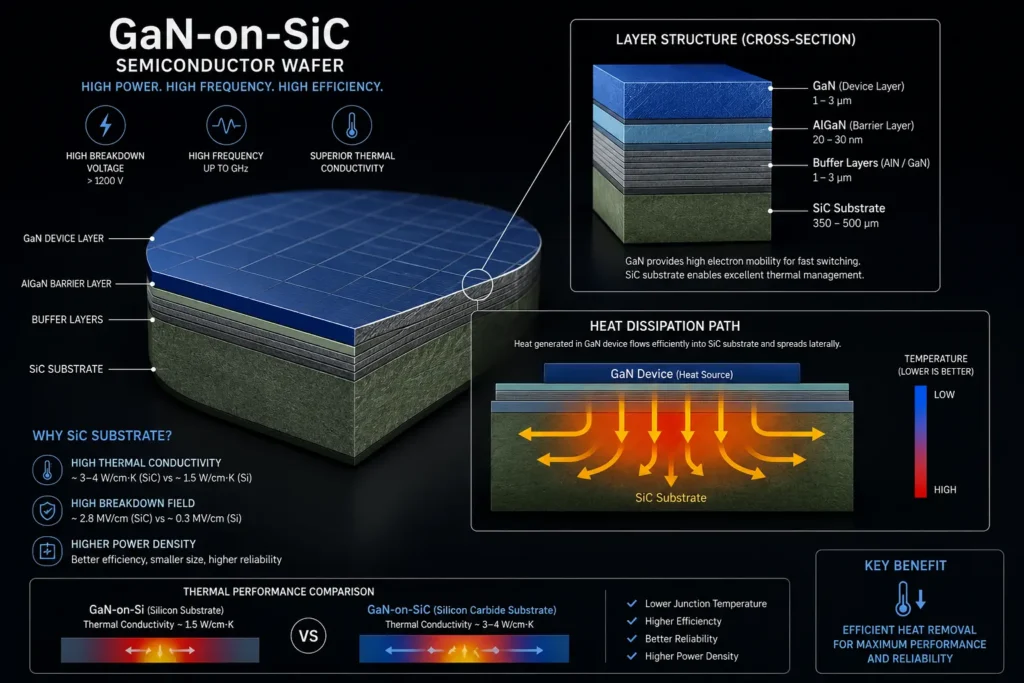
Gallium Nitride (GaN) solves both problems. GaN has a “wide bandgap” of 3.4 electron volts. This means it can withstand electrical fields an order of magnitude higher than silicon before breaking down. When paired with a Silicon Carbide (SiC) base layer for extreme heat dissipation, a GaN chip can operate at scorching temperatures and handle 5 to 10 times the power density of older GaAs systems.
4. Technical Depth: Epitaxy and Wafer Fabrication
Creating a GaN microchip is exponentially harder than building a silicon chip. Because pure liquid gallium cannot easily be grown into large crystals, engineers use a process called “epitaxy.” In highly specialized chemical vapor deposition (CVD) chambers, they spray vaporized gallium and nitrogen atoms onto a base wafer (like Silicon or SiC). The atoms settle layer by layer, building a flawless crystalline structure just a few micrometers thick.
5. Real-World Consequences: AESA Radar Dominance
Because GaN can handle massive amounts of power in a tiny footprint, it enables the creation of Active Electronically Scanned Array (AESA) radars. An AESA radar does not use a physically spinning dish; it uses hundreds of tiny, stationary GaN transmitter/receiver modules. By electronically steering the radar beam using GaN chips, a fighter jet can track a stealth missile, jam an enemy communication frequency, and map the ground simultaneously—capabilities that are physically impossible without a secure supply of raw gallium.
Impact on Defense Tech and AI Data Centers
The disruption of the gallium supply chain hits the most sensitive hardware in the Western arsenal.
Next-Generation Defense Systems: GaN is the non-negotiable standard for modern military RF (Radio Frequency) power amplifiers. It is the beating heart of the U.S. Navy’s SPY-6 radar system, the F-35 Lightning II’s electronic warfare suites, and the Patriot missile defense interceptors. GaN’s ability to operate at higher voltages allows these systems to project radar energy significantly further, detecting incoming threats earlier than legacy systems.
AI Data Center Power Infrastructure: AI data centers using NVIDIA Blackwell or advanced AMD hardware require unprecedented amounts of electricity. Converting high-voltage AC grid power down to the clean DC power required by server racks usually results in massive energy loss as waste heat. GaN-based solid-state transformers and power supplies operate at over 98% efficiency, saving hyperscalers millions of dollars in electricity and cooling costs.
Satellite Communications (SATCOM): Space is brutally constrained by weight and radiation. GaN power amplifiers are naturally highly resistant to total ionizing dose (TID) radiation in orbit. Because GaN delivers more power per millimeter, SATCOM manufacturers can shrink the size of the communication arrays on military and commercial satellites (like Starlink), reducing launch weights and costs.
Economic & Strategic Impact
The export embargo serves as the ultimate catalyst for supply chain decoupling.
The $1,850 per kilogram spot price in early 2026 has crossed a critical economic threshold. Historically, Western mining companies refused to extract and refine gallium because Chinese state-subsidized foundries sold it so cheaply that domestic production was unprofitable. By restricting the supply and artificially inflating global prices, Beijing has inadvertently made Western gallium recycling and primary extraction financially viable for the first time in two decades.
Consequently, the U.S. Department of Defense has activated the Defense Production Act (Title III) to fund domestic gallium recovery projects. Companies are now building facilities to harvest gallium from the zinc refining process and recycle GaN scrap from semiconductor cleanrooms. While these facilities take years to reach commercial scale, the embargo has permanently shattered the “just-in-time” procurement model, forcing Western primes to stockpile raw materials at a massive premium.
Advantages (Why GaN is Irreplaceable)
- Extreme Power Density: GaN handles 5 to 10 times the power of legacy gallium arsenide (GaAs) systems, allowing radar arrays to be built smaller, lighter, and vastly more powerful.
- High-Frequency Performance: Essential for millimeter-wave communications, acting as the foundational hardware for 5G/6G cell towers and advanced military targeting seekers.
- Thermal Robustness: GaN’s superior thermal conductivity (especially GaN-on-SiC) means it requires significantly less physical cooling infrastructure, freeing up payload weight on aircraft and satellites.
Limitations (The Supply Chain Fragility)
- Single-Point Failure: A 94 percent drop in Chinese unwrought gallium exports directly paralyses the specialized epitaxy foundries in Europe and the U.S. that rely on the raw ingots to bake wafers.
- Cost and Yield: Growing flawless GaN crystals is notoriously difficult. Defect rates (dislocations in the crystal lattice) remain a major manufacturing bottleneck, making GaN wafers significantly more expensive than standard silicon.
- Evasion and Middlemen: Sanctions are highly porous. Reports from 2025 show Chinese suppliers successfully mislabeling gallium shipments and routing them through third-party countries to evade direct export scrutiny, creating a chaotic and untraceable gray market for defense contractors.
Common Misconceptions
Misconception: The US can just open a gallium mine to solve the shortage.
Reality: There is no such thing as a “gallium mine.” Gallium is a byproduct metal found in microscopic trace amounts inside bauxite (aluminum) and zinc ore. You cannot mine it directly; you must build massive, multi-billion-dollar aluminum refineries and then attach specialized, highly toxic chemical extraction plants to siphon off the trace gallium.
Misconception: The November 2025 “truce” ended the embargo.
Reality: MOFCOM Document No. 72 merely suspended the explicit ban on U.S. entities until November 2026. However, China still retains the original 2023 “dual-use” export licensing requirements. By simply dragging their feet and refusing to approve the paperwork, Beijing executes a de facto embargo while maintaining diplomatic plausible deniability.
Misconception: Silicon Carbide (SiC) and Gallium Nitride (GaN) do the same thing.
Reality: They are complementary, not identical. SiC is excellent for high-voltage, high-current switching (like the drivetrain of an electric vehicle). GaN is superior for high-frequency, ultra-fast switching (like military radar and telecom RF signals). Often, GaN is physically grown on top of a SiC base layer (GaN-on-SiC) to combine the RF speed of gallium with the heat-dissipation of silicon carbide.
What Most People Miss
The impact of The Scrap Recycling Loop.
Because primary extraction of gallium takes years to scale, the immediate defense strategy in 2026 relies entirely on the scrap market. During the process of carving GaN wafers into tiny microchips, nearly 40 to 50 percent of the raw material is wasted as dust or trimmings.
What most geopolitical analysts miss is that the West is heavily investing in closed-loop metallurgical recycling to capture this exact waste. Specialized chemical companies are deploying novel hydrometallurgical processes to sweep the floors of semiconductor fabs, dissolve the scrap, and re-purify the gallium back to 99.9999% purity. Until new North American zinc-gallium refineries come online late in the decade, scraping the bottom of the manufacturing barrel is the only thing keeping the aerospace supply chain afloat.
Comparison Table
| Feature | Silicon (Si) | Gallium Arsenide (GaAs) | Gallium Nitride (GaN) |
| Bandgap Energy (eV) | 1.1 (Narrow) | 1.4 (Moderate) | 3.4 (Wide) |
| Primary Use Case | Logic, CPU, Memory | Legacy Telecom, Low-Noise Amplifiers | AESA Radar, 5G, EV Chargers |
| Thermal Conductivity | Good | Poor (~0.46 W/cm·K) | Excellent (~1.3+ W/cm·K) |
| Power Density | Low | Moderate | Extreme (5-10x higher than GaAs) |
| Supply Chain Risk | Very Low (Global) | High (Gallium dependent) | Critical (Subject to PRC embargo) |
Case Study
Situation: In early 2024, a major Tier-1 U.S. defense contractor was tasked with ramping up production of a next-generation naval AESA radar system to counter advanced anti-ship missiles in the Indo-Pacific. The system relied entirely on premium GaN-on-SiC transmit/receive modules.
Challenge: Following China’s aggressive December 2024 export ban (Document No. 46), the contractor’s primary European and Japanese semiconductor foundries could no longer source unwrought gallium. Wafer lead times ballooned from 12 weeks to over 40 weeks, and the cost of raw high-purity gallium spiked by nearly 200 percent, crushing the fixed-price margins of the defense contract.
Solution (The Dual-Sourcing Pivot): Unable to wait out the diplomatic gridlock, the prime contractor utilized emergency Defense Production Act (DPA) funding to execute a massive pivot. They partnered with an obscure Canadian critical minerals startup capable of extracting raw gallium from domestic germanium-zinc tailings. Simultaneously, they mandated a strict closed-loop recycling protocol across their assembly lines to recapture GaN scrap.
Outcome: By mid-2026, despite China suspending the official ban but maintaining a de facto blockade of shipments, the defense prime successfully insulated its production line. While the per-unit cost of the GaN modules increased significantly due to the localized supply chain, the contractor met its delivery schedule, proving that “friend-shoring” critical minerals is possible, albeit at a severe financial premium.
Lessons Learned: The crisis shattered the illusion that commercial diplomacy guarantees supply. The case study proves that for critical defense infrastructure, relying on the spot market of an adversarial nation is an existential threat. True supply chain resilience requires vertical integration all the way down to the mining tailings.
Future Outlook
Next 12–24 Months
The expiration of the November 2026 Suspension. The global hardware market is holding its breath for November 27, 2026. When the temporary suspension of MOFCOM Document 46 expires, Beijing will possess the immediate legal authority to officially reinstate the absolute ban on U.S. exports. Expect a frantic period of stockpiling by Western foundries throughout mid-2026, driving spot prices well beyond the $1,850/kg threshold as companies hedge against a permanent geopolitical freeze.
Next 3–5 Years
The scaling of Domestic Metallurgical Extraction. Supported by aggressive government subsidies, new refining capacity in North America and Australia will begin to come online by 2028-2029. Companies will successfully retrofit existing zinc and aluminum smelters with gallium extraction circuits. While this domestic supply will be significantly more expensive than Chinese subsidized metal, the U.S. defense sector will gladly absorb the premium to secure a completely closed, North American GaN supply chain for military applications.
Next 10 Years
The evolution to Ultra-Wide Bandgap (UWBG) Materials. As the physical limits of Gallium Nitride are reached by the mid-2030s, the aerospace and AI industries will shift toward even more exotic materials like Diamond or Aluminum Nitride (AlN). GaN-on-Diamond substrates are already demonstrating significant junction temperature reductions in laboratories. By transitioning to synthetic diamond substrates, the semiconductor industry will partially bypass the gallium constraint, achieving higher power densities while relying on materials that can be synthetically manufactured in a lab rather than mined from the earth.
Most Likely Scenario
The era of cheap, globally abundant gallium is over. China will maintain its de facto export embargo, using a slow, bureaucratic drip of licenses to selectively punish Western defense contractors while supplying its own domestic tech giants with subsidized materials. Western power electronics will successfully decouple by the end of the decade, but the resulting “bifurcated market” will permanently inflate the manufacturing costs of 6G infrastructure, EV chargers, and military radar across the NATO alliance.
Key Takeaways
- The gallium export embargo is a Chinese geopolitical strategy that restricts the global supply of a critical mineral required to build advanced semiconductors and military radar.
- Gallium is fundamentally required to manufacture Gallium Nitride (GaN) chips, which can handle 5 to 10 times more power and heat than traditional silicon or gallium arsenide (GaAs).
- GaN is the foundational technology behind Active Electronically Scanned Array (AESA) radars, enabling modern fighter jets to track targets at extreme ranges without physical moving parts.
- Despite a November 2025 “truce” suspending the explicit U.S. export ban until late 2026, Chinese shipments have nearly vanished, causing global spot prices to spike over 200% to $1,850/kg.
- Gallium cannot be mined directly; it is a byproduct of refining aluminum and zinc. Rebuilding this toxic, complex refining infrastructure in the West will take years and billions in CapEx.
- To survive the immediate shortfall, Western semiconductor manufacturers are relying heavily on advanced chemical recycling to scrape and purify GaN waste directly from factory floors.
Glossary
AESA (Active Electronically Scanned Array): A highly advanced radar system that uses hundreds of tiny, stationary GaN transmitter modules to electronically steer a radar beam instantly in multiple directions.
Bandgap: The energy required to excite an electron from a resting state into a conductive state. “Wide-bandgap” materials like GaN can handle massive voltages without failing.
Dual-Use Technology: Hardware or software (like GaN chips) that possesses both a massive commercial application (5G networks, EV chargers) and a highly lethal military application (missile seekers, radar).
Epitaxy: A highly complex manufacturing process used to build a semiconductor crystal by depositing vaporized atoms layer by layer onto a base wafer (like SiC).
Gallium Nitride (GaN): A wide-bandgap semiconductor compound that is the undisputed backbone of next-generation high-power, high-frequency electronics.
MOFCOM: The Ministry of Commerce of the People’s Republic of China, the agency responsible for issuing and weaponizing export licenses and embargo directives.
Frequently Asked Questions
Why does the military need Gallium Nitride?
Legacy radar systems were large, heavy, and generated massive amounts of heat. GaN chips can process significantly higher voltages and frequencies while running cooler. This allows the military to put vastly more powerful radars into smaller spaces, like the nose of a fighter jet or the head of a missile.
Is there any gallium mined in the United States?
No. As of 2026, there is zero primary extraction of raw gallium in the United States. All domestic supply currently relies on stockpiles, imports, or the recycling of scrap materials from manufacturing facilities.
Why doesn’t the US just start mining it tomorrow?
Gallium is a byproduct metal. It only exists in trace amounts (parts per million) inside bauxite (aluminum ore). To get gallium, you must build a massive, environmentally hazardous aluminum refinery, which takes years of environmental permitting and billions in capital to construct.
Will this embargo stop the production of AI chips?
Not directly. The actual “brains” of an AI (like an NVIDIA GPU) are made of silicon, which is not under embargo. However, AI data centers require massive power supplies and transformers to handle the electricity. Those power supplies increasingly rely on GaN to remain efficient. A gallium shortage slows down the construction of the power grid needed to plug the AI chips in.
What happens when the embargo suspension ends in November 2026?
If diplomatic relations deteriorate, China will likely allow the suspension to expire, officially reinstating the hard ban on exports to U.S. entities (Document No. 46). This would legally cement the current de facto blockade and ensure global spot prices remain at historic, punitive highs.
Sources
Takshashila Institution: Sand Slipping Through Fingers – China Ga/Ge Export Restrictions (March 2026)
GvW Graf von Westphalen: China Export Control Update – MOFCOM Announcement 72/2025 (November 2025)
ThinkChina.sg: China’s critical minerals export ban falls short
Andersen Institute: China’s Export Controls: Critical Minerals and Strategic Pressure Points (April 2026)
Center for Strategic and International Studies (CSIS): The U.S.-China Trade Truce Has Not Solved the Gallium Problem (May 2026)
Mouser Electronics: What is Gallium Nitride (GaN) Technology?
RayPCB: GaAs Vs. GaN Radar: What is the Difference
Electronics Era: The Role of Gallium Nitride (GaN) in Next-Gen Defense Electronics (October 2025)